






Organic Bacon avocados from Spain: in season now, don't miss out!

Shop now
Foods for Digestive Health

Foods for Digestive Health: What a Living Plate Can Change for Your Gut Comfort

Between stomach pain and diet, the link is real: without replacing medical advice, your plate can change your everyday comfort, with foods for digestive health such as mostly soluble fibre introduced step by step, a little plant-based fermented food, soaked or sprouted legumes, and a few days of light meals when things flare up. At Biovie, we built this page on one meta-analysis, two randomised trials, two reviews and the benchmarks of EFSA, ANSES and the Assurance Maladie.

On Tuesday 1 December 2026 at 9:05 pm, France 5 airs "Maux de ventre, nos luttes intestines", a documentary directed by Céline Bittner and presented by Marina Carrère d'Encausse. Its press kit states that one in two French people regularly suffers from digestive problems. Do the maths around a table of four: two of the guests would know that bloated evening belly. The figure comes from the programme, not from a study. But it says one thing clearly: the subject is strikingly common, and yet we talk about it so little at the table.

I have been sprouting seeds since my teens, at my parents' house, long before founding Biovie in 2007, and I have been vegan since 1992. The film has not aired yet, so I am not going to comment on it. Instead, here is what studies say about stomach pain and diet, and what I take from them.

Stomach pain and diet: when to see a doctor before changing your plate

Food can help with digestive comfort, but it does not make a diagnosis. Before touching your plate, some signs should first send you to your doctor, according to the Assurance Maladie:

  • bright red blood in the stools, or black stools;
  • unintentional weight loss;
  • fever;
  • recently changed symptoms;
  • first digestive problems after the age of 50;
  • a family history of colorectal cancer;
  • symptoms lasting more than three months.

The doctor first, the plate second. None of these signs necessarily points to something serious, but each deserves a medical look before any change of menu. This is not token caution: adding flaxseed to silence a symptom that needs an examination would be fighting the wrong battle. Once things are clarified, notably if irritable bowel syndrome has been diagnosed, the ideas that follow on irritable bowel and diet find their place, alongside medical follow-up.

Foods for digestive health: what to eat when your stomach often hurts?

When your stomach often hurts, it is better to count on mostly soluble fibre introduced gradually, water, small amounts of plant-based fermented foods, legumes that are always soaked or sprouted, and regular meals. During a flare-up, eat light for a few days, then gradually go back to fibre.

These guidelines apply as part of a varied and balanced diet and a healthy lifestyle, where sleep and the time you take to eat also count. A meal swallowed standing up between two messages, let's admit it, does not give the belly much of a chance. Here are the foods for digestive health I keep coming back to.

During a one-off episode

Everyone knows the day after a meal that was too rich, when the belly protests for two or three days. Simple meals (cooked vegetables, stewed apple, soup, small portions) let you get through the episode without overloading it. The trap is to prolong this light diet for weeks. A low-fibre diet is made for a few days, not to last.

Day to day

In the long run, the logic reverses. We add rather than remove: I have never believed in dietary changes that start with a list of bans. Three avenues have been studied: mostly soluble fibre, plant-based fermented foods, and soaked or sprouted legumes. One change at a time is better than three at once, each at their own pace.

Fibre: which kinds, how much, at what pace

First, the official benchmark. EFSA, the European Food Safety Authority, considers that 25 g of fibre a day is enough for normal bowel function in adults (EFSA, 2010). Against that, the reality: in France, the INCA 3 survey measures an average intake of 20 g a day among adults, an intake ANSES judges too low (ANSES, 2017).
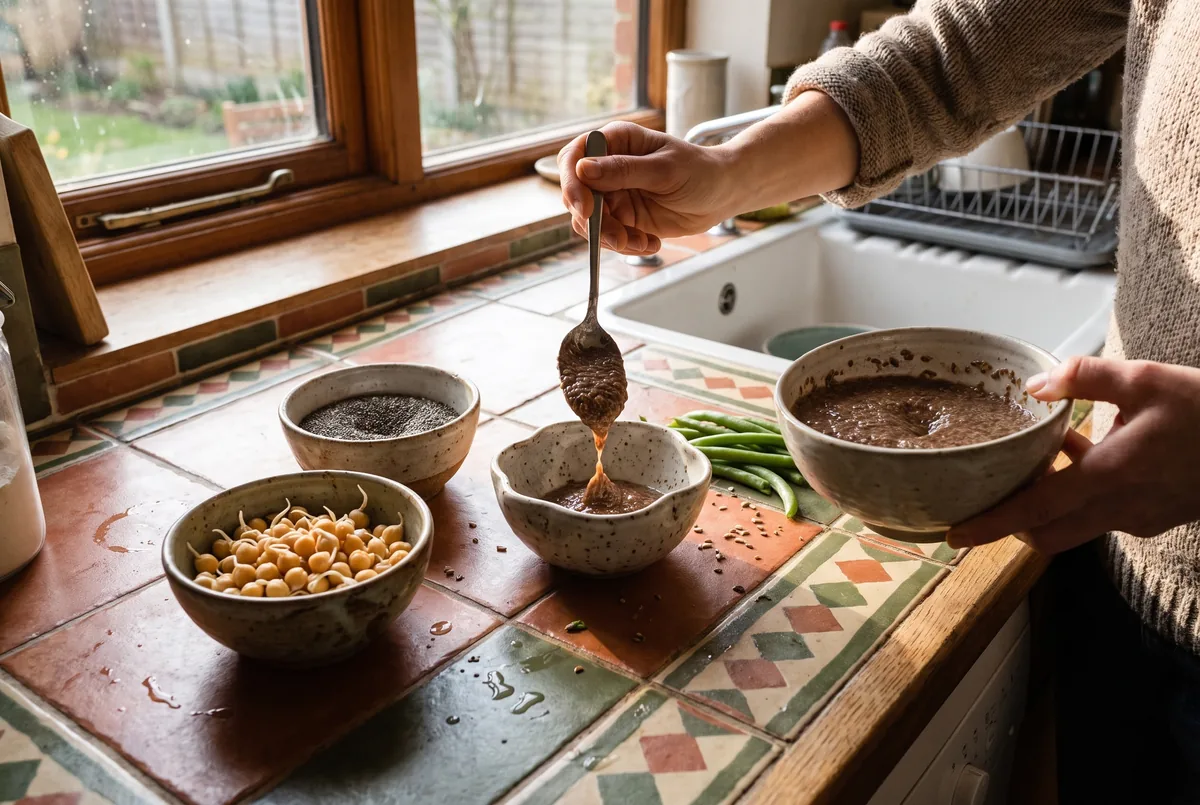
Hands pouring ground flaxseed next to bowls of chia and sprouted chickpeas

25 g on one side, 20 g on the other. The first figure is a reference value, the second is what adults actually eat. That leaves 5 g to find, a quarter more than current intake: it is made up through small regular gestures, not by emptying your cupboards. Another article shows what fibre and legumes change on the plate.

Soluble or insoluble: not the same effect

A meta-analysis pooled 14 randomised trials involving 906 patients with irritable bowel syndrome (Moayyedi et al., 2014). Fibre as a whole reduces the risk of remaining symptomatic (RR 0.86, 95% confidence interval from 0.80 to 0.94), soluble fibre a little more (RR 0.83, from 0.73 to 0.94). Bran, that insoluble fibre we readily recommend for transit, does not reach significance (RR 0.90, from 0.79 to 1.03): its interval crosses 1, so we cannot rule out that it changes nothing.

How do you read these figures without being a statistician? The NNT is the most telling: the number of people who must take the fibre for one extra person to feel the difference. For soluble fibre, 7 people need to take it for one more of them to feel better than in the control group, against 10 for fibre as a whole. It is not spectacular, it is honest. One important point: these trials tested fibre given as supplements, not whole foods.

Type of fibrePlant-based examplesMeta-analysis (14 trials, 906 patients)
Fibre as a wholeAll types tested as supplementsRR 0.86 (0.80 to 0.94), NNT 10
Soluble fibreGround and soaked flaxseed, chia, soaked legumes, cooked fruit and vegetablesRR 0.83 (0.73 to 0.94), NNT 7
Bran (insoluble fibre)Outer layer of cereal grainsRR 0.90 (0.79 to 1.03), not significant

How to increase fibre without bloating?

Fibre and bloating often go together when you change everything at once: the belly does not like being moved house overnight. Increasing fibre is done in small steps, over several weeks, drinking water throughout the day. One spoonful of soaked ground flaxseed in the first week, a small portion of soaked legumes later. And if the belly swells anyway? Slow down rather than stopping everything. We ease off, we do not turn back. Fibre for gut health is a matter of gentle, regular steps.

Very sensitive belly: the case of FODMAPs

FODMAPs are short sugars that the gut ferments quickly. In a single-blind crossover trial, 30 people with irritable bowel and 8 controls followed two 21-day diets in turn (Halmos et al., 2014). On a scale from 0 to 100 mm, the overall symptom score was 22.8 mm on the low-FODMAP diet, against 44.9 mm on the usual Australian diet, meaning discomfort rated about half as strong.

On paper, it is striking. This restrictive diet is followed with a dietitian and for a limited time. The trial was short and small, and this diet is not for everyone. Removing foods is not my philosophy, but it is a serious tool.

Fermented foods: what studies show, and their limits

Honestly, on fermented foods and digestion, studies remain few. One randomised trial followed 36 healthy adults for 17 weeks, 18 per group (Wastyk et al., 2021). The group eating more fermented foods saw its microbiota diversity increase steadily, while that of the group on the high-fibre diet did not move. The result may surprise you.

Microbiota diversity is a bit like the number of varieties in a vegetable garden: we count what grows, without judging the harvest. And you have to read the study to the end: participants had no digestive problems, and the trial measured the microbiota, not stomach pain.

A 2019 review takes stock on the clinical side (Dimidi et al., 2019): only a few fermented foods have been tested in a randomised trial for digestive outcomes, including sauerkraut, natto and sourdough bread, and none for kombucha, miso, kimchi or tempeh. The authors consider the clinical evidence still very limited, which does not mean these foods bring nothing. Little studied does not mean useless, it means research is lagging behind.

In practice, start with one spoonful of raw lacto-fermented vegetables per meal. Then a small glass of fruit kefir or kombucha, if you feel like it. A tip drawn from my own failures: start your lacto-fermentations with very fresh vegetables. I once tried with vegetables that were already damaged; rot won the race, and the jar turned into a real stink bomb. Tested for you, and not recommended at all.

To go further, see the role of the gut microbiota and the list of fermented foods on the blog. These small regular amounts fit as part of a varied and balanced diet and a healthy lifestyle.

If you like having a guiding thread rather than improvising, the book Santé intestinale by Justine Lamboley offers a six-week path devoted to digestive comfort, to follow at your own pace.
Share this article

Sprouted seeds and soaked legumes: a more digestible plate

Imagine a carpentry workshop. If whole tree trunks are delivered there, they must first be sawn; if planks already sawn are delivered, the work moves much faster. Soaking and sprouting are exactly that for a seed. Part of the digestive work is done outside, before the seed even reaches your plate.

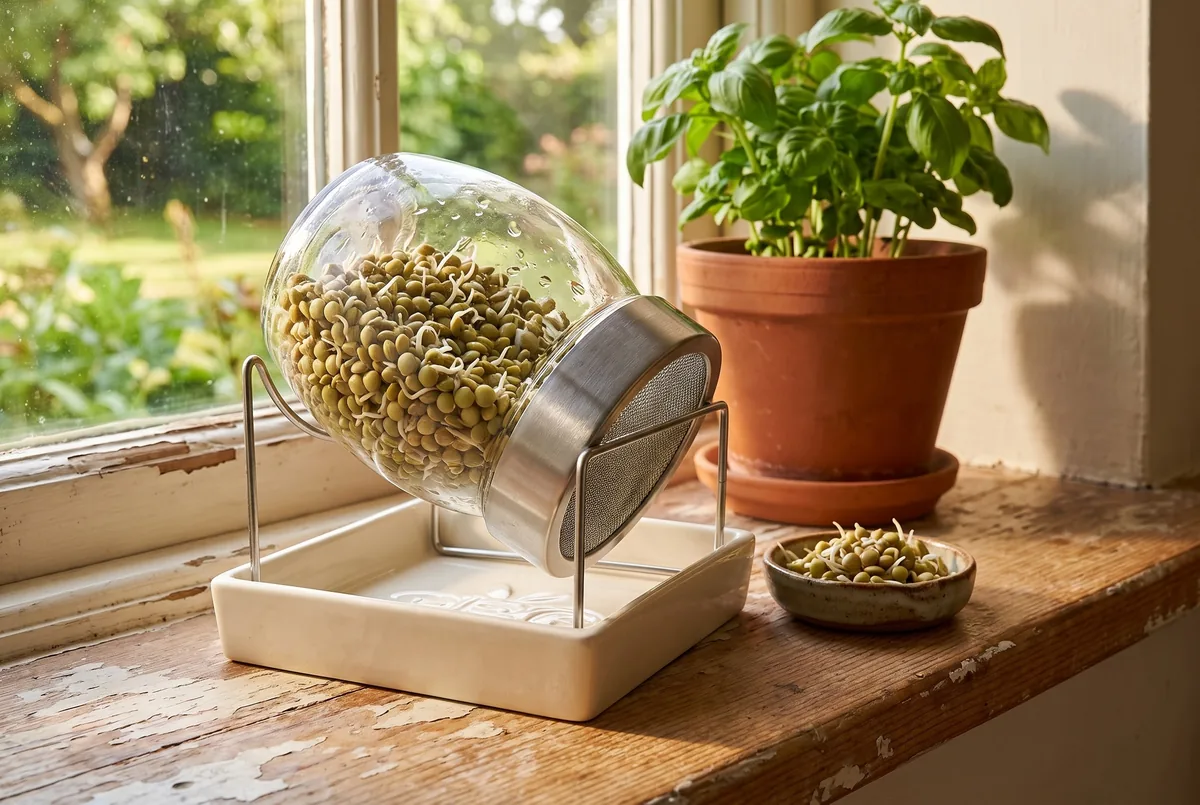
Whole green lentils sprouting in a sprouting jar on a windowsill

A review published in 2018 describes the mechanism (Nkhata et al., 2018): fermentation and germination activate the seed's own enzymes, such as alpha-amylase, phytase or pullulanase. They break down phytates and trypsin inhibitors and cut complex reserves into more digestible forms. The seed "pre-digests" its reserves to feed its future shoot. The review does not measure stomach pain. But it sheds light on a conviction I have held for a long time: we are not what we eat, but what we absorb. In short, soaked and sprouted legumes are among my favourite foods for digestive health.

At Biovie, this is a rule without exception. Every legume is soaked for at least one night, or better, soaked for one night and then sprouted for 48 hours. Red lentils and split peas, being hulled, do not sprout: simply soak them overnight, and prefer whole lentils for sprouting. On the safety side, kidney beans and other dried beans, like soy, are always cooked for a long time, even when sprouted. Raw sprouts are not recommended for vulnerable people.

To sort fact from fiction about sprouted seeds and digestion, see these misconceptions about living food.

Storing dried seeds and preparations well

One very down-to-earth question remains: how do you store seeds and soups? At Biovie, we recommend vacuum sealing in glass jars with the BocUp kit: a bell and a small manual pump, no electricity and no plastic bag, that work with your jars if they have "shoulders" and a 65 or 84 mm lid. According to the manufacturer, fresh products keep up to 5 times longer (a vegetable soup 8 to 10 days instead of 2), and dry foods stay protected from moisture and moths.

Vacuum does not replace the fridge or the freezer, and it does not sterilise. A vacuum-sealed soup therefore goes in the fridge. See also the benefits of vacuum sealing.

A typical day for a sensitive belly

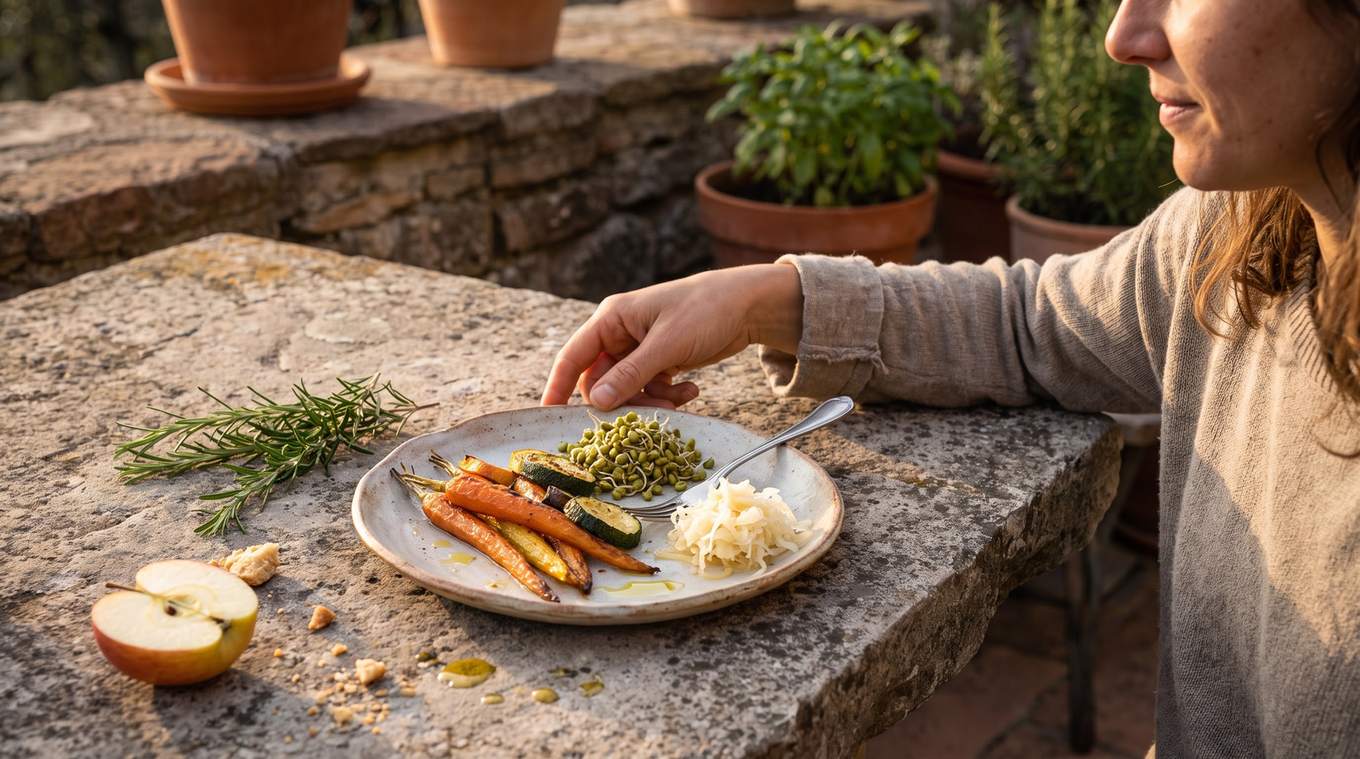
A typical day remains the simplest way to link stomach pain and diet. Take it as an idea, not as a menu to follow to the letter: nobody eats the same two days in a row. It is a day built from the foods for digestive health we have just seen.

  • For breakfast, stewed apple with a spoonful of ground flaxseed, put to soak the night before.
  • Lunch: cooked vegetables, whole lentils soaked overnight, then sprouted for 48 hours and cooked, and a spoonful of raw sauerkraut on the side.
  • A small glass of fruit kefir in the afternoon.
  • In the evening, a vegetable soup with seaweed flakes added off the heat, never cooked.

Nothing complicated. On rushed evenings, the raw superfood broth can flavour this soup, added off the heat like the seaweed. Rhythm matters more than the list: one change at a time, over several weeks. Note down in a notebook what suits you, two lines a day are enough. In a few weeks, your own benchmarks take shape, and they will be worth more than any general advice, mine included.

All of this fits as part of a varied and balanced diet and a healthy lifestyle, with nothing of a restrictive regime. I have also listed eating habits to adopt that combine well with these, and Justine Lamboley's 21-day Programme offers a gradual transition to a raw, vitalising way of eating.

On 1 December, many viewers will probably recognise themselves in this documentary. Good: talking about your belly should embarrass nobody. I like to imagine some of them, the next evening, simply putting a spoonful of flaxseed to soak for breakfast. It is not much. It is often how everything begins. And if you have your own tips for a calmer belly, write to me!

The full range Well-being training

This range brings together the well-being training offered by Biovie's partners: naturopathy, breathing, hydroponics, women's balance and personal development. Each instructor is chosen for their recognized expertise in their field, independently of the Biovie product catalog: the shop has no hidden commercial link with these partners. To choose, start from the topic that interests you rather than the format or the duration: a short masterclass does not require the same commitment as a naturopathy certification course spread over several months., 12 products

Discover the full range
Discover our category Well-being training

Frequently asked questions

What should I eat when my stomach hurts a little?

Light, simple meals for a few days: cooked vegetables, stewed apple, soup, small portions, with water throughout the day. This light diet stays temporary: once the episode has passed, gradually go back to fibre, and see your doctor if warning signs appear or if the discomfort lasts.

Which foods are easy to digest?

Cooked vegetables, stewed fruit and soaked or sprouted legumes, then cooked, are good candidates. According to a review published in 2018, soaking and sprouting activate the seed's own enzymes, which break down phytates and trypsin inhibitors and cut its reserves into more digestible forms.

How can I soothe my belly day to day?

By gradually introducing mostly soluble fibre and small amounts of plant-based fermented foods, one change at a time. In a meta-analysis of 14 trials, soluble fibre reduced the risk of persistent irritable bowel symptoms (RR 0.83). Many people report better comfort, but medical advice remains necessary if the discomfort persists.

What should I eat during an irritable bowel flare-up?

Light, simple food during the flare-up, with water. If flare-ups keep coming back, a low-FODMAP diet can be considered with a dietitian, for a limited time: in a trial of 30 patients, the symptom score was 22.8 mm against 44.9 mm on the usual diet, out of 100.

Which signs should make me see a doctor?

According to the Assurance Maladie: bright red blood in the stools or black stools, unintentional weight loss, fever, recently changed symptoms, first digestive problems after the age of 50, a family history of colorectal cancer, symptoms lasting more than three months. In these situations, see your doctor before changing your diet.

What should I eat for breakfast when I have stomach pain?

Stewed apple with a spoonful of ground flaxseed, soaked the night before, is a simple option. Flaxseed provides soluble fibre, the type of fibre that gave the best results in irritable bowel trials. Start with a small amount, increase gradually and drink water.

Which foods should I favour when my gut is sensitive?

Soluble fibre (ground and soaked flaxseed, chia, cooked fruit and vegetables), small amounts of plant-based fermented foods such as raw sauerkraut, and legumes soaked overnight or sprouted then cooked. Introduce them one by one, over several weeks, and get support if the discomfort persists.

References

  1. France Télévisions, 2026. Maux de ventre, nos luttes intestines (dossier de presse). francetvpro.fr.
  2. Assurance Maladie, 2026. Syndrome de l'intestin irritable : que faire pour être soulagé et quand consulter ? ameli.fr (page accessed in November 2026).
  3. EFSA Panel on Dietetic Products, Nutrition, and Allergies (NDA), 2010. Scientific Opinion on Dietary Reference Values for carbohydrates and dietary fibre. EFSA Journal 8(3):1462.
  4. ANSES, 2017. Communiqué de presse sur l'étude INCA 3 (12 juillet 2017). ANSES.
  5. Moayyedi P, Quigley EM, Lacy BE, Lembo AJ, Saito YA, Schiller LR, Soffer EE, Spiegel BM, Ford AC, 2014. The effect of fiber supplementation on irritable bowel syndrome: a systematic review and meta-analysis. Am J Gastroenterol.
  6. Halmos EP, Power VA, Shepherd SJ, Gibson PR, Muir JG, 2014. A diet low in FODMAPs reduces symptoms of irritable bowel syndrome. Gastroenterology.
  7. Wastyk HC, Fragiadakis GK, Perelman D, et al., Sonnenburg JL, 2021. Gut-microbiota-targeted diets modulate human immune status. Cell.
  8. Dimidi E, Cox SR, Rossi M, Whelan K, 2019. Fermented Foods: Definitions and Characteristics, Impact on the Gut Microbiota and Effects on Gastrointestinal Health and Disease. Nutrients.
  9. Nkhata SG, Ayua E, Kamau EH, Shingiro JB, 2018. Fermentation and germination improve nutritional value of cereals and legumes through activation of endogenous enzymes. Food Science & Nutrition.

Updated: November 2026. Article written and validated by Éric Viard, founder of Biovie since 2007 and ISTOM engineer, co-author of « Algues au quotidien » (Gallimard, 2024), Best cookbook in the world, Gourmand Cookbook Awards 2025, and Best cookbook in France, Académie Nationale de Cuisine 2025.

The information presented in this article is provided for information purposes only and does not constitute medical advice. Consult a healthcare professional before making any change to your diet or supplementation.

Share this article

Loading...
Back to top