What castor oil does for hair
Ricinoleic acid: the main component of castor oil (80-92%)
Ricin oil is distinguished from other vegetable oils by its exceptional concentration of ricinoleic acid. This compound accounts for between 80 and 92% of its total composition, making it a unique oil in the plant world.
Specifically, ricinoleic acid has a molecular structure that allows it to penetrate the superficial layers of the scalp.
Theorganic castor oil Biovie, cold-pressed, retains the entirety of this active ricinoleic acid. Cold pressing is essential: hot extraction would degrade some of these beneficial compounds.
Action on prostaglandin D2 and hair follicles
Recent research has highlighted the role of prostaglandin D2 in hair loss. This molecule, present in excess in scalps suffering from alopecia, contributes to the miniaturization of hair follicles.
The massage during application also plays an important role. It helps the oil reach the areas that need it. This is why the application technique is as important as the product itself.
The true causes of hair loss to identify
Before starting a protocol, it is essential to identify the type of hair loss you are experiencing. Losing between 50 to 100 hairs per day is perfectly normal. Beyond that, or if you notice a localized loss, it is important to understand what is happening.
Hormonal drop (menopause, pregnancy): recognizing the signs
Hormonal fluctuations are the primary cause of hair loss in women. Pregnancy, postpartum, perimenopause, and menopause are particularly sensitive periods.
The characteristic signs: diffuse hair loss across the entire scalp, hair that gradually thins, and a parting that appears to widen. This hair loss is generally reversible once hormonal balance is restored.
Stress and Deficiencies: Reversible Hair Loss
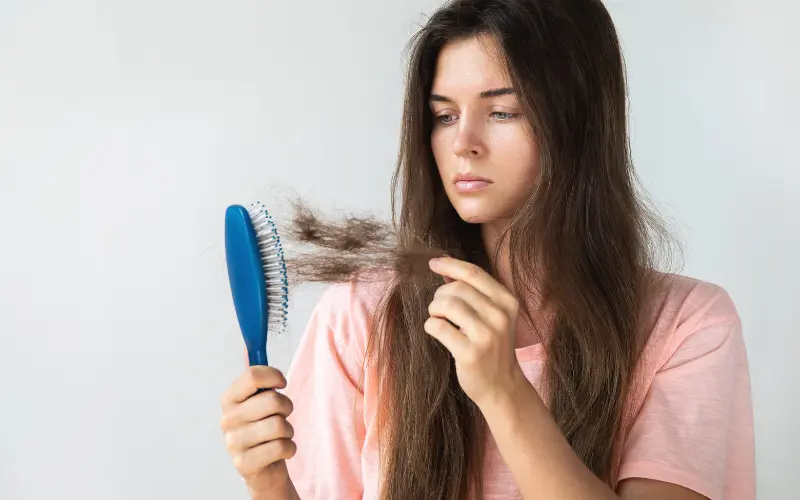
Chronic stress causes what is known as telogen effluvium: an abnormal proportion of hair simultaneously enters the shedding phase. You end up with handfuls of hair on the brush, in the shower, on the pillow.
Nutritional deficiencies, particularly in iron, zinc, and proteins, produce similar effects. Hair, considered non-essential by the body, is the first to suffer when resources are lacking.
Good news: these losses are completely reversible.
Seasonal shedding: a natural phenomenon to support
In the spring and fall, our body naturally renews part of its hair. This seasonal shedding usually lasts 4 to 6 weeks and should not be a cause for concern.
Using castor oil during these periods helps support the natural cycle while preparing the ground for new growth. In fact, it's the ideal time to start a preventive protocol.
When it isn't temporary shedding: androgenetic alopecia
The three previous causes have one thing in common: they are reversible. There is a fourth scenario, more common than all the others combined, which follows a different logic.
Androgenetic alopecia is not shedding, it is a progressive miniaturisation of the follicle: hair does not fall out more, it regrows a little finer and a little shorter with each cycle, until it becomes fine down. The mechanism depends on a hereditary sensitivity of the follicles to androgens, and it affects both sexes, with a different pattern.
- In men, it starts at the temples and the crown, leaving the back of the head untouched.
- In women, it shows as a widening centre parting and diffuse thinning on the top of the head, without ever receding at the hairline, which is what distinguishes it from stress-related shedding.
Why mention this in an article about castor oil? Out of honesty. No vegetable oil changes a follicle's sensitivity to androgens: on established androgenetic alopecia, massage and oil improve scalp comfort and the hold of the hair fibre, not density. A dermatology consultation is called for, all the more so because the treatments that exist work better the earlier they start.
The check-up worth doing before you start
Before crediting castor oil with a result, or a lack of one, it's worth ruling out what a blood test can fix. Three markers explain a large share of diffuse shedding: ferritin, which reflects iron stores; vitamin D; and zinc.
Two useful benchmarks. Ferritin within the lab's normal range is not necessarily enough for hair: many dermatologists consider that a low level, under 30 to 40 µg/l, is worth correcting even without anaemia. A thyroid panel is also commonly added to the list, since hypothyroidism produces a misleading hair-loss picture.
These corrections are not an alternative to the routine described here: they are its precondition, as part of a varied and balanced diet and a healthy lifestyle.
What science really shows, and what it doesn't
Let's be frank about it, because it's the question everyone asks: no clinical study demonstrates that castor oil speeds up hair growth. What the literature offers are laboratory hypotheses and a well-documented mechanical effect. The two deserve to be kept separate.
The PGD2 hypothesis: appealing, never demonstrated in humans
Ricinoleic acid might slow down the production of prostaglandin D2, a molecule present at markedly higher levels in bald areas of the scalp, a related logic, incidentally, underlies a well-known medical treatment. This hypothesis has never been validated by a clinical trial in humans: nobody has run one. It should therefore be presented for what it is, a mechanistic hypothesis, and nothing more.
The demonstrated effect is mechanical
Research published in the Journal of Cosmetic Science showed that castor oil reduces protein loss from the hair fibre and limits damage. Translated into bathroom language: it forms a lipid film that retains moisture and improves the hair's mechanical resistance. Less breakage, fewer split ends, length better preserved. This is not accelerated growth, it is length no longer being lost, and visually, the result looks a lot alike.
A useful sense of scale to stay grounded: natural growth speed already varies considerably from person to person, on the order of 1.8 to 2.8 cm a month depending on hair type. Against that backdrop, measuring a gain of a few millimetres is largely an illusion.
The role of massage, widely underestimated
Here is what tends to go unsaid: part of the benefits observed probably comes from the massage itself. A Japanese study published in 2016 measured an improvement in hair density after regular scalp massages, with no particular oil. Yet nobody applies castor oil without massaging for several minutes.
Oil or massage? Very likely both: the oil protects the fibre and the massage helps the oil reach the scalp. This is precisely why the application technique, detailed further below, matters as much as the product.
The anti-hair loss protocol in 4 weeks with castor oil
Here is the protocol we recommend, based on feedback from many people who have successfully followed it. The key: consistency rather than intensity.
Week 1-2: Scalp preparation and initial massages
During the first two weeks, the goal is to get your scalp accustomed and establish the routine.
- Frequency: 2 applications per week, spaced at least 3 days apart
- Installation time: 1 to 2 hours (not all night to start)
- Quantity: 1 teaspoon for fine hair, 1 tablespoon for thick hair
What is happening: Your scalp is adjusting. You may notice a slight increase in hair loss in the first few days, which is normal. The hairs that are already in the shedding phase are simply being dislodged more quickly.
Week 3-4: Intensification and first visible results
The scalp is now accustomed. We can intensify the protocol.
- Frequency: 2 to 3 applications per week
- Installation time: 2 to 4 hours, or all night if you can handle it well
- Quantity: Identical to the previous phase
What is happening: The lengths feel softer and break less when brushing.
Month 2-3: consolidation
It is the consolidation phase. The results are becoming truly visible.
- Frequency: 2 applications per week in interviews
- Installation time: According to your preference and availability
What is happening: you keep the routine going. The 500ml format of the organic castor oil Biovie is ideal for regular use over several months.
Step-by-step application: the effective massage technique
Ideal quantity according to your hair type
The most common mistake: using too much. Castor oil is very viscous, and an excess will make rinsing difficult.
- Fine and short hair: 1 teaspoon is enough
- Medium-length hair: 1 tablespoon
- Long and thick hair: 1 to 2 tablespoons maximum
Warm the oil for a few seconds between your palms before application. It will be more fluid and easier to spread.
How long to leave castor oil on
The exposure time directly influences the results. Here are the options:
- Short pose (30 minutes to 1 hour): For beginners or sensitive scalps
- Average pose (2 to 4 hours): The right balance between efficiency and practicality
- Long exposure (all night): For deep action, with a towel on the pillow
A longer session does not make up for insufficient frequency. It is better to have 2 hours twice a week than 8 hours once a month.
Effective rinsing: avoiding the residual greasy effect
Rinsing castor oil requires a particular technique. Its viscosity makes it resistant to regular shampoos.
Step 1: Apply the shampoo directly to dry hair before wetting. The shampoo will emulsify the oil better.
Step 2: Massage the scalp well, then add a little water to create a lather.
Step 3: Rinse thoroughly with warm water.
Step 4: Make a second shampoo if necessary.
Tip: mix castor oil with the organic hemp oil Biovie (half-and-half) to make rinsing much easier.
Expected results: realistic timeline
Let's be honest: castor oil is not a miracle solution. Here is what you can reasonably expect if you follow the protocol regularly.
After 2 weeks: softer lengths
It is often the first encouraging sign. The lengths are softer and break less when brushing. The scalp may feel less tight, less sensitive.
Attention: Some people notice a slight increase in hair loss during the first week. This is a normal phenomenon that corresponds to the natural shedding of hair that is already at the end of its cycle.
After 1 month: softer, less brittle lengths
The lengths become more supple and less brittle, and the overall texture improves.
After 3 months: a settled routine
This is also the time when many give up, thinking the work is done. In reality, continuing the protocol in maintenance (1 to 2 times a week) helps to maintain and amplify the results.
Castor oil and hair loss: the 3 myths to forget
Myth #1: Castor oil causes hair loss
It is probably the most widespread fear, and it is unfounded. Castor oil does not cause healthy hair to fall out. What can happen:
- The massage dislodges hairs that are already in the shedding phase (they would have fallen out anyway in the following days).
- An overly aggressive application can break weakened hair (but not cause it to fall out at the root).
- A (rare) allergic reaction can irritate the scalp.
Always perform a test on a small area before the first full use.
Myth #2: The more you use, the more effective it is
No. An excessive amount does not penetrate better and mainly creates rinsing problems. The scalp only absorbs a certain amount of product. The rest remains on the surface and clogs the hair.
A well-packed teaspoon will be more effective than a tablespoon simply placed.
The 5 mistakes that cancel the results
1. Using low-quality oil: Refined or blended oils lose a large portion of their ricinoleic acid. Always opt for a cold-pressed organic oil.
2. Apply on dirty hair: Sebum and product residues create a barrier. The oil must be able to reach the scalp.
3. Neglecting the massage: Simply applying the oil is not enough. It is the massage that aids in absorption.
4. Lack of consistency: An application per month will have no effect. The minimum is 2 times per week for at least 4 weeks.
5. Giving up too soon: Significant results appear between 4 and 8 weeks. Patience.
Optimize the results: tested natural synergies
Castor oil alone gives good results. Combined with other active ingredients, the effects can be amplified.
Castor oil + hemp oil association (external)
Theorganic hemp oil is our favorite synergy for several reasons:
- It thins castor oil and significantly eases application and rinsing.
Mix in equal parts organic castor oil Biovie and organic hemp oil Biovie. You get a mixture that is easy to use.
Against other hair oils
- Fibre protection: castor oil is the most effective of the group, ahead of coconut and argan.
- Hydration: coconut takes the lead here, argan follows; castor oil comes last.
- Ease of application: this is its weak point, very thick, it needs diluting, whereas argan or hemp oil can be applied on their own.
- Budget: castor oil remains affordable, while argan and hemp cost noticeably more.
- Effect on growth: none of these oils has clinical proof. Castor oil at least has a documented mechanistic hypothesis, which is not the case for the others.
The practical takeaway fits in one sentence: choose castor oil to keep your length and soothe your scalp, not to make your hair grow faster. That is how it delivers on its promise.
FAQ, Your questions about anti-hair loss castor oil
Does castor oil really make hair grow back ?
Castor oil does not make hair regrow on dead or atrophied follicles. No clinical study shows that it speeds up growth. Its documented effect is mechanical: it protects the hair fibre and limits breakage.
How long does it take to see results with castor oil ?
The first visible results generally appear between 4 and 8 weeks of regular use (2 to 3 times per week). After a few weeks, the lengths are often softer and break less when brushing. Patience and consistency are essential.
Can castor oil cause hair loss ?
No, castor oil does not cause healthy hair to fall out. If you notice a temporary increase in hair loss during the initial applications, it is because the massage is dislodging hairs that are already at the end of their cycle. They would have naturally fallen out in the following days. This phenomenon stops after 1 to 2 weeks.
How to apply castor oil for hair loss ?
Warm the oil between your palms, apply directly to the scalp in small amounts (1 teaspoon for fine hair, 1 tablespoon for thick hair). Massage with the fingertips in circular motions for at least 5 minutes. Leave on for 2 to 4 hours or overnight. Rinse by applying shampoo to dry hair before adding water.
Can castor oil be applied to hair every day ?
It is not recommended. Daily application would overload the scalp and make the hair heavy and greasy. The optimal frequency is 2 to 3 times a week, with a day of rest between each application. This allows the scalp time to breathe and absorb the nutrients provided.
What can you mix castor oil with for hair ?
Hemp oil is the best synergy: it thins castor oil, makes rinsing easier, and provides complementary omega-3s. Mix in equal parts. You can also add a few drops of rosemary essential oil
Which castor oil to choose for hair care?
Opt for an organic, cold-pressed, and unrefined castor oil. These criteria ensure a maximum concentration of ricinoleic acid (between 80 and 92%), the active component. Biovie organic castor oil meets these criteria. The 500ml size is ideal for regular use over several months.
In conclusion
Castor oil can be part of a hair care routine, provided it is used correctly and regularly. The 4-week routine I have detailed for you is simple to follow.
Remember the essentials: quality of the oil (organic, cold-pressed), regularity of applications (2 to 3 times a week), patience (at least 4 weeks before the first results), and appropriate technique (gentle massage, reasonable quantity).
For application, castor oil blends well with organic hemp oil.
There you go, you have all the tools at your disposal. It's up to you to take action !