Organic castor oil: how to choose the right one (complete buying guide)
Looking for the best organic castor oil without getting lost among dozens of bottles that all look alike? Here is our 2026 guide, with a single goal: to help you choose an oil that is genuinely certified, cold pressed and fairly priced per 100 ml.
In short: the essential criteria of a good organic castor oil
Before going into detail, here is what you need to remember to choose a quality organic castor oil:
Certification is a must: COSMOS Organic, Ecocert or Cosmebio as a minimum
Cold extraction: the only method that preserves all of the fatty acids
100% pure: no additives, no fragrance, no preservatives
Opaque packaging: amber glass or metal to protect it from light
Traceable origin: traditionally India, ideally bottled in France
Our favourite: the Anaé organic castor oil that we distribute at Biovie. Dual COSMOS + Cosmebio certification, artisanally cold pressed, and above all unbeatable value for money at €1.84/100 ml. But we will come back to it further down, because the other nine also deserve a closer look.
Why choose organic castor oil?
An exceptional composition, preserved
Cold-pressed organic castor oil retains all of its active components. Its richness in ricinoleic acid, around 90%, makes it a unique care product for hair, nails and skin.
In concrete terms, this vegetable oil contains:
Ricinoleic acid (about 90%, between 85 and 92% depending on the batch): a hydroxylated omega-9 fatty acid that is almost unique in nature, responsible for most of its properties
Oleic acid: nourishing, it contributes to skin comfort
Linoleic acid: it is involved in the synthesis of cell membranes
Stearic and palmitic acid: emollient properties and components of the skin barrier
You sometimes read that ricinoleic acid "blocks" a prostaglandin responsible for hair loss. Let's be honest: it is an appealing hypothesis, but it has never been validated by a clinical trial in humans. What research actually documents is the action of ricinoleic acid on scalp microcirculation and its topical anti-inflammatory effect. To separate myth from reality, we have written a dedicated article: castor oil and hair growth, the scientific truth.
The benefits of organic castor oil
Organic castor oil for hair is the most sought after, but its uses go well beyond that:
Hair: supports scalp microcirculation, repairs the ends, adds shine and resistance to breakage
Eyelashes and eyebrows: nourishes fine hairs and supports their density
Nails: strengthens the cuticle and keratin
Skin: deeply moisturises dry and rough areas
Its best scientifically documented benefit remains the anti-inflammatory effect when applied locally. A study published in Mediators of Inflammation in 2000 highlighted the anti-inflammatory activity of ricinoleic acid applied to the skin. To learn more about all its uses, see our full article on the benefits of castor oil.
Organic vs conventional: why it changes everything
Organic castor oil guarantees seeds grown without pesticides, mechanical cold extraction without chemical solvents, and full traceability. Conventional oil, on the other hand, may contain pesticide residues and be solvent-extracted. For a product you apply to your scalp, eyelashes or skin, the difference is far from trivial.
How to choose the right organic castor oil?
The 5 essential criteria
Not all castor oils are equal, far from it. Here are the five points to check before buying.
1. Organic certification. COSMOS Organic, Ecocert or Cosmebio: these labels guarantee the absence of pesticides and strict specifications. Without a label, there is no real guarantee.
2. Extraction method. Insist on a virgin, cold-pressed, first-pressing oil. It is the only way to preserve ricinoleic acid and vitamin E. Avoid the word "refined" or a lack of information.
3. Purity. A real castor oil is 100% pure: no fragrance, no preservative, no filler oil. Just one ingredient on the label: Ricinus Communis Seed Oil.
4. Packaging. Amber glass or an opaque container protects the oil from light and oxidation. A detail that makes all the difference for storage.
5. Value for money. Always compare the price per 100 ml, not the price of the bottle. And beware of rock-bottom prices: below €3 per 100 ml, there is often a quality or certification problem.
How to recognise a real castor oil (and spot a counterfeit)
A real castor oil can be recognised by a few simple signs:
Thick, viscous and "sticky" texture, never watery
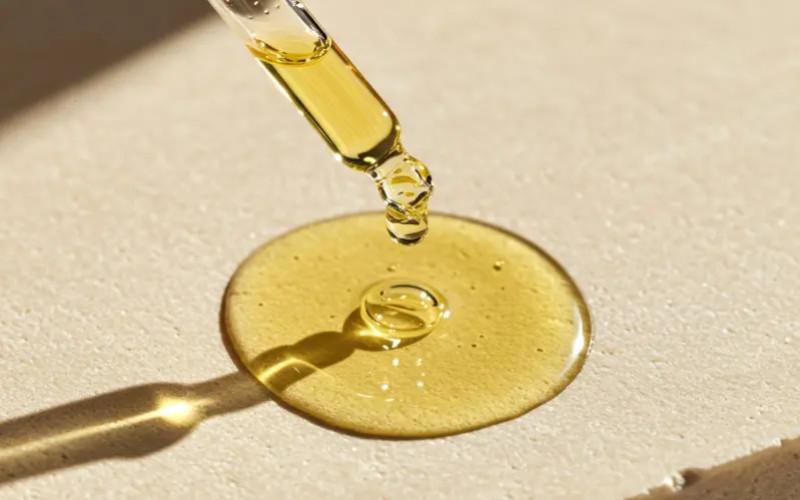
Pale yellow to golden colour, translucent, with no sediment
Very faint smell (a rancid smell = oxidised oil, throw it away)
A single entry on the label: Ricinus Communis Seed Oil
A legible organic label and an amber glass bottle
If the liquid is clear and runny like water, or the label is vague or multilingual with no certification: walk away.
Classic castor oil vs Jamaican black castor oil
You may have heard of "Jamaican Black Castor Oil". Here is the difference:
Classic (pale) castor oil: cold pressed, retains all the nutrients, versatile
Jamaican black castor oil: seeds roasted before extraction, dark colour, stronger smell, traditionally used for coily and curly hair
Where to buy organic castor oil?
You may be wondering whether you can find organic castor oil in pharmacies. It is possible, but often more expensive, with less choice and rarely organic. Shops specialising in natural cosmetics generally offer better value for money and more expert advice. We compare the five channels in detail a little further down in this article.
The main types of organic castor oil, and the one that suits you
Rather than a ranking of brands, here are the main types of organic castor oil you will find on the market, with what really sets them apart. For each one, look at the same four points: certification, extraction method, bottle and price per 100 ml.
The example we use every day: Anaé oil
Aurélie and I use this oil every day at home, and it is the one we chose to distribute. It meets the criteria of this guide: dual COSMOS Organic + Cosmebio certification, artisanal cold pressing, bottled in Brittany. And its price remains affordable even in a large size: €9.20 for 500 ml, i.e. €1.84/100 ml.
Strengths: precise application on eyelashes and eyebrows, handy size for travel. Weaknesses: it is the most expensive size per 100 ml, often between €8 and €15. Our advice: keep it for your eyelashes, or refill a small dropper bottle yourself from a large size.
Oils from brands specialising in aromatherapy
Strengths: generally careful traceability, documented batch testing. Weaknesses: high prices (€12 to €15/100 ml) and small sizes only. Our advice: the quality is often there, but you are also paying for the brand. Check that it really is a virgin, cold-pressed oil.
Entry-level oils in plastic bottles
Strengths: low prices, several sizes available. Weaknesses: a transparent plastic bottle lets light through, quality can vary from one batch to another and the extraction method is not always stated. Our advice: acceptable for trying it out, provided the organic label and the words "cold pressed" appear on the label.
Oils imported from outside the European Union
Strengths: some carry strict labels from their country of origin (USDA Organic in the United States, Soil Association in the United Kingdom). Weaknesses: import delays and fees, prices that vary with the exchange rate. Our advice: favour a European certification (Ecocert, COSMOS, AB, Euro-leaf), which is easier to check.
Third-party sellers on marketplaces
Strengths: large sizes, fast delivery. Weaknesses: origin and seller sometimes not very transparent, higher risk of counterfeits. Our advice: check the seller's name, the batch number and the organic certificate before buying.
Small French producers
Strengths: short supply chain, maximum traceability, support for the local economy. Weaknesses: limited production, oil that is hard to find and often expensive. Our advice: a great approach if you find a certified organic producer.
Summary: what to compare from one bottle to the next
The Anaé example (Biovie)
Origin: India / Bottled in France (Brittany)
Certification: COSMOS Organic + Cosmebio
Price: €1.84/100 ml (€9.20 for 500 ml)
Customer rating: ★★★★★
Ideal for: all uses, hair, eyelashes, skin and packs
And for heavy users (regular packs, families, daily use), the 5 L size makes a real difference to the budget.
Small dropper bottle: about €8 to €15/100 ml · precise application on eyelashes
Aromatherapy brand: about €12 to €15/100 ml · careful traceability, small sizes
Entry-level in plastic: about €5 to €8/100 ml · for trying it out, checking for the words "cold pressed"
Imported from outside the European Union: about €8 to €10/100 ml · non-European label, import fees
Third-party marketplace seller: about €5 to €7/100 ml · check the seller and the batch
Small French producer: variable price · short supply chain, limited production
What our customers say
"I do courses of castor oil packs for my joints, as a course and as packs, with very good results." - KAZE (5/5, Trustpilot)
"The castor oil arrived impeccably packed, nice packaging protected from light, amber bottle, truly organic." - Sheherazade (5/5)
"Castor oil 5 L, very good value for money, flawless quality." - Amrita (5/5)
Where to buy your organic castor oil in France? Comparing the channels
Knowing what to look for is one thing, knowing where to find it at the right price is another. Here is what the five distribution channels are worth, with their limits.
Specialised online shops: the best compromise
This is the option we recommend, and not only because Biovie is one of them. A shop specialising in natural cosmetics takes responsibility for the traceability of what it sells:
Organic certificates are accessible and verifiable
Sizes are more varied, including economical large sizes
Advice is available: detailed product page, articles, customer service
Prices are generally more competitive than in physical shops
Pharmacies and drugstores: convenient, but expensive
You will indeed find castor oil in pharmacies, and it is convenient when you need it right away. The drawbacks are worth pointing out:
Prices are commonly two to three times higher than online
Sizes are often limited to 50 or 100 ml
The range is restricted and rarely certified organic
Advice rarely covers the quality criteria specific to this oil (cold pressing, filtration, origin)
As a stopgap, why not. For regular use, the bill adds up quickly. For the other bathroom essentials, see our natural hygiene range.
Organic shops: product in hand, limited choice
Organic shops sometimes offer a certified castor oil. The advantage is real: you see the bottle before you buy. So are the limits.
The choice is often reduced to a single product
Economical sizes (500 ml, 1 L) are rarely on the shelves
Prices sit between the pharmacy and the specialised online shop
Supermarkets: very variable quality
Some supermarkets now stock castor oil in the cosmetics aisle. This is the channel where reading the label matters most: refined oils sit next to virgin oils without any clear distinction, organic certification is not systematic and the origin is often not stated. Not everything there is bad, but nothing helps you sort it out.
Marketplaces: the riskiest channel
Hundreds of products, every price, and third-party sellers whose identity cannot always be verified: quality is inconsistent, sometimes from one batch to another for the same product. If you buy there anyway, check that the seller is the manufacturer itself or an official distributor, and keep a critical eye on the reviews.
Which size and which price to choose?
The right size depends on your use. Here are the benchmarks we give our customers, and the only indicator that lets you compare two bottles honestly: the price per 100 ml.
Small size (50 to 100 ml): to try it out
If you are new to castor oil, the small size makes sense: expect €4 to €8 for 50 to 100 ml, i.e. €6 to €8 per 100 ml. It is the most expensive size per litre, but it lets you check that the texture and smell suit you before going further.
Standard size (250 to 500 ml): the best value for money
This is the size we recommend for regular use. On the market, a certified 500 ml bottle generally sells for between €15 and €25, i.e. €3 to €5 per 100 ml: you halve the price per 100 ml compared with small bottles. The Anaé organic castor oil 500 ml that we offer costs €9.20, i.e. €1.84 per 100 ml. When you apply a hair mask once or twice a week, 100 ml goes quickly: our 5 homemade hair mask recipes will give you an idea of the pace.
Large size (1 L and more): for packs and daily use
Five clues are enough to rule out a bottle before you even open it:
"Refined oil": the oil has undergone treatments that deplete its composition
No organic certification: there is then no way of checking the growing conditions
"Solvent extraction", or no mention of the extraction method
Vague origin, such as "non-EU product" with no further detail
An abnormally low price, below €3 per 100 ml: producing a quality organic oil has a cost
Is castor oil dangerous?
For external use, castor oil is very well tolerated: a simple skin test in the crook of the elbow 24 hours before the first application is enough to rule out the risk of allergy. The real nuance concerns internal use: when ingested, castor oil is a powerful laxative, which should only be used on the advice of a professional and is not recommended during pregnancy. A 2025 clinical study also confirmed its effect on intestinal permeability. One last reassuring point: ricin, the toxin in the seed, is not present in the oil, as it is removed during pressing. To understand it all, read our article on the purgative effect of castor oil and its precautions.
How to use organic castor oil?
For hair: supporting growth and repairing
Organic castor oil for hair is used as a pre-shampoo mask:
Apply the oil to the scalp, massaging with your fingertips
Spread it over the lengths and ends
Leave on for at least 30 minutes (ideally overnight)
Wash with two gentle shampoos to remove the oil thoroughly
Recommended frequency: 1 to 2 times a week. For a structured routine, follow our 4-week hair loss protocol. And if you find the texture too thick, mix it with a lighter oil such as hemp oil.
For eyelashes and eyebrows: naturally fuller
Clean a mascara wand, dip it into your bottle and apply in the evening to clean eyelashes and eyebrows, avoiding contact with the eye. Visible results after 4 to 8 weeks of daily application.
For beard, skin and nails
On the beard, dilute 50/50 with jojoba oil to soften the texture. On the skin, since the pure oil is thick, dilute it to 1/3 in a lighter oil. On the nails, a daily massage with one drop at the base of the nail nourishes the cuticle.
As a pack
This is the traditional use popularised by Edgar Cayce and Irène Grosjean. Soak a square of flannel, place it on the area for 30 to 60 minutes, cover it with a film and a gentle source of heat. Everything is detailed in our article on castor oil packs according to Irène Grosjean, and you can enhance the effect with the castor oil, turmeric and cabbage synergy.
3 homemade recipes with organic castor oil
Recipe #1: Strengthening hair mask
Ingredients: 4 tablespoons of coconut milk, 2 tablespoons of organic castor oil, optionally 5 drops of rosemary essential oil.
Preparation: mix the lukewarm coconut milk and the castor oil, add the essential oil if you are using it, apply to dry hair from roots to ends, leave on for 30 minutes to overnight under a shower cap, then wash with two gentle shampoos.
Recipe #2: Long-lasting eyelash and eyebrow serum
Ingredients: 1 teaspoon of organic castor oil, 1 teaspoon of coconut oil, 1/2 teaspoon of vitamin E (optional).
Preparation: mix the oils in a small clean bottle, apply every evening with a clean wand. Storage: 3 months away from light.
Recipe #3: Multi-purpose moisturising balm
Ingredients: 2 tablespoons of organic castor oil, 2 tablespoons of shea butter, 1 tablespoon of coconut oil.
Preparation: melt the shea butter and coconut oil in a bain-marie, remove from the heat and add the castor oil, pour into a jar and leave to set. Use on lips, hands, elbows and heels.
5 mistakes to avoid with castor oil
Mistake #1: using an oil that is not certified organic. Without a label, you have no guarantee regarding pesticides or the extraction method.
Mistake #2: applying too much oil. A few drops are enough. Too much oil weighs hair down and makes rinsing harder.
Mistake #3: expecting immediate results. Allow at least 4 to 6 weeks of regular use before judging.
Mistake #4: neglecting rinsing. On hair, two gentle shampoos are often needed to remove everything.
Mistake #5: storing your oil badly. Away from light and heat, in its amber bottle. An oil that smells rancid should be thrown away.
Frequently asked questions about organic castor oil
What is the best organic castor oil?
There is no single best oil for everyone: the right oil is certified organic, virgin, cold pressed, sold in an opaque bottle and at a reasonable price per 100 ml. Aurélie and I use Anaé organic castor oil (available at Biovie): its dual COSMOS + Cosmebio certification, its artisanal cold extraction and its price of €1.84/100 ml make it our recommendation.
Does castor oil really make hair grow?
Let's be nuanced. Ricinoleic acid supports scalp microcirculation and the activity of hair bulbs, and many users notice a reduction in seasonal hair loss after 4 to 6 weeks. However, the idea that it "blocks" a prostaglandin remains an unproven hypothesis in humans. We go over this in detail in our article on the scientific truth about castor oil and hair growth.
Is castor oil dangerous?
For external use (hair, eyelashes, skin, nails), no: a prior skin test is enough. It is internal use that calls for caution, as castor oil is a powerful laxative, to be reserved for medical supervision and not recommended during pregnancy. Ricin, for its part, is not present in the oil.
Can you use castor oil every day?
For eyelashes and eyebrows, yes, daily application is recommended. For hair, 1 to 2 masks a week are enough. Using it too often on hair can weigh it down.
Is organic castor oil suitable for pregnant women?
For external cosmetic use (hair, eyelashes, nails), it is generally considered safe. However, internal use (purge) and abdominal packs are not recommended during pregnancy. If in doubt, ask your doctor for advice.
What is the difference between organic and conventional castor oil?
Organic oil guarantees seeds grown without pesticides, mechanical cold extraction without solvents, and full traceability. Conventional oil may contain pesticide residues and be solvent-extracted.
What does a quality organic castor oil cost?
Generally expect €15 to €25 for 500 ml on the market, i.e. €3 to €5 per 100 ml - the Anaé oil we offer costs €9.20 for 500 ml, i.e. €1.84 per 100 ml. Beware of prices below €3 per 100 ml, which often indicate a refined, diluted or uncertified oil. Small sizes (50 to 100 ml) work out proportionally twice as expensive.
Is castor oil sold in pharmacies?
Yes, but often two to three times more expensive than online, with a range limited to small sizes and rarely certified organic. For a 500 ml organic bottle, specialised online shops remain the better option.
Is organic castor oil edible?
Its common use is external: hair, eyelashes, skin, nails and packs. Internal use exists in the naturopathic tradition, but castor oil is a powerful laxative: it requires supervision by a health professional and is not recommended during pregnancy. If you are considering it, choose an oil explicitly labelled "food grade" and read our article on the purgative effect of castor oil.
How long does organic castor oil keep?
About 12 to 18 months after opening, stored away from light and heat. An oil that smells rancid should be thrown away.
Can castor oil be mixed with other oils?
Absolutely. Being very thick, it blends well with lighter oils such as hemp, coconut or sweet almond oil. A 50/50 ratio works very well.
Is ricin present in castor oil?
No. Ricin is a toxic protein contained in the castor seed, but it does not pass into the oil: it remains in the press cake (the residue) and is removed during pressing. A properly produced castor oil therefore contains no ricin.
Can castor oil be used on the face?
Yes, but diluted. The pure oil is too thick and can clog pores. Mix a few drops into your moisturiser or a lighter oil such as camelina oil.
Where can you find quality organic castor oil?
In pharmacies, organic shops or online. For the best value for money with dual certification, we recommend the Anaé oil available in our Biovie shop (€9.20 for 500 ml).
Our final verdict: which organic castor oil to choose?
To sum up, here is the type of oil to favour depending on your needs:
Best value for money → Anaé (Biovie)
Precise application (eyelashes) → a small dropper bottle, which you can refill from a large size
Packs and daily use → a large 1 L or 5 L size
Small budget to try it out → a 100 to 250 ml bottle, certified organic and cold pressed
Bottled in France → Anaé, bottled in Brittany
If you are still unsure, start with our Anaé organic virgin castor oil - the one we have been using at home for years. You will get a professional-quality product at an affordable price, and you can use it for your hair as well as your eyelashes, your beard or your packs.
This product is part of our Hygiene range, where you will find all our products in this category.
Discover on this page simple, effective and eco-friendly products to enrich your daily routine and hygiene with pure, natural ingredients. The castor oil and the Epsom salt we offer here are multi-purpose solutions and versatile products. All our oils come from organic farming., 3
products
Disclaimer: the information presented in this article is provided for information purposes only and does not constitute medical advice. Consult a qualified health professional before making any changes to your diet or supplementation. As part of a varied and balanced diet and a healthy lifestyle.










.webp)