


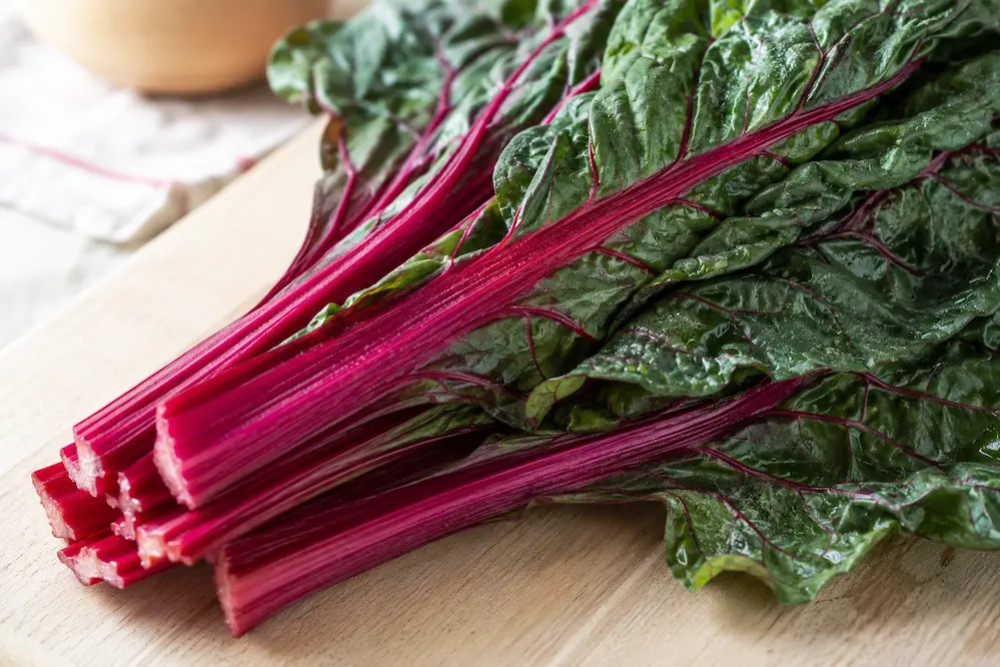

You've probably scrolled past it on Pinterest without putting a name to it. Those scarlet-red stalks blazing against deep green foliage, those veins shifting from soft pink to deep burgundy - that's red chard. And behind that almost theatrical beauty hides a leafy green with a nutritional density that most people completely underestimate.
The short answer, if you're in a hurry: red chard is one of the leafy greens richest in vitamin K, iron, magnesium and pigment antioxidants - the betalains, the very same ones found in beets - for only about twenty calories per 100 g. In other words, plenty of nutrients and very little of everything else. That's exactly the kind of profile I look for, after three decades spent building a plant-based, living-foods diet.
And then there's the other dimension, the one nobody really talks about: this vegetable is gorgeous. In the garden, on the plate, in front of a lens. We're going to cover both, because to my mind they don't come apart.
What Is Red Chard, Exactly?
Let's set the scene first. Red chard is Beta vulgaris var. cicla - the direct cousin of the beet and of ordinary white chard. Same species, different branches of the family. The beet bet everything on its root; chard poured all of itself into its leaves and stems.
It also goes by ruby red chard, and rhubarb chard (because the stems recall rhubarb). When it comes to varieties, there are real stars: Rhubarb Chard and Feurio for true red, Magenta Sunset for the pink-purple tones, and Vulcan for that almost fluorescent red that leaves no one indifferent.
Visually, the difference from white chard jumps right out at you: where the white one shows pale stems and uniformly green foliage, the red one unfurls magenta veins that sometimes thread the whole leaf with fine purple lines. It's not just an aesthetic matter, and that's where it gets interesting.
For a bit of botanical background, you can take a look at the reference entry: chard on Wikipedia.
Why Red Chard's Magenta Color Is NOT Just About Beauty
Here's the point that articles on the subject systematically forget. This deep red color isn't a whim of nature: it's produced by a family of pigments called betalains. And those pigments are exactly the same ones that give the beet its purple coat.
Betalains: Pigments and Antioxidants at Once
Why does that matter? Because betalains aren't just dyes. Research ranks them among the most active antioxidants in the plant world. A 2025 study published by Bondonno and colleagues, which compared in detail the biochemical profile of beetroot and Swiss chard, confirms how rich the colored leaves of Beta vulgaris are in betalains and polyphenols.
Concretely, what does that mean for you? An antioxidant, in everyday language, is a molecule that helps the body cope with oxidative stress - that background cellular wear we accumulate a little each day, with pollution, lack of sleep, meals eaten too fast. Eating colorful, really colorful, is one of the simplest and most enjoyable ways to put protective pigments back on your plate. Color, here, is information: the more intense the red, the higher the pigment concentration.
Why Red Varieties Contain More Than White Ones
It makes sense when you think about it: the color IS the molecule. A white stem contains few betalains - by definition, it isn't pigmented - whereas a ruby-red stem is loaded with them. PasseportSanté put it well: red chard is thought to have higher antioxidant activity than the white kind. That's why, at the market stall, I always grab the most flamboyant bunch. It isn't visual greed - well, not only.
The 9 Key Red Chard Benefits
Let's get specific. Here's what this vegetable really brings to the table, point by point. I've kept the wording careful: we're talking about what the nutrients contribute to within a varied diet, not overblown promises.
- 1. A vitamin K bomb. This is its signature. A serving of raw chard covers well over 300% of the reference intake for vitamin K. And vitamin K contributes to normal blood clotting and to the maintenance of normal bones. Beyond the number: it's exactly the kind of nutrient people rarely discuss, and one that's often missing from plates low in green leafy vegetables.
- 2. Iron and copper. Chard provides non-heme iron, accompanied by copper. Iron contributes to the reduction of tiredness and fatigue and to normal red blood cell formation. A little agronomist's reflex: pair it with a source of vitamin C - a squeeze of lemon, a few raw veggies - on the same plate, and it helps the body make better use of this plant iron.
- 3. Magnesium and potassium. The balance duo. Magnesium contributes to normal energy-yielding metabolism and to normal muscle function; potassium helps maintain normal blood pressure. Translated into how you feel, these are the minerals you notice the absence of when your legs feel heavy and recovery drags.
- 4. Vitamins A and C. Vitamin A contributes to the maintenance of normal vision and normal skin; vitamin C contributes to the normal function of the immune system. Two raw leaves shredded into a salad, and you've already got a good share.
- 5. Lutein and zeaxanthin. Two carotenoids found concentrated in the retina. Green leafy vegetables are an excellent source, and the work of Morris and colleagues (2018, Neurology) shone a light on the link between regular consumption of green leaves and the preservation of cognitive function with age. Nothing dramatic day to day - it's a long-game benefit, the kind you build plate after plate.
- 6. The betalains. We talked about them: those antioxidant pigments found in only a handful of plants. Eating red, here, means eating usefully.
- 7. Fiber. The leaves and stems provide fiber that feeds the gut microbiome and supports regular transit. In practice, it's the digestive comfort you only notice when it's missing.
- 8. Flavonoids - quercetin, kaempferol, rutin. A whole family of protective compounds that accompany the betalains. It's this synergy of molecules, and not a single isolated nutrient, that gives a whole vegetable its value.
- 9. Very few calories. Around 19 kcal per 100 g. It sounds trivial, but it says something essential: with every bite you get a huge amount of nutrients for very little energy. That's the very definition of nutrient density - lots of substance, little ballast.
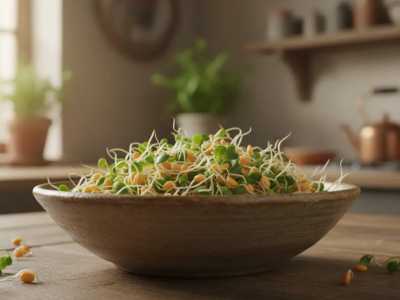
The best way to keep these ultra-fresh leaves on hand all year round is still to grow them yourself. A sprouter genuinely changes the game on this front.
An Unbeatable Aesthetic Asset: Red Chard & the Art of Living
Now let's talk about what nobody talks about. Because this vegetable has a superpower that nutrition tables will never show: it's stunning.
It's a plant you grow as much for the eye as for the plate. When the scarlet-red stalks stand out against the green foliage in the late-spring sun, the effect is striking - gardeners know it well.
In the Garden: a Frankly Ornamental Leafy Green
Red chard holds its own in a decorative bed just as well as in a vegetable plot. The green/red contrast works beautifully alongside nasturtiums, marigolds or calendula. You harvest leaf by leaf for months, and the plant stays beautiful the whole time. Hard to be more generous.
In the Kitchen: the Plating That Changes Everything
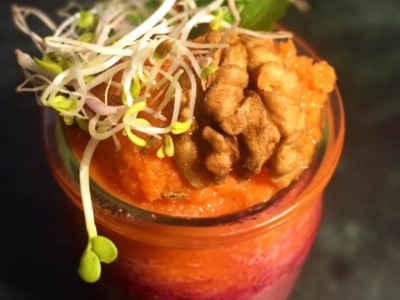
The secret to keeping that color is to respect the pigment. Betalains are sensitive to prolonged heat: gentle, brief cooking preserves the ruby, while a long boil washes it out. Shredded raw, finely, the red stem becomes a true color chart on the plate - from pink to magenta. It's the simplest garnish in the world for turning an ordinary dish into something you want to look at before you eat it. In the same colorful spirit, take a look at these beet and carrot verrines bursting with color.
In Food Photography: Why Chefs and Photographers Love It
Its warm palette, luminous against a dark background, makes it a dream subject. If you create any food content for Pinterest or Instagram, red chard is a gift: it brings color without artifice, movement, life. "Living food" here becomes literally photogenic.
As Microgreens: Concentrated Color and Nutrients
If the adult leaves are already spectacular, their baby version plays in another league. And here, the agronomist in me gets genuinely excited.
Nutrient Density Multiplied
The microgreens - those young shoots harvested at the first-leaf stage - often concentrate far more nutrients than the adult plant. The work of Xiao and colleagues (2012, Journal of Agricultural and Food Chemistry) showed that some young shoots can contain up to four to five times more of certain vitamins and carotenoids than mature leaves. In practice, that means a tiny amount of shoots already gives you a lot - handy when you're short on space or time.
A Remarkable Mineral Profile
A 2025 study (Lenzi and colleagues, Scientific Reports) measured the nutritional quality of several young shoots: it found notable levels of potassium and iron. What that covers day to day is the idea that a tray of shoots grown on the windowsill isn't a magazine gimmick: it's a real source of minerals, available year-round, regardless of the seasons.
How to Grow Them Easily at Home
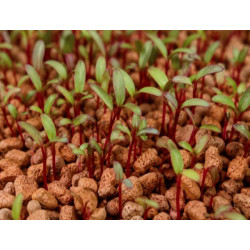
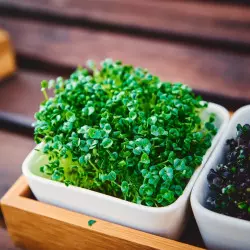
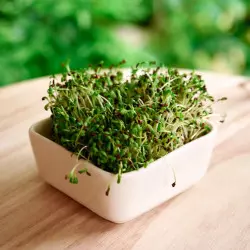
It's disarmingly simple: red chard seeds, a little potting soil or a sprouter, some light, and ten to fourteen days of patience. The soft-pink cotyledons are, as a bonus, breathtakingly beautiful. To go further, this complete guide to sprouts and how to grow them at home will give you all the basics.
If you want to test for two weeks what it's like to have fresh red chard shoots in your kitchen, these are the seeds we grow ourselves for their mildness and color: