What began as a simple curiosity 35 years ago for me while I was still living with my parents has become a true staple of our family's daily diet today. And frankly, when you discover that some seeds can increase their vitamin C content by up to 600% during germination, you understand why this ancient practice is making a strong comeback.
But here is the question everyone asks at the beginning: where to start? Which seeds to choose? Which ones to absolutely avoid? This is precisely the purpose of this article: to offer you a complete list of seeds for sprouting, categorized by family and difficulty level, to help you get started confidently.
More than 50 varieties of sprouting seeds available to you
The good news is that there are more than 50 types of sprouted seeds !They are generally classified into 5 main families: legumes (lentils, alfalfa, fenugreek...), cereals (wheat, quinoa, buckwheat...), cruciferous vegetables (broccoli, radish, arugula...), oilseeds (sunflower, sesame...), and aromatics (basil, coriander...).
At Biovie, we offer 25 varieties of organic sprouting seeds, all selected for their germination rate above 95%. Our Italian supplier Geo Bavicchi, specializing in quality seeds since 1896 and over 3 generations, tests each batch before marketing.
Each family has its own characteristics, germination times, and especially its flavors. This is what makes the adventure exciting: you will be able to explore a whole universe of tastes and textures, from the spiciness of radishes to the sweet softness of sunflowers.
Legumes: Easy Sprouted Seeds for Beginners
If you are just starting out, this is clearly where you should begin. Legumes are the easiest sprouted seeds and the most tolerant. Even if you forget a rinse, they generally do very well.
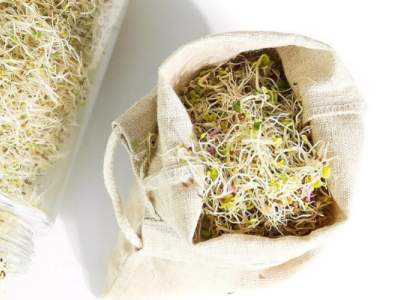
Alfalfa (or lucerne) is probably the most popular seed for beginners. It only requires 4 to 6 hours of soaking and sprouts in 4 to 5 days. Its flavor is mild and fresh, perfect for enhancing a salad or topping a sandwich. It is one of the seeds we consistently recommend to people who are starting out. You can discover our organic alfalfa for sprouting which is among our bestsellers.
Lentils are also ideal. Whether they are green, coral, or blonde, they sprout in just 2 to 3 days after 12 hours of soaking. Their taste is mild and slightly earthy. Personally, I often add them to my salads or lightly sauté them in a pan.
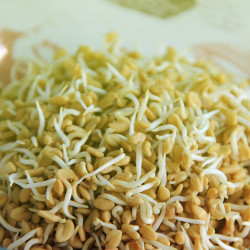
Fenugreek deserves a special mention. This small golden seed with a spicy and slightly bitter taste is a true concentrate of benefits. It sprouts in 2 to 4 days and adds an oriental touch to your dishes. Studies show that germination significantly increases its content of B-group vitamins. For more information, check out our article on the interest of sprouting your seeds.
Mung bean - the one often mistakenly called "soybean sprout" - is a must-have. With up to 32% protein, it contains all the B-group vitamins. Our mixes like the Mix Andante (mungo/alfalfa/radish) allow the discovery of multiple flavors in a single germination.
Among other legumes to discover: chickpeas, peas, clover, and azuki beans. All of them are easy to manage and forgiving of small beginner mistakes.
Cereals: Express Germination
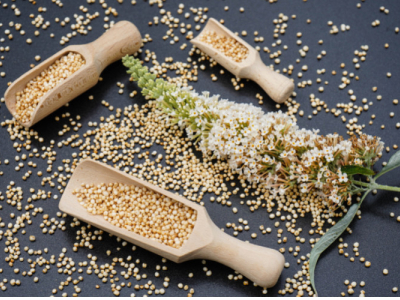
Cereals are the champions of speed. Some, like quinoa, sprout in just 1 to 2 days! In fact, it's THE fastest seed I know. For technical details, check out our dedicated article: Quinoa, the fastest germinating seed.
Wheat remains a great classic. It requires 8 to 12 hours of soaking and sprouts in 2 to 3 days. Its sweet and malty flavor is generally very popular. It is also the base for making wheatgrass juice if you let the sprouts grow. We work with Geo Bavicchi to offer a special sprouting wheat, Timilia, an ancient and rustic variety that does not present bitterness when pressed.
Buckwheat has a unique feature: it only requires 20 minutes of soaking! Yes, you read that right. Then, it sprouts in 1 to 2 days. Its mild flavor makes it an excellent addition to mueslis or smoothie bowls.
Spelt and the kamut behave like wheat, with slightly different flavors. Spelt has nutty notes that I particularly enjoy.
Quinoa is technically a pseudo-cereal, but it is often classified with cereals for simplicity. Its record germination time (1 to 2 days after only 2 to 4 hours of soaking) makes it a perfect ally for the impatient. Moreover, its richness in complete proteins is a real advantage.
Theoats, the millet and theBarley are a bit more demanding and are better suited for people with some experience. They require special attention to rinsing.
Cruciferous vegetables: the champions of antioxidants
Here is a family that truly deserves attention. Sprouted cruciferous vegetables are real nutritional powerhouses, particularly rich in glucosinolates and isothiocyanates, compounds associated with numerous positive health effects.
Sprouted broccoli is probably the most scientifically studied. It contains up to 50 times more sulforaphane than mature broccoli! This compound is the subject of numerous studies. Germination takes 4 to 6 days and requires a bit more attention than legumes. We offer organic broccoli seeds for sprouting of high quality, tested for their germination capacity.
The radish is my personal favorite. Its tangy and spicy flavor enlivens any dish. It sprouts in 4 to 5 days and adds a touch of color with its pinkish stems. Specifically, it's the seed I recommend to those who want to add some zest to their plate. Our Mix Adagio (broccoli/radish/clover) combine these flavors harmoniously.
The rocket and the watercress are more delicate to germinate because they are mucilaginous seeds. I will explain a little further what this means and how to manage them. For cress, discover our organic cress for sprouting.
The red cabbage, the mustard and the turnip complete this family. All bring a variety of flavors, from sweet to spicy.
Oilseeds: rich in lipids and proteins
The sunflower is the undisputed star of this category. Its seeds (unshelled) germinate easily in 2 to 3 days. The sprouts have a delicious nutty flavor and are very nutritious. However, be careful: you must use seeds with their shell for germination. Young sunflower sprouts are excellent for heart health and for strengthening the immune system.
Sesame is a bit more technical. It germinates in 2 to 3 days after 4 to 6 hours of soaking, but it tends to develop bitterness if overwatered. When done successfully, its sweet and oily flavor is a delight.
Almonds can be "activated" by soaking (8 to 12 hours), which corresponds to the very beginning of the germination process. This releases enzymes and significantly improves their digestibility. This is also a topic we have written about in detail in our article on the benefits of sprouted seeds.
Flax and the Hemp are part of oilseeds, but flax is mucilaginous (like arugula) and requires a particular technique.
Aromatics: For Patient Gardeners
Honestly, these seeds are not for beginners. The basil, the Coriander, the parsley and the Caraway require patience: expect 10 to 15 days for germination for most.
Basil is also mucilaginous, which complicates things. But when you manage to grow your own basil sprouts, the taste is absolutely incredible. It's a real little challenge that is worth it.
Slow-growing vegetables such as leek, the Fennel, theonion, the carrot and the celery also fall into this "advanced" category. They require between 10 and 15 days of attentive care. For these demanding varieties, consult our Mix Allegro (leek/cress/rocket/alfalfa).
The particular case of mucilaginous seeds
Here is a term you will often encounter in the world of germination. Mucilaginous seeds produce a gelatinous substance when in contact with water. This is the case for arugula, cress, flax, basil, and mustard.
These seeds cannot be sprouted in a classic jar or tiered sprouter. They need a flat and moist surface, typically a germination dish with a support like hemp or linen.
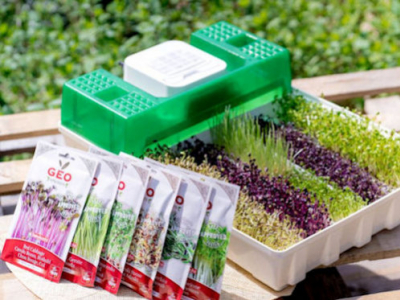
The technique is different: you don't soak them, you simply place them on the damp support and maintain the moisture by spraying. It's a bit more technical, but once you understand the principle, it becomes natural. A Easygreen automatic sprouter greatly facilitates the cultivation of these delicate seeds thanks to its misting system.
⚠️ The seeds you should NEVER sprout
Attention, not all seeds are good for sprouting! Some are even dangerous when consumed raw. Here is the list of prohibited sprouted seeds :
Yellow soybeans (Glycine max) is toxic when raw. It contains antinutritional substances that are only eliminated through cooking. This is a very common confusion because what is commonly referred to as "soybean sprouts" is actually mung bean, a completely different seed that is perfectly edible raw.
This confusion is also the source of many misunderstandings. The mung bean is sometimes called "green soy," which adds to the confusion. In reality, true soy (the yellow one) should never be consumed sprouted without cooking. French regulations (DGCCRF) are very clear on this matter.
The nightshades (Tomato, eggplant, pepper) contain solanine in their green parts, including the sprouts. Absolutely to be avoided.
Rhubarb : its leaves and seeds contain oxalic acid at potentially dangerous concentrations.
In summary: if you have any doubts about a seed, do not experiment. Use only certified seeds intended for germination.
Sprouted seeds, microgreens, or young shoots: what's the difference ?
This is a question that comes up often, and the confusion is understandable. Here's how to distinguish them:
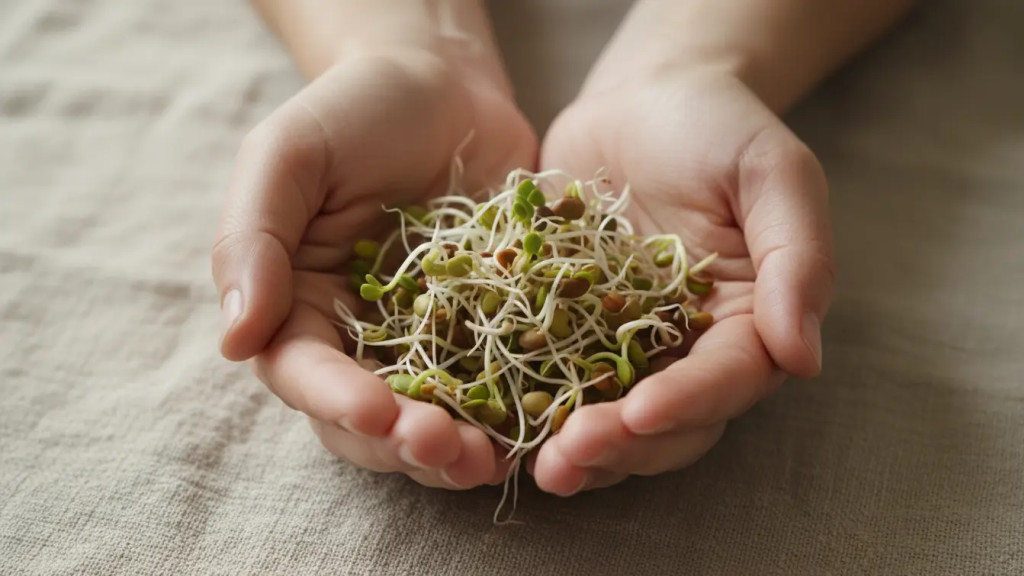
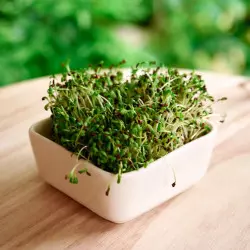
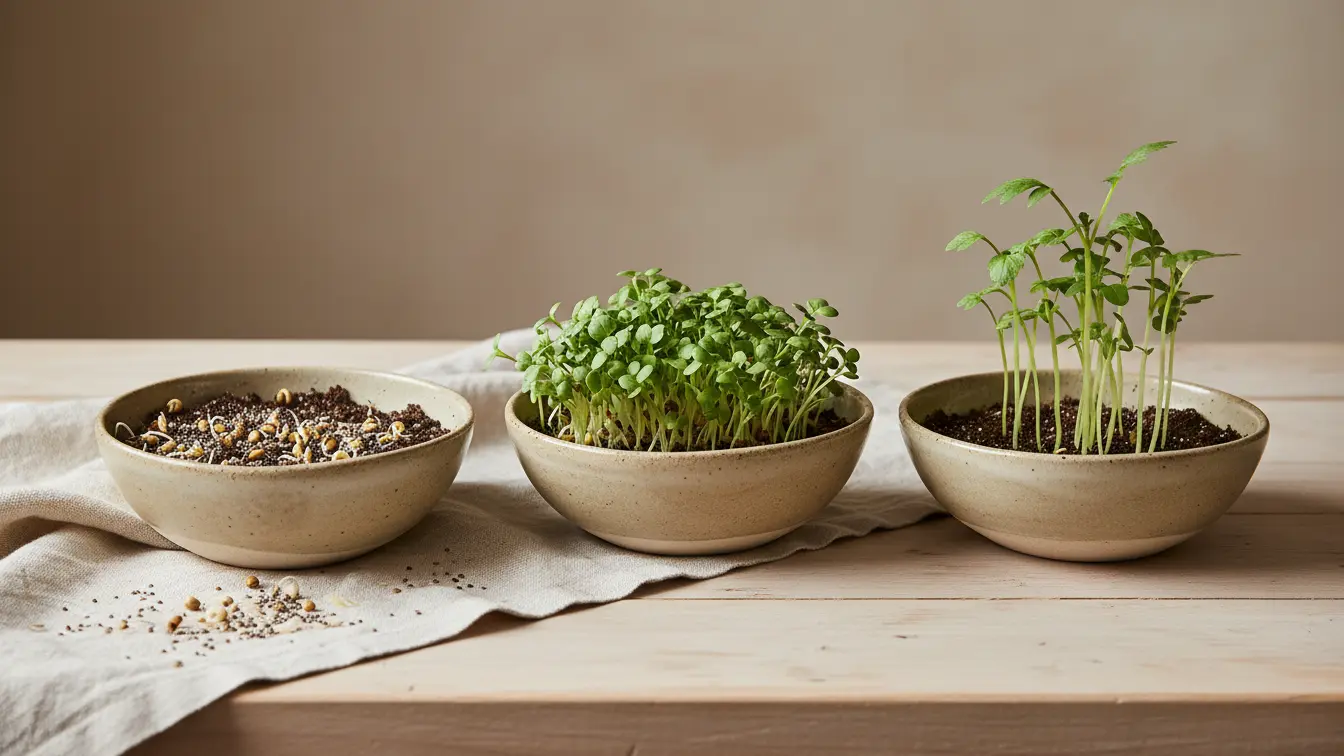
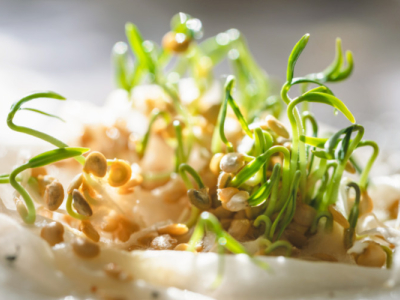
Sprouted seeds are consumed at the very beginning of their development, when the sprout measures a few millimeters to a few centimeters. The entire seed is eaten with its sprout. No soil is needed, just water and a bit of light at the end of germination.
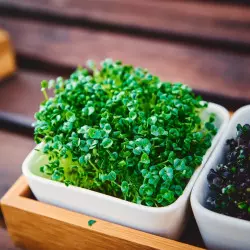
Microgreens (or microgreens) are harvested later, when the first leaves (cotyledons) are well developed. They are generally grown on a substrate (potting soil, hemp, coco) and only the aerial part is consumed, not the seed or the roots.
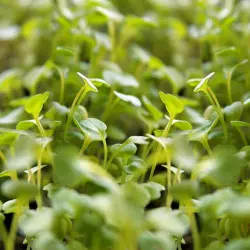
The young shoots go even further in development. They are harvested when the true leaves begin to appear.
Each stage has its advantages. Sprouted seeds are the quickest and simplest to produce. Microgreens offer more volume and sometimes more intense flavors. It's a matter of preference and what you are looking for. To learn more, consult our Complete Guide to Sprouted Seeds by Eric Viard.
How to choose your sprouting seeds according to your level
Here is my recommendation based on our experience at Biovie:
For beginners in sprouted seeds : start with alfalfa, lentils, wheat, quinoa, mung beans, or sunflower seeds. These seeds are forgiving of mistakes and sprout quickly. A simple glass jar with a piece of gauze is enough to get started, or a sprouting bag for the nomads.
Intermediate level : once comfortable, explore broccoli, radish, chickpea, sesame, oats, and millet. These seeds require a bit more attention but remain accessible.
For the experts : mucilaginous seeds (arugula, cress, flax, basil), aromatic herbs (coriander, parsley), and slow-growing vegetables (leek, fennel, carrot) present real challenges. They require suitable equipment and daily monitoring.
To help you with your first germinations, download our free germination chart with all the soaking and germination times.
Some essential hygiene rules
Germination occurs in a warm and humid environment, which can promote bacterial growth if not carefully monitored. The 2011 contamination incident (Egyptian fenugreek seeds) indeed left a lasting impression.
Here are the basic rules:
Choose quality seeds : organic and specifically intended for germination. Traditional vegetable seeds may be treated with non-food products.
Rinse 2 to 3 times a day : it is the key to healthy germination. Stagnant water is the enemy.
Keep refrigerated after germination : your sprouted seeds can be stored for a maximum of 4 to 5 days in the refrigerator.
Clean your sprouter between each use.
When in doubt, throw it out. : abnormal odor, suspicious color, mold... it's better not to take any risks.
For immunocompromised individuals, pregnant women, young children, and the elderly, light cooking (1 to 2 minutes in boiling water) eliminates bacteriological risks while preserving a large portion of the nutrients.
A millennia-old practice that has proven itself
Germination is nothing new. The Chinese were already sprouting mung beans in the 2nd century! The Sumerians, the Celts, and many other civilizations have been using this technique for over 7,000 years.
Today, scientific studies confirm what our ancestors intuitively knew. During germination, the seed comes out of dormancy and activates all its enzymatic processes. Vitamins multiply (up to +600% for vitamin C, +500% for B6), antinutrients like phytic acid decrease, and the digestibility of proteins improves considerably.
Dr. Martine Cotinat, a gastroenterologist, summarizes it well: "Sprouted seeds on the plate are for pleasure, decoration, taste, but above all for their nutritional richness! The transition from a dormant seed to an active state awakens its enzymes and enriches the food with nutrients."
The global sprouted seeds market today reaches 8.58 billion dollars, evidence of the growing enthusiasm for this living food.
Starting without going broke
One of the great advantages of sprouting is its negligible cost. Two tablespoons of dry seeds yield a generous amount of sprouts. The seeds can be stored for several years in a dry, dark place.
For the equipment, a simple glass jar with a gauze is sufficient to start. If you want to go further, a tiered or automatic sprouter like the Easygreen allows you to produce several varieties continuously without having to think about it. The Easygreen Light is actually what led to the creation of Biovie in 2007 – we even acquired the American company in 2020 to offer you the best automatic sprouter existing.
FAQ: Your questions about sprouting seeds
What are the easiest seeds to germinate for a beginner ?
Alfalfa, lentils, mung beans, and quinoa are the easiest seeds to sprout. They are forgiving of rinsing mistakes and sprout quickly in 2 to 5 days. Start with these before exploring more demanding varieties.
Can all seeds be germinated ?
No, some seeds are toxic when sprouted. Yellow soybeans, nightshade seeds (tomato, eggplant, pepper), and rhubarb should never be consumed raw when sprouted. Only use seeds that are certified for sprouting.
What is the difference between sprouted seeds and microgreens ?
Sprouted seeds are consumed at the very beginning of development (sprout of a few mm to cm), including the whole seed. Microgreens are harvested later with the first developed leaves, grown on a substrate, and only the aerial part is eaten.
How long does it take for seeds to germinate ?
The time varies according to the varieties: quinoa sprouts in 1-2 days, lentils in 2-3 days, alfalfa in 4-5 days, broccoli in 4-6 days, and herbs like basil require 10-15 days. Refer to our germination chart for all the details.
How to store sprouted seeds ?
Sprouted seeds can be stored for a maximum of 4 to 5 days in the refrigerator in a container that allows air circulation. Rinse them before consumption. If there is an abnormal odor or mold, discard them without hesitation.
Are sprouted seeds really more nutritious ?
Yes, germination significantly increases the nutrient content: up to +600% of vitamin C and +500% of vitamin B6 according to studies. It also reduces antinutrients like phytic acid and improves the digestibility of proteins.
What equipment is needed to germinate seeds ?
To start, a simple glass jar with a gauze or cloth held by an elastic band is sufficient. To go further, a tiered sprouter or an automatic sprouter like the Easygreen allows you to produce several varieties simultaneously with less effort.