


Organic Fenugreek Seeds
Fenugreek seeds for sprouting in doypack of 35g, 300g, or 5kg bag
No queries yet, leave the first!
Price:
€50.41
Product availability:
In stock
Tax included


Organic Fenugreek Seeds images


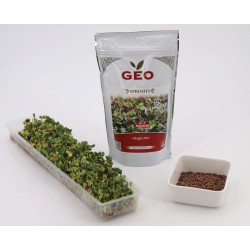
Organic Fenugreek sprouting seeds
🌱 Fenugreek is one of our favourite seeds, and one of the easiest to sprout! It will pleasantly flavour your dishes with its spicy taste reminiscent of cumin or curry... but not only that!
> Fun fact: when you eat it, your sweat takes on a pleasant curry smell a few hours later.
Soaking: 10 hours
Germination: Our organic fenugreek seeds can be eaten between 2 and 4 days after being set to sprout.
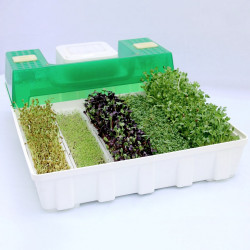
It is very easy to grow in theEasygreen Light or in theEasygreen Sol.
🌱 Below is a video showing you behind the scenes at our supplier Bavicchi:
🌱 A special sprouted seeds FAQ video:
🌱 As well as a video of an interview we had the pleasure of filming with Dario Bavicchi:
Fenugreek (Trigonella foenum-graecum) is a legume from the Fabaceae family - and frankly, it has been one of my favourites since the early days of Biovie.
Composition
Organic fenugreek sprouting seeds. The detailed nutritional composition of fenugreek is in the Ciqual ANSES.
Fenugreek: contraindications and precautions for use
Fenugreek is generally well tolerated when eaten in food quantities. A few precautions are nevertheless needed - and it is important to know them before starting regular consumption:
- Pregnancy: large quantities can stimulate uterine contractions. To be consumed in moderation and after medical advice.
- Legume allergy: fenugreek belongs to the Fabaceae family. In case of allergy to peanuts, chickpeas or peas, consult before consuming.
- Medically treated diabetes: if you are on antidiabetic treatment, ask your doctor for advice before any regular consumption.
- Drug interactions: may potentiate certain anticoagulants (coumarin content). Tell your doctor if you are on treatment.
- Body odour: sweat can take on a pleasant curry smell - due to sotolone, a natural aromatic molecule in fenugreek. A normal, temporary phenomenon.
If in doubt, the advice of a health professional is recommended before any regular consumption.
To find out more, see our blog articles:
> Why is fenugreek a must for sprouting?> Methi salad (sprouted fenugreek): freshness and natural flavours
To learn more about the advantages of sprouting:
Sprouted seeds
Which is the best sprouter?
The best sprouting seeds: complete guide
And this interview with Eric where he tells you all about sprouted seeds!
⭐⭐⭐⭐⭐ Jérôme - Trustpilot
"I order my sprouting seeds from Biovie and I am very satisfied. I also ordered the Easygreen Sol, which works very well and is very useful to me."
⭐⭐⭐⭐⭐ Henri A. - Google
"We started up the sprouter 3 weeks ago. It has changed our lives. The seeds grow much better, the sprouts are even better."
Frequently asked questions about fenugreek seeds
How to eat sprouted fenugreek seeds?
Sprouted fenugreek seeds are eaten raw, straight after rinsing. They fit easily into salads, smoothies, cold soups, open sandwiches or sprinkled over your dishes. Their slightly spicy flavour, reminiscent of curry, brings character to all preparations.
Can you eat fenugreek seeds raw, without sprouting them?
Yes, fenugreek seeds can be eaten soaked (after 10 hours in water) without being fully sprouted. We do however recommend waiting a minimum of 2 days of germination.
How much fenugreek per day is recommended?
In everyday eating, a few grams of sprouted seeds per day (one to two tablespoons) is a reasonable amount. It is advisable to start gradually.
Is fenugreek dangerous? What are its side effects?
Eaten in food quantities, fenugreek is well tolerated by most adults. Excessive consumption can cause discomfort (flatulence, loose stools). People on antidiabetic treatment should ask their doctor for advice. Pregnancy requires particular caution (see the precautions section above). People allergic to legumes should avoid fenugreek.
Why do fenugreek seeds smell of curry?
This characteristic smell is due to sotolone, an aromatic molecule naturally present in fenugreek. In tiny amounts, it evokes maple and curry. After consumption, it can be found in sweat and urine - this is a normal, harmless and temporary phenomenon, often described as a fun anecdote by regular consumers.
Best before: 01/01/2028
- Packaging : Available in 35g or 300g doypack bags or 5kg sacks
- Best before : 3 years after the production date
- Storage : Store in a cool, dry place away from light. In good conditions, the seeds keep their ability to germinate for several years.
- Quantity : Start with a small amount (a few grams) and increase gradually as you wish.
Updated: March 2026. Article validated by Éric Viard, founder of Biovie and ISTOM, co-author of " Algues au quotidien " (Gallimard, 2024) - Best cookbook in the world, Gourmand Cookbook Awards 2025, and Best cookbook in France, Académie Nationale de Cuisine 2025.
The information presented on this product sheet is provided for information purposes only and does not constitute medical advice. Consult a qualified health professional before making any changes to your diet or supplementation. As part of a varied and balanced diet and a healthy lifestyle.
The documents that back up what we write about this product. Every document is dated; we remove those that are no longer valid.
Biovie organic certificate
Valid until 31/03/2027Bavicchi organic certificate
Valid until 02/12/2028Wondering… ?
Everything you need to know before ordering.
Be the first to ask a question about this product!
Question about the product
Ask a question