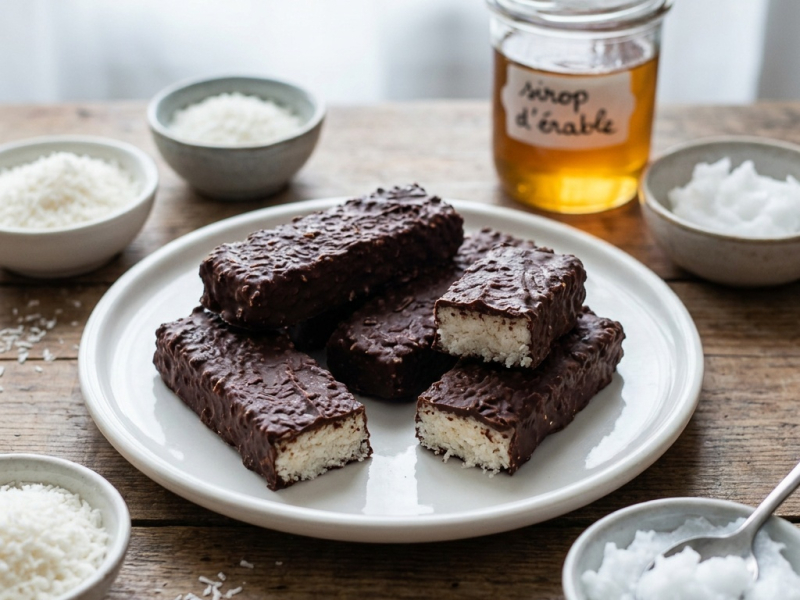


This recipe rests on a very aromatic honey, with pronounced herbaceous notes, which perfumes the whole cookie base. Combined with coconut and Brazil nuts ground to a coarse powder, it gives a dense, soft dough that you simply press into a tin. A thin layer of raw chocolate, melted at low temperature, then covers the whole thing. One hour in the fridge and you have rustic bars, to cut into small squares and keep cool.
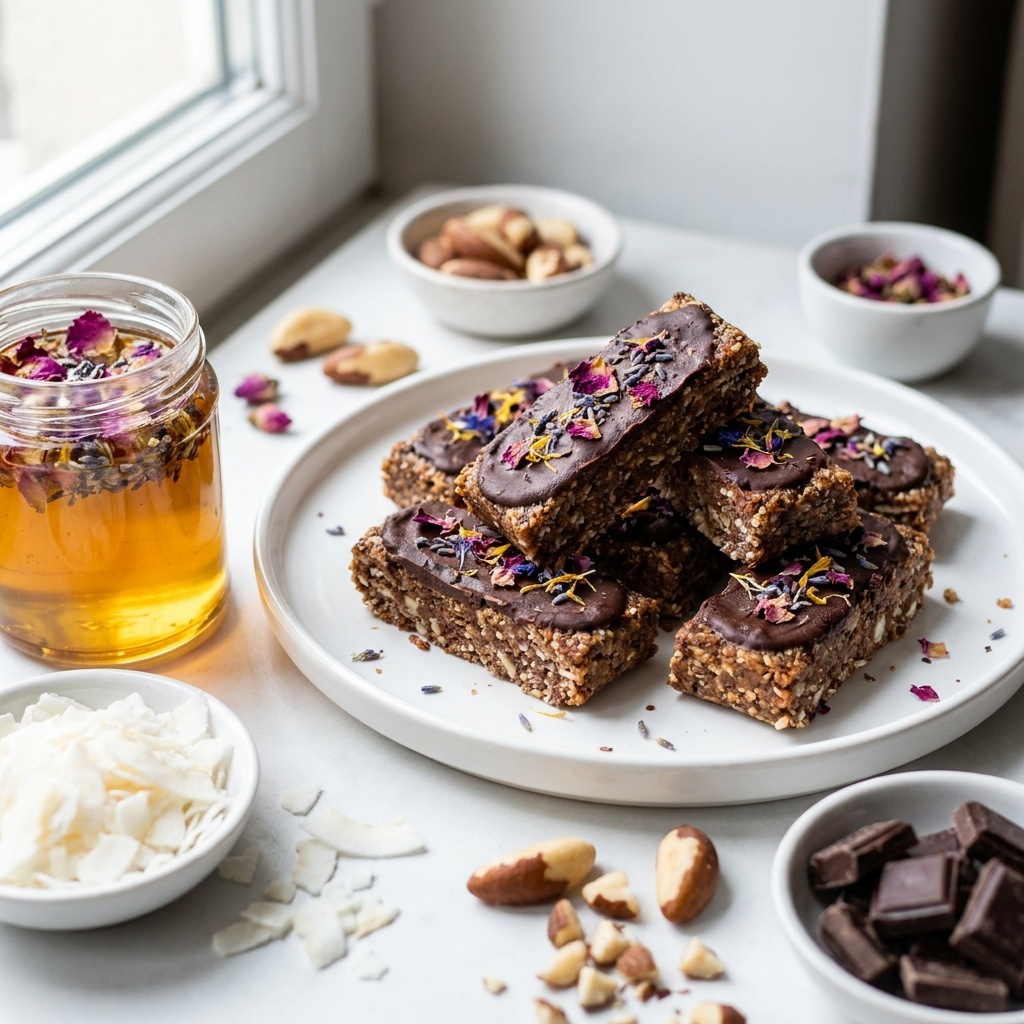
Coconut and Brazil nut cookie bars with raw chocolate

Share this article
Ingredients
For the cookie base
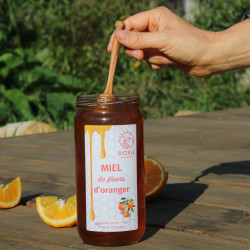
- 130 g very fragrant honey with herbaceous notes
- 250 g coconut flakes
- 100 g Brazil nuts
- 7 large pitted dates
- 3 tablespoons runny raw honey
- 1/4 teaspoon salt
- 1 pinch of freshly grated nutmeg and cinnamon
For the chocolate layer
- 180 g raw cacao paste, in pieces
- 2 tablespoons coconut oil
- 4 to 5 tablespoons runny raw honey
- 1 pinch of salt (or the equivalent of 1 tablespoon - 15 ml - of seawater)
- 1 pinch of nutmeg and cinnamon
- 1/4 teaspoon powdered vanilla (or 1/2 vanilla pod, scraped)
Method
The cookie base
- Put the coconut and the Brazil nuts in the bowl of a food processor and blend until you get a floury texture.
- Add the fragrant honey, the dates, the raw honey, the salt and the spices, then blend until you have a smooth dough that holds together between your fingers.
- Press this dough firmly into a rectangular tin of about 20 x 30 cm, in a layer one centimetre thick.
The chocolate layer
- Cut the cacao paste into small pieces and melt it very gently in a bain-marie, in a bowl set over a pan of hot water that does not touch the bottom of the bowl. In a dehydrator set to 40 °C the result is gentler still.
- Off the heat, add the coconut oil and stir until it is perfectly blended in.
- Stir in the honey, the salt, the spices and the vanilla, then mix until the texture is smooth and glossy.
- Pour this mixture over the cookie base and smooth the surface with a spatula.
- Chill for about 1 hour, until the chocolate has set properly, then cut into small squares.
Tip
No herbaceous honey to hand? A well-characterised raw honey (chestnut, lavender, buckwheat) plays the same part: the important thing is to keep a pronounced aromatic note, otherwise the base falls flat. Take care never to go above 42 °C when melting the cacao paste, beyond that it loses its raw character and the taste rounds off. The bars keep for a week in the fridge in an airtight box, and cut far more neatly with a blade run under hot water then wiped dry.
The full range Honey
3 products
Discover the full range

FAQ: your questions about raw chocolate cookie bars
Can you eat baking chocolate raw?
Yes, baking chocolate can be eaten as it is, it has already been conched and tempered in the factory. But it is not the same thing as raw chocolate: in this recipe we use raw cacao paste, made from unroasted beans ground at low temperature. The taste is fruitier, sharper, and the melting has to stay very gentle so as not to lose that character. If all you have is classic dark chocolate the recipe still works, it will simply be closer to a shop-bought bar.
What is raw honey?
It is a honey that has been neither heated nor pasteurised, extracted cold and simply filtered coarsely. It often stays cloudy and thicker, and it crystallises faster than a shop-bought honey. That is exactly what we are looking for here: a very fragrant honey that brings flavour and not just sweetness. Use it runny, or warm it for a few minutes in a very gentle bain-marie so that it blends well into the dough.
What is the recipe for cacao paste?
Cacao paste is simply the whole cacao bean ground until it turns fluid thanks to its own butter: nothing else, no sugar and no milk. In the raw version the beans are not roasted and the grinding is done at low temperature. At home you would need a stone grinder to manage it, which is why it is most often bought ready made, in pieces or in discs. Allow 180 g here to cover a 20 x 30 cm tin.
Share this article
Related articles