








Raw sauerkraut is one of the simplest ways to add flavour to a plate, and one of the cheapest to make at home. It still has to stay raw: a pasteurised sauerkraut has little in common with the one quietly fermenting in a jar on the counter. This version pairs finely shredded red cabbage with grated beet and ginger, with a few chilli flakes for warmth. The colour, a frank purple, comes from the cabbage and beet together. Everything else comes down to one principle: the vegetables must stay under the brine from start to finish. That's what separates a fermentation that goes well from a jar you'll have to throw out. The cabbage core, kept on purpose, works as a natural weight to keep everything submerged. Allow three days at room temperature, then five more days in the fridge before you start eating it. Cleanliness of the equipment matters as much as the recipe itself: scalded jars and utensils, clean hands, a wooden spoon rather than a metal one.

Raw Red Cabbage and Beet Sauerkraut with Ginger

Share this article
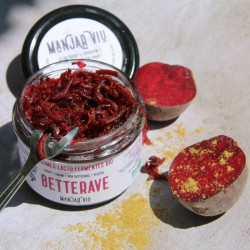
Organic lacto-fermented beetroot and white cabbage with cumin
€6.50 Out-of-Stock
Ingredients
- 1/2 medium red cabbage, finely shredded
- 1/2 beet, grated
- A piece of fresh ginger about 5 cm long, grated
- 1 teaspoon chilli flakes
- 2 teaspoons sea salt
- 500 ml filtered water
- 1 large sterilised glass jar
Method
- Clean all the utensils and the jar very thoroughly, scalding them or rinsing them in very hot water. This is the starting condition.
- Wash the red cabbage, peel the beet and the ginger. Remove the 4 or 5 outer leaves of the cabbage, cut it in half, then remove the core and stem: keep the core, it will be used later.
- Shred the cabbage into thin strips, coleslaw-style.
- Grate the half beet and the ginger in a food processor.
- Pack the cabbage, beet and ginger into the clean jar without overpacking, scattering the chilli flakes in as you go.
- Prepare the brine by dissolving the salt in the filtered water, stirring with the wooden spoon. Pour it over the vegetables, leaving 2 to 3 cm of space at the top of the jar, as the vegetables will swell during fermentation.
- Press down gently with the wooden spoon to submerge the cabbage and release any air bubbles.
- Place the cabbage core on top to keep the vegetables under the brine and fill the remaining space. Close the jar and set it on a plate: it may overflow when fermentation starts.
- Leave the closed jar at room temperature for 3 full days. Bubbles appear on the surface: fermentation is under way.
- After 3 days, the mixture should smell lightly acidic and clean.
- Move the jar to the fridge and let it ferment for 5 more days before eating.
Tip
This sauerkraut keeps in the fridge and is best eaten within three months. Add it to a salad, a wrap or an open sandwich for an instant tangy note. If the brine level drops below the vegetables while fermenting, top it up with a little salted water at the same ratio rather than letting part of the cabbage sit exposed to air.
The full range Lacto-fermented products
5 products



FAQ: your questions about raw sauerkraut and lacto-fermentation
What is the recipe for making lacto-fermented sauerkraut?
Shred the cabbage very finely, salt it at around 2% of its weight, then massage it by hand for a good quarter of an hour: the salt draws out the water and creates the brine. Pack it firmly into a scalded jar until the liquid covers the vegetables, and keep everything submerged with a cabbage leaf or the core. Close it without sealing it completely, leave it at room temperature for one to three weeks, then move it to the fridge. That's all there is to it.
Is it good to eat raw sauerkraut?
Raw sauerkraut keeps its live lactic bacteria, its vitamins and its sharp acidity, whereas a pasteurised or cooked version is little more than an acidic vegetable. It provides fibre, vitamin C and a very distinct taste that wakes up a plate. Two caveats: it's salty, which matters if you're watching your intake, and guts unused to fermented foods do better starting with a spoonful rather than a whole plate.
Is fermenting sauerkraut dangerous?
The real risk isn't the fermentation itself, which is self-protecting thanks to its acidity, but mistakes at the start. The three classics: not enough salt, vegetables poking out above the brine, and poorly cleaned equipment. The result is easy to see and smell: green, black or fuzzy mould on the surface, or a genuinely putrid smell, mean you should throw the whole batch out. A flat white film, on the other hand, is usually a harmless yeast that you can simply skim off with a spoon.
Share this article