





Chlorella Algae
There is 1 product.
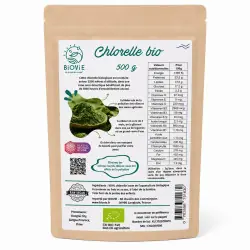
You have seen 1 of 1 products
Questions & answers
All about Chlorella Algae.
The questions we get asked most often, and our straight answers.
What is the composition of chlorella?
✳️ Chlorella is a microalgae very rich in nutrients. Its composition can vary depending on growth conditions and sunlight, here we provide general ranges for the main nutrients:
- Proteins: Very rich in proteins, it contains between 50-60% of its dry weight in the form of proteins, which is considerable compared to other foods. It contains all essential amino acids in a bioavailable form, making it a complete source of protein.
- Vitamins: Source of vitamins, notably vitamin C, B6, B2, vitamin E which protects the body against damage caused by free radicals, and beta-carotene (precursor of vitamin A).
- Minerals: Chlorella contains a variety of essential minerals for the body such as iron, zinc, magnesium, calcium.
- Fatty acids: It contains about 10-20% lipids, including essential fatty acids, such as alpha-linolenic acid (ALA) which is important for heart and blood vessel health.
- Chlorophyll: Chlorella is rich in chlorophyll (3260mg/100g) which has antioxidant properties and can help support the body's detoxification. This pigment gives plants their green color and plays a crucial role in photosynthesis.
- Antioxidants: Chlorella contains antioxidants, such as lutein and zeaxanthin, which can protect the body against damage caused by free radicals.
- Carbohydrates: About 20% of chlorella's dry weight is composed of carbohydrates.
✳️ Find on our YouTube channel a video explaining in more detail its origin and virtues:
✳️ To learn more about this super algae, also check out our blog articles:
What are the benefits of chlorella?
Chlorella: Super algae with multiple virtues for your health
What are the benefits of chlorella?
We recommend a consumption of 5 grams per day, either as a treatment or over the long term.
✳️ Chlorella is a unicellular freshwater algae that belongs to the Chlorophyceae family. It is considered one of the most nutrient-rich foods, which is why it is often used as a dietary supplement for its numerous health benefits. Here are a few:
- Rich in nutrients: Rich in proteins, fibers, vitamins (such as vitamin C, vitamin B, and beta-carotene), minerals (such as iron and calcium), and essential fatty acids. (Kulshreshtha et al., 2015).
- Possesses detoxifying properties: Used to eliminate heavy metals, toxins, and pollutants from the body (Uchikawa et al., 2011), it also supports liver function and digestion. This is why it is most often recommended.
- Boosts the immune system: Chlorella supports the immune system. In fact, a specific study showed that chlorella improved the immune response in subjects who consumed it (Otsuki et al., 2013). It stimulates the production of white blood cells that help fight infections and diseases.
- Supports digestive health: This algae contains fibers and enzymes that can help improve digestion and relieve symptoms of irritable bowel syndrome (IBS).
- Enhances cardiovascular health: A study showed that chlorella could reduce cholesterol and blood pressure in subjects with mild to moderate hypertension, thus helping to reduce cholesterol and blood pressure. (Hidaka et al., 2011)
- Anti-inflammatory properties: It helps reduce inflammation in the body, which can relieve joint and muscle pain.
- Improves skin quality: Some people use chlorella as a dietary supplement to improve skin quality due to its high antioxidant content. It can be taken internally, but it can also be used as an ingredient in face masks, for example. (Otsuki et al., 2013)
Sources:
Hidaka, M., Okumura, M., Fujita, K., Ogikubo, T., Yamasaki, K., Isemura, M., & Nakano, T. (2011). The effects of Chlorella on high-normal blood pressure and borderline hypertension in placebo-controlled double blind study. Clinical and experimental hypertension, 33(4), 257-263.
Kulshreshtha, A., Zacharia, A. J., Jarouliya, U., Bhadauriya, P., Prasad, G. B., & Bisen, P. S. (2008). Spirulina in health care management. Current pharmaceutical biotechnology, 9(5), 400-405.
Otsuki, T., Shimizu, K., Iemitsu, M., & Kono, I. (2013). Salivary secretory immunoglobulin A secretion increases after 4-weeks ingestion of chlorella-derived multicomponent supplement in humans: a randomized cross over study. Nutrition journal, 10(1), 1-7.
Hsu, S., et al. (2015). "Effects of the Intake of Undaria pinnatifida (Wakame) and its Sporophylls (Mekabu) on Postprandial Glucose and Insulin Metabolism". Clinical, Cosmetic and Investigational Dermatology, 8, 295–302. doi:10.2147/CCID.S86811.)
✳️ To learn more about this super algae, also check out our blog articles:
What are the benefits of chlorella?
Chlorella: Super algae with multiple health benefits
✳️ Also find on our YouTube channel a video explaining in more detail its origin and benefits:
What is the difference between spirulina and chlorella?
✳️ Several biological (nucleus, cell wall) and nutritional points differentiate these two microalgae:
At the biological level, the Chlorella is a unicellular green alga, it has a true cell nucleus. The spirulina, on the other hand, is a cyanobacterium, also known as a blue-green alga. Technically, it is not a "true" alga because it does not have a true nucleus in its cells, unlike chlorella.
Nutritional composition :
The Chlorella is slightly higher in terms of chlorophyll content and omega-3 fatty acids. It also contains a unique and specific compound, the "chlorella growth factor," which contributes to tissue growth and repair.
The spirulina is generally richer in protein and contains more balanced proportions of essential amino acids. It is also rich in phycocyanin, a pigment with antioxidant, anti-inflammatory, and neuroprotective properties.
Digestibility :
The cell wall of the ChlorellaIs indigestible for humans, so it must undergo a special process to "break it down" so that we can absorb its nutrients. Once this is done, it is considered to have very good digestibility. At Biovie, we ONLY offer chlorella with lysed cell walls to ensure it is digestible. This is an essential point to check at the time of your purchase.
The spirulina on its side, has a thinner cell wall and does not require this process, so its nutrients are more easily accessible.
Detoxification :
The Chlorella is often cited for its detoxification properties, particularly for its ability to bind to heavy metals and other toxins to help eliminate them from the body.
The spirulina is generally more recognized for its potential to stimulate the immune system.
| Characteristic | Spirulina | Chlorella |
|---|---|---|
| Color | Blue-green | Green |
| Form | In spiral | Unicellular |
| Mode of cultivation | Alkaline or saline bodies of water | Freshwater bodies |
| Nutritional composition | Rich in proteins, essential fatty acids, vitamins, minerals, and antioxidants |
Rich in proteins, fatty acids |
| Protein content | Approximately 60-70% | Approximately 60% |
| Vitamin B12 content | Average | Low or absent |
| Content in chlorophyll |
Weak | Raised |
| Uses common |
Dietary supplement in Powder, capsules, or tablets |
Dietary supplement in Powder or tablets |
🟢 What are the side effects of Chlorella?
Certified organic chlorella almost never presents side effects. However, as it is a chelator of heavy metals, the recirculation of heavy metals before their elimination by the body can cause various unpleasant indirect symptoms before a real improvement in well-being.
✳️ Here are some potential and rare side effects of chlorella:
Gastrointestinal issues: One of the most common side effects of chlorella is gastrointestinal issues. This can include bloating, diarrhea, nausea, stomach pain, and gas.
Allergic reaction: Some people may be allergic to chlorella and may experience symptoms such as hives, shortness of breath, or swelling of the face, lips, tongue, or throat.
Increased sensitivity to sunlight: Some people taking chlorella have reported increased sensitivity to sunlight. This can lead to rashes or sunburns occurring more quickly.
Interactions with medications: Chlorella can interact with certain medications. If you are considering taking medications at the same time as chlorella, it is best to consult your doctor before starting to take chlorella.