


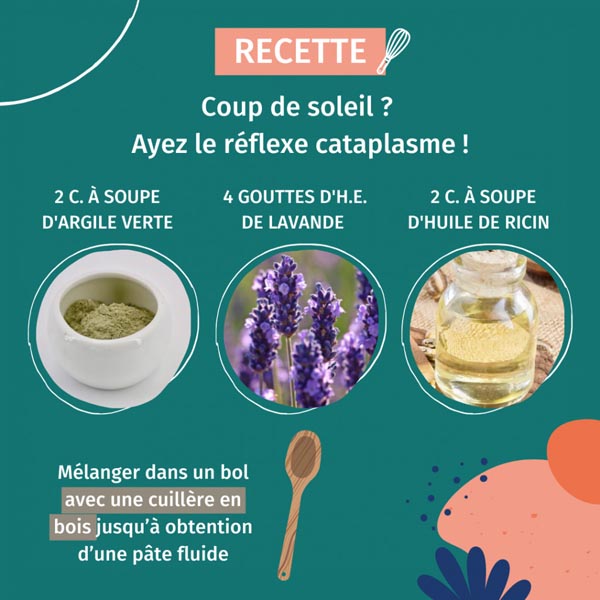
 Anti-inflammatory and healing, clay is the reflex to have in case of injury or irritation. the first reflex of injured wild animals or victims of a heat blow is to ride in the mud! in the event of a sunburn, a clay cataplasm and ricin will come to repair the epidermis in depth. Antalgic and soothing, the essential oil of lavender is the incontournable of summer! it will also be useful in case of mosquito bites

 the recipe
 2 tablespoons of green clay2 tablespoons of ricin oil4 drops of essential oil of aspic or officinal lavender
 Do not forget: clay must not come into contact with metal. Use a wooden or plastic spoon.
Even before thinking about a possible sunburn, it's obviously best to prepare your skin for the sun beforehand. And if you're going on holiday, also think about putting together your natural first-aid kit for your holidays, it can really come in handy.
The enriched version: clay, aloe vera and coconut oil
The recipe above works very well as it is. Here is the version we make when the skin really feels tight, with two ingredients that change how comfortable it is to apply.
- Two tablespoons of clay powder, mixed in gradually with filtered water, in a glass or ceramic bowl, never metal. The paste should be smooth, neither runny nor stiff.
- One tablespoon of aloe vera gel, which stops the clay from pulling too much on the skin as it dries.
- One teaspoon of virgin coconut oil, which nourishes the skin and limits dryness once the poultice is rinsed off.
- Optional: a few drops of lavender, provided you have done a tolerance test beforehand.
Let the mixture rest for a few minutes before applying: the ingredients bind together better.
The application protocol, step by step
- First rinse the area with cool water, without rubbing.
- Spread the poultice in a layer about 5 mm thick, using a wooden spatula or a spoon.
- Leave on for 20 to 30 minutes maximum, the time it takes the clay to dry, no longer, as cracked clay pulls on the skin.
- Rinse with lukewarm water without rubbing, pat dry with a clean towel.
- Repeat two to three times a day depending on how severe the burn is.
Three precautions not to overlook: do a patch test on a small area 24 hours beforehand if your preparation contains an essential oil; never apply to broken skin, blisters or open wounds, and stop immediately at the first sign of infection, consulting a healthcare professional. Any leftover preparation keeps in the fridge, in an airtight container, and should be used within a few days.
You can browse all our products in this category in our Clays range.
FAQ, Your questions about sunburn
What should you do after sunburn?
The first reflex is to cool the burned area under water at 15-25 °C for 15 minutes (ameli.fr recommendation). Then apply a green Montmorillonite clay poultice or pure aloe vera gel. Spike lavender essential oil is always used diluted in a vegetable oil. These steps apply to mild, first-degree sunburn.
How do you use green clay after sunburn?
The green clay poultice is a traditional remedy after mild sunburn. Apply a thick layer of Montmorillonite clay mixed with filtered water onto the reddened area, and leave it on for at least 2 hours. Pure aloe vera and compresses of diluted apple cider vinegar (1 part to 2 parts water) are other traditional remedies.
Can green clay be put on sunburn?
Yes, green clay has been used traditionally as a poultice for centuries on skin heated by the sun. Avoid applying it if blisters are present: consult a doctor in that case.
Which essential oil for sunburn?
Spike lavender (Lavandula latifolia) is the essential oil I use after sun exposure. Apply 2 drops diluted in a teaspoon of vegetable oil. Peppermint provides an immediate cooling effect as a complement. Precautions: these essential oils are not recommended for children under 6 years old or for pregnant or breastfeeding women.
Can sunburn disappear overnight?
Apply a green clay poultice to the burned area before bedtime, hold it in place with a cotton cloth, and leave it on all night. Hydrate abundantly. Let's be honest: sunburn does not disappear overnight.
What simple steps after sunburn?
Several natural steps are possible after mild sunburn: the green Montmorillonite clay poultice, pure aloe vera gel, a few drops of diluted spike lavender essential oil, cool water compresses at 15-25 °C and organic castor oil.
Can green clay be put on a second-degree burn?
No: green clay is used only on mild, first-degree sunburn (redness, heat, moderate pain, no blisters). If blisters appear or if the burn is extensive, it is a second-degree burn: consult a doctor before any poultice (see the precautions above).
What should you do if blisters appear after sunburn?
Blisters must never be popped: they signal a second-degree burn. Rinse the area with cool water, protect it, and consult a doctor rather than applying a poultice to damaged skin. The clay and castor oil poultices in this article are intended for sunburn without blisters.