Soy and deforestation: the scientific truth will surprise you!
About 77% of the soy produced worldwide is intended for animal feed - livestock, poultry, pigs - and not for direct human consumption. This is established by FAO data and the meta-analysis by Poore & Nemecek published in Science in 2018, which remains to this day the global reference study on the environmental footprint of food. As an agronomist and founder of Biovie since 2007, I invite you to calmly read these figures - and discover why seaweeds and microalgae like spirulina offer, in this area, a remarkably effective protein alternative.
This is a key article for me because the subject is often treated with more passion than rigor. Let's try, together, to do the opposite.
Who really consumes the world's soy?
Here is the data that changes everything, and that I often repeat during our conferences: a European consumes on average about 61 kg of soy per year. Of this total, 57 kg are consumed indirectly, incorporated into meat, eggs, and dairy products. The remaining 4 kg correspond to direct food use: tofu, tempeh, miso, plant-based drinks, edamame (WWF / Greenpeace, Eating the Planet, 2018).
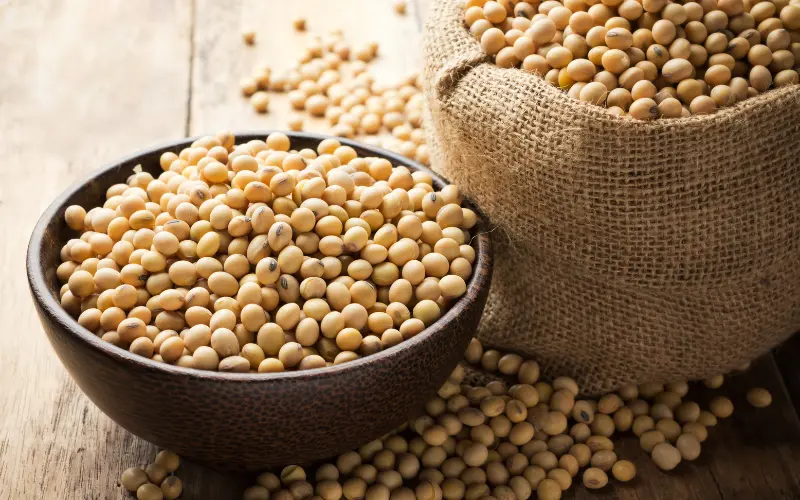
This figure overturns the usual image of the "big soy consumer." The vast majority of agricultural soy passes through the animal production chain before reaching a plate. And on a global scale, the FAO estimates that 70 to 80% of production is processed into meal and flour for animal feed.
Soybean oil - found in many ultra-processed products - is actually a co-product of this industrial extraction, secondarily valued because the sector must be profitable.
What does the trophic chain make your plate lose?
There is a fundamental concept in agronomy and biology: the trophic chain. At each link, energy dissipates. A farm animal must ingest several kilos of plant proteins to return a single kilo of animal proteins. This biological reality is unavoidable - it does not depend on farming practices, it is inscribed in animal physiology.
The data published by van Zanten et al. (2016, Animal Feed Science and Technology) quantify it as follows: to produce 100 g of chicken protein, about 109 g of soy protein must be mobilized in animal feed. For 100 g of pork protein: about 51 g of soy. For beef in intensive farming, the ratios are generally even less favorable.
Concretely, this means that a significant portion of the nutrients contained in soy - proteins, lipids, micronutrients - is dissipated in the form of body heat, inedible structures, and metabolic waste even before the food reaches your plate.
This inefficiency is not an ideological critique: it is a biological constraint with direct and measurable consequences on the agricultural areas needed to feed a population.
Deforestation and soy: who is really responsible?
This is the question I am most often asked during our live food training sessions. "But don't vegans also contribute to deforestation through their soy consumption?"
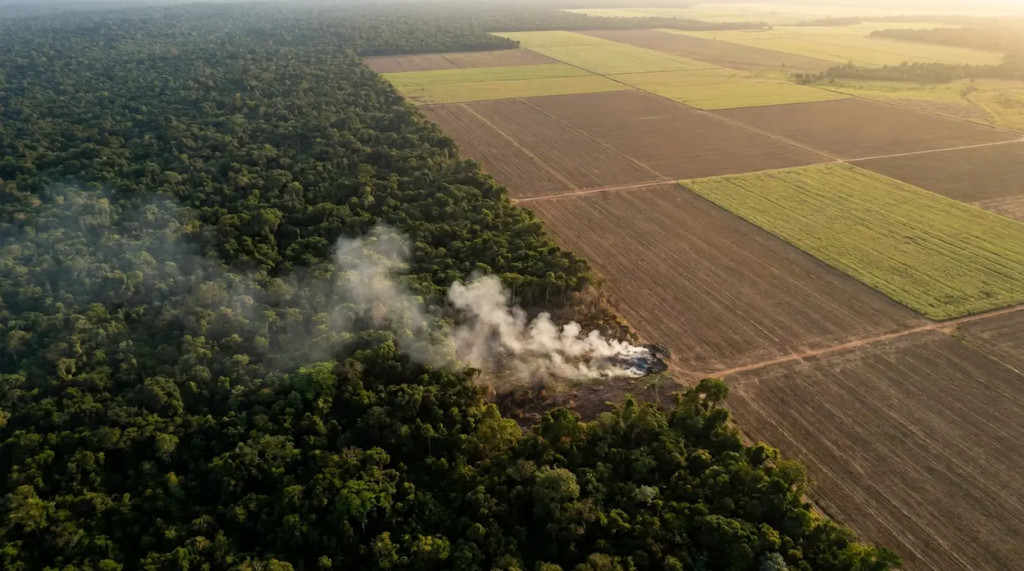
The answer lies in trade flows. The soy produced in Brazil - the world's largest producer, with a major concentration in the Amazon and Cerrado - is exported at about 80% in the form of meal and oil intended for animal feed, mainly to China, the European Union, and Southeast Asia (USDA, Foreign Agricultural Service, 2023; Mighty Earth Report, 2023).
Certified non-GMO soy intended for direct human consumption (organic tofu, plant-based drinks, tempeh) is produced under specific supply chains, mostly in Europe and North America, with strict specifications and dedicated areas that represent a minor fraction of global production.
This distinction does not mean that all soy cultivation is without impact. But it allows for placing responsibilities where the volumes justify it.
Poore & Nemecek (2018) modeled what a global dietary transition to plant-based foods would change: their results indicate a possible reduction in global agricultural land by about 75% - an area equivalent to North America, China, the European Union, and Australia combined - which could be returned to natural ecosystems.
This is a scientific fact published in a peer-reviewed journal, not an ideological stance.
Algae, a protein alternative without deforestation
And this is where our work at Biovie takes on its full agronomic meaning.
Frankly, if I had to summarize in one sentence why algae have excited me for twenty years, it would be this: they produce exceptional nutritional density without using a single hectare of agricultural land. They grow where nothing else does - in the sea, in ponds, in photobioreactors - with an efficiency that terrestrial crops, including soy, cannot match.
Spirulina vs. soy: what do the protein numbers say?
Here are some data that deserve to be placed side by side.
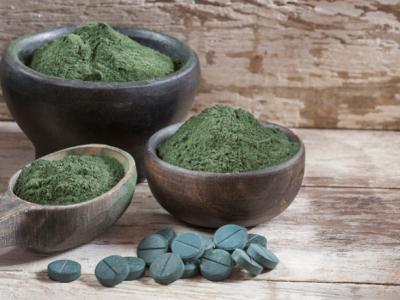
Spirulina (Arthrospira platensis) - 60 to 70% protein by dry weight, cultivated in ponds or photobioreactors, no agricultural land needed, non-GMO.
Chlorella (Chlorella vulgaris) - 50 to 58% protein by dry weight, cultivated in ponds, no agricultural land needed, non-GMO.
Soy for human consumption (non-GMO supply chain) - 36 to 40% protein by dry weight, about 2,500 m² per ton of protein produced, non-GMO.
Soy for animal feed (GMO supply chain) - 36 to 40% protein by dry weight, about 2,500 m² per ton of protein produced, GMO in 77% of cases globally.
Intensive beef farming - about 26% protein by fresh weight, but ~160,000 m² per ton of protein produced, with indirect consumption of GMO soy via animal feed.
Sources: Becker, 2007 (Biotechnology Advances); Poore & Nemecek, 2018 (Science); Spolaore et al., 2006 (Journal of Bioscience and Bioengineering).
Spirulina thus contains between 60 and 70% protein by dry weight - nearly double that of soy. Its amino acid profile is complete and comparable to that of an egg, according to WHO analyses. And on an equivalent area, it can produce 10 to 20 times more protein per year than soy (Spolaore et al., 2006). This efficiency is due to its growth cycle in an aquatic environment, its ability to directly use solar radiation, and its remarkable multiplication speed.
Chlorella (Chlorella vulgaris) shows similar performance in terms of protein content, with the advantage of a significant concentration of chlorophyll, iron, and B vitamins. And dulse, a red seaweed, contains between 20 and 35% protein by dry weight - which makes it considered a protein equivalent to soy, with an infinitely smaller production area.
Seaweeds: Nori, Wakame, Kombu, Dulse
Seaweeds have a much older nutritional history than the current debate on soy. Japanese, Korean, Breton, and Irish coastal populations have been consuming them for centuries-not as a niche superfood, but as an ordinary component of daily diet.
Wakame (Undaria pinnatifida), Nori (Porphyra spp.), Kombu (Laminaria japonica), and Dulse (Palmaria palmata) provide specific polysaccharides-fucoidan, alginates, carrageenans-that are of growing scientific interest, in addition to their rich mineral profile (iodine, calcium, magnesium, iron).
And none of these foods require a single square meter of agricultural land. Marine algaculture can even help improve the quality of coastal ecosystems by filtering excess nutrients (Chopin et al., 2001, Reviews in Fisheries Science).
In our book Seaweeds in Daily Life (Gallimard, 2024)-Best Cookbook in the World at the Gourmand Cookbook Awards 2025-Aurélie and I have gathered over 80 accessible recipes and precise nutritional sheets to integrate these seaweeds into daily life, without prior experience.
How to Practically Integrate Seaweeds to Reduce Soy Footprint?
I do not claim that spirulina will "replace" soy tomorrow. Living food, as practiced for years at Biovie, is above all a matter of gradual transition towards a diet with a lower environmental footprint-not a revolution overnight. Everyone progresses at their own pace, according to their constraints and tastes.
But a few concrete actions can help integrate this logic into daily life:
3 to 5 g of spirulina per day (a small level teaspoon) in a smoothie, fresh vegetable juice, or vinaigrette. At this dosage, the taste is very discreet, and the intake of proteins, iron, and B vitamins is significant.
Dehydrated wakame flakes: 5 g in a mixed salad, broth, or pasta. Just rehydrate it for 5 minutes in warm water. It's the simplest way to integrate seaweeds into daily life.
Nori in sheets or flakes: on toast, in homemade spring rolls, sprinkled on soup. With Aurélie, it's the seaweed we use most often in everyday cooking-its natural umami often replaces part of the salt.
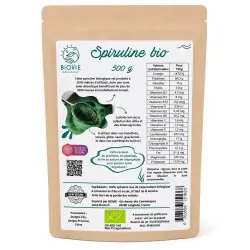
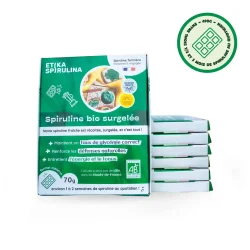
Biovie organic spirulina comes in 4 formats: fresh, grown in a greenhouse by Etika; frozen fresh, produced in northern France by Etika Spirulina; powder, from organic aquaculture; and phycocyanin, the concentrated extract of the blue pigment, almost tasteless but intensely colorful. To start a regular routine, powder is the most economical and the easiest to dose; for freshness, choose fresh or frozen spirulina of French origin, closer to the harvest. Phycocyanin suits anyone looking for a concentrated extract with a discreet taste, to add to a preparation without changing its flavor., 4
products
Diversifying sources of direct plant proteins (legumes, sprouted seeds, nuts) mechanically reduces dependence on animal production-and thus, indirectly, the pressure on soy crops intended for livestock.
In summary, the idea is not to change everything at once. It's about understanding the dynamics at play-then acting gradually, at your own pace, with foods that fit your lifestyle.
Discover our complete range of organic seaweeds-spirulina, chlorella, wakame, nori, dulse, kombu-mostly Ecocert certified, selected after visiting our producers.
FAQ - Soy, Livestock, Deforestation, and Algae
Why is it said that livestock consumes more soy than vegans?
Because global data from the FAO confirms it: between 70 and 77% of the world's soy production is processed into meal and cake for animal feed (cattle, poultry, pigs). Direct human consumption - tofu, plant milk, tempeh - represents only a minor fraction of this production, often from non-GMO separate supply chains. A European consumes an average of 57 kg of soy per year indirectly through animal products, compared to only 4 kg in direct use (WWF, Eating the Planet, 2018).
What is the difference between spirulina and soy in terms of protein?
Spirulina (Arthrospira platensis) contains between 60 and 70% protein by dry weight, compared to 36 to 40% for soy. Its amino acid profile is complete, with all essential amino acids in proportions close to those recommended by the WHO. With equivalent production area, spirulina generates 10 to 20 times more protein per year than soy, as it is cultivated in aquatic basins and does not require agricultural land (Spolaore et al., 2006; Becker, 2007).
Can algae really replace animal proteins?
They can contribute to diversifying plant protein intake effectively and sustainably. Spirulina and chlorella provide complete proteins with high nutritional density. Seaweeds (nori, wakame, dulse) complement with minerals (iodine, calcium, iron) and specific polysaccharides absent from terrestrial proteins. It is not a unique "replacement" but a diversification that reduces dependence on animal production, and thus indirectly on industrial soy cultivation.
How can you incorporate spirulina into your diet without tasting it?
In small doses (3 g, or a level teaspoon), spirulina powder is almost tasteless in a sweet smoothie or orange juice. It can also be mixed into a lemon and tamari-based vinaigrette or incorporated into a plant-based pancake batter. The secret is not to expose it to heat (beyond 40°C, some vitamins degrade) and to pair it with flavors that balance its slight marine taste.
Is organic soy also responsible for deforestation in the Amazon?
No, generally speaking. Brazilian soy that fuels Amazonian deforestation and the destruction of the Cerrado is mostly GMO soy grown for export to animal feed markets (China, Europe, Southeast Asia). Organic non-GMO soy intended for direct human consumption mostly comes from Europe (France, Austria, Italy) and North America, in traceable supply chains with no link to tropical deforestation. AB and non-GMO certifications require specifications that exclude these problematic origins.
In Practice - Summary and Resources
The data allows us to assert this, with a solid scientific basis:
77% of global soy is intended for animal feed, not direct human consumption (FAO, 2023).
A European consumes an average of 57 kg of soy indirectly through animal products, compared to 4 kg in direct use (WWF, 2018).
The trophic chain involves a substantial loss of protein efficiency: ~109 g of soy to produce 100 g of chicken protein (van Zanten et al., 2016).
A transition to plant-based diets could reduce global agricultural land use by ~75% (Poore & Nemecek, 2018 - meta-analysis of 38,700 farms in 119 countries).
Spirulina contains 60–70% protein by dry weight and generates 10 to 20 times more protein per area than soy, without using agricultural land (Spolaore et al., 2006; Becker, 2007).
There you have it, this list is of course not exhaustive. But it hopefully provides the basics for thinking about your diet with a bit more perspective - and a bit less emotion.
Spolaore, P., Joannis-Cassan, C., Duran, E., & Isambert, A. (2006). "Commercial applications of microalgae". Journal of Bioscience and Bioengineering, 101(2), 87–96. (literature review)
Disclaimer: The information presented in this article is provided for informational purposes only and does not constitute medical advice. Consult a qualified healthcare professional before making any changes to your diet or supplementation. As part of a varied and balanced diet and a healthy lifestyle.