Marine collagen does not replace the collagen in your skin - your body digests it into amino acids before (possibly) reusing them to create new collagen. This is the nuance that 90% of commercial sites forget to mention. As the founder of Biovie since 2007 and an agronomist by training, I have been observing the explosion of this market for years - estimated at $9.1 billion by 2025 according to Grand View Research - and frankly, the gap between marketing promises and scientific reality deserves to be discussed openly.
What I am offering you here is an honest overview. The documented benefits of marine collagen, yes. But also its limitations, its contraindications, its environmental impact. And then - this is the part that excites me the most - the plant-based alternatives that allow your body to naturally produce its own collagen.
What exactly is marine collagen ?
Where does marine collagen come from? (origin, extraction, types I, II, III)
Marine collagen is a structural protein extracted from the skin, scales, and bones of fish - sometimes from shellfish. It primarily refers to type I collagen (the most abundant in our skin and bones) and type III (found in blood vessels and organs). Type II mainly concerns cartilage and more often comes from terrestrial sources.
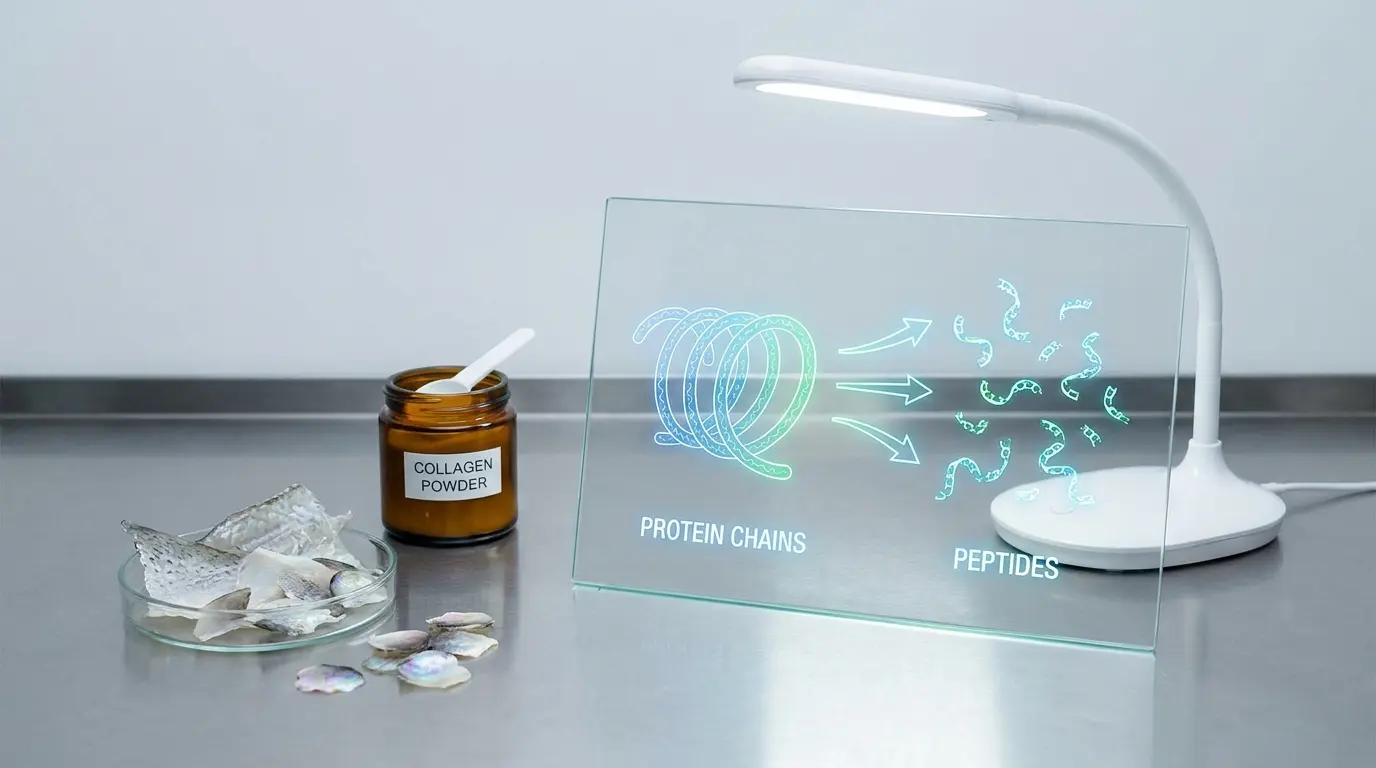
The extraction involves a process of hydrolysis - enzymatic or acidic - which breaks down long protein chains into shorter peptides. This is known as hydrolyzed marine collagen. Specifically, by-products from the fishing industry (cod skins, tilapia scales, salmon bones) are collected and transformed into powder or liquid.
Hydrolyzed marine collagen: why is this form better absorbed ?
Hydrolysis reduces the size of collagen molecules. Instead of chains of 300,000 daltons, peptides of 2,000 to 5,000 daltons are obtained. Your intestine absorbs these small fragments much more easily. In fact, this is the only form that has been the subject of serious clinical studies - native (non-hydrolyzed) collagen is simply too large to pass through the intestinal barrier significantly.
But - and this is a crucial point - once absorbed, these peptides are broken down into individual amino acids (glycine, proline, hydroxyproline). Your body then decides what to do with them. There is no guarantee that these amino acids will go on to rebuild collagen in your skin rather than serve other metabolic functions. This is the difference between ingesting collagen and producing collagen.
What are the real benefits of marine collagen ?
Marine collagen and skin: what do clinical studies say ?
Let's start with what is best documented. A meta-analysis published in 2021 in the Journal of Drugs in Dermatology, involving 1,125 participants, showed that supplementation with hydrolyzed collagen peptides could improve skin hydration and elasticity after a 90-day treatment. The results are statistically significant.
For my part, I remain cautious about the interpretation. The improvement in skin hydration can also be explained by an increased intake of amino acids, which can be obtained through other means. Additionally, it's important to know that our body produces about 1% less collagen each year starting at age 25. This decline is natural. What accelerates it is smoking, excessive sun exposure, oxidative stress, and a deficient diet. (And for these factors, no powder can replace a healthy lifestyle.)
Here, it is more nuanced. In a January 2024 article, INSERM highlights that the scientific evidence on the joint benefits of collagen remains limited and heterogeneous. Some studies show a reduction in pain among athletes suffering from joint discomfort, but the protocols vary so much that it is difficult to draw firm conclusions.
Que Choisir, also in 2024, has raised concerns about the unproven claims of many collagen supplements sold in France. Frankly, when a product promises to "repair your joints," it's more about marketing than science. At best, collagen can provide amino acids useful to the body - as part of a varied and balanced diet and a healthy lifestyle.
Bones, hair, and nails: other documented effects
For bones, some preliminary studies suggest that collagen peptide supplementation could contribute to bone density in postmenopausal women. However, these are small studies, often funded by the industry. For hair and nails, there is simply a lack of robust data.
What is certain, however, is that the key nutrients for these tissues - zinc, iron, vitamin C, sulfur, silicon - are perfectly accessible through diet. And this is where our approach at Biovie makes perfect sense: providing the nutritional building blocks your body needs to build itself.
What are the dangers and limitations of marine collagen ?
Allergens and contraindications: who should not take it ?
Marine collagen is derived from crushed fish. If you are allergic to fish or seafood, it is an absolute contraindication. It seems obvious, but how many commercial sites mention it prominently? Not many.
Other situations where caution is required:
Kidney failure - high protein intake can overload the kidneys
Hypercalcemia - some marine collagens contain added calcium
Pregnancy and breastfeeding - lack of sufficient data to ensure safety
Anticoagulant treatment - possible interaction, consult your doctor
And then there is the taste. Marine collagen powder has a fishy smell and taste that do not go unnoticed. Some manufacturers mask this with artificial flavors. To each their own choices.
Heavy metals and marine contaminants: a real risk ?
Yes, it is a serious subject. Fish accumulate contaminants present in the oceans: mercury, lead, arsenic, PCBs. The quality of marine collagen directly depends on the quality of the sourcing. Collagen derived from intensively farmed fish in Southeast Asia does not offer the same guarantees as collagen from certified wild fishing in cold waters.
The ANSES (French Agency for Food, Environmental and Occupational Health & Safety) has also issued recommendations on collagen-based dietary supplements, emphasizing the importance of batch-specific analytical controls. When purchasing marine collagen, it is essential to request certificates of analysis - heavy metals, microbiology, dioxins. If the manufacturer cannot provide them, you should look elsewhere.
The environmental impact of the marine collagen industry
We are touching on a subject that is particularly close to my heart. The marine collagen industry relies on fishery by-products - in theory, it's about waste valorization. In practice, the growing demand has created additional pressure on fish stocks. Some species used for collagen (tilapia, pangasius) come from intensive farming, whose environmental impact is documented.
With Aurélie, we have always asked ourselves the question: can we recommend a product without considering its entire supply chain? This is actually one of the reasons why we chose to focus on the Edible seaweeds and their benefits - a territory where the environmental impact is radically different.
Does plant-based collagen really exist ?
Why do we talk about "precursors" and not plant collagen ?
Let's be clear: plant-based collagen does not exist. Collagen is an exclusively animal protein - no plant, algae, or fungus produces it. When you see "vegan collagen" on packaging, it is a misuse of language (or marketing).
What does exist, however, are plant-based collagen precursors: nutrients that provide your body with the amino acids and cofactors necessary to synthesize its own collagen. This is a fundamentally different approach. Instead of ingesting already formed collagen (which will be broken down into amino acids by your digestion anyway), you directly supply the building blocks and tools that your fibroblasts - the cells that produce collagen - need to work.
Which plant nutrients stimulate collagen production ?
The synthesis of collagen by your body relies on three pillars:
Constituent amino acids - glycine (35% of collagen), proline, and hydroxyproline. Spirulina contains these three amino acids, as well as all 8 essential amino acids in their entirety.
Vitamin C - an essential cofactor for the hydroxylation of proline. Without vitamin C, there is no functional collagen (this is the mechanism of scurvy).
Cofactor minerals - zinc (activates synthesis enzymes), copper (necessary for the cross-linking of collagen fibers), sulfur, and silicon (structuring elements).
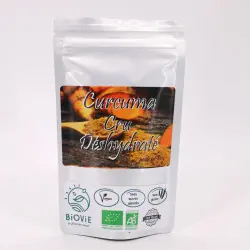
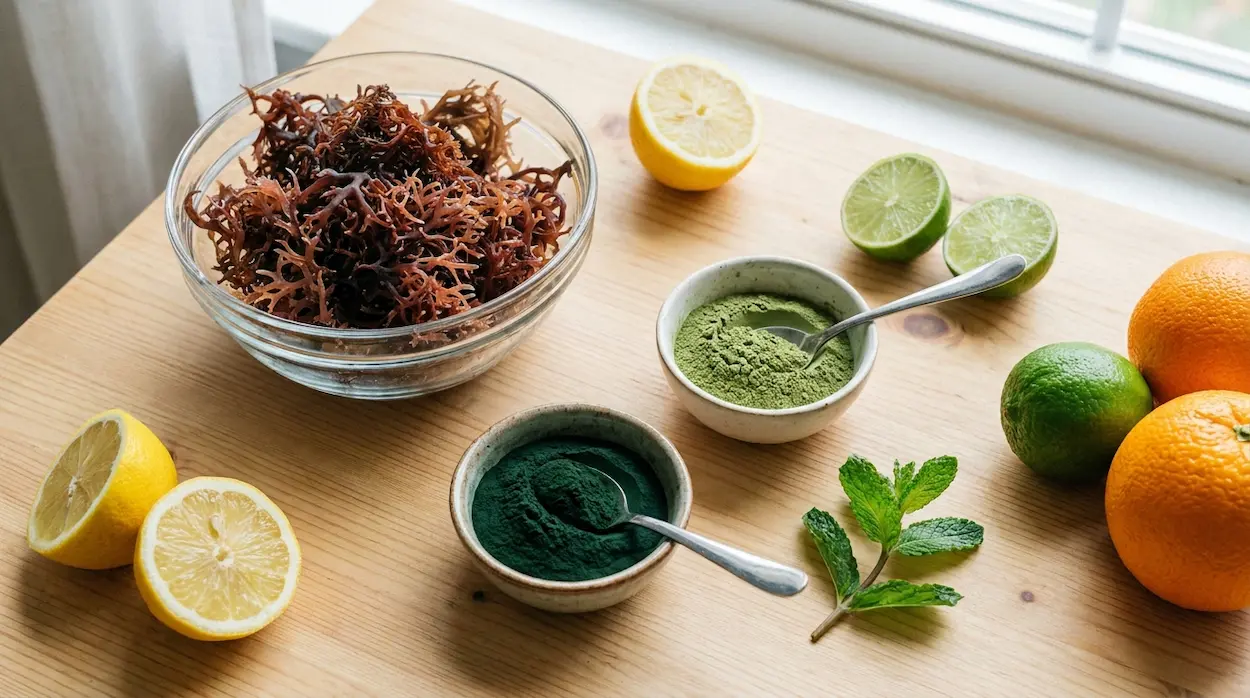
Specifically, a diet rich in citrus fruits, peppers, berries (vitamin C), pumpkin seeds (zinc), raw cocoa (copper), spirulina, and chlorella (amino acids) provides your body with everything it needs to maintain optimal collagen production.
What are the best plant-based alternatives to marine collagen ?
Irish Moss (sea moss): the marine and vegan precursor
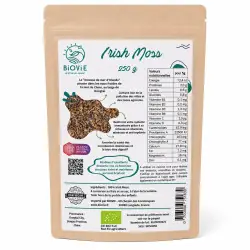
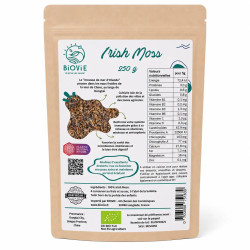
Irish Moss - or Chondrus crispus, Irish moss - is truly a unique case. It is a seaweed, so it grows in the sea (like the fish from which collagen is derived), but it is 100% vegan. Its composition is remarkable: Irish moss contains 92 of the 102 minerals the body needs, including zinc and sulfur, which are directly involved in collagen synthesis.
What I like about Irish Moss is that it provides both cofactor minerals AND a matrix of polysaccharides (carrageenans) that contribute to tissue hydration. It is a whole food, not an isolated nutrient. It has been used for centuries in Ireland and the Caribbean - it is not a product that came out of a laboratory.
Spirulina and chlorella: key amino acids for collagen
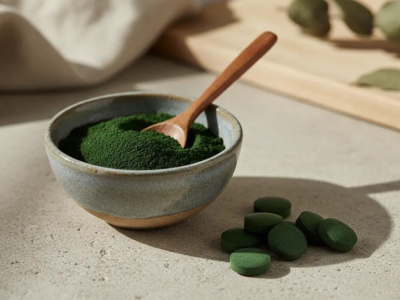
Spirulina contains between 55 and 70% protein by dry weight-2 to 3 times more than meat, by equal weight. Most importantly, it contains all 8 essential amino acids, including glycine, proline, and hydroxyproline, the three amino acids that make up collagen. A teaspoon of spirulina powder in the morning-about 3 grams-already provides a remarkably complete amino acid spectrum.
Chlorella, on the other hand, is rich in zinc and iron-two cofactors in collagen synthesis. It also provides chlorophyll and "Chlorella Growth Factor" (CGF), a nucleotide complex involved in cellular repair.
Vitamin C, zinc, and silicon: the essential cofactors
You can swallow all the amino acids in the world - without vitamin C, your body will not produce functional collagen. It's as simple as that. Citrus fruits, kiwis, peppers, and acerola berries are excellent sources of it.
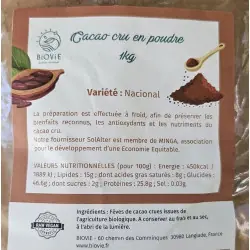
Zinc - found in pumpkin seeds, sprouted chickpeas, raw cocoa - activates metalloproteinases necessary for collagen remodeling. And copper, present in good quantities in our raw cacao, is essential for lysyl oxidase, the enzyme that creates cross-links between collagen fibers.
Silicon, finally, contributes to the maintenance of the structure of connective tissues. It is found in nettles, bamboo, horsetail - and in certain seaweeds.
Proline, glycine, lysine: where to find them on the plant side
The body builds its collagen from three main amino acids, and this is where a plant-based approach mostly plays out. Glycine is found in quantity in legumes, sesame and pumpkin seeds, and spirulina; proline in nuts, seeds and seaweed; lysine in lentils, chickpeas, quinoa and buckwheat.
These building blocks are useless, however, without their cofactors: vitamin C, essential to the reaction itself, zinc, copper, silicon and manganese. This is why a varied plant-based diet does better than an isolated supplement - it supplies the amino acids and their cofactors within the same meal.
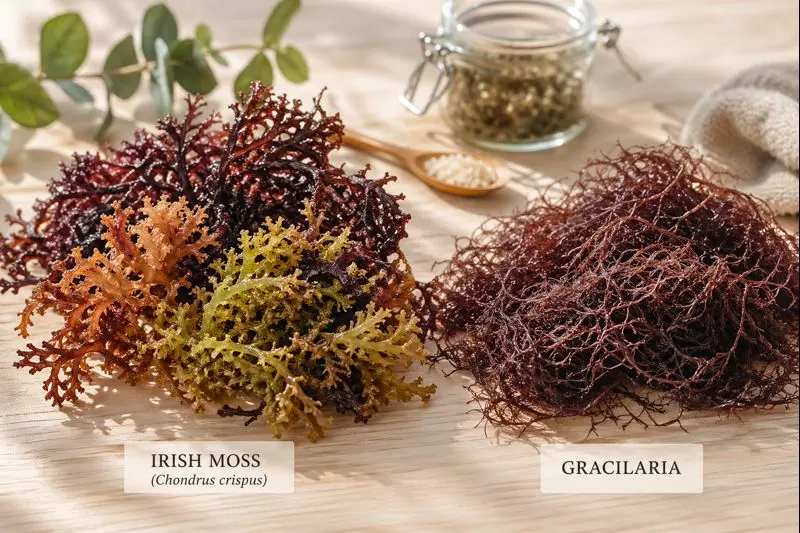
Irish Moss vs Gracilaria: how do you tell real sea moss apart?
This is an interesting topic because there's massive confusion on the market. When you buy "sea moss," you may receive two very different seaweeds:
Irish Moss (Chondrus crispus) - A red seaweed from the North Atlantic. Firm, cartilaginous texture. Over 90 minerals identified. Rich in carrageenan (a gelling polysaccharide). Variable colours: yellow-green, red, dark purple. Used for centuries in Ireland and Brittany. This is the genuine, traditional sea moss.
Gracilaria - A tropical seaweed, often farmed in Southeast Asia or the Caribbean. Softer, filamentous texture. Markedly lower mineral profile. Rich in agar (a different polysaccharide). Usually cheaper, which explains its dominance on the market.
It's not that Gracilaria is "bad" - it's a perfectly respectable seaweed. But when it comes to plant-based collagen cofactors, the mineral density and amino profile of genuine Irish Moss (Chondrus crispus) are simply not comparable. At Biovie, we offer exclusively genuine, certified organic Irish Moss. No relabelled Gracilaria. No compromise.
To compare formats and see the rest of the range, browse our Dried seaweed range.
What protocol should you follow to support your collagen as a vegan?
What daily dose, and in what form?
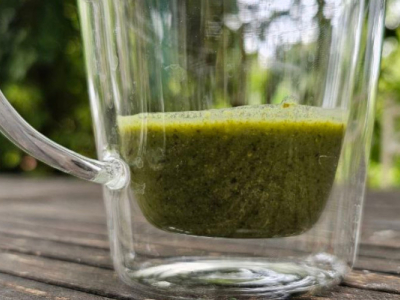
As a powder, 3 to 5g of Irish Moss a day is enough - roughly a level teaspoon. You can also make a gel by blending 5 to 10g of soaked Irish Moss with a little water, then mixing it into smoothies, soups or raw desserts.
For spirulina, 3 to 5g a day is the commonly used dose (a level teaspoon, about 3g). And for dietary vitamin C, aim for at least ANSES's 90mg/day - but honestly, a kiwi and half a red pepper will get you well past that.
Which foods should you combine for optimal synergy?
The concept is simple: combining cofactors within the same meal maximises absorption and synergy. Here's an example of a typical day I've personally followed for years:
Morning: Smoothie with 3g of Irish Moss powder + 3g of spirulina + a kiwi + a handful of spinach + almond milk made from almonds soaked overnight. (Cofactors covered: vitamin C, zinc, proline, glycine, iron, phycocyanin.)
Midday: Salad of red lentils soaked overnight + red pepper + pumpkin seeds + avocado + lemon juice. (Cofactors covered: lysine, vitamin C, zinc, copper, sulphur.)
Snack: A few raw cacao beans + Brazil nuts + berries. (Cofactors covered: protective antioxidants, selenium, copper.)
Not complicated. Not expensive. And for under €1 a day in Irish Moss, you get a supply of collagen-cofactor minerals that no synthetic supplement matches in terms of diversity.
How to choose between marine collagen and plant-based alternatives ?
Comparison: Marine Collagen vs. Plant Precursors
Origin - Marine collagen: fish skins and scales (animal product). Plant precursors: algae, microalgae, plants, and fruits (vegan product).
Mechanism of action - Marine collagen: exogenous supply of peptides broken down into amino acids. Precursors: supply of amino acids + cofactors to stimulate endogenous synthesis.
Allergens - Marine collagen: contraindicated in case of fish/seafood allergy. Plant-based precursors: generally free of major allergens (check seaweed if sensitive to iodine).
Scientific evidence (skin) - Marine collagen: positive meta-analysis (2021, 1,125 participants) on hydration and elasticity. Precursors: strong indirect evidence on the role of cofactors (vitamin C, zinc) in collagen synthesis - EFSA-approved claims.
Scientific evidence (joints) - Marine collagen: heterogeneous results according to INSERM (2024). Precursors: no specific studies on joint effects.
Environmental impact - Marine collagen: linked to the fishing industry (overfishing, intensive farming). Plant-based precursors: generally lower ecological footprint (algae cultivation, plant agriculture).
Usage cost - Marine collagen: €1 to €3 per day depending on the brand. Precursors (spirulina + Irish Moss): less than €1 per day for a complete supply of amino acids and cofactors.
Ethics - Marine collagen: animal-derived product. Plant-based precursors: compatible with a vegan diet.
Personally, my choice has been made for a long time. But I'm not here to decide for you. What I can tell you is that plant-based precursors offer a more comprehensive approach - you're not just providing collagen (which will be broken down anyway), you're giving your body the tools to produce it itself. And that, whether you're vegan or not, is a sound nutritional strategy.
Moreover, even for people who consume marine collagen, diversifying nutrient sources and adding plant-based precursors to their diet remains relevant - if only to reduce exposure to potential marine contaminants.
From what age does the question arise?
This is the first question we're asked, and the answer often surprises: much earlier than people imagine.
Collagen synthesis peaks around age 20-25, then declines by about 1% per year - a slow, steady pace that isn't visible before your forties but starts well before that. By 40, production has already dropped by roughly 15 to 20% from its peak; after menopause, the drop in oestrogen clearly speeds up the process in women.
Three factors weigh at least as much as age itself, and these ones can be managed: unprotected sun exposure, which directly degrades dermal fibres; smoking, which reduces skin microcirculation; and insufficient vitamin C intake, without which the body simply cannot assemble collagen. In other words, before looking for a supplement, there are simple things to get right first.
Which gives a practical benchmark: the question of intake usefully arises from your thirties onward, but it plays out first on your plate and in your lifestyle, as part of a varied and balanced diet and a healthy lifestyle.
Marine collagen, halal and kosher: what to check
This question comes up regularly and is far from trivial. Marine collagen derived from the skin and bones of scaled fish is, in principle, compatible with both halal and kosher rules, unlike bovine or porcine collagen. But "in principle" isn't enough: certification covers the entire process, not just the raw material - the enzymes used for hydrolysis, additives, and the gelatine of any capsules.
In practice, only an explicit certification on the packaging can settle the question. This is also one of the most concrete arguments in favour of the plant-based and marine precursors described above: with them, the question simply doesn't arise.
FAQ - Marine Collagen: Your Frequently Asked Questions
Is marine collagen really effective for the skin ?
Clinical studies show positive results on hydration and skin elasticity after 8 to 12 weeks of treatment, with doses of 2.5 to 10 g per day of hydrolyzed collagen peptides. The 2021 meta-analysis of the Journal of Drugs in Dermatology (1,125 participants) confirms these trends. However, INSERM reminds us that the evidence remains heterogeneous and that other factors-balanced diet, hydration, sun protection-play a crucial role in skin health. Marine collagen can be part of a comprehensive approach, but it is not a miracle solution on its own.
What are the dangers and contraindications of marine collagen ?
Marine collagen is contraindicated in cases of allergies to fish and seafood - this is the main contraindication. People with kidney failure should avoid high protein intake. Hypercalcemia is also a precaution if the product contains added calcium. During pregnancy, the lack of sufficient data warrants caution. Finally, there is a risk of contamination by heavy metals (mercury, lead) depending on the quality of sourcing - always demand the manufacturer's certificates of analysis.
Does plant-based collagen exist ?
No, collagen is an exclusively animal protein. No plant or algae produces collagen. What is improperly called "plant collagen" or "vegan collagen" actually refers to precursors-nutrients that provide the body with the amino acids (glycine, proline, hydroxyproline) and cofactors (vitamin C, zinc, copper, silicon) necessary for the body to produce its own collagen. It is a different but scientifically coherent approach.
What food can replace marine collagen ?
Several foods provide the building blocks and cofactors necessary for the endogenous synthesis of collagen. Irish Moss provides 92 of the 102 minerals in the body, including zinc and sulfur. Spirulina provides the 8 essential amino acids, including the three that make up collagen (glycine, proline, hydroxyproline). Citrus fruits and berries provide the essential vitamin C. Pumpkin seeds are rich in zinc. Raw cocoa provides copper. Combined, these foods offer a complete and ethical alternative to marine collagen.
How long does it take to see the effects of collagen ?
For the skin, clinical studies report visible improvements in hydration and elasticity after 8 to 12 weeks of daily supplementation with hydrolyzed collagen peptides. For joints, the results-when positive-can take 3 to 6 months, with less robust evidence according to INSERM. For plant-based precursors, the timelines are similar: the endogenous synthesis of collagen is a gradual process that depends on the regularity of intake and overall lifestyle habits.
In practice
Here it is. I'm not saying that marine collagen is useless - studies on skin are encouraging. But I invite you to look at the full picture: the scientific limitations, the contraindications, the environmental impact, the cost. And to seriously consider plant-based precursors as a relevant alternative - or complement.
At Biovie, for almost 20 years, we have been supporting this transition towards more conscious eating. Irish Moss, spirulina, chlorella, raw cacao - these are foods that we personally use, with Aurélie, on a daily basis. Not because they are trendy, but because they seem right to us, both nutritionally and ethically.
Warning: The information presented in this article is provided for informational purposes only and does not constitute medical advice. Consult a qualified healthcare professional before making any changes to your diet or supplementation. As part of a varied and balanced diet and a healthy lifestyle.