

Disclaimer: this article is for information only and aims to explain irritable bowel syndrome (IBS, also called functional bowel disorder). It draws on the scientific literature and field experience, but it is not a substitute for medical advice. IBS is a complex, multifactorial condition: any persistent, painful or unusual symptom should be assessed by a doctor to rule out another disease. The dietary and lifestyle ideas below aim to support day-to-day digestive comfort, as part of a varied, balanced diet and a healthy lifestyle. They are not a treatment and should be tailored to each situation, ideally with a healthcare professional (doctor, gastroenterologist, dietitian).
When to see a doctor right away: the red flags you should never ignore
First things first. IBS is a diagnosis a doctor makes, after ruling out other causes. Some signs are not compatible with simple IBS and call for prompt medical advice: blood in the stool, unexplained weight loss, persistent fever, intense pain or pain that wakes you at night, anemia, a change in bowel habits starting after age 50, or a family history of colorectal cancer or inflammatory bowel disease. If any of these apply to you, don't look for an answer on your plate: book an appointment. No exceptions.
You have a sensitive gut. Maybe a doctor has told you it's "irritable bowel syndrome," maybe you just know it as a touchy stomach that runs your day. The name changes, the daily reality stays the same: bloating, pain, a transit that does whatever it wants, and that fatigue that clings to you. I know how draining it is.
Irritable bowel syndrome is best managed with a gradual, personalized approach: you cut back on the fermentable sugars that irritate the gut (the famous FODMAPs), you soothe the digestive terrain (soluble fibre, plant-based omega-3s, stress management), you take care of your microbiome — and you steer well clear of the aggressive "detoxes" that only inflame an already sensitive gut. That's what recent science confirms, and it's what I've seen for years at Biovie. But no dietary idea replaces a doctor's follow-up: it works alongside it.
In this first part, I explain what's really going on in your gut, why classic detoxes are a bad idea for IBS, and which lifestyle habits can genuinely calm things down. Part 2 (coming soon) will dig into the low-FODMAP diet and living foods in detail.
Contents
What is irritable bowel syndrome (IBS)?
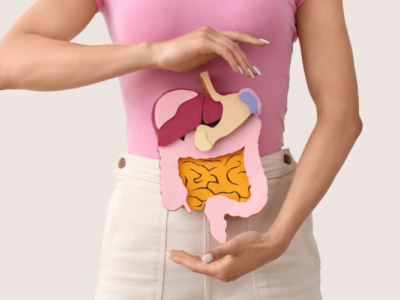
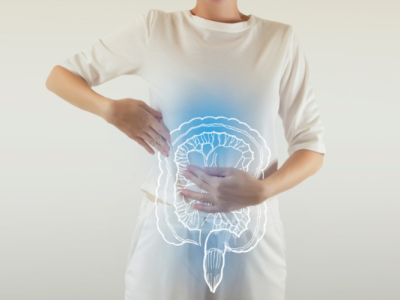
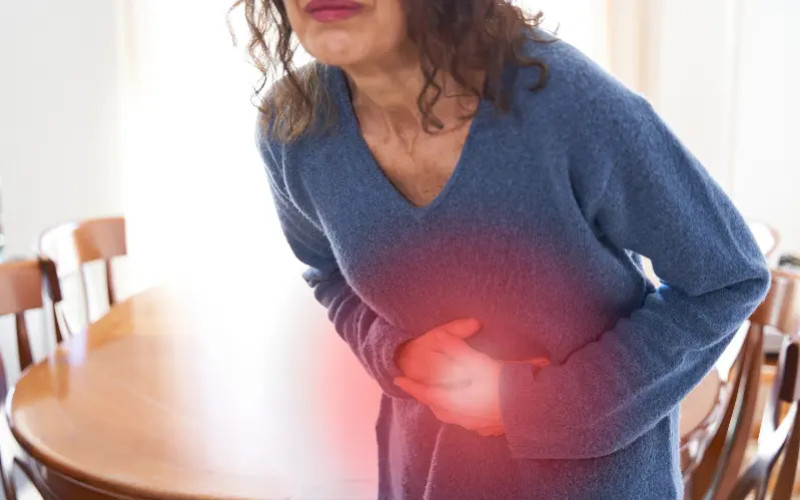
Irritable bowel syndrome (IBS) is a chronic functional disorder of the colon, with no lesion visible on standard tests. The word "functional" says it all: your gut works poorly, but endoscopy and lab work show nothing abnormal. That doesn't mean it's "all in your head." It means the problem is in how things work, not in the structure.
And it's anything but rare. IBS affects an estimated 5 to 10% of adults worldwide, with women diagnosed roughly twice as often as men. It also accounts for a large share of gastroenterology visits. So if you've been suffering in silence, you're in very large company.
That's exactly why I wanted to write this. Too many people think they just have to "live with it," without trying anything. Not true. You don't cure IBS overnight, but you can clearly improve your comfort. As long as you understand what's happening.
The symptoms that wreck your day
You probably know them by heart. Let's name them anyway, because that helps. The most common signs of IBS:
- Abdominal pain: cramps, spasms, a twisting feeling, often relieved after a bowel movement.
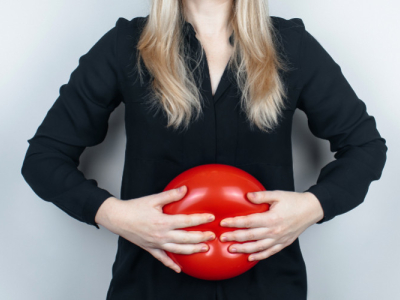
- Bloating: a belly that swells over the day, until you feel "full" and tight.
- Bowel changes: diarrhea (IBS-D), constipation (IBS-C), or alternating between the two (IBS-M, "mixed").
- Gas and gurgling: intestinal fermentation you can actually hear.
- Urgency and incomplete evacuation: that anxiety of needing a toilet, fast.
On top of that come symptoms we talk about less: chronic fatigue, broken sleep, anxiety, sometimes headaches. The most exhausting part? The unpredictability. You're fine for three days, then a meal, a worry, and it all comes back. That constant uncertainty wears down your mind as much as your body.
The mechanisms: why your gut overreacts
There isn't one cause of IBS. There's a cluster of mechanisms that stack up. Here they are, without the jargon.
Visceral hypersensitivity. This is the heart of the problem. Your gut reads as painful the kind of signals another person wouldn't even feel. Picture a volume dial turned up too high: a normal sound becomes unbearable. That's exactly it, but for the sensations in your belly. The cause: scrambled communication along the gut-brain axis.
Motility problems. Your colon contracts too fast (diarrhea), too slowly (constipation), or chaotically. Hence the spasms.
Microbiome imbalance (dysbiosis). Too many gas-producing, fermenting bacteria, not enough protective ones. This imbalance can follow a course of antibiotics, a low-fibre diet, chronic stress, or a bad bout of gastroenteritis — that's "post-infectious" IBS, affecting roughly 10% of cases.
Low-grade inflammation. Invisible on tests, but present in the mucosa of many people with IBS. It keeps symptoms going and weakens the gut barrier.
FODMAP sensitivity. FODMAPs are fermentable sugars found in a huge range of foods (onion, garlic, apple, wheat, milk, legumes, cruciferous vegetables). Poorly absorbed, they ferment in the colon, produce gas and water, and trigger symptoms. An estimated 75% of people with IBS are sensitive to them. More on this below.
Stress. Not the single cause, but a major amplifier. Your gut and brain talk constantly through the vagus nerve. Stress disrupts motility, increases permeability, and stokes inflammation. And an irritated gut sends back signals that feed anxiety. A vicious circle, in short.
You see the picture. A tangle of interwoven factors. That's precisely why there's no single fix — and why a standard "detox," which addresses none of them, can do more harm than good. Let's talk about that.
Why aggressive "detoxes" make IBS worse
Classic detox cures are designed for "ordinary" guts, not for a hypersensitive irritable bowel: they over-stimulate it, throw the microbiome further off balance, and weaken the mucosa. The result is that they often worsen the very symptoms you hoped to calm. If you've ever tried a "miracle" detox juice and ended the day doubled over, you know what I mean.
It's not your fault. The method just wasn't suited to you. Here are the ones to be wary of.
The methods to avoid
- Raw fruit and vegetable "detox" juices: concentrated in fructose and FODMAPs (apple, pear, mango), or in raw cruciferous veg (cabbage, broccoli). A fermentation bomb for a sensitive gut.
- Lemon water on an empty stomach: very acidic, often spiked with cayenne. On an already irritated mucosa, that's pouring fuel on a fire.
- Stimulant laxatives (senna, cascara): they trigger violent contractions. On an already hyperreactive colon, that's a guarantee of cramps — and, over time, dependence.
- Enemas and colon hydrotherapy: flooding the colon with water to "scrub" the walls. Appealing in theory. In practice, risk of cramps, a washed-out microbiome, and rare but serious complications. Not to be done on your own.
- Prolonged water fasting: starving the gut for days can weaken the barrier and starve the good bacteria, with a sometimes brutal rebound when you start eating again.
- Activated charcoal or chlorella at high doses: charcoal absorbs everything, including your nutrients and medications. Chlorella, above 10 g/day, can cause bloating and gas in sensitive people. These products have their place — but in small doses, gradually, never as a "shock cure."
I'm not demonizing anything. I'm simply saying: for IBS, these head-on approaches miss the mark. Gentle intermittent fasting (skipping a meal) may suit some people; senna, never. Nuance.
Why these cures worsen IBS
The logic is simple, once you understand the mechanisms. These detoxes ignore the hypersensitivity (they stimulate where you should soothe). They wash out an already fragile microbiome. They increase gut permeability. And they impose physiological stress — and stress, as we saw, triggers flares. In short, they tick every wrong box.
So what do we do? We flip the mindset completely. We stop trying to "purge." We aim to soothe, nourish, rebalance. Patiently.
When an irritable bowel digests poorly, partly broken-down food reaches the colon and ferments there — hence the gas. Helping digestion upstream often changes a lot. That's the idea behind our Enzymes Assimil complex, in powder form, taken at the start of a meal — the one we keep in the cupboard at home. To be tried gently, and always alongside your doctor's advice.
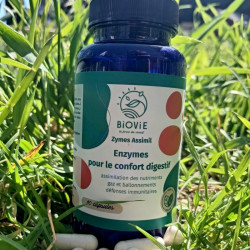
One customer, Chon du Barry, left us this note (review ★★★★★): "The enzymes for digestion, I can't do without them anymore!" A subjective report, passed on as is, with no promise attached.
FODMAPs and IBS: what soothes the plate
A low-FODMAP approach means temporarily cutting back on the fermentable sugars that feed IBS symptoms, then reintroducing them one by one to pinpoint your personal triggers. It is, to date, the best-documented dietary approach for IBS. But it's best done with a dietitian, because poorly run, it impoverishes the diet.
And the evidence is solid. A meta-analysis of randomized controlled trials showed that a low-FODMAP diet clearly reduces IBS symptom severity compared with a standard diet. A network meta-analysis published in 2025 in The Lancet Gastroenterology & Hepatology ranks dietary interventions among the most effective strategies, with the low-FODMAP diet at the top. This isn't a fad. It's validated.
IBS: what to eat (the foods that soothe)
In practice, during a soothing phase, here's what usually goes down well (everyone has their own threshold, so observe yourself):
- Gentle proteins: firm tofu, tempeh, pumpkin and sunflower seeds.
- Well-tolerated starches: rice, quinoa, potatoes, sweet potato, gluten-free sourdough bread.
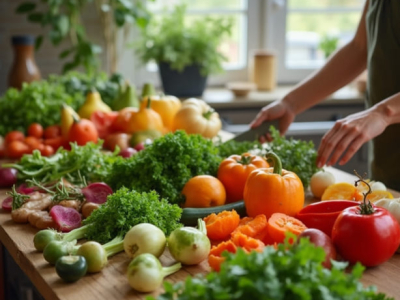
- Cooked vegetables: carrot, zucchini, squash, spinach, green beans (cooking softens them enormously).
- Low-fructose fruit: ripe banana, blueberry, strawberry, kiwi, orange (in moderation).
- Good fats: olive oil, a little avocado, plant-based omega-3s (coming up).
Foods to limit (at least while you soothe)
- Dairy (lactose), and gluten for sensitive people.
- Large amounts of legumes (lentils, chickpeas, kidney beans).
- Onion, garlic, leek, shallot — high in fructans.
- Raw cruciferous veg (cauliflower, broccoli, Brussels sprouts) and mushrooms.
- High-fructose fruit (apple, pear, mango, cherry, watermelon) and polyol sweeteners (sorbitol, xylitol).
I know, that's a lot of "no." But keep this in mind: it's temporary, and the goal is not to eat sadly for life. It's to identify your triggers so you can then widen your plate as much as possible. We add, we don't subtract for the sake of subtracting. Diversity stays the goal.
Lifestyle habits, alongside your medical care
What follows is neither a protocol nor a treatment. These are lifestyle habits that, in my experience and according to the literature, can support digestive comfort — always to be checked and tailored with your doctor, gastroenterologist or dietitian. I'll insist: go gradually, at your own pace, watching how you react. There's no failure, only experiments.
Habit 1 — Make digestion easier
Start from a simple fact: the better you digest upstream, the less work (and fermentation) the colon has downstream. A few concrete levers:
- Digestive enzymes: in powder, at the start of meals, to support the breakdown of food. Never as tablets or capsules with us — living food, not pills.
- Chewing: chew thoroughly, 30 times per mouthful if you can. It sounds silly. It really isn't: digestion starts in the mouth.
- Pre-digested foods: sprouted seeds, kefir, miso. Sprouting and fermentation do part of the work for you. Like boards already cut, rather than logs to saw.
- Meal rhythm: leave 3 to 4 hours between meals, and avoid constant snacking, to let the stomach empty.
Habit 2 — Soothe the terrain
Low-grade inflammation doesn't vanish overnight. But you can calm it gently, with everyday foods.
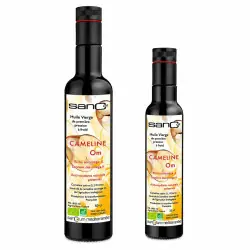
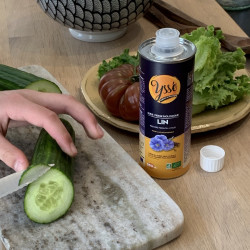
Plant-based omega-3s. Flaxseed oil (one tablespoon, about 10 to 15 ml a day, never heated and kept cold), ground chia or hemp seeds, camelina oil. These good fats contribute to a calmer terrain, as part of a varied, balanced diet. Flaxseed oil is the one I use on my salads, for my part.
Turmeric, with a pinch of pepper. Start small: a knife tip in a cooked dish, always with a little fat and a pinch of black pepper (which markedly improves curcumin uptake). Increase only if you tolerate it well. Never on an empty stomach, never in mega-doses on a fragile mucosa.
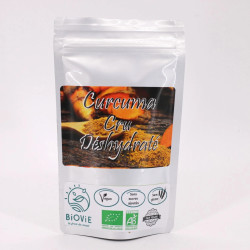
Want to start simply? A spoonful of virgin organic flaxseed oil on cooked vegetables, a pinch of raw organic turmeric in a soup. Two tiny gestures, slipped into your usual meals. Watch, over a few weeks, how your belly responds.
Another customer, marion tesson, writes (review ★★★★★): "Real gems for my anti-inflammatory diet." Again, a personal experience, shared with no promise.
Psyllium husk. This soluble fibre forms a gel that regulates transit (both ways) and lines the mucosa. Start with a teaspoon diluted in a large glass of water, and increase slowly. Golden rule: always at least 250 ml of water, or you get the opposite effect. L-glutamine (an amino acid that fuels the cells of the gut lining) can also be discussed with your practitioner, around 5 g a day.
Habit 3 — Support the microbiome
Is your gut flora off balance? You reseed it gently, never by force. It's the opposite of a purge.
Gentle fermented foods, very gradually. Not raw sauerkraut or spicy kimchi to begin with. Start with a spoonful of kefir, then build up over several days if all goes well. Kefir, miso diluted in a soup: living sources of microorganisms.

Targeted probiotics. Not all strains are equal for IBS. The best documented is Bifidobacterium infantis 35624, whose value in IBS was assessed in a meta-analysis on probiotics and IBS. To choose with your practitioner, rather than at random off the shelf.
Plant diversity. The more you vary plant foods over the week, the more bacterial families you feed. Think of it as a rainbow of shades on your plate. Aim wide — but go in stages, cooking foods at first. Sprouted seeds, gentle and enzyme-rich, are a lovely way in — more on that in part 2.
A word on peppermint, often cited for spasms: its essential oil showed value in a meta-analysis on IBS, but it's not advised if you have acid reflux. So test it carefully.
IBS and stress: your belly, that second brain
Stress isn't the cause of IBS, but it's one of its main triggers: acting on it is part and parcel of soothing your gut. Your gut hosts hundreds of millions of neurons — hence the nickname "second brain." When the head struggles, the belly follows. And the other way round.
No need to overhaul everything. A few minutes of slow breathing before meals, regular sleep, a little daily walking (movement stimulates transit), and the terrain already settles. The gut and the head are linked — treat them together.
One last word on cures: if the idea of a "big clean-out" is nagging at you, remember that with IBS, gentleness always wins.
Conclusion: consistency, not the shock
Let's recap, because this is the essential part. IBS isn't a life sentence, but it isn't an express-cure affair either. What works: cutting FODMAPs while you soothe, caring for your terrain (omega-3s, soluble fibre, turmeric in small doses), gently reseeding the microbiome, taming stress. What to avoid: aggressive detoxes, stimulant laxatives, enemas, prolonged fasting. And always, in the background, your doctor's follow-up.
Here's what matters to me: giving you honest keys, without scaring you or selling you a dream. We're not here to fill a stomach, but to nourish an organism. At your own pace, always.
This first part laid the groundwork. Part 2 (coming soon) gets concrete: the low-FODMAP diet step by step, living foods for IBS, sprouted seeds and juices, and long-term maintenance strategies. See you very soon.
Your questions, answered
IBS: what should I eat during a flare?
Favour low-FODMAP, easy-to-digest foods: rice, well-cooked zucchini or carrot, ripe banana, firm tofu, a little olive oil. Temporarily avoid raw vegetables, cruciferous veg, onion, garlic, legumes and dairy. The goal is to calm things down, as part of a varied diet, before gradually widening your plate again.
IBS or a stomach bug: how do I tell them apart?
Gastroenteritis is acute and short-lived (a few days), often with fever, nausea and contagion. IBS is chronic: symptoms return over weeks or months, with no fever and no lesion. When in doubt, or if unusual signs appear, only a doctor can decide.
What should I drink in the morning with IBS?
A large glass of room-temperature water, or a gentle chamomile, lemon balm or fennel tea, is usually well tolerated. Avoid acidic lemon water on an empty stomach, strong coffee and high-fructose fruit juices, which can wake symptoms up. Simple, and often effective.
How can I soothe IBS naturally?
By working on several levers at once: cutting FODMAP triggers, adding gentle soluble fibre (psyllium with plenty of water) and plant-based omega-3s, supporting the microbiome with gradual fermented foods, and reducing stress. These habits support digestive comfort, without ever replacing your doctor's advice.
Can stress really trigger an IBS flare?
Yes. The gut and brain communicate continuously through the vagus nerve. A spike of stress alters gut motility, increases permeability and can trigger pain and bowel changes. That's why stress management and good sleep are an integral part of an IBS approach.
Are probiotics useful for IBS?
Some strains, yes, especially Bifidobacterium infantis 35624, the best studied for IBS. Not all strains are equal, and the effect varies from person to person. Better to choose a targeted product with a healthcare professional than at random.
Should I do a detox when I have IBS?
No aggressive detox: no enemas, no prolonged water fasting, no stimulant laxatives, which most often worsen a sensitive gut. The gut self-cleans. What truly helps is a gentle, gradual approach to the terrain, diet and stress.
Scientific references
- Black, C.J., et al. "Efficacy of a low FODMAP diet in irritable bowel syndrome: systematic review and meta-analysis". Gut / peer-reviewed journal. Meta-analysis of randomized controlled trials (high level of evidence) showing a significant reduction in symptom severity.
- "Dietary interventions for irritable bowel syndrome: a systematic review and network meta-analysis" (2025). The Lancet Gastroenterology & Hepatology. Network meta-analysis ranking dietary interventions among the most effective in IBS.
- "Efficacy of probiotics in irritable bowel syndrome: systematic review and meta-analysis". Synthesis on probiotic strains, including Bifidobacterium infantis 35624.
- "Peppermint oil for the treatment of irritable bowel syndrome: a meta-analysis". Meta-analysis of randomized controlled trials (peppermint essential oil; variable tolerance, caution with reflux).
In practice
Last updated: June 2026. Article reviewed by Éric Viard, founder of Biovie and ISTOM agronomist, co-author of "Algues au quotidien" (Gallimard, 2024) — Best Cookbook in the World, Gourmand Cookbook Awards 2025, and Best Cookbook in France, Académie Nationale de Cuisine 2025.
Disclaimer: the information in this article is provided for general information only and does not constitute medical advice. IBS requires diagnosis and medical follow-up. Consult a qualified healthcare professional before making any change to your diet or supplementation. As part of a varied, balanced diet and a healthy lifestyle.