Fenugreek for men: what you need to know, sprouting and precautions
Fenugreek (Trigonella foenum-graecum) is a legume with curry notes, much sought after by men. It is the subject of research, notably on testosterone, but this work does not make it possible to attribute an effect to a food, and no health claim is authorised for fenugreek in Europe. At Biovie, we love it above all sprouted, for its taste and its versatility in the kitchen.
I have been working on living food for 33 years. I know fenugreek in all its forms: a spice in a curry, a seed soaked in a sprouter, a powder blended into a smoothie. In this article, I share what I know about this seed, how to sprout and cook it, and the essential precautions.
What is fenugreek?
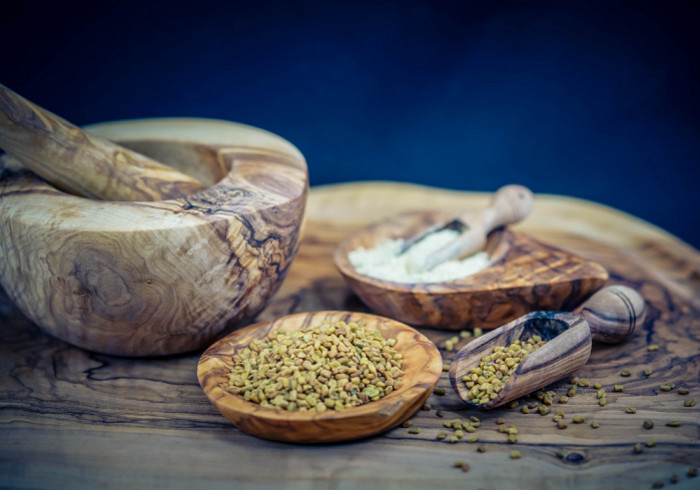
Fenugreek, also called trigonella, Greek hay or bird's-foot, is an annual plant of the Fabaceae family, cultivated for more than 4,000 years in Asia and around the Mediterranean. Its small golden seeds, with a slightly bitter flavour and that so recognisable curry background, are above all a culinary spice.
In terms of composition, the seed contains in particular:
Steroidal saponins (including protodioscin)
Flavonoids
Mucilaginous fibres (galactomannans), which give it its gel-like texture when soaked
Alkaloids (including trigonelline)
Protein : 23 to 30 g per 100 g
Iron : 33.5 mg per 100 g; magnesium : 191 mg per 100 g
Fenugreek and testosterone: what can be said
An important clarification, because I want to be honest with you: fenugreek is the subject of research on testosterone, but no health claim is authorised in Europe on this subject, and this work, carried out for the most part with concentrated extracts, does not make it possible to attribute an effect to the seed you eat. If you think you have a hormonal deficiency, consult a doctor.
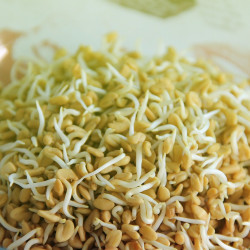
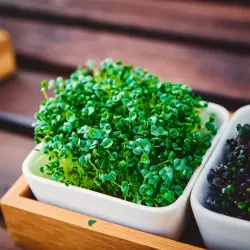
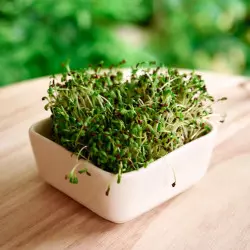
Our favourite way: sprouted fenugreek
This is where our approach differs from almost everything you find on the market. While other brands offer you capsules, extracts and standardised powder, we recommend fenugreek in its living form: sprouted.
Why? Because sprouting is an extraordinary biological process: when a fenugreek seed starts to grow, it mobilises its reserves to become a plant. And in the kitchen, the sprout is eaten raw, in a salad, in a green juice or as a garnish.
And an anecdote I like to share: after eating sprouted fenugreek, perspiration takes on a pleasant curry smell in the hours that follow. It is a little surprising the first time - but it is anything but a problem. It is the sign that the volatile sulphur compounds characteristic of fenugreek are actively circulating in the body.
Rinse thoroughly, then leave to sprout for 2 to 4 days (rinsing morning and evening)
Eat the sprouts raw: in a salad, in a green juice, in a smoothie, as a garnish on a hot dish
Tip to soften the natural bitterness: pair sprouted fenugreek with green apple, cucumber or mild spices (cumin, coriander). Our Methi fenugreek salad recipe is a lovely way in. And for an overview of sprouted seeds, the complete guide to sprouted seeds that I wrote will give you all the basics.
As a powder
In practice: ½ to 1 teaspoon in a smoothie, a juice or a soup. The powder also blends very well into curries and slow-cooked dishes: it is its natural territory in Indian and North African cooking.
As an infusion
Simple for daily consumption: 1 teaspoon of seeds in 250 ml of hot water (not boiling, at 70-80 °C), infuse for 10 to 15 minutes. 1 to 2 cups per day. You can add a little honey or a lemon zest to soften it.
Four simple ways to include it in your cooking
Moroccan halba : seeds simmered with semolina, honey and olive oil, served at breakfast.
Red lentil dahl : a handful of fenugreek sprouts added at the end of cooking, off the heat.
Quick condiment : sprouted seeds, olive oil, lemon juice, salt - perfect on a tomato salad.
Green smoothie : a teaspoon of fenugreek powder with banana, spinach, plant-based milk and dates, which mask its bitterness.
Fenugreek is generally very well tolerated at dietary doses. A few important points to know, however:
Allergies to legumes: fenugreek belongs to the Fabaceae family (like soya, peanuts, lentils). In case of a known allergy to these plants, prior medical consultation is required.
Interactions: fenugreek may amplify the effect of anticoagulants (aspirin, warfarin), with a bleeding risk to monitor. It may also potentiate antidiabetic treatments and cause hypoglycaemia. Medical follow-up is essential if you take these treatments.
Excessive doses: stick to culinary quantities; at very high and prolonged doses, undesirable effects (acne, increased body hair, mood changes) have been reported.
Pregnant or breastfeeding women: fenugreek is not recommended at high doses during pregnancy (uterotonic effects documented in animals). During breastfeeding, the LactMed database of the National Institutes of Health reports frequent undesirable effects in the mother (diarrhoea, maple syrup smell of perspiration, urine and milk) and an isolated case in a newborn: speak to a midwife or your doctor before consuming it.
Combinations to avoid: garlic, ginkgo biloba, horse chestnut, ginseng, red clover, saw palmetto - these plants share effects on blood clotting. The cumulative combination can be problematic.
Fenugreek and gynaecomastia in men: the question comes up often, because fenugreek contains phytoestrogens. At normal dietary doses - sprouted seeds, infusion, cooking powder - no effect on male breast development is documented in the scientific literature. The phytoestrogens of fenugreek do not have the activity of endogenous oestrogens at usual doses. Consult a doctor if you notice unusual changes.
Biovie offers 24 varieties of organic sprouting seeds, produced since 1896 by our Italian supplier Geo Bavicchi, and every batch is tested before it goes on sale (germination rate above 95% required). Radish, fenugreek, sunflower and alfalfa sprout the fastest and most easily for beginners, in 3 to 5 days on a windowsill. To discover several varieties without making a mistake, the packs (The 3 Radishes, The Essentials, The Pep's Seeds...) are a good starting point, before choosing your varieties individually. The range also covers microgreen seeds to grow on a substrate, and sprouters to get started without unnecessary equipment., 46
products
No health claim is authorised for fenugreek in Europe: I will therefore not promise you any effect, neither on testosterone, nor on libido, nor on anything else. Fenugreek is the subject of research, but this work does not make it possible to attribute an effect to a food. I recommend it for what it is: a seed with curry notes, delicious sprouted.
Does fenugreek have an effect on testosterone?
The subject is under research, carried out for the most part with concentrated extracts. This work does not make it possible to attribute an effect to a food, and no health claim is authorised on this point. If you think you have a hormonal deficiency, consult a doctor.
What happens if a man takes fenugreek every day?
In culinary quantities (sprouted seeds, powder in cooking, infusion), fenugreek is generally well tolerated on a daily basis. Observe the precautions above, in particular if you are taking anticoagulant or antidiabetic treatment.
What should be avoided when taking fenugreek?
Avoid combining fenugreek with plants or treatments that act on blood clotting (garlic, ginkgo biloba, ginseng, horse chestnut, high-dose aspirin, anticoagulants). Be cautious if you take antidiabetic treatments: talk to your doctor. Pregnant women should avoid fenugreek at high doses. If in doubt, always consult your doctor.
What is the difference between fenugreek powder, capsules and sprouted seeds?
Capsules and standardised extracts are concentrated forms, used in most studies. The powder is versatile in cooking. Sprouted fenugreek is the form we prefer at Biovie: it is the most alive and the simplest to include raw in a salad or a juice. It takes a little more preparation, but it is worth the effort.
Can fenugreek make men's breasts grow?
At normal dietary doses (sprouted seeds, infusion, cooking powder), no gynaecomastia effect (development of male breasts) is documented in the scientific literature. Although fenugreek contains phytoestrogens, their concentration and activity at usual doses are insufficient to induce this type of effect in a healthy man. If you observe unusual changes, consult your doctor.
Disclaimer: The information presented in this article is provided for information purposes only and does not constitute medical advice. Consult a qualified healthcare professional before any change to your diet or supplementation, in particular if you are undergoing ongoing medical treatment. As part of a varied and balanced diet and a healthy lifestyle.