



After a big meal, digestive enzymes do most of the heavy lifting: these proteins break starch, protein and fat down into fragments small enough to pass into the blood, and your pancreas already makes plenty of them. A supplement only makes sense in specific cases, such as lactase for lactose. This guide draws on eleven scientific and regulatory sources, including an EFSA opinion and European Regulation No 432/2012.
You probably know the scene. A festive lunch that drags on, that feeling of having swallowed a stone, then in the supplements aisle a whole row of enzyme bottles that all talk about digestion.
And yet your body already makes its own enzymes, and not just a few. So why swallow more?
Vegan since 1992, into living food since the early 2000s and trained at the Hippocrates Health Institute in 2005 and 2006, I have been talking about enzymes for a long time. My training as an ISTOM engineer also taught me to tell what is demonstrated from what is simply repeated. So here is an honest sort, case by case, between what is proven and what is much less so.
What are digestive enzymes for?
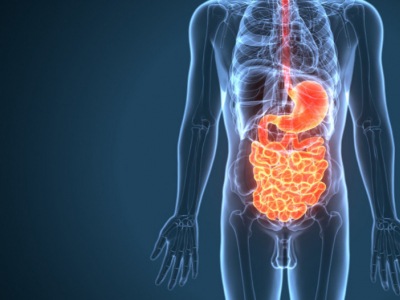
Digestive enzymes are proteins that break food down into pieces small enough to pass into the blood: amylase for starch, proteases for protein, lipase for fat. Most of them are made by the pancreas and the small intestine (Karpińska and Czauderna, 2022).
Think of specialised scissors: each one cuts only one type of chemical bond, thanks to a pocket, the active site, whose shape only suits certain molecules. That is the lock-and-key principle, which I explain in the article on what an enzyme is.
I also like the image of a workshop of carpenters in blue overalls: the more of them there are and the better equipped they are, the better the wood (your meal) gets processed. In practice, what you eat only really nourishes you once these workers have cut it up. You are not what you eat, but what you absorb.
Where are they made?
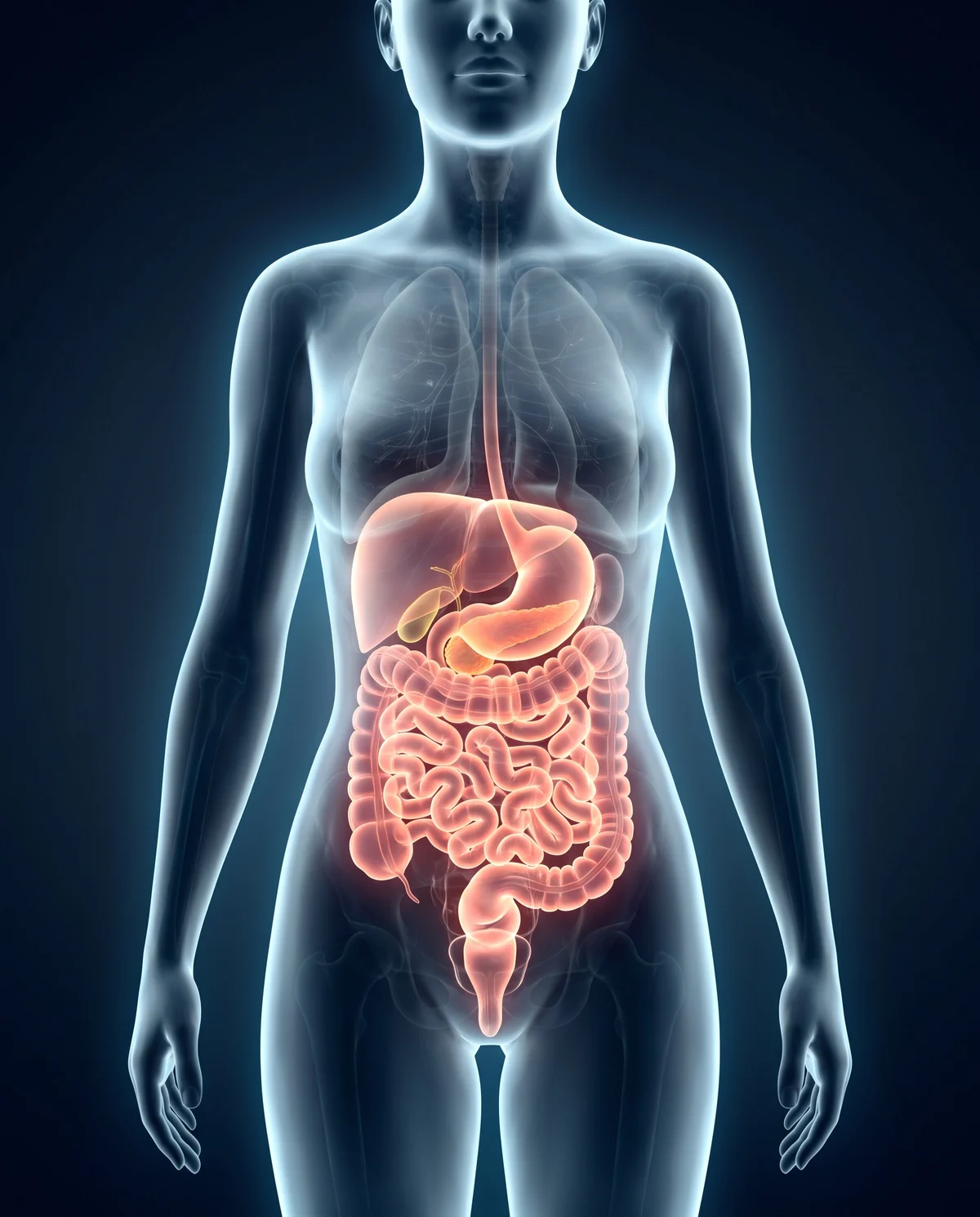
Mostly in the pancreas. In humans, this organ secretes 1 to 4 litres of pancreatic juice a day, depending on what you eat (Karpińska and Czauderna, 2022). Enough to fill, depending on the day, a big water bottle or a household bucket.
Lactase, for its part, is made by the small intestine. It is its shortage that explains the poor digestion of lactose, the sugar in milk (EFSA, 2009).
List of digestive enzymes
Here is the list of the main digestive enzymes, grouped by family (Karpińska and Czauderna, 2022; EFSA, 2009 for lactase).
| Family | Examples | What it breaks down |
|---|---|---|
| Proteases | trypsin, chymotrypsin, carboxypeptidase, elastase | proteins |
| Lipases | lipase, phospholipase, esterase | fats |
| Amylase | pancreatic amylase | starch |
| Nucleases | ribonuclease, deoxyribonuclease | nucleic acids |
| Lactase | small-intestine lactase | lactose, the sugar in milk |
Poor digestion: what are the signs, and when should you see a doctor?
A heavy feeling after a big meal, a bit of bloating after a dish of lentils, now and then: that is everyone's lot. Nothing alarming. Honestly, it does not mean you are short of enzymes.
A real shortage does exist, and it has a medical name: exocrine pancreatic insufficiency. The pancreas then secretes too little juice, especially too little lipase, the fat enzyme, which weighs on quality of life and exposes you to complications (Capurso et al., 2019). This insufficiency occurs in diseases of the pancreas and in other diseases, including cystic fibrosis (Ianiro et al., 2016). It is most often diagnosed by measuring faecal elastase.
Fatty stools or unexplained weight loss are not something to manage with a supplement: talk to your doctor.
And then there is the pharmacy shelf, which muddies the waters: when you look for digestive enzymes at the pharmacy, you come across both medicines and supplements. Prescribed pancreatic enzymes are a medicine, the reference therapy for this insufficiency, whereas supplements come under food. Married for twenty years to a doctor, I know how modest a place nutrition has in medical studies; a proper diagnosis nonetheless keeps all its value.
Lactose intolerance is the other big scenario. It is lactase that is lacking (EFSA, 2009), and tolerance to lactose varies from one person to another (Regulation (EU) No 432/2012).
If your discomfort has another origin, see the possible causes of digestive disorders, or dill against bloating for a lead from the kitchen side. Justine Lamboley's book, Santé intestinale, lays out a six-week programme.
Natural enzymes: what sprouting and fermentation do to your food
This is where living food has something original to say. When a cereal or a legume sprouts or ferments, it activates its own enzymes: alpha-amylase, pullulanase, phytase and other glucosidases (Nkhata et al., 2018).
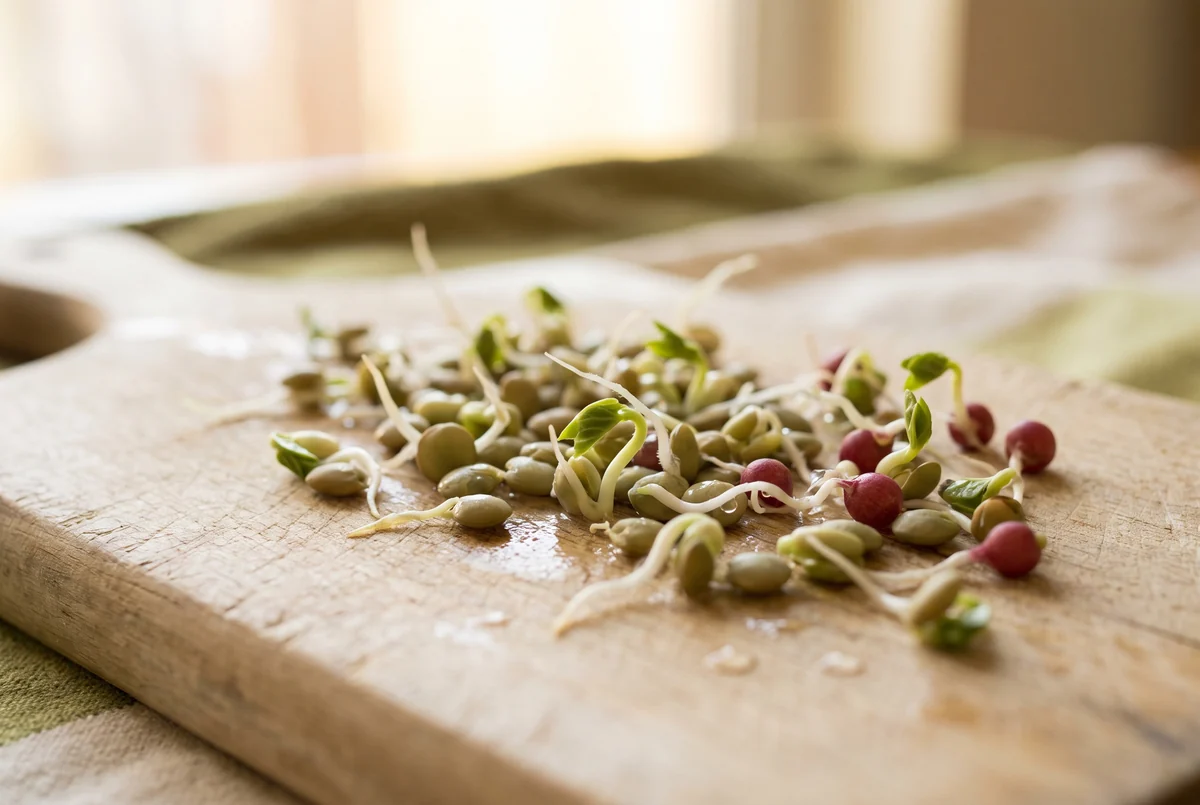
These enzymes break down antinutritional factors such as phytates and trypsin inhibitors, and cut starch and protein into more digestible forms, which the review documents for cereals as well as for legumes. The work starts outside. This is the image that speaks to me most: you bring planks that are already sawn to the workshop, rather than logs.
Fermentation goes in the same direction. It transforms the constituents of the food and forms bioactive compounds (Marco et al., 2017). In reality, clinical trials in humans remain few, which calls for modesty.
One clarification, to be complete: none of the sources in this article shows that the enzymes of a raw food keep working in your gut. The benefit plays out in the food itself, before the meal. That is the whole logic of the article on eating raw and enzymes, and more broadly of the habits that support better digestion.
If you are looking for natural digestive enzymes, then, they do their work in the sprouter and in the jar. As part of a varied and balanced diet and a healthy lifestyle, a handful of sprouted seeds on your plate remains a simple gesture, at your own pace.
Enzyme supplements: what the studies really say
To form a view on digestive enzymes and their benefits, it is better to look at the trials one by one. A word on method first. In a double-blind trial, neither the participants nor the researchers know who receives the product or the placebo, which limits the expectation effect. When authors are tied to the manufacturer, the result remains readable, and you then wait for confirmation from other teams.
Lactase, the only authorised claim
EFSA validated a cause-and-effect link between lactase and lactose digestion in people who digest it poorly (EFSA, 2009). European regulation drew from it the only authorised health claim for an enzyme: "lactase improves lactose digestion in individuals who have difficulty digesting lactose".
It applies only to food supplements, at a rate of at least 4,500 FCC units with each meal containing lactose, with the statement that tolerance is variable (Regulation (EU) No 432/2012). In other words, this figure is a threshold: below it, a product cannot claim this effect.
Alpha-galactosidase and gas from legumes
This enzyme was tested on a very concrete question: gas after a dish of beans. In a randomised, double-blind, placebo-controlled trial on 8 healthy volunteers, 1,200 GalU reduced exhaled hydrogen and the severity of flatulence after 420 g of cooked beans (Di Stefano et al., 2007). A 420 g plateful is far more than an ordinary portion.
In 20 adults with irritable bowel syndrome, however, a crossover pilot study (each participant takes the enzyme and the placebo in turn) showed no difference from placebo at the same dose, either on symptoms or on exhaled gases (Böhn et al., 2021). What helps a healthy gut faced with too many beans does not necessarily help a sensitive gut.
Enzyme blends in functional dyspepsia
Functional dyspepsia refers to persistent discomfort in the upper abdomen, with no visible lesion on examination. A 2018 trial followed 40 patients for 60 days, at 50 mg of a multi-enzyme complex three times a day: dyspepsia scores improved significantly compared with placebo, with no adverse effect attributed to the product (Majeed et al., 2018). "Significant" means the gap is unlikely to be due to chance. Two limits all the same: the sample is small, and several authors are tied to the manufacturer.
The 2023 trial, run in a single centre in Italy, is larger: 120 adults aged 18 to 59, for 2 months, with two 200 mg doses a day of a blend of enzymes of fungal origin. Participants reported a better quality of life, less pain and better sleep, with good tolerance (Ullah et al., 2023). Three times as many people as in the first trial: the signal gains credibility.
Pancreatic enzymes: a medicine
In pancreatic insufficiency and cystic fibrosis, pancreatic enzymes of animal origin are the recognised standard of care, and their use outside a deficiency is still under study, with no established proof (Ianiro et al., 2016; Capurso et al., 2019).
At bottom, these studies say one simple thing: each problem has its own enzyme. A supplement off the shelf cannot be judged in the light of these trials, which cover specific formulas. If you would still like to try one, as part of a varied and balanced diet and a healthy lifestyle, Biovie offers Enzymes Assimil, whose composition is listed on its product page.