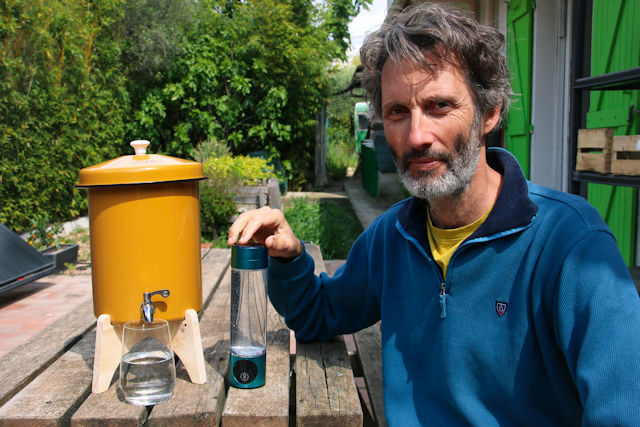
This article is part of our section "We tested for you", where Aurélie and I share our real experiences with the products and solutions we use daily at Biovie. Today, I am going to talk to you about Ecofiltro, this clay water filtration system that we have been testing for 6 months now. And as always, I will be transparent with you: I will share what convinced us, but also what sometimes annoyed us.
Why we tested Ecofiltro for 6 months
Issues with tap water in France
I will start with an observation that personally caught my attention when I began to delve into the subject. According to a recent study by Global Coolers, only 80% of French people trust tap water.. It is the lowest level ever recorded in history. And frankly, when you dig a little deeper, you understand why this mistrust is growing.
More than 40% of tap water samples in France contain PFAS. - these famous "forever pollutants" that are increasingly being talked about. But that's not all. An investigation by 60 Millions de Consommateurs revealed that 78% of bottled mineral waters contain microplastics.. So there you have it, between the tap and the bottle, we find ourselves a bit stuck.
For my part, since I became interested in natural health-and it's now been over 20 years since I created Biovie-the quality of water has always been a central concern. We have tested quite a few solutions over the years: filter jugs, reverse osmosis systems, Personally, I have been filtering my water for 30 years, and I am now using our Ecofiltro. Our motivation? To find a solution that is effective, ecological, and realistic for a family's daily life.
Our promise: a 100% transparent review with advantages AND disadvantages
We purchased our Ecofiltro before we started selling it following a discovery of this filter during a trip to Costa Rica. We used it regularly for 6 months, and I will tell you exactly what we thought of it. This has always been Biovie's philosophy: we are the first consumers of the products we sell, and we personally know the strengths AND weaknesses of each solution.
How does an Ecofiltro work: clay, activated carbon and silver
Before I tell you about six months of use, a word on what actually happens inside the pottery. The Ecofiltro reproduces, in fast-forward, the filtration that nature performs in groundwater: water descends by simple gravity through a porous material that holds back what should not end up in your glass. No electricity, no pressure, no plumbing connection.
Porous clay: the mechanical sieve
The body of the filter is a fired clay pottery whose porosity is calibrated. It mechanically stops suspended particles, sediment and micro-organisms that are too large to pass through. This is the principle of the domestic ceramic filter, whose effectiveness has been measured in controlled trials under real-world conditions, notably a randomised trial conducted in rural Bolivia (Clasen et al., American Journal of Tropical Medicine and Hygiene, 2006).
Activated carbon: chemical adsorption
Sandwiched between two layers of clay, a mass of activated carbon works on a completely different mechanism: adsorption. Its surface, riddled with micro-cavities, attracts and traps molecules that bind to it - chlorine, disinfection by-products, organic residues, and a good share of heavy metals. It is this carbon that explains the disappearance of the chlorine taste, the first thing you notice in use.
Silver ions: the antimicrobial barrier
The clay is impregnated with silver, whose ions have a long-known antibacterial action. Its role here is twofold: treating the water that passes through, and preventing bacteria from colonising the filter itself between uses - a classic weak point of systems that stay permanently damp.
The concrete specs
Two capacities: 5 litres for a household of one to three people, 20 litres for a large family or shared use
A flow rate of about 500 ml per hour: it is slow, and it is the main organisational adjustment to plan for (we come back to this further down)
A lifespan for the filtering pottery of about two years in domestic use
A stainless steel tap: the water only ever touches natural materials, never plastic
At the end of its life, the pottery is reused as a flowerpot - it is the only filter in our range that ends up on a windowsill rather than in the bin
The system was born in Guatemala, where it now equips hundreds of thousands of households. It is not a laboratory novelty: it is a technology proven at scale in countries where tap water is not drinkable, which later arrived here for different reasons - chlorine, pesticides, PFAS, microplastics.
Our 6-month testing protocol
Methodology: daily use, regular measurements
We installed our Ecofiltro in May 2025, and we have been using it as the main source of drinking water for the whole family.
I should mention that we have rather hard tap water in the Gard, which didn't make things easier. So it was a test in real conditions, not in a sterile laboratory.
The first thing that struck us was the taste. From the second week (the first week, it has a clay taste as the ceramic absorbs at the start), we noticed a real difference. Our well tap water became much softer and more pleasant to drink. Aurélie, who is very sensitive to tastes, immediately embraced it.
She is so good that Zia is self-sufficient with this filter and has started drinking more water naturally, without us needing to remind her.
According to the Global Coolers study, 59% of French people would drink more tap water if its taste were improved.. I can tell you that with us, that's exactly what happened. Moreover, if you are looking for other solutions to ensure pure and hydrating water all year round, we tested several complementary approaches.
Ecological solution (clay, zero waste, compostable filter)
What really attracted me to Ecofiltro is the ecological approach. The system is made of natural clay, not plastic. The filter is compostable or can be turned into a flower pot at the end of its life. Zero plastic waste, no cartridge to throw away every month. For someone who has been advocating for organic and ecological products for years - which was one of the reasons for creating Biovie in 2007 - this is a significant argument.
74% of French people believe that companies should make water conservation a priority.. With Ecofiltro, we feel a bit more aligned with our values. And honestly, that is priceless. This approach fits perfectly with our philosophy of living food where pure water is a fundamental pillar.
Autonomy (no electrical or plumbing connection)
Another big advantage: total autonomy. No need for an electrical connection, no need for plumbing, no need for water pressure. You place your Ecofiltro on the countertop, fill the top container, and that's it. Gravity does the rest.
We, who have tested quite a few filtration systems over the years - I particularly think of our experience with the reverse osmosis system that required a whole installation under the sink - were really charmed by this simplicity. It's plug-and-play, low-tech version.
Aesthetics in the kitchen (design, natural materials)
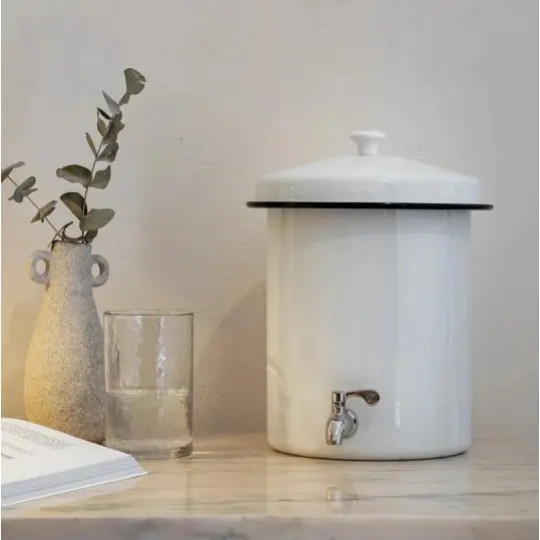
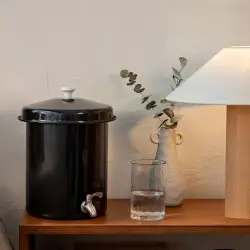
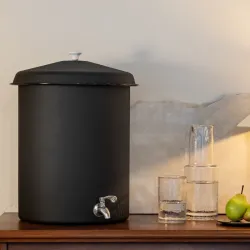
I must admit that I did not expect the design to play such a significant role. The Ecofiltro is really beautiful. The natural materials (clay, ceramic) fit perfectly in our kitchen. It has become a decorative element in its own right.
Aurélie, who has always had an artist's eye for these things, has also gotten into the habit of photographing it for our Instagram account. And the feedback from our community has been unanimous: people find it pretty. This is not insignificant. When an object is beautiful, we are more inclined to use it daily.
Proven effectiveness against pollutants
Alright, let's talk seriously now. Does it really work? According to independent tests by the Measurlabs laboratory (ISO/IEC 17025 accredited), Ecofiltro filters effectively:
99% of microplastics
95% of PFAS
More than 90% of pharmaceutical residues
99.9% of bacteria and parasites
We have not conducted laboratory analyses ourselves, but the results published by independent organizations are solid enough to have convinced us. Pure water naturally contributes to support the body's elimination functions.
What convinced us less: the real limitations
Now, let's talk about what bothers us. Because if I tell you that everything is perfect, you won't believe me. And you would be right.
Relatively slow speed (patience required)
The first disadvantage, and it is significant: the flow rate is slow compared to the kitchen faucet, of course. Then you need to plan ahead a bit to filter a new quantity of water. On average, you should expect about 1 hour to filter 3 liters of water.
The first few weeks, it annoyed me a bit, being used to other faster systems. For those of us accustomed to a different pace, this slowness required a bit of adjustment. You have to anticipate. Fill the pottery in the evening to have water the next morning, or in the morning for midday. Plan ahead.
But in reality, with a bit of organization, it is managed very well. And I realized that this "constraint" forced us to slow down a bit, to be more conscious of our water consumption. It's not necessarily a bad thing.
Initial price higher than basic carafe
Third point: the price. An Ecofiltro is significantly more expensive than a basic filtering carafe at €30. For many people, this is a deterrent.
So yes, if you do the calculation in the long term, Ecofiltro becomes cost-effective. But you need to have the amount to pay upfront.
Clutter on the work surface
Fourth disadvantage: the bulkiness. Ecofiltro takes up some space. About 20 cm in diameter. If you have a very small kitchen, it can quickly become problematic.
At our place, we have space, so it doesn't bother us, and besides, it's nice. But I understand that for a 25m² Parisian studio, it can be a deal-breaker. You really need to have a small dedicated spot on the countertop or on a piece of furniture.
Clay taste at the beginning (adaptation needed)
Fifth and final point: the initial clay taste. In the first few days, the water indeed had a slight clay taste. This is normal, as it takes time for the filter to stabilize. However, if you are very sensitive to tastes, it might put you off.
In our case, this taste completely disappeared after a week. But I have read accounts from people who experienced it for 2-3 weeks. It varies depending on the filters and the quality of the tap water.
Actual cost over 6 months: our detailed financial report
Initial investment
Let's start at the beginning: the initial purchase.
Ecofiltro 8 liters : €144 (+ shipping)
Calculated depreciation (vs bottled water, vs carafe)
Now, let's compare with the alternatives over 6 months:
Bottled water (family of 4 people, 8L/day):
Average price for a 1.5L bottle: €0.30
Daily consumption: 8L = 5.3 bottles = €1.60/day
Cost over 6 months (180 days): €288
Economy with Ecofiltro : 288€ - 149€ = 139€
Basic water filter pitcher:
Carafe: €30
Cartridges (1 per month): 6 x €8 = €48
Total cost for 6 months: €78
Ecofiltro Surcharge : 149€ - 78€ = €71
Conclusion : Over 6 months, Ecofiltro is more expensive than a carafe (+€71) but widely more economical than bottled water (-€139).
Cost per year and over 5 years
Now, let's project in the long term:
Annual cost of Ecofiltro :
Initial investment: €140 (year 1 only)
Filter replacement: €50/year (every 12 months)
Maintenance: €18/year
Year 1 : 140€ + 50€ + 18€ = 208€
Subsequent years : 50€ + 18€ = €68/year
Cost over 5 years 208€ + (4 x 68€) = 480€ 480€
5-year comparison :
Bottled water : 288€ x 10 semesters = €2,880
Basic carafe(30€ + 96€) x 5 = €630
Ecofiltro : 480€
Financial verdict : Over 5 years, Ecofiltro is the most economical option after the carafe, with a Economy of €2,400 vs bottled water and a moderate additional cost of €150 compared to a Brita carafe, but with a much higher filtration efficiency.
Ecofiltro vs alternatives: practical comparison
Now that we have tested Ecofiltro for 6 months, let's objectively compare it with the main alternatives on the market. If you want a comprehensive overview of the different filtration methods available, we have written a comprehensive guide.
Ecofiltro vs water filter pitcher
Water filter pitcher: the entry-level solution
Carafe benefits:
Very affordable purchase price (€30)
Compact, stores in the fridge
Instant filtration (fills in 5 minutes)
Easy to find (large retail)
Disadvantages of a carafe:
Plastic cartridges (monthly waste)
Limited effectiveness (chlorine, taste, some heavy metals)
Does NOT filter PFAS or pharmaceutical residues
Reduced capacity (2-3 liters max)
Long-term cost of cartridges
Our opinion The carafe is a good entry-level solution for improving the taste of water. However, if you are looking for effective filtration against modern pollutants (PFAS, microplastics, pharmaceutical residues), it is not sufficient.
Ecofiltro vs under-sink filter
Under-sink filter : the discreet and practical solution
Under-sink filter advantages :
Invisible (no clutter)
Normal water flow (no waiting)
Efficient filtration (according to model)
Large capacity (several thousand liters)
Disadvantages of under-sink filter :
Complex installation (plumber often required)
High price (200-500€ depending on the model)
Technical maintenance (cartridge replacement)
Not portable (fixed under the sink)
Our opinion : Excellent solution if you are a homeowner and have the budget. But for renters or those looking for a simple and standalone solution, Ecofiltro is more suitable.
Ecofiltro vs reverse osmosis
Reverse osmosis system : the maximum filtration
Advantages of a reverse osmosis system :
The most comprehensive filtration on the market (99.9%)
Eliminates absolutely everything (viruses, bacteria, heavy metals, PFAS, etc.)
Immediate water flow
Disadvantages of a reverse osmosis system :
Very high price (500-1000€)
Complex installation (plumber required)
Water waste: rejects 3 to 5 liters of water for 1 liter filtered
Total demineralization: the water must be remineralized afterwards
Our opinion The reverse osmosis system is the most technically effective solution, but also the least environmentally friendly. Water waste is a real ethical issue. Ecofiltro is simpler, more eco-friendly, but slightly less effective on certain specific pollutants.
Synthetic comparison table
Here is a visual summary of our comparisons:
Price : Carafe < Ecofiltro < Osmosis System
Filtration efficiency : Osmosis system > Ecofiltro > Carafe
Opt for an organic, healthy and chlorine-free shower thanks to the integral water filter without cartridges with retro-cleaning system. Filtration and dynamization., 20
products
Honestly? For a family of 4 or more, the 5-liter Ecofiltro might be a bit limited in terms of flow rate. You'll spend your time refilling the tank. In this case, I would recommend a 20-liter Ecofiltro instead (but it takes up space).
Profile 2: Childless couple
This is the ideal profile for Ecofiltro. Two people who consume about 3-4 liters of water per day, it's perfect. You fill it in the morning, and you have water for the day.
Profile 3: Single in an apartment
Also a very good profile. The only downside is the bulkiness in a small kitchen. But for a single person, an Ecofiltro can last the whole week without daily refilling.
Profile 4: Very hard or polluted water
If you live in an area where the water is really bad (hard water, strong taste, suspicion of pollution), Ecofiltro is an excellent solution. The feedback we have received from customers in the North of France or the Paris region is excellent.
Once a week or every 15 days, we gently scrub the ceramic filter with a clean brush (without any product). This removes any limescale deposits that may slow down the flow.
Monthly maintenance
Once a month, we do a thorough cleaning:
Dismantling of all the elements
Soaking in a solution of diluted white vinegar (1 part vinegar to 3 parts water)
Abundant rinsing
Complete drying before reassembly
Errors to avoid
The mistakes we made and that are better avoided:
Let the water stagnate for a long time : if you leave for more than 3/4 days, completely empty the Ecofiltro
Use chemicals : never use soap or dishwashing liquid on the filter
Rub too hard : the ceramic filter is fragile
Forget the weekly maintenance : the flow slows down quickly if not cleaned
Frequently Asked Questions (FAQ)
Is Ecofiltro effective for filtering water ?
Yes, according to independent tests by the Measurlabs laboratory (ISO/IEC 17025 accredited). Ecofiltro filters 99% of microplastics, 95% of PFAS, and more than 90% of pharmaceutical residues. It has also obtained NSF 42 certifications (improvement of taste, odor, chlorine) and NSF 53 (reduction of contaminants impacting health).
Is Ecofiltro worth it financially ?
In the long term (2 years and more), yes. The initial investment is higher than a carafe (€140 vs €30), but the maintenance costs are low (a filter lasts 12 months for about €50). Compared to bottled water, The savings are substantial: around €2,400 over 5 years.. The break-even point with a Brita pitcher is reached after 2 years.
What are the disadvantages of Ecofiltro ?
The main disadvantages are: the slow flow (approximately 2 hours to filter 8L), theregular maintenance required (weekly mandatory cleaning), the high initial price (140€), and theclutter on the countertop (30 cm in diameter, 35 cm in height). There is also a slight taste of clay in the first few days, which disappears after a week.
Ecofiltro or Berkey: which one to choose ?
If you have the budget (€300-500), Berkey is slightly superior in filtration and flow rate. But for standard family use, Ecofiltro does the job very well for half the price (€140). Ecofiltro is also more eco-friendly: compostable clay filter versus Berkey's plastic filters. Our recommendation: Ecofiltro for couples and small families, Berkey for large families (4+ people) with a comfortable budget.
Gravity filter or reverse osmosis: what is the difference?
A gravity filter lets water pass through a filtering material under its own weight: it holds back contaminants and lets through the minerals naturally present in the water. A reverse osmosis system pushes water through a semi-permeable membrane and removes almost everything, minerals and trace elements included: the resulting water is very pure but demineralised, which calls for remineralisation that is often overlooked. Reverse osmosis costs significantly more, needs regular maintenance and sends water to the drain. For everyday household use, a gravity filter remains the best trade-off between simplicity and effectiveness.
Are ceramic beads a valid alternative?
They are very cheap and often presented as a complete solution. Honestly, their filtering effectiveness is not backed by any solid study: at best they act on the taste and the microbial life of stored water, but they remove neither pesticides, nor PFAS, nor heavy metals. They are not a substitute for a filter.
How can I find out the water quality in my area?
The annual report on the quality of distributed water is public: it can be consulted at the town hall, on your water supplier's website, and, area by area, on the health ministry's portal. It gives the results of the mandatory analyses - bacteriology, nitrates, pesticides, hardness. It is the logical starting point: your filtration priority will not be the same depending on what that report says.
Is bottled water safer?
Not necessarily. Research published in Frontiers in Chemistry (Mason et al., 2018) found plastic particles in a large share of the bottled waters analysed, and other research has shown that the packaging itself releases some. Add the cost and the weight of the packs: in practice, filtering at home remains simpler and cheaper.
Our final verdict after 6 months
Who is Ecofiltro recommended for?
We recommend Ecofiltro for:
The Couples or small families (2-3 people)
The people sensitive to ecology
Those who have a poor tap water
People who are looking for a autonomous solution (without electricity or plumbing)
For whom is Ecofiltro not recommended?
We do not recommend Ecofiltro for:
The large families (4+ people) with high water consumption
People who don't no room on their work plan
Those who easily forget regular maintenance
People with very tight budget (prefer a carafe in this case)
Alternatives to consider
If Ecofiltro does not suit you, consider:
Carafe: for a tight budget
Reverse osmosis system : for maximum filtration (but be careful of water waste)
After 6 months of daily use, our verdict is mixed but overall positive. Ecofiltro is not perfect - the slightly slow flow rate and regular maintenance require some organization - but for us, the advantages far outweigh the disadvantages.
The water really tastes better. We have reduced our ecological footprint by eliminating plastic bottles. And most importantly, we have the peace of mind of drinking water free from the majority of modern pollutants.
Is it the miracle solution? No. Is it an excellent solution for a couple or a small family concerned about their health and the environment? Definitely yes.
As always at Biovie, we only offer solutions that we use ourselves on a daily basis. Ecofiltro is now part of our routine, and we are happy to be able to share it with you.












How does an Ecofiltro work: clay, activated carbon and silver
Before I tell you about six months of use, a word on what actually happens inside the pottery. The Ecofiltro reproduces, in fast-forward, the filtration that nature performs in groundwater: water descends by simple gravity through a porous material that holds back what should not end up in your glass. No electricity, no pressure, no plumbing connection.
Porous clay: the mechanical sieve
The body of the filter is a fired clay pottery whose porosity is calibrated. It mechanically stops suspended particles, sediment and micro-organisms that are too large to pass through. This is the principle of the domestic ceramic filter, whose effectiveness has been measured in controlled trials under real-world conditions, notably a randomised trial conducted in rural Bolivia (Clasen et al., American Journal of Tropical Medicine and Hygiene, 2006).
Activated carbon: chemical adsorption
Sandwiched between two layers of clay, a mass of activated carbon works on a completely different mechanism: adsorption. Its surface, riddled with micro-cavities, attracts and traps molecules that bind to it - chlorine, disinfection by-products, organic residues, and a good share of heavy metals. It is this carbon that explains the disappearance of the chlorine taste, the first thing you notice in use.
Silver ions: the antimicrobial barrier
The clay is impregnated with silver, whose ions have a long-known antibacterial action. Its role here is twofold: treating the water that passes through, and preventing bacteria from colonising the filter itself between uses - a classic weak point of systems that stay permanently damp.
The concrete specs
The system was born in Guatemala, where it now equips hundreds of thousands of households. It is not a laboratory novelty: it is a technology proven at scale in countries where tap water is not drinkable, which later arrived here for different reasons - chlorine, pesticides, PFAS, microplastics.