


Summary
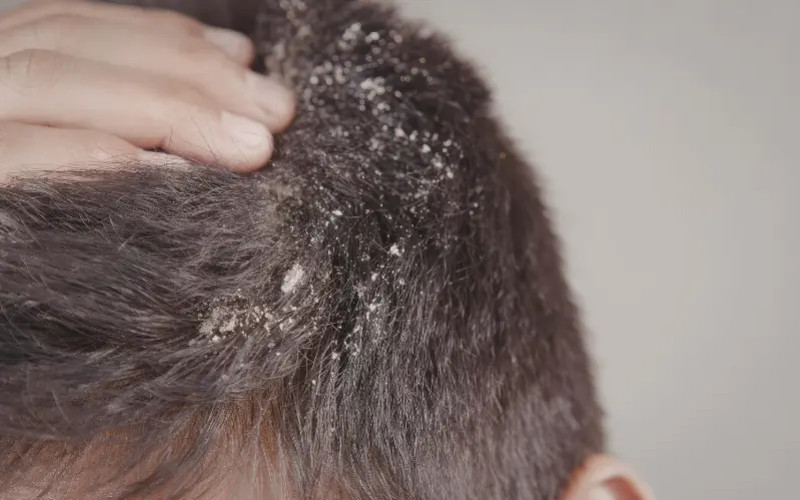
Dandruff affects more than one in two adults during their lifetime (1). Anti-dandruff shampoo makes the flakes disappear for a few weeks - then they return, often faster than before.
In reality, these products act on the symptom, not the cause. This cause is a fungus naturally present on 90% of scalps., Malassezia, which proliferates when the scalp environment is unbalanced. What if the real solution was marine? This is the angle we have been advocating at Biovie for years: rebalancing this area in depth with marine algae and sea minerals, whose properties are now scientifically documented. In this article, I explain everything to you - from the exact mechanism of dandruff and itching to the concrete protocol you can implement as early as this week.
Why do dandruff return despite all the shampoos ?
This is the question I asked myself for years, long before founding Biovie. You change shampoo, you see results after two weeks, and then - invariably - the flakes reappear. Why ?
Malassezia, the fungus responsible for dandruff
Malassezia is not a bacterium. It is a fungus (a yeast) that naturally colonizes the scalp of almost all humans. The two species mainly involved in dandruff are Malassezia globosa and Malassezia restricta - this is what a reference genomic study has established (3). This fungus feeds on the sebum produced by the scalp. When it proliferates excessively, it disrupts cell renewal and causes the appearance of characteristic white or gray flakes.
What classic anti-dandruff shampoos do is temporarily inhibit this proliferation. What they do not do is rebalance the environment that allowed Malassezia to proliferate in the first place. That's why dandruff returns as soon as the treatment is stopped.
The 5 true causes of recurring dandruff
Frankly, few articles on the subject take the time to explain what actually disrupts the scalp. Here's what science tells us:
- A depleted hair microbiome. Individuals prone to dandruff exhibit a significant reduction in the ratio. Cutibacterium/Staphylococcus and an increase of Malassezia - that's what a study showed systematic review published in Experimental Dermatology in 2021 (PMID 34415635) (4). The diversity of the hair microbiome is the key factor for a healthy scalp.
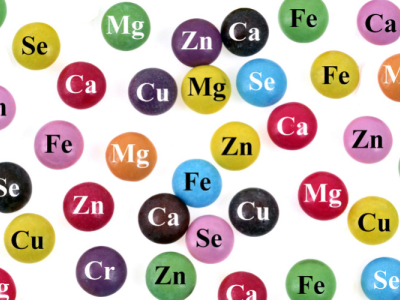
- Unaddressed mineral deficiencies. Zinc and magnesium play a central role in regulating sebum and in the strength of the scalp's skin barrier.
- Chronic stress. Cortisol, the stress hormone, disrupts the skin flora and can promote the proliferation of Malassezia by altering the pH of the scalp - dandruff and stress are indeed connected.
- A pro-inflammatory diet. Refined sugars, alcohol, and ultra-processed foods worsen scalp dysbiosis and contribute to a favorable environment for oily dandruff.
- Aggressive hair styling products. Sulfates and parabens in conventional shampoos destroy the natural hydrolipidic film of the scalp - which, paradoxically, worsens the conditions favorable to Malassezia.
What nutritional deficiency causes dandruff ?
The answer is multiple: deficiencies in zinc, vitamins B2, B3, B6, and B7 (biotin), as well as vitamin D are all associated with a flaky scalp and the formation of dandruff (7). Zinc, in particular, plays a role in the normal regulation of scalp sebum and the production of keratin (8). The good news is that marine sources-spirulina, brown algae, marine Quinton-precisely concentrate these minerals in a highly bioavailable form. To learn more about the spirulina and hair health, I have written a comprehensive guide on our blog.
Dry or oily dandruff: how to distinguish them for better treatment ?
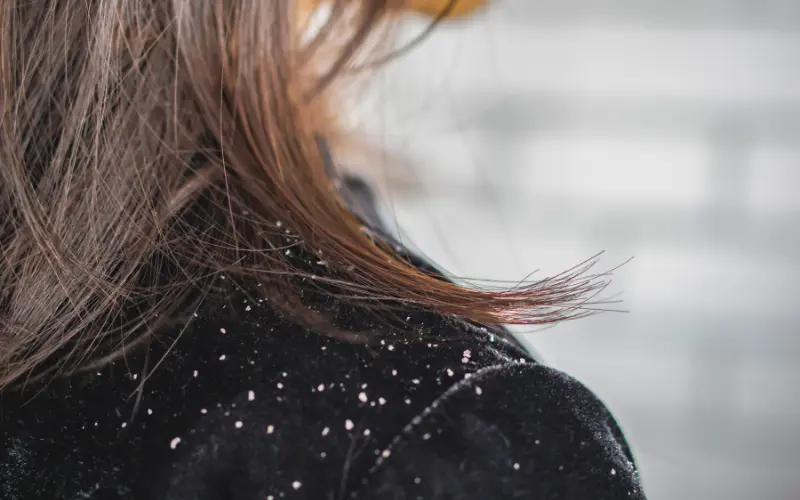
Before taking action, you first need to know what type of dandruff you are dealing with. Because the two do not respond to the same treatments.
Dry dandruff:
- Small, light white flakes that easily fall onto clothing
- Normal to dry scalp, without excess sebum
- Moderate itching
- Often worsened in winter by heated and dry environments
- Main cause: weakened skin barrier, dehydration of the scalp
Oily dandruff:
- Thicker, yellowish scales that stick to the scalp
- Oily scalp, often with slight redness
- More intense itching - characteristic hair dandruff itching
- Can affect the eyebrows, the sides of the nose, and the ears - a sign of seborrheic dermatitis
- Main cause: overproduction of sebum + increased proliferation of Malassezia
Specifically, if your dandruff is oily and your scalp is red or inflamed, it could be seborrheic dermatitis - a more severe form that affects 3 to 5% of the global population (2). In this case, consulting a dermatologist is recommended before any treatment protocol.
Which natural assets really work against dandruff ?
The 7 proven natural anti-dandruff agents
Here are the assets whose effectiveness on Malassezia or on the scalp is documented, with their level of evidence:
- Zinc ⭐⭐⭐ - Participates in the normal regulation of sebum, may help inhibit the proliferation of Malassezia (scientific consensus)
- Magnesium ⭐⭐ - Contributes to skin balance and supports the normal functioning of the microbiome
- Iodine ⭐⭐ - Contributes to the maintenance of normal skin; documented properties on yeasts
- Vitamins B (B2, B3, B6, B7) ⭐⭐⭐ - Participate in normal cell renewal and skin health
- Excerpt from Laminaria digitata (Algo'Zinc) ⭐⭐ - Documented active against Malassezia furfur in vitroAlgal Research, vol. 84, 2024) (6)
- Tea tree essential oil ⭐⭐ - Documented surface antifungal action, to be used diluted
- Apple cider vinegar ⭐ - Scalp pH rebalancing, limited and temporary effectiveness
Tea tree, apple cider vinegar... what the competitors don't say
When looking at most articles on the subject, you will consistently find the same ingredients: tea tree, apple cider vinegar, coconut oil, baking soda - the classic home remedies for dandruff and itching. I'm not saying these ingredients are ineffective - tea tree does indeed have a surface antifungal action. But here's what is generally overlooked: its action is short-lived, and it does not remineralize the scalp in-depth. It does not address zinc or magnesium deficiencies. It does not restore the diversity of the scalp microbiome.
These three levers - remineralization, microbial rebalancing, and addressing deficiencies - are what enable a lasting improvement, not just a cosmetic one. In fact, it is a proven natural anti-dandruff agent that many are unaware of: marine minerals.
The Unexpected Role of Marine Minerals
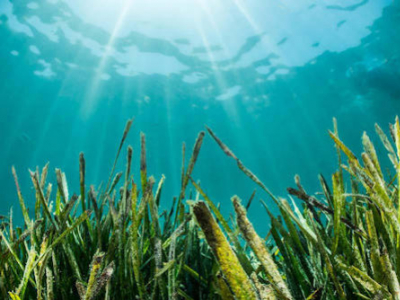
The marine territory is completely absent from the discourse on dandruff. This is our exclusive angle at Biovie, and it is scientifically sound. Seawater contains 78 bioavailable trace elements - including zinc, magnesium, and iodine - directly involved in the balance of the scalp. Brown algae of the type Laminaria concentrate these minerals at remarkable levels.
To learn more about the role of the algae and skin balance, I invite you to read this other blog article.
Seaweed against dandruff: what does science say ?
Laminaria digitata and the active ingredient Algo'Zinc against Malassezia furfur
This is the point that I find the most exciting - and the most overlooked by our competitors on the SERP. The Algo'Zinc asset, derived from brown algae Laminaria digitata combined with zinc sulfate, has been documented to be active in vitro against Malassezia furfur, but also against Staphylococcus aureus and Propionibacterium acnes (6). These results, published in Algal Research In 2024, they open a very interesting perspective for natural hair care. Brown algae act on two levels: they directly provide the zinc necessary for sebum regulation, and their extracts can help slow down the proliferation of Malassezia on the scalp.
Zinc, magnesium, iodine: the marine anti-dandruff triad
The Benefits of marine plasma concentrate a particularly interesting mineral triad for the scalp:
- Zinc contributes to the maintenance of normal skin and participates in the normal regulation of sebum production - claim recognized by the EFSA under EU regulation 432/2012.*
- Magnesium contributes to normal energy metabolism and supports the normal functioning of the nervous system, which can play a role in stress management-a known aggravating factor of dandruff.*
- Iodine contributes to the maintenance of normal skin.* Brown algae are one of the most concentrated dietary sources.
*A varied and balanced diet and a healthy lifestyle are important. The beneficial effect is achieved with a regular daily intake in accordance with the nutritional references of theANSES.
Why brown algae work where tea tree stops
Tea tree works on the surface during rinsing or treatment. Seaweeds, on the other hand, work from the inside: when consumed in cooking (wakame, kombu, dulse), they quickly remineralize the body as a whole - and particularly the scalp - over time. This is the principle of the internal/external double action that we advocate at Biovie. The zinc and vitamin B content of spirulina ideally complements the topical action of Quinton and algae. It is a dual-effect curative approach that competitors do not have.
"I have been ordering Quinton, sprouting seeds, seaweed, and more for several years... Everything is of exceptional quality. I have complete trust in their products and their choices."
- Pascale B., Trustpilot ⭐⭐⭐⭐⭐
"I find specific products there that are unavailable elsewhere, such as fresh seaweed and seawater."
- Dominique, Trustpilot ⭐⭐⭐⭐⭐
What are the nutritional benefits of marine plasma ? - my explanatory video on marine Quinton
How to use marine plasma to treat dandruff ?
The anti-dandruff marine plasma rinse - step-by-step protocol
Here is the DIY recipe I developed. It is simple, takes 30 seconds after your usual shampoo, and can help gradually rebalance the scalp's microbiome.
Ingredients:
- 5 to 10ml of seawater diluted in 200ml of warm water
- 5 drops of tea tree essential oil (Optional, with medical advice if pregnant or known allergy)
Protocol:
- Wash your hair normally with your usual shampoo.
- Rinse thoroughly
- Apply the sea rinse to the scalp, section by section.
- Massage for 2 minutes in circular motions to promote the absorption of minerals.
- Do not rinse - let it work
- Frequency: 2 to 3 times per week for 4 weeks
Zinc and magnesium from marine plasma can help rebalance the environment in which Malassezia proliferates. To learn more about the Marine plasma and the skin microbiome, I refer you to this other blog article.