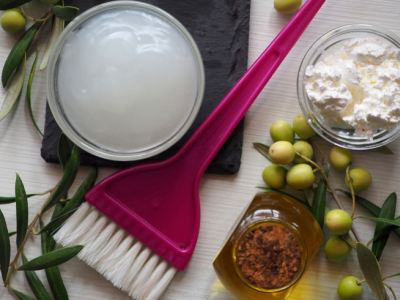
Industrial shampoos contain an average of 25 ingredients, including sulfate surfactants that strip the scalp and trigger a vicious cycle: the more you wash, the more the sebaceous glands produce sebum to compensate, and the faster the hair becomes greasy again. The solution does not come from a new gentler shampoo, but from a change in logic: the homemade ghassoul shampoo, a cleansing clay used for over a thousand years in Moroccan hammams.
In this comprehensive guide, you will find the 5-minute homemade ghassoul shampoo recipe, its real benefits according to scientific studies, the application method known as no-poo, how to adapt it to your hair type (oily, dry, curly, colored), and what you need to know before starting. This recipe has been tested and validated by the Biovie team with the raw unheated ghassoul from Argiles du Soleil for over 15 years.
What is ghassoul, this clay from the Middle Atlas?
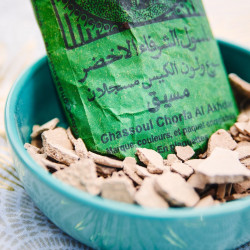
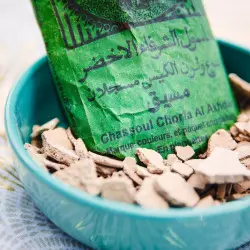
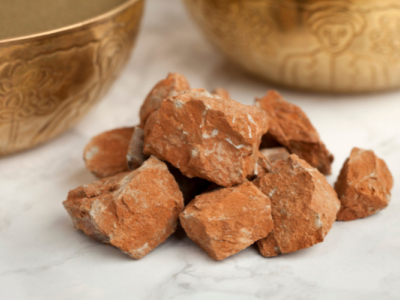
The ghassoul (also spelled rhassoul, rassoul or rassal) derives its name from the Arabic verb ghassala, which means “to wash”. It is literally “the earth that washes.” Used for over a thousand years by Berber women in traditional hammams to clean the skin and hair without soap, it is now established as the go-to alternative to industrial shampoo in no-poo routines.
A unique volcanic clay in the world
Unlike other cosmetic clays, ghassoul is extracted from only one deposit in the world: Jbel Ghassoul, in the Boulemane region at the heart of the Moroccan Middle Atlas. Geologically, it is a stevensite - a magnesium smectite clay - of volcanic origin. This geographical rarity and its exceptional composition make it an ingredient almost without equivalent in natural cosmetics.
An exceptional mineral composition
Ghassoul is distinguished by a remarkable mineral richness, entirely of natural origin:
Silica: about 58% - structure and tonicity of the hair fiber
Magnesium: about 25% - soothing for irritated scalp
Iron: about 4.7% - revitalizing, shine
Potassium: about 2.4% - hydration and suppleness
Calcium, sodium, trace elements: in trace amounts
Natural pH: 7 to 8 - slightly alkaline, compatible with the scalp's hydrolipidic film
Why it replaces shampoo (and how)
The fundamental difference between a classic shampoo and ghassoul is chemical. Shampoos clean by detergence: their surfactants (often sulfates like SLS or SLES) emulsify fats but attack the protective lipid barrier. Ghassoul, on the other hand, cleans by adsorption: its lamellar crystalline structure physically captures sebum, residues, and pollution particles, without ever stripping. The hydrolipidic film is preserved, breaking the “wash-re-grease” cycle.
A study published in 2009 in the International Journal of Cosmetic Science (Clark & Marks) compared ghassoul to a standard soap on 28 volunteers: ghassoul significantly improved skin texture, reduced flaking and roughness, without stripping or unbalancing the skin. These effects are transferable to the scalp, whose physiology is similar to that of the face.
The homemade ghassoul shampoo recipe in 5 minutes
This basic recipe is suitable for all hair types. It is prepared just before showering and does not keep for more than 24 hours in the refrigerator.
Ingredients (1 wash for medium-length hair)
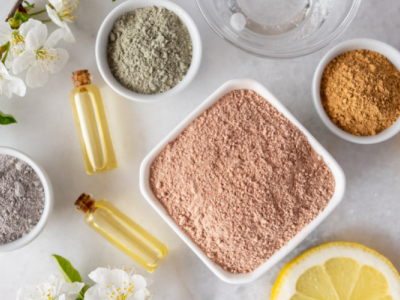
2 to 3 tablespoons of ghassoul in flakes or powder (adjust according to length)
Filtered lukewarm water or spring water - about 10 cl
Optional: 1 teaspoon of hydrosol (lavender, rosemary, chamomile) instead of part of the water
Optional: 2 to 3 drops of essential oil (tea tree for dandruff, ylang-ylang for dry hair, lavender to soothe)
Equipment: a glass, ceramic, or wooden bowl - never metal, as it neutralizes the ionic activity of the clay. A wooden or plastic spoon for mixing.
The 3 step-by-step stages
Pour the ghassoul into the bowl. Gradually add the lukewarm water while mixing with the wooden spoon until you obtain a smooth, homogeneous, and creamy paste, with the consistency of thick yogurt or dessert cream.
Let it sit for 5 minutes so that the clay fully absorbs the water and releases its minerals. At this stage, you can add the hydrosol or essential oils.
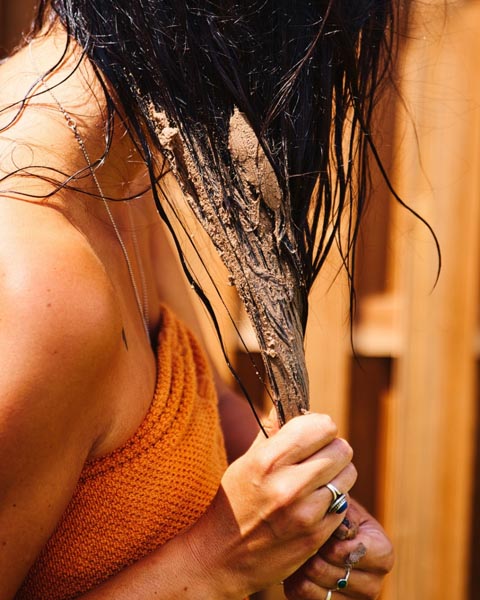
Apply immediately to wet hair, root by root. The paste should be fluid; if it thickens too much during resting, add a few drops of water.
Preparation time and storage
The preparation takes 5 minutes. The paste does not keep: it is prepared on demand. The dry ghassoul in flakes or powder can be stored for several years away from moisture in its original bag.
Feedback and scientific data converge on several concrete benefits of ghassoul on hair, without any of the usual aggressions of industrial surfactants.
Oily Hair and Unbalanced Scalp
This is the primary indication for ghassoul. Its adsorption action absorbs excess sebum without stimulating the compensatory production triggered by detergent shampoos. Over the weeks, the frequency of washing naturally decreases: you go from 3-4 shampoos per week to 1 or 2 sufficient weekly washes. It is one of the most effective alternatives for a homemade oily hair shampoo.
Dry, Fragile, and Damaged Hair
Contrary to popular belief, ghassoul does not dry out dry hair if used correctly. Its alkaline pH (7-8) preserves the hair fiber. For dry hair, simply add a vegetable oil (coconut, argan, jojoba, hemp oil for the ends) to the paste, or do a pre-oil bath on the lengths. The result: washed but supple hair, never rough.
Fine, Curly, Kinky Hair: An Adaptation for Every Type
Ghassoul adapts to all hair types. For fine hair, it provides volume without weighing it down. For curly and kinky hair, it helps define curls without creating frizz, provided you hydrate well after washing (leave-in, vegetable oils). Many curly girl routines incorporate ghassoul alternately with co-wash.
What It Does, What It Doesn't Do
Ghassoul cleans, soothes, adds shine and volume, rebalances the scalp and acts as a gentle homemade clarifying shampoo, capable of removing care residues without being harsh. However, it is not a styling product: it does not replace a moisturizing treatment, an oil, or a detangler after washing. And it does not lather - a peculiarity to accept at the beginning of the transition.
How to Adapt the Recipe to Your Hair Type
The strength of ghassoul shampoo is its modularity. From the basic recipe, you can adapt according to your needs.
Oily Hair: Pure and Effective Version
Ghassoul + water, period. Optionally, 2 drops of tea tree or rosemary essential oil to enhance the sebum-regulating action. Frequency: 1 to 2 times per week maximum. Do not increase the dose, it will not make the wash more powerful.
Dry or Damaged Hair: Add a Vegetable Oil
Incorporate 1 to 2 teaspoons of melted coconut oil, hemp oil, argan, or jojoba oil into the paste. You can also replace half of the water with plant milk (oat, almond) for a more nourishing effect. Also discover our complementary homemade hair mask recipes to extend care between washes.
Colored or White Hair: Precautions
On colored hair, ghassoul can dull the color after several washes: it is clarifying. To limit the effect, use a reduced dose, leave on for a short time (2 to 3 minutes maximum), and rinse very thoroughly. On white or gray hair, the presence of iron can cause slight yellowing if left on for too long: same recommendation - light dose, brief application, thorough rinsing, and a final rinse with diluted apple cider vinegar to close the cuticles.
Enhanced Version with Hydrosols and Essential Oils
To further personalize, replace the water with a suitable hydrosol: rosemary (tired hair, hair loss), lavender (irritated scalp), chamomile (blond hair), nettle (dull hair). Add 2 to 3 drops of essential oil. For scalps prone to dandruff or for a homemade anti-dandruff shampoo, add tea tree or noble laurel.
The No-Poo Washing Method: The 5 Application Steps
The application technique is as important as the recipe. A good ghassoul shampoo poorly applied will give disappointing results; well applied, it becomes the best ally for a healthy scalp.
Thoroughly wet the hair with lukewarm water for 1 minute. Well-soaked hair will facilitate the penetration of the ghassoul.
Apply the paste directly to the scalp, part by part, in small amounts. The goal is to treat the roots, not the lengths. Gently massage with the pads of your fingers (not the nails) for 2 to 3 minutes - this massage activates microcirculation.
Slide the paste onto the lengths by adding a little water if necessary. Do not rub: ghassoul works by contact, not by friction.
Leave on for 3 to 5 minutes maximum (never more than 10 minutes, the clay should not dry completely on the hair).
Rinse very thoroughly with lukewarm water until the water runs completely clear. Insufficient rinsing is the number one cause of dull hair after a ghassoul wash. Ideally finish with a final rinse with diluted apple cider vinegar (1 tablespoon in 1 liter of fresh water) to close the cuticles and add shine.
Recommended Frequency: 1 to 2 washes per week. Initially, you can keep your usual shampoo between two ghassoul washes, then gradually space them out.
Precautions, Mistakes to Avoid, and Contraindications
Ghassoul is non-toxic, hypoallergenic and suitable from childhood. However, it is useful to know the points of caution to avoid disappointments:
Insufficient rinsing: This is the most common mistake. Clay residues can leave a dull film, grayish films, or a "sticky hair" appearance. Rinse for at least 2 to 3 minutes with plenty of water.
Hard water: Lime can precipitate with the clay and leave a deposit. If your water is very hard, consider a chlorine and lime scale shower filter, or at least a final acidic rinse (diluted apple cider vinegar or lemon juice).
Too long application: Never let it dry completely. Maximum 10 minutes.
Metal utensils: Avoid. Metal disrupts the ionic activity of ghassoul. Use only glass, ceramic, or wooden bowls.
Very dry hair: Never apply pure, always enrich with a vegetable oil.
Sensitive scalp (active eczema, wounds, severe irritations): Test on a small area 48 hours before, or seek advice from a dermatologist.
White hair: Avoid long applications (risk of slight yellowing due to iron), prefer reduced doses.
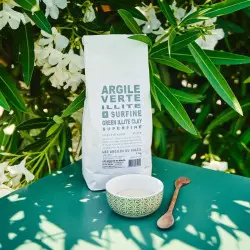
Do not confuse with green clay (montmorillonite), whose uses and properties differ. Ghassoul cleanses, green clay purifies.
How long for a true no-poo transition?
Switching from industrial shampoo to ghassoul involves a transition period. The sebaceous glands, accustomed to overproducing to compensate for the aggression of sulfates, take 2 to 6 weeks to return to their natural rhythm. During this phase, hair may seem greasier than usual, or have an unusual texture (rough, dull). This is normal and temporary.
Feedback from users on the ghassoul hair before and after experience converges on the same observation: after 4 to 6 weeks, hair becomes shinier, more voluminous at the roots, less greasy over time. The frequency of washes is halved. Many describe a sensation of a "finally soothed" scalp, without itching. This qualitative testimony aligns with the 2009 study mentioned earlier, which measured comparable effects on the skin.
FAQ: Your questions about homemade ghassoul shampoo
What is ghassoul and where does it come from?
Ghassoul is a volcanic clay from the stevensite family, extracted only from the Jbel Ghassoul deposit in the Middle Atlas of Morocco. Its name comes from the Arabic ghassala meaning "to wash." Used for over a thousand years in traditional hammams, it cleanses the skin and hair without detergent thanks to its adsorption properties.
How to make a homemade ghassoul shampoo in 5 minutes?
Mix 2 to 3 tablespoons of ghassoul flakes with about 10 cl of filtered warm water in a glass bowl, never metal. Let it sit for 5 minutes until you get a smooth paste, then apply to wet hair, massage for 2 to 3 minutes, leave on for 3 to 5 minutes, and rinse thoroughly.
Is ghassoul good for all hair types?
Yes, ghassoul is suitable for all hair types: oily, dry, fine, thick, curly, frizzy. For dry hair, it should be enriched with a vegetable oil (coconut, argan, hemp). For colored or white hair, use a reduced amount with a brief application to limit the clarifying effect. It is hypoallergenic and suitable from childhood.
How often can ghassoul be used on hair?
1 to 2 times a week maximum. Unlike industrial shampoos that trigger overproduction of sebum, ghassoul rebalances the scalp over the weeks. The frequency of washing spontaneously decreases: many users go from 3-4 weekly washes to just 1 after a few months.
How long should ghassoul be left in the hair?
From 3 to 5 minutes, never more than 10 minutes. The clay should not dry completely on the hair or scalp: it would continue to draw out water and weaken the fiber. For colored or white hair, reduce to 2 to 3 minutes maximum.
What are the disadvantages or precautions to know?
The main disadvantage is the transition period of 2 to 6 weeks, during which hair may appear greasier or rougher. Other points of caution: rinse well to avoid deposits, avoid metal utensils, enrich with a vegetable oil for dry hair, and reduce application time on colored or white hair.
Can ghassoul be used on colored or white hair?
Yes, but with caution. On colored hair, ghassoul is slightly clarifying and can dull the color after several washes: use a small amount, a short application (2 to 3 minutes), and rinse thoroughly. On white hair, its iron content can cause slight yellowing with prolonged application: same precautions, and a final rinse with diluted apple cider vinegar to revive whiteness.
How long does the no-poo transition with ghassoul last?
Between 2 and 6 weeks depending on the person. Hair accustomed to sulfate shampoos needs to rebalance: sebum production, pH, scalp microbiota. After this period, hair becomes shinier, more voluminous, and less greasy on a daily basis. To ease the transition, alternate with regular shampoo during the first few weeks.
“We have been using ghassoul at home for almost twenty years, with Aurélie and our six children. It is probably the simplest and most universal care product in our bathroom: a single ingredient, water, and hair that rebalances itself. When we discovered Argiles du Soleil and their sun-dried, non-thermized rassal, the difference with classic mass-market ghassouls was striking - much creamier, much gentler on the scalp. It is in this same logic of living, unprocessed ingredients that we built Biovie and that I wrote Algae for Everyday.” - Eric Viard, founder of Biovie.
Warning: The information presented in this article is provided for informational purposes and does not constitute medical advice. Consult a qualified healthcare professional before making any significant changes to your care routine, especially in the case of active scalp dermatosis. As part of a natural beauty routine and a healthy lifestyle.
Find our entire range of unheated clays and organic ingredients for natural care at https://www.biovie.fr/en/