Fast delivery
.png)
 Fair prices


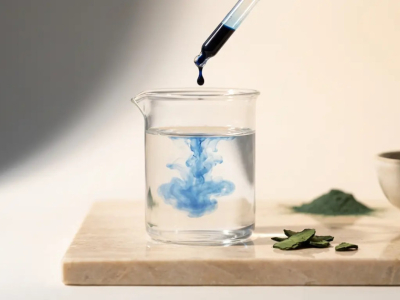

Phycocyanin is the blue pigment-protein that gives spirulina its characteristic color — and above all, it is its main asset. It helps protect cells against oxidative stress, contributes to the balance of the inflammatory response, and plays a documented role in supporting the immune system. In this article, I share with you what 18 years of rigorous selection of organic spirulina and the available studies allow us to assert — without exaggeration, and without hiding from you what we still poorly understand.
Phycocyanin: definition and origin (the basics everyone is looking for)
What exactly is phycocyanin ?
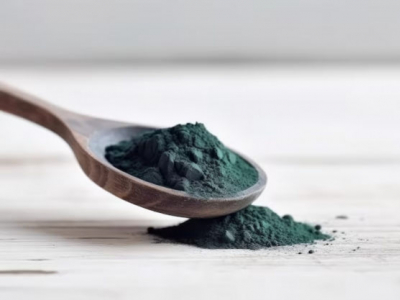
Let's start at the beginning. The Phycocyanin belongs to the family of phycobiliproteins — in simple terms, these are naturally pigmented proteins capable of absorbing light and converting it into energy. It is mainly found in cyanobacteria, the most well-known and widely consumed of which is Spirulina platensis, our spirulina.
What makes phycocyanin truly remarkable is that it combines two rare functions in nature: on one hand, it acts as a structural protein of the algal cell; on the other, it is a powerful free radical scavenger. It is this dual nature that explains the scientific enthusiasm around it for the past thirty years.
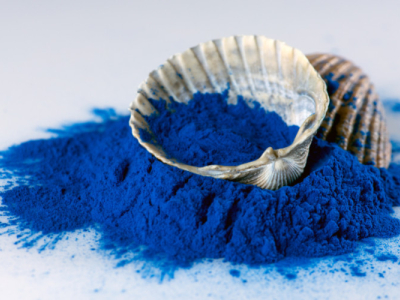
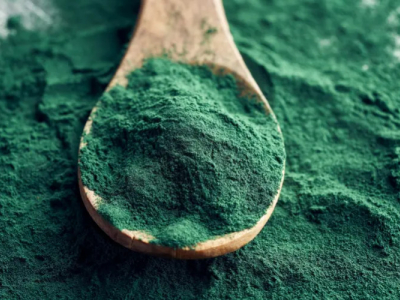
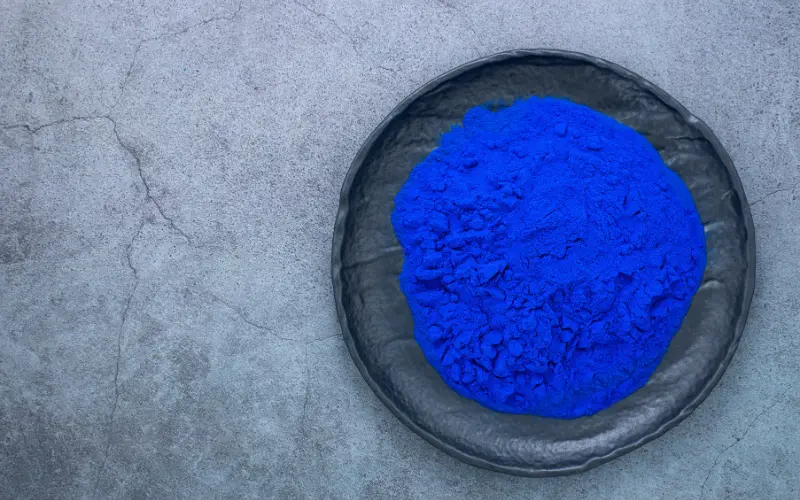
Its intense blue color — a deep and very characteristic cyan-blue — has become its visual identity. It is often referred to as "the blue gold of algae," which is not just a marketing argument: it is also an indicator of quality. The more intense and pure the hue, the more the Phycocyanin is focused and active.
Where does it come from? Spirulina, Klamath, and other sources
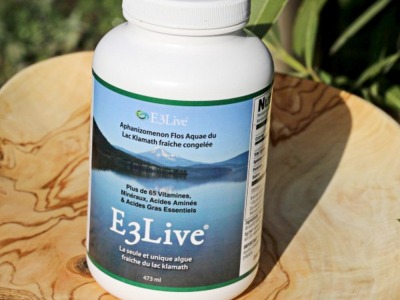
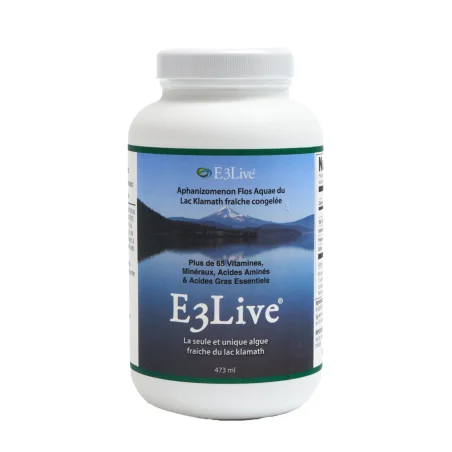
Spirulina remains by far the most widespread source of phycocyanin. However, there is another freshwater microalga that is just as rich in it, if not more so under certain conditions: the Klamath algae.Aphanizomenon flos-aquae), harvested from Klamath Lake in Oregon. This is one of the reasons why we offer this frozen Klamath algae at Biovie — freezing preserves fragile compounds like phycocyanin much better than traditional drying processes. If you want to learn more about this particular algae, I discuss it in detail in my article on Klamath, the algae of regeneration.
Apart from these two sources, other cyanobacteria contain phycocyanin, but they are not available on a commercial food scale. For you, the consumer, the question is simple: spirulina or Klamath are your two concrete options.
France is today the leading European producer of organic spirulina artisanal, with more than 200 certified farms, many of them located in the south of France, particularly in Occitanie.
Blue phycocyanin: why this color ?
The blue color of phycocyanin is not a coincidence of nature. It results from a very particular molecular structure that allows it to absorb light wavelengths in the orange-red tones and reflect blue. This optical property is also used by scientists to measure the concentration of Phycocyanin in an excerpt: we talk about theIndex E6 (or absorbance at 620 nm), which corresponds to the measurement of this specific light absorption.
Concretely, a E6 index greater than 0.7 indicate a spirulina that is sufficiently rich in phycocyanin to have real value. At Biovie, this is one of our non-negotiable selection criteria.
Phycocyanin vs spirulina: what is the concrete difference ?
This is the question our clients ask me most often, and it's a very good question. The confusion is understandable — both are mentioned in the same articles, the same aisles of organic stores. Here's how to clearly distinguish them.
Whole spirulina contains phycocyanin, but not the other way around.
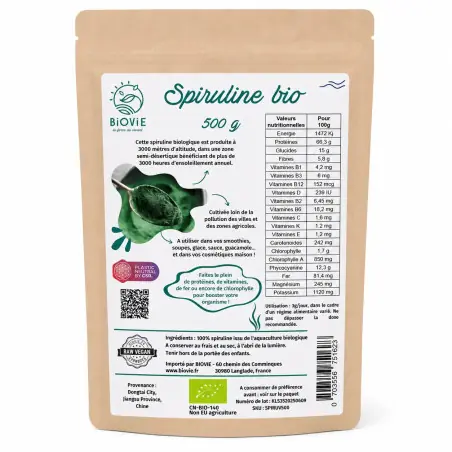
Spirulina is a complete living organism—a filamentous cyanobacterium that concentrates proteins, vitamins (B12, B9, beta-carotene), essential fatty acids, minerals, and chlorophyll in its biomass. The Phycocyanin, it is only one component of this spirulina — its main pigment, its most studied active ingredient, but a component among others.
In reality, phycocyanin represents between 10 and 20% of the dry weight of a quality spirulina. This means that if you consume 3 grams of dried spirulina per day — a common dose — you theoretically absorb between 300 and 600 mg of phycocyanin. In theory.
How to calculate your actual phycocyanin intake
This is where it gets interesting — and where the competition often lacks transparency.
Your actual contribution in Phycocyanin depends on several factors that few brands explain to you:
- The quality of spirulina : A low-cost spirulina, often of Chinese origin and dried at high temperatures, can lose a large part of its active phycocyanin, which is a fragile molecule. This is why the E6 index is so important.
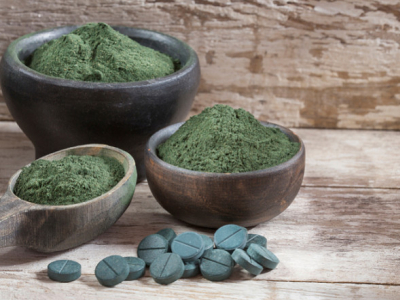
- The dosage form Phycocyanin is more bioavailable in liquid form or as a concentrated extract than in whole spirulina powder. In the powder, it is "trapped" within the cell wall, and a portion is not absorbed.
- Concentrated extracts : an extract of phycocyanin titrated at 25% means that 100 mg of this extract provides 25 mg of active phycocyanin. This is very different from 100 mg of spirulina powder, which would contain only 10 to 20 mg at most, with variable bioavailability.
This is why "taking spirulina" and "taking phycocyanin" are not exactly the same thing, even though spirulina remains an excellent way to naturally benefit from this active ingredient. To learn more, consult our guide on how to consume spirulina.
The 6 benefits of phycocyanin proven by science
I will be precise on this point because it is important: all the properties of the Phycocyanin are not documented at the same level of evidence. Some are established in humans, while others are still at the stage of animal or in vitro studies. I tell you each time where the research stands — it's more useful than presenting everything as established.
1. An exceptional antioxidant that contributes to cellular protection
This is the best-documented benefit. The Phycocyanin contributes to remarkably effectively neutralizing reactive oxygen species (ROS) — these free radicals that damage our cells daily and contribute to aging. Its ORAC (Oxygen Radical Absorbance Capacity), which measures antioxidant capacity, is estimated to be between 5 and 20 times higher than that of conventional plant antioxidants according to studies.
A meta-analysis published in 2022 in the Journal of Functional Foods confirmed measurable antioxidant activity in vivo — that is to say, not only in test tubes but in living organisms. Reddy et al. (2000) had already shown in Biochemical and Biophysical Research Communications antioxidant properties particularly active on peroxyl radicals.
A varied and balanced diet and a healthy lifestyle are important for maintaining good health.*
2. Support for inflammatory balance (COX-2 mechanism)
The Phycocyanin participates in the modulation of the enzyme COX-2 — cyclooxygenase-2 — which is one of the main pathways for the production of inflammatory mediators in the body. This mechanism of action is well documented in the scientific literature, notably by Chamorro et al. (2002) in the Journal of Applied Phycology, who observed a reduction in inflammatory markers — IL-6, TNF-α, CRP — in subjects supplemented with phycocyanin.
It is a very promising course of action, particularly for individuals whose bodies are subjected to a chronic low-grade inflammatory state. It should be noted that phycocyanin is not a medication and does not replace medical treatment — it is part of a comprehensive nutritional support approach.
3. Documented immune system support
Studies conducted on athletes have shown an interesting immunomodulatory effect of the Phycocyanin. An article published in 2019 in the journal Nutrients monitored athletes who were supplemented for 8 weeks with 25 mg of phycocyanin per day: the researchers observed a reduction of about 30% in the frequency of upper respiratory infections in the supplemented group compared to the placebo group.
The proposed mechanism involves the stimulation of T lymphocytes and NK (natural killer) cells, which play a central role in our adaptive immune response. These results are consistent with what we empirically observe in our clients — and with the feedback we receive every winter about our spirulinas. To go further, I have dedicated a full article to the link between spirulina and immunity.
"Serious site on which I have ordered several times (spirulina, chlorella, sea water...). Quality products at fair prices, quite unique and unavailable elsewhere."
— Gillian, Biovie customer ⭐⭐⭐⭐⭐ (Trustpilot)
4. Neuroprotection: What the 2022-2024 Studies Say
This is the most exciting research avenue at the moment, and I will present it to you honestly. Studies conducted in vitro and on animal models show that the Phycocyanin participates in the reduction of neurotoxicity related to the accumulation of beta-amyloid — the well-known plaque characteristic of Alzheimer's disease — and contributes to the protection of dopaminergic neurons, which are the ones affected in Parkinson's disease.
These results are still preliminaries in humans — I cannot tell you today that phycocyanin prevents Alzheimer's, that would be excessive and inaccurate. However, the observed mechanisms make it a molecule closely monitored by neuroscientists, and human studies are underway. It should be followed with great attention.
5. Support for hematopoiesis: interest for athletes and convalescents
The Phycocyanin participates in stimulating the production of red blood cells and platelets by acting as a natural support factor for hematopoiesis — the process by which our bone marrow produces our blood cells. It is precisely for this reason that phycocyanin has been nicknamed "the natural EPO" in professional cycling circles, where its use has been documented since the 2000s.
For endurance athletes, support for muscle oxygenation can lead to better recovery. For people in recovery — post-surgery, post-chemotherapy — preliminary Japanese studies (2021) show potential interest in supporting the replenishment of blood cells.
The beneficial effect is achieved with a dose of 25 to 50 mg of phycocyanin per day, combined with a varied and balanced diet.
6. Liver health support: preliminary results
Studies on animal models show support for liver tissue against oxidative damage, with a measurable reduction in transaminases (the enzymes whose elevation indicates liver distress). Phycocyanin appears to play a protective role for liver cells subjected to significant oxidative stress.
Here again, the evidence in humans is still limited — but the mechanisms are robust enough for this avenue to be taken seriously by researchers.
Phycocyanin and fatigue: what can really be expected
This is the number one reason why our clients turn to the Phycocyanin. And it is a perfectly legitimate expectation — provided that one understands why she can help, and in what timeframe.
Phycocyanin contributes to the improvement of vitality through two complementary mechanisms. First, its support for hematopoiesis aids in better cellular oxygenation — when your red blood cells function better, your cells receive more oxygen, and you have more energy available. Then, its antioxidant action helps reduce oxidative stress, which is one of the underlying causes of chronic fatigue.
72% of our Biovie customers report a noticeable improvement in their energy levels after a spirulina treatment — this is internal data, but it is consistent with what science explains. In fact, I have dedicated an entire article to it. spirulina and chronic fatigue if you want to go further.
In terms of timing, let's be realistic: the first effects on energy are generally observed after 1 to 2 weeks regular dose treatment. The effects on immunity require 4 to 8 weeks. It is not an overnight miracle solution, but a gradual and sustainable support. To complement your approach, also consult our 5 tips to combat fatigue.
"Since discovering BioVie and living foods, my health has transformed. I feel lighter, more energetic, with a true sense of serenity every day. The products are of exceptional quality with a real positive impact on well-being."
— Siegfried RAMAUGE, Biovie customer ⭐⭐⭐⭐⭐ (Trustpilot)
Phycocyanin Dosage: The Practical Guide by Objective
This is one of the most important sections of this article because this is where most of the sources are vague or inaccurate. Here is what science and our field experience allow us to recommend.
According to your goal:
- Vitality / daily antioxidant maintenance : 10 to 15 mg of phycocyanin per day, continuously
- Immune support and anti-fatigue : 20 to 25 mg per day, in a course of 4 to 8 weeks
- Sports recovery : 30 to 50 mg per day, before and after exercise
- Intensive protocol : 50 mg per day, for a maximum duration of 4 weeks, followed by a one-month break
A progressive protocol that I often recommend for beginners: start at 15 mg the first week, increase to 25 mg in the following weeks, then adjust according to how you feel. Your body adapts better to a gradual increase.
How to take phycocyanin: morning on an empty stomach, forms, duration of treatment
The Phycocyanin is ideally taken in the morning, on an empty stomach or at breakfast, to maximize absorption. It pairs very well with citrus juice or lemon water — vitamin C can enhance the absorption of certain active ingredients.
Regarding the duration: a course of 3 to 8 weeks is generally recommended, followed by a break of at least 3 to 4 weeks. It is not a lifelong supplementation, but a targeted tool to be used at times when your body needs it most — change of season, periods of intense stress, sustained athletic effort, recovery.
Liquid phycocyanin vs spirulina powder: advantages and bioavailability
The form presents a notable advantage in bioavailability: the Phycocyanin is directly available, without the barrier of the spirulina's cell wall. In powdered spirulina, the active ingredient must first be released during digestion — which occurs well, but more slowly.
For maintenance and daily comfort purposes, organic whole spirulina (in powder form) remains an excellent natural option that provides phycocyanin along with all the other nutrients of the algae. For more targeted purposes — sports recovery, intensive protocol — phycocyanin offers superior dosage precision.
"High-quality products and fast delivery. The spirulina powder is exceptional."
— Barbara Wencker, Biovie customer ⭐⭐⭐⭐⭐ (Trustpilot)
Phycocyanin danger: the real contraindications (without dramatizing)
I will provide you with honest and balanced information here — because the question "phycocyanin danger" comes up frequently in searches, and the answers found are often either too alarmist or too vague.
The rare observed side effects
The Phycocyanin certified organic spirulina is overall very well tolerated. The reported side effects are rare and most often mild: slight nausea, headaches, or skin rashes at the beginning of the treatment. These occurrences almost exclusively pertain to two situations: poor quality products (contaminants, heavy metals in uncertified spirulina) or an excessively high initial dosage.
The solution is simple: choose a spirulina certified organic by a recognized organization like Ecocert, and start with a low dose, gradually increasing it. This is why certification is not just a marketing detail — it is a guarantee of real safety. To learn more about how to identify the right labels, check out our guide on the reliable organic labels.
Who should avoid or monitor phycocyanin ?
Several situations require vigilance or prior medical consultation:
- People on anticoagulants (VKAs) : phycocyanin may have an effect on platelet coagulation — monitoring with your doctor is advised
- Immunocompromised individuals : immune stimulation may not be suitable for certain pathologies
- Pregnant or breastfeeding women : as a precaution, in the absence of sufficient human data
- People allergic to algae : obvious contraindication
- People suffering from phenylketonuria : spirulina contains phenylalanine
Apart from these cases, at usual doses and with a quality product, phycocyanin does not present any proven danger.
Phycocyanin and cancer: what science says (honestly)
This topic is being researched, and it deserves a straightforward answer.
Studies in vitro — on cancer cells cultured in the laboratory — showed that the Phycocyanin could contribute to inhibiting the proliferation of certain tumor cell lines and induce apoptosis (programmed death of cancer cells). These results are scientifically interesting.
But I will be direct: To date, there is no robust clinical study in humans that establishes an anticancer effect of phycocyanin.. Animal studies are promising, the in vitro mechanisms are real, but the leap to clinical use in humans is still a research horizon, not a validated reality.
What can be said with more foundation: phycocyanin, through its antioxidant properties, helps reduce oxidative stress and chronic inflammation, two factors involved in the development of various long-term pathologies. It is an indirect benefit, but well-documented.
How to choose a quality phycocyanin (the Biovie angle)
After 18 years of selecting and auditing organic spirulina, I have learned to distinguish what truly makes a difference from one product to another. Here are the criteria I apply myself.
The E6 index: the purity indicator that few brands mention
TheIndex E6 (Spectrophotometric absorbance at 620 nm) is the only objective and measurable indicator of the active phycocyanin concentration in a spirulina. A quality spirulina should display an E6 index. greater than or equal to 0.7 — it is the threshold below which the phycocyanin content becomes too low to have a real impact.
Yet very few brands communicate this index to their customers. However, it is a piece of data that can be easily measured and should not be hidden. When we select our spirulina at Biovie, it is one of the first criteria we check — along with the complete batch analysis certificate.
"I ordered the frozen Klamath (delivered in insulated packaging) and the unheated illite clay (rare today), the quality is there! I am very satisfied."
— Agnès Fourcin, Biovie customer ⭐⭐⭐⭐⭐ (Google)
The certifications to require (organic, contaminant-free)
Points to watch out for before buying a Phycocyanin or a spirulina:
- Organic certification : Ecocert, AB, EU Organic — these labels guarantee the absence of pesticides and a controlled production specification.
- Contaminant analysis : Ideally, the brand should be able to provide a batch analysis certificate including the testing for heavy metals (lead, mercury, cadmium).
- E6 index communicated : if the brand does not mention it, ask for it — a serious brand will respond to you
- Traceability of origin : France or Europe preferably, with the name of the farm if possible
FAQ — Your questions about phycocyanin
What is phycocyanin ?
Phycocyanin is a blue pigment-protein naturally found in spirulina and certain algae like Klamath. It is the main active component that contributes to giving spirulina its antioxidant properties and its role in inflammatory balance. It accounts for between 10 and 20% of the dry weight of high-quality spirulina, with a characteristic intense blue color.
Can phycocyanin be taken every day ?
Yes, phycocyanin can be consumed daily during a course of 3 to 8 weeks. The recommended dose varies between 20 mg and 50 mg per day depending on the goal. It is advisable to take a one-month break between courses to maintain the body's sensitivity. A varied and balanced diet and a healthy lifestyle are important for maintaining good health.
What are the effects of phycocyanin on the brain ?
Phycocyanin contributes to a documented neuroprotective effect by reducing brain inflammation and helping protect neurons against oxidative stress. Preliminary studies on animal models suggest potential benefits in supporting cognitive function. These results are still being evaluated in humans.
What are the side effects of phycocyanin ?
Side effects are rare and generally mild: slight nausea, headaches, or skin rashes at the beginning of the treatment. These manifestations are often linked to insufficient product quality or an excessively high initial dosage. Starting with a low dose and gradually increasing it helps to avoid these inconveniences in most cases.
What is the difference between spirulina and phycocyanin ?
Phycocyanin is the main active compound extracted from spirulina — it is the most studied substance from it. Consuming whole spirulina naturally provides phycocyanin, but in varying amounts depending on the quality. Concentrated extracts allow for more precise and higher doses for specific purposes.
When do we see the effects of phycocyanin ?
The initial effects on energy and vitality are generally observed after 1 to 2 weeks of regular dosage treatment. The effects on immunity require 4 to 8 weeks to become fully noticeable. A long-term commitment — at least 3 to 4 weeks — is necessary to observe real benefits.
Is phycocyanin dangerous ?
No, phycocyanin derived from certified organic spirulina is very well tolerated. The situations to monitor involve people on anticoagulants, pregnant women, immunocompromised individuals, and those allergic to algae. Outside of these cases, organic quality phycocyanin does not present any known danger at usual doses.
A varied and balanced diet and a healthy lifestyle are important for maintaining good health. Phycocyanin is a dietary supplement, not a substitute for a quality diet or medical treatment. If in doubt, consult your doctor or pharmacist.
Update: March 2026. Article approved by Éric Viard, founder of Biovie and engineer ISTOM, co-author of " Seaweed in everyday life "(Gallimard, 2024) —" Best cookbook in the world, Gourmand Cookbook Awards 2025, and Best cookbook in France, National Academy of Cuisine 2025.