





Introduction: The Dilemma of Water Filtration
Are you tired of buying packs of bottled water, but are unsure whether to choose a water filter pitcher or a reverse osmosis system? You are not alone: thousands of French people ask themselves the exact same question every month when they are looking for a alternative to bottled water.
Honestly, I understand your hesitation. With Aurélie, we regularly receive messages from people completely lost in the face of contradictory statements about water filtration, or disappointed with bottled water. On one hand, carafe sellers promise you pure water for next to nothing. On the other hand, osmosis system installers tell you it's the only truly effective system. And in between? You're there, wondering what is true, what is just marketing, and most importantly: which solution will really meet your needs.
That's why I decided to write this article today to give you a clear, honest, and comprehensive view of these two systems. Because the quality of the water we drink daily is something fundamental to our health, isn't it ?
The numbers are staggering: in France, we consume 9 billion liters of bottled water per year. That represents 4.5 billion plastic bottles. Meanwhile, 59% of French people state that they would drink more tap water if it tasted better. And here, it's interesting: the home filtration market is literally booming. The global water filter market is going to increase from $15.88 billion in 2024 to $26.42 billion in 2032. In France, the water treatment sector has experienced growth of +10.8% between May 2024 and May 2025.
Why this explosion? Because trust in tap water has never been so low: only 80% of French people trust their tap water today. This is a historically low level. And frankly, when we discover that 96% of the tested municipalities contain traces of PFAS (those infamous forever chemicals) and that 93% of our waterways are contaminated by pesticides, this mistrust is better understood.
So yes, choosing a home water filtration system, it has become a real concern. But here it is: What is the difference between a water filter pitcher and a reverse osmosis system? ?How do you know which one corresponds to your situation? That's exactly what we will explore together in this comprehensive comparative article.
How does a water filter pitcher really work ?
Let's start at the beginning: the water filter pitcher. Today, about 20% of French households by using one. It's huge! But do you really know what happens when you pour your tap water into a carafe ?
The principle is actually quite simple. Water passes through a filter that is often the size of a thimble, or slightly larger, mainly composed of activated carbon and ion exchange resins. Activated carbon is somewhat like a microscopic sponge that captures certain undesirable molecules: chlorine (which gives tap water its unpleasant taste), certain pesticides, and some heavy metals. The resins exchange ions to reduce limescale.
On paper, it sounds perfect, doesn't it? A small cartridge that transforms your tap water into pleasant drinking water for a minimal investment. A pitcher filter costs on average 5 to 6€ and allows you to filter about 100 to 150 liters of water. It's true that when you calculate, you end up with about €0.06 per liter. Compared to €0.20 to €0.40 per liter in a bottle, the savings are real: between 60€ and 350€ per year depending on the brand of water you used to buy.
Concretely, a single filter replaces approximately 300 bottles of 500ml. It is still significant from an ecological and economic point of view.
The real benefits of the water filter pitcher
So, what makes carafes successful? Several things, and it's important to recognize them:
Ease of use is really the first point. You buy your carafe at any supermarket, you go home, rinse the filter, and voilà: you're all set. No installation, no need to call a plumber, no hole to drill under the sink. Even my 75-year-old mother was able to do it all by herself.
The entry price is unbeatable. Between €20 and €40 for the carafe with an initial filter included. Honestly, it's affordable for any budget. And the replacement filters really don't cost much.
For tenants, it's ideal. You can take it with you when you move, no need to ask the landlord for permission, no plumbing modifications. It's just... simple.
The improvement in taste is real. I'm not going to lie to you: removing chlorine really changes the taste of the water. For many people I know, it was the trigger to stop buying bottled water. And honestly, drinking more water because it tastes better is already a big health benefit.
Here are the positive points. And they are real, I do not minimize them.
The limitations identified by ANSES: the true effectiveness of water filter pitchers
Now, we need to talk about the problems. Because it's becoming less rosy. And be careful: I'm not telling you this to scare you, but because there have been serious studies on the subject that question the actual effectiveness of water filter pitchers.
In 2017, ANSES (National Agency for Food, Environmental and Occupational Health Safety) released a report that caused quite a stir. Honestly, this report is chilling when you read the conclusions.
First shocking observation: out of 31 households tested under real usage conditions, 100% of the filtered water was microbiologically degraded compared to the unfiltered tap water. You read that correctly: 100%. Not 30%, not 50%, ALL the samples.
Why? Because the filter is a moist, warm environment (in your kitchen), and rich in organic matter. In short: it's paradise for bacteria. If you don't change your filter exactly on time (and let's be honest: who precisely counts the liters of filtered water?), if you don't store it in the fridge between uses, if you don't rinse it well each time... you are literally creating a bacteria nest in your filter pitcher.
UFC Que Choisir even referred to "filter jug breeding ground for bacteria" in one of its reports. Not a very appealing title... And when we talk about the potential dangers of water filter pitchers, it is exactly this point that worries the experts the most.
Second point: the filtration efficiency is "more than questionable" according to the report. Carafes effectively remove chlorine (which is why the taste improves), but what about the rest? It's much more unpredictable. Some pollutants are not filtered at all, while others are only partially filtered. And over time, the filter jug is losing effectiveness Drastically.
Third issue: the release. What is that again? In fact, when the filter becomes saturated, it can release substances into the water that it initially trapped. The result: your water can end up being more contaminated than it was at the start. Nice, isn't it ?
I remember a discussion with a blog reader who told me that he had invested in a high-end carafe, convinced he was making a healthy choice. Three months later, after reading the ANSES report, he had his filtered water analyzed. The result: more bacteria than before filtration. He was disgusted.
Is a water filter pitcher really effective? So? Yes, but with strict conditions: change the filter at the right time (about 1 month or 100-150 liters), rinse the system every day, ideally store it in the fridge, and use the filtered water quickly. Honestly? It's restrictive. And in real life, we don't always do all that.
If you want to delve deeper into the subject of filtration and understand how to properly filter tap water, I recommend our dedicated article that details all the available methods.

The reverse osmosis system: when you want perfection
So now, let's move to the other extreme: the reverse osmosis system. If the pitcher is the entry-level solution, the reverse osmosis system is the professional setup installed in your home, which you will find difficult to take with you if you move.
The principle of reverse osmosis explained simply
Alright, I will try to explain this to you without overwhelming you with technical terms. Reverse osmosis is a process initially inspired by what NASA and other space agencies do to purify water on the International Space Station.
Specifically, tap water arrives under pressure and passes through an ultra-fine membrane. We're talking about pores of 0.0001 microns. To give you an idea, it's so fine that only water molecules can pass through. Everything else - bacteria, viruses, pesticides, heavy metals, lime, nitrates, chlorine, PFAS - all of that is blocked on the other side and goes directly to the sewer.
The complete system generally includes several steps:
- A pre-filter that retains large particles
- An activated carbon filter that removes chlorine
- The famous reverse osmosis membrane
- A post-filter that finalizes the processing
- A storage tank (because the process is slow)
The impressive performances
So, let's be honest: in terms of pure efficiency, the osmosis system outperforms everything. 95 to 98% of contaminants removed, that is the announced rate. And it's true. We are talking about a water purity of more than 98% (NASA standard, no less).
A domestic reverse osmosis system can treat between 10 to 50 liters per day according to the models. For a family, it's more than enough. And frankly, the water that comes out is of exceptional purity. If you've tasted osmosis water, you know what I'm talking about: it's... neutral. Completely neutral. No taste, no smell, nothing.
For people living in areas where tap water is really problematic (high levels of nitrates, pesticides, heavy metals), it is clearly the best tap water filtration system in terms of raw performance.
The major drawbacks they are hiding from you
Okay, now let's talk about the things that annoy us. Because frankly, when you look for information on reverse osmosis systems, you mostly find seller websites that praise their benefits. The major disadvantages of the reverse osmosis system ?That's less emphasized.
Water waste: the real ecological scandal
First problem, and the one that really bothers me the most: the water consumption of a reverse osmosis system. To produce 1 liter of pure water, a reverse osmosis system discharges to the sewer between 3 and 4 liters of water. Yes, you read that correctly. Some older models even go up to 10 liters wasted for 1 liter produced.
Concretely, if your family consumes 4 liters of osmosis water per day, you waste between 12 and 16 liters. Over a year, that amounts to 4,380 to 5,840 liters of water wasted. For a resource that we are told to preserve, frankly, it hurts.
I have a friend who installed a reverse osmosis system without really doing any research. When his water bill arrived, he thought it was a mistake. His overall consumption had increased by 10%.
Osmosis water removes ALL minerals
Second major issue: a reverse osmosis system removes minerals from the water. And I'm not just talking about limescale. I'm talking about EVERYTHING: calcium, magnesium, potassium... all the essential minerals that tap water naturally contains.
So yes, some will tell you "we make up for it with food." That's true. But water is also an important source of minerals, especially for people who drink a lot. Canadian and British studies have shown that water with a too low pH (which happens with osmosis water) can facilitate the release of certain metals from pipes.
Is osmosis water good for health? in the long term? The scientific debate exists. Some experts believe that completely demineralized water is not ideal. Others say it's not a problem. Personally, I prefer to be cautious.
The price: how much does a home reverse osmosis system really cost ?
Let's talk about money now. How much does a home reverse osmosis system cost? ?Hold on:
- Purchase price: €200 to €500 for basic domestic models without any water dynamization
- High-end models can go up to 1500€
- Professional installation: +€200 to €250 (because, let's be clear install a reverse osmosis system yourself, it's technical and risky)
- Annual maintenance cost : a few dozen euros for the filters
- Price of reverse osmosis filters per year : variable depending on usage, but estimate 50-100€
- The membrane (the centerpiece) lasts 2 to 5 years and costs between €50 and €150
In total, over 5 years, you can easily exceed €1000 to €1500. It's a real investment.
Maintenance: how often for the filters ?
Now, attention: a reverse osmosis system, it's regular maintenance. It's not like a carafe that you quickly rinse.
The maintenance of a reverse osmosis system, its frequency :
- Prefilter: every 6-12 months
- Charcoal filter: every 6-12 months
- Osmosis membrane: every 2-5 years
- Tank disinfection: Once a year
If you do not meet these deadlines, efficiency drops, and you even risk contaminating your water. Frankly, it's restrictive. You have to note the dates, order the filters on time, make the changes...
Installation constraints
Last but not least: the installation. An osmosis system requires:
- A water pressure of at least 3.5 bars (otherwise you need to install an electric pump)
- Of the place under the sink (the tank takes up space)
- Of the plumbing modifications (drilling, connections)
- A dedicated faucet on the sink
- Sometimes a power supply (for the pump or the UV lamp)
For a tenant, it is often a deal-breaker. You need the landlord's approval, and when you leave, you must restore everything to its original state or leave the system in place.

Detailed Comparison: 7 Criteria to Make Your Choice
Okay, now that we have looked at both systems in detail, let's do a real point-by-point comparison. Because the difference between a carafe and a water purifier, it's not just the price or the efficiency. It's a set of criteria to evaluate according to YOUR situation.
Budget: initial investment and recurring costs
Filtered carafe:
- Initial investment: €20 to €40
- Monthly filter cost: 5-6€
- Annual cost: 60-72€
- Cost over 5 years: 320-400€
Reverse osmosis system:
- Initial investment: 200-1500€ + installation (200-250€)
- Annual maintenance cost: 50-150€ (filters + membrane)
- Cost over 5 years: 900-2500€
Verdict: The carafe is much more budget-friendly. However, be careful: if you are looking for true filtration efficiency, the TCO (Total Cost of Ownership) of the carafe can become disappointing given its limitations.
Filtration efficiency: what does each system remove ?
Filtered carafe:
- ✅ Chlorine: Very well eliminated (improvement of taste)
- ⚠️ Limestone: Partially reduced
- ⚠️ Heavy metals (lead, copper): Partially reduced
- ❌ Pesticides: Very variable and limited effectiveness
- ❌ PFAS (forever pollutants): Practically not eliminated
- ❌ Medications: Very few eliminated
- ❌ Bacteria/viruses: Risk of proliferation in the filter
Reverse osmosis system:
- ✅ Chlorine: 100% eliminated
- ✅ Limestone: 95-99% eliminated
- ✅ Heavy metals: 95-98% eliminated
- ✅ Pesticides: 95-99% eliminated
- ✅ PFAS: 90-99% eliminated
- ✅ Medications: 95-98% eliminated
- ✅ Bacteria/virus: 99.9% eliminated
Verdict: The reverse osmosis system is largely dominant. If your priority is maximum efficiency, it's without question. But be careful: it also removes EVERYTHING that is good (minerals).
Ecological Impact: The True Environmental Cost
Filtered carafe:
- ❌ Plastic waste : 12 cartridges/year = 60 cartridges over 5 years
- ✅ Water consumption : Zero waste
- ✅ Energy : No electricity consumption
- ⚠️ Production : Plastic cartridges to recycle (rarely done)
Reverse osmosis system:
- ✅ Plastic waste : Less waste (filters changed 1-2 times/year)
- ❌❌❌ Water consumption : 3-4L wasted for 1L produced = 4,380 to 5,840L/year for a family
- ⚠️ Energy : Often electric (pump, UV)
- ⚠️ Production : Complex system with synthetic membrane
Verdict: Ecologically, both have issues. The carafe generates a lot of plastic waste. The reverse osmosis system wastes a significant amount of water. Neither is truly a solution. Ecological for filtering water. This is precisely why gravity filters are emerging as an alternative.
Ease of installation and use
Filtered carafe:
- ✅ Installation: Immediate, no tools required
- ✅ Usage: Fill, wait 5-10 min, drink
- ✅ Laptop: You are taking him/her on a move.
- ✅ Tenants: Perfect, no modification.
Reverse osmosis system:
- ❌ Installation: Complex, requires a plumber (€200-250)
- ❌ Modifications: Sink drilling, plumbing connections
- ❌ Space: Under-sink tank (bulky)
- ❌ Tenants: Mandatory owner agreement
- ✅ Usage: Dedicated tap, water available immediately
Verdict: The carafe outperforms the water purifier in terms of simplicity. It's plug-and-play versus professional plumbing installation.
Water quality: mineralization and pH
Filtered carafe:
- ✅ Preserved minerals : Calcium and magnesium remain
- ⚠️ Slightly modified pH : According to ion exchange resins
- ✅ Improved taste : Chlorine removed = better taste
- ❌ Bacteriological risk : If maintenance neglected
Reverse osmosis system:
- ❌ Demineralized water : ALL minerals removed
- ❌ Acidic pH : Osmosed water often <6 (risk of metal leaching)
- ⚠️ Neutral taste : No taste (some find it bland)
- ✅ Maximum purity : 98%+ pure water
Verdict: It's a matter of priority. Do you prefer naturally mineralized water (carafe) or absolute purity but demineralized (reverse osmosis)? Both philosophies have their merits.
Maintenance and servicing
Filtered carafe:
- ⚠️ Frequency : Filter change every month (or 100-150L)
- ⚠️ Necessary rigor : Daily rinsing, ideally fridge storage
- ✅ Simplicity : Remove, discard, insert new filter
- ❌ Risk : Forgetting = bacterial proliferation
Reverse osmosis system:
- ✅ Spaced frequency : Filters every 6-12 months, membrane every 2-5 years
- ❌ Complexity : Technical change (sometimes called pro call)
- ❌ Maintenance cost : €50-150/year
- ⚠️ Disinfection : Tank to be disinfected 1x/year
Verdict: The carafe requires more frequent attention but it's simple. The reverse osmosis system requires less frequent attention but it's more technical and expensive.
Practicality in everyday life
Filtered carafe:
- ⚠️ Limited capacity : 1.5-2.5L max (wait between refills)
- ⚠️ Slowness : 5-10 minutes of filtration by filling
- ❌ Large family : Quickly saturating (constant filling)
- ✅ Single/couple : Largely sufficient
Reverse osmosis system:
- ✅ Capacity : Reservoir 8-15L + continuous production
- ✅ Immediate availability : Dedicated tap, water on demand
- ✅ Large family : No flow problem
- ❌ Clutter : Large under-sink system
Verdict: For a family or large consumption, the reverse osmosis system is more practical. For 1-2 people, the pitcher may be sufficient.
And if you're wondering whether your tap water really requires advanced filtration, I invite you to read our article on the importance of filtering water beyond consumption, because the quality of the water also affects your skin and hair.
Which system to choose according to your situation ?
Now that we have gone through everything, let me help you choose according to your situation. Because frankly, there is no universal answer. It depends on your needs, your housing, your budget.
You are a tenant
My recommendation: Filter jug or gravity filter
Why? Because you cannot modify the plumbing without the landlord's consent. And even if you get it, when you move (statistically in 2-3 years), you won't be able to take your reverse osmosis system with you.
The carafe is the flexible solution. You can take it anywhere. But if there are several people in the household, opt instead for a gravity filter (like Ecofiltro) with a capacity of 5 or 20 liters. It's just as portable, much more practical for multiple people, and the efficiency is much better. Compare the volume and total filtering mass between a carafe (a thimble or a little more) and the Ecofiltro: a large flower pot. There's no comparison.
You are a homeowner with a limited budget
My recommendation: Carafe or gravity filter according to needs
If you are alone or a couple and consume little filtered water, a quality pitcher will do the job. But be diligent with maintenance: change the filter monthly and rinse daily.
For a family, I really recommend skipping the carafe and going directly for a gravity filter. The investment is between €150-300, but over 5 years, it's cost-effective, and the convenience is unmatched. You will avoid the constant chore of refilling the carafe.
The reverse osmosis system, with an initial investment of 400-700€ plus installation and maintenance, is complicated for a tight budget.
You are looking for maximum efficiency and you have a good budget.
My recommendation: Reverse osmosis system (but with ecological awareness)
If your tap water is really problematic (high pollution, intensive agricultural area, old buildings with lead pipes), and you are looking for the most effective solution, the reverse osmosis system remains the champion.
But be careful: choose a recent model with a good produced water/rejected water ratio (ideally 1:2 instead of 1:4). Consider remineralizing your water if you consume a lot of it (remineralizing cartridges in post-filtration). And be prepared for the cost: 1000-1500€ over 5 years.
And above all: You will absolutely need to revitalize your water afterwards, because it is literally "dead."
Alternative: a gravity filter with a ceramic cartridge + activated carbon + mineral beads. You will achieve 99.9% efficiency on bacteria and good filtration of pollutants, while retaining minerals. It's an excellent efficiency/ecology compromise.
You are a large family.
My recommendation: Gravity filter or reverse osmosis system depending on budget
Honestly, forget the carafe. With 4-5 people drinking 1.5-2L each per day, you'll spend all your time refilling it. It's a daily nightmare.
Two options:
- Moderate budget (150-400€): Gravity filter with 20L reservoir. You fill it once in the morning, once in the evening. The whole family has access to filtered water without waiting. Simple maintenance, low recurring cost. Discover why many families choose Ecofiltro.
- Comfortable budget (€700-1500): Reverse osmosis system with a minimum 12L tank. Water is immediately available at the tap with sufficient flow. However, be aware: significant water wastage and an annual maintenance cost of €50-150.
My personal advice? The gravity filter. Really. It's the unbeatable quality/price/ecology ratio for a family.
The Balanced Alternative: The Ecofiltro Gravity Filter
Alright, I admit it: I've talked a lot about "gravity filters" in this article. It's time to explain why, at Biovie, we are convinced that this is THE solution that truly deserves to be known.
The best of both worlds
Imagine a system that combines:
- The ease of installation of a carafe (no tools, no plumbing)
- Theefficiency close to that of a reverse osmosis system (99.9% of bacteria eliminated)
- Zero water waste (unlike the reverse osmosis system)
- The mineral conservation (unlike the reverse osmosis system)
- A family capacity 16-20L (unlike the carafe)
- A reasonable cost (€150-300, between carafe and reverse osmosis system)
Does it seem too good to be true? Yet, that's exactly what a gravity filter like the Ecofiltro does.
How the Ecofiltro Works
The principle is disarmingly simple, yet devilishly effective.
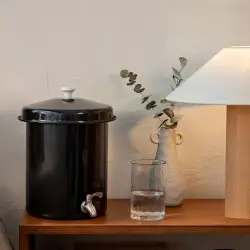
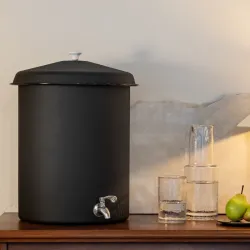
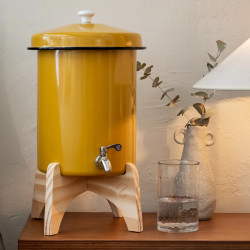
The Ecofiltro consists of two stacked containers (one on top, one on the bottom) and a natural microporous ceramic filter. You pour tap water into the upper container, and it flows down by gravity (hence the name) through the ceramic filter.
The magic happens in this ceramic filter:
- The 0.5 micron micropores block 99.9% of bacteria, parasites, and protozoa
- The impregnated activated carbon eliminates chlorine, pesticides, heavy metals
- The essential minerals (calcium, magnesium) pass without any problem
Result: pure, healthy, remineralized water with a neutral and pleasant taste. And all this without electricity, without water waste, without pressure, without technical installation.
The flow rate? About 1-2 liters per hour. It may seem slow compared to a faucet, but with a 20L tank, you fill it in the morning and evening, and the whole family has filtered water available all day.
.webp)