




Here, rice is replaced by jicama blended to a grain, squeezed dry and seasoned with rice vinegar and agave: the texture really does come close to sushi rice, as long as you don't skimp on the squeezing. The shiitake spend an hour in a mix of nama shoyu and olive oil, the fresh ginger candies in vinegar for at least twenty-four hours, and the rest is just assembly. Part of the ginger can be coloured with beetroot juice, which gives that characteristic pink of sushi ginger without any dye. Expect six to eight rolls, and plan ahead: this is a make-ahead recipe rather than a last-minute one.
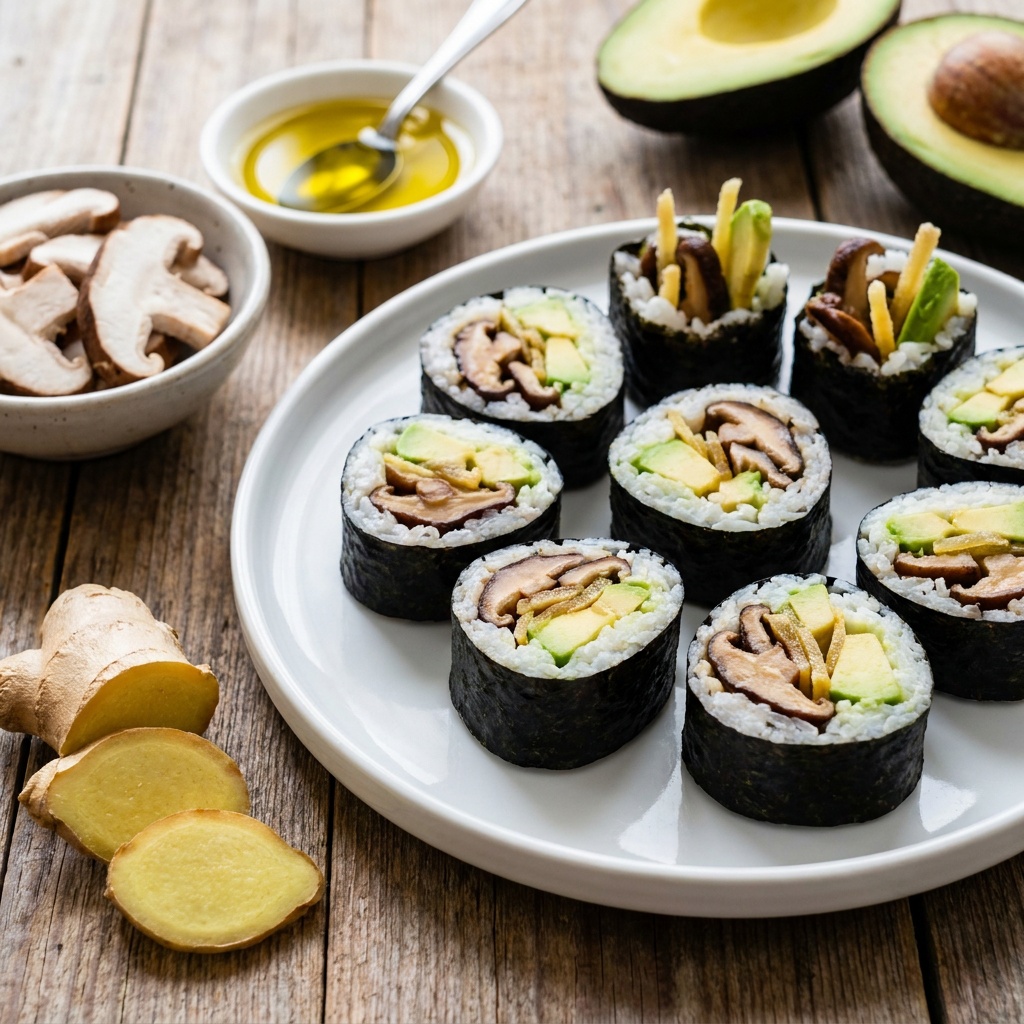
Raw Maki Rolls with Marinated Shiitake, Avocado and Candied Ginger

Share this article
Ingredients
Filling
- 1 cup finely sliced shiitake caps
- 6 cl nama shoyu for the marinade, plus 12 cl for dipping
- 2 tbsp extra virgin olive oil
- 2 large young ginger roots, peeled and very thinly sliced on a mandoline
- 2 tbsp sea salt
- 35 cl raw cider vinegar or rice vinegar
- 18 cl agave syrup
- 12 cl beetroot juice (optional, for colour)
Jicama Rice
- 6 cups jicama, cut into 2–3 cm cubes
- 12 cl pine nuts
- 1 tbsp plus 2 tsp sea salt
- 6 cl whole rice vinegar
- 3 tbsp agave syrup
Assembly
- 6 to 8 untoasted nori sheets
- 1 medium cucumber, peeled, seeded and cut into thin julienne
- 2 ripe avocados, peeled, pitted and sliced
- 1 small bunch sunflower sprouts or other long-stemmed sprouts
- 2 spring onions, the white part plus 2 cm of green, finely sliced
- 12 cl wasabi
- 2 tbsp black sesame seeds
Preparation
The filling
- Mix the shiitake with 6 cl nama shoyu and the olive oil in a small bowl. Leave to marinate for about an hour, then drain thoroughly and set aside.
- Put the sliced ginger in a bowl and salt it generously. Let it sweat for 5 minutes, rinse well, drain and squeeze out the water.
- Place about two-thirds of the ginger in a bowl with 25 cl vinegar and 12 cl agave syrup.
- Cut the remaining ginger into julienne and put it in a second bowl with the remaining vinegar and agave.
- Add the beetroot juice to the julienned ginger bowl if using. Make sure the ginger is fully submerged in the liquid, topping up with a little more vinegar and agave if needed.
- Cover both bowls and refrigerate for at least 24 hours, up to 3 days. Drain well before using.
The jicama rice
- Pulse the jicama and pine nuts in a food processor until you get grains the size of rice.
- Press the jicama between clean tea towels to squeeze out all the moisture.
- In a large bowl, mix this rice with the salt, rice vinegar and agave syrup.
- Gently spread the mixture over dehydrator trays and dehydrate at 45°C for about 2 hours, to remove the remaining moisture. Check regularly and stir: the edges dry faster than the centre, and rice that's too dry turns brown and loses its softness.
The assembly
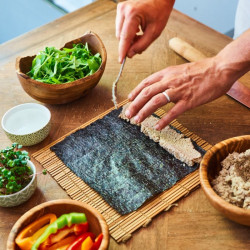
- Place a nori sheet on a bamboo mat, rough side up, with the short side facing you.
- Spread about 12 cl of rice over the bottom third of the sheet, leaving 2 cm clear along the bottom edge.
- Arrange the marinated shiitake, cucumber, avocado, sprouts, spring onion and a dash of wasabi in the centre of the rice.
- Roll firmly using the mat, seal the edge with a little water, then slice with a well-sharpened knife.
- Sprinkle with black sesame and serve with the candied ginger and the remaining nama shoyu.
Tip
Squeezing the jicama dry is the make-or-break step of this recipe: rice that's still damp soaks through the nori and the roll falls apart when sliced. Press for longer than you think you need to, then finish off in the dehydrator.
The full range ALGAE
26 products
Discover the full range
FAQ: your questions about nori sheets
What exactly are nori sheets?
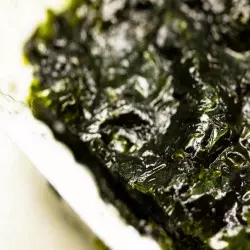
Nori is a red seaweed of the genus Porphyra, harvested, then washed, chopped and spread in thin layers on racks, exactly the way paper is made. Once dried, it becomes that dark, pliable, slightly shiny sheet everyone associates with maki. At Biovie, it's dried below 45°C and not toasted: it keeps a more tender texture than classic yaki nori, which makes it easier to roll without cracking.
How can you tell if a nori sheet is still good?
A spoiled sheet is first noticeable by touch: it has softened, it bends without breaking and sticks slightly to your fingers, a sign it has reabsorbed moisture from the air. The colour also shifts, from deep blackish-green to a dull brown, and the sea smell fades. As long as it stays dry and brittle, it keeps for a very long time in an airtight container away from light. A softened sheet isn't dangerous, but it tears when rolled: save it for soup or crumbling.
Is nori seaweed good for your health?
Nori provides protein, fibre, iron and iodine, in a very low-calorie food: one sheet barely weighs three grams. It's mainly the iodine that calls for moderation, since seaweed concentrates far more of it than land plants do. One to two sheets a day remains a reasonable amount for an adult; anyone being monitored for a thyroid condition should discuss it with their doctor before making it a daily habit.
Share this article