






There's a lot of talk about young coconut water and rarely about what's left once you've drunk it: the soft white flesh stuck to the shell. Marinated then dehydrated at low temperature, it takes on a crisp texture that really recalls jerky, with the coconut's natural sweetness balancing the tamari's saltiness. Cider vinegar brings the acidity, fresh herbs the nuance, chilli flakes the heat, and a touch of liquid smoke, or smoked paprika if you'd rather avoid flavourings, completes the illusion. The marinade matters as much as the drying: thirty minutes, stirring regularly, is enough, and a sealed freezer bag does a much better job than a bowl, because the marinade stays in contact with the whole surface. Then, eight hours in the dehydrator at 45°C, spreading the strips out without letting them overlap too much. They shrink noticeably and should no longer feel moist when they're ready. Count on two full trays, or about four cups. And above all, don't throw away the coconut water: drink it or freeze it for smoothies.
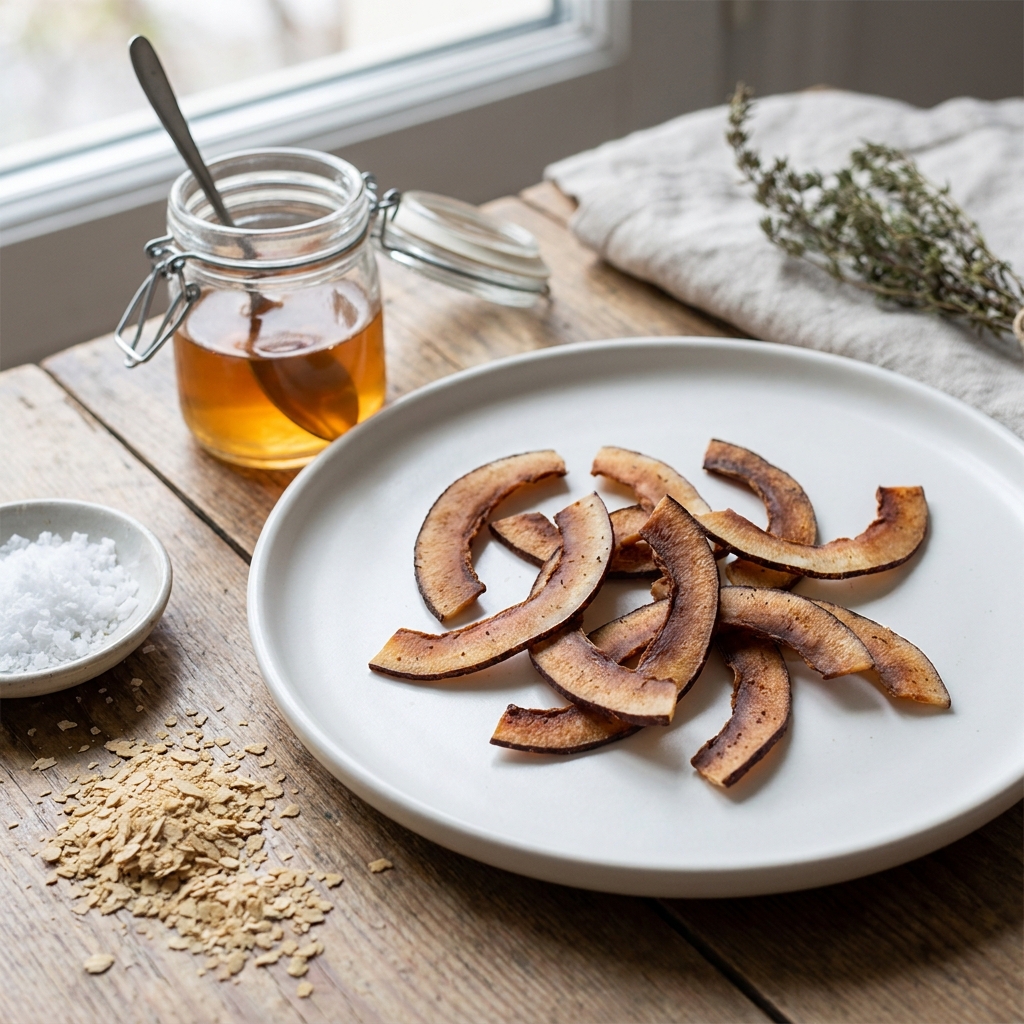
Tamari-Smoked Coconut Chips, Jerky-Style

Share this article
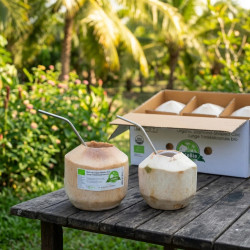
Certified organic fresh coconuts
€33.90 NEXT ARRIVAL MID-SEPTEMBER
Ingredients
- The flesh of 5 fresh young coconuts, or 2 packs of 500 g pre-cut fresh coconut flesh
- 1/4 cup finely chopped fresh herbs, your choice: mint, coriander, basil, rosemary, dill, tarragon
- 1/4 cup plus 2 tablespoons tamari or soy sauce
- 2 tablespoons cider vinegar
- 1 teaspoon liquid smoke, optional, or smoked paprika
- 1 teaspoon sea salt
- 1 tablespoon nutritional yeast
- 1 teaspoon olive oil or another oil
- 1 tablespoon red chilli flakes
Method
- If using fresh coconuts, open them, collect the water and set it aside to drink or freeze. With a spoon, scrape the inside of the shell to loosen the white flesh into long strips, recovering as much as possible. Discard the shells.
- Gather all the flesh in a bowl as you go.
- Add all the other ingredients and mix thoroughly. Leave to marinate for about 30 minutes, stirring often. A sealed freezer bag gives better results than an open bowl.
- Spread the marinated flesh onto the non-stick dehydrator sheets, arranging the strips without overlapping them too much.
- Dehydrate for at least 8 hours at 45°C. The pieces are ready when they've visibly shrunk and no longer feel moist to the touch.
Tip
Liquid smoke isn't essential: smoked paprika gives a very similar result without additives. If your strips are still pliable after 8 hours, extend the drying in one-hour increments rather than raising the temperature, which would take the preparation out of raw territory.
The full range Fresh coconut
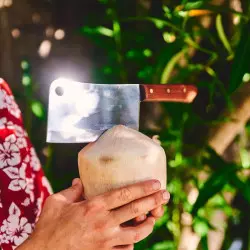
Enjoy a gourmet and nutritious coconut flesh thanks to these Thai organic green coconuts, proposed with its machete for easy opening, 5 products
Discover the full range

FAQ: your questions about low-temperature dehydration
What is a dehydrator used for?
To dry food without cooking it, by circulating warm air for several hours. By removing the water, it stops micro-organisms from developing: it's one of the oldest preservation methods. In raw cuisine, it plays a second, equally important role: it creates textures that no other technique produces cold — the crunch of a cracker, the softness of a bread, the crispness of a coconut chip like this one. All of it under 42°C, which is what sets it apart from an oven.
How long can dehydrated food be kept?
Properly dried and stored away from air, light and moisture, most dehydrated foods keep for six months to a year without difficulty. Dried fruit and vegetables keep the longest; fatty preparations, like coconut chips or nut crackers, turn rancid faster and are best eaten within two to three months. The real deciding factor remains the drying: food that's still pliable at the core will go mouldy, whatever container it's in.
What are the downsides of a food dehydrator?
Time, first of all: allowing eight to twelve hours for a tray of crackers means planning ahead, and the machine runs all night. Then there's the bulk, since a decent dehydrator takes up real space on a worktop. The fan noise, often underestimated, is also a factor when the machine runs in an open kitchen. And the price: the first models that are genuinely satisfying for raw cuisine cost noticeably more than entry-level ones.
Share this article