


Bio-based filtered water bottle - 75cl
75cl filtering bottle to purify any water (except seawater)
Bio-based material (sugarcane), 100% recyclable
Filter capacity: 200 liters (then only the filter can be changed)
No queries yet, leave the first!
Price:
€39.90
Product availability:
In stock
Tax included


Bio-based filtered water bottle - 75cl images


WATER TO GO & BIOVIE
After years of use, we FINALLY have the opportunity to offer you the Water To Go filtering bottle in an eco-friendly version! Exclusively in France, Biovie offers you this filtering bottle that purifies any freshwater, from anywhere, made from bio-based materials (unlike the classic plastic version). In concrete terms, it is the most comprehensive portable water filter we have evaluated, and we have reviewed many.
We chose this water bottle because the filtration efficiency achieved is superior to all other systems we have personally studied. This bottle is versatile, economical to purchase and use, lightweight, low tech, recyclable, made mostly with a plant-based material, and the filtering part is replaceable.
Since 2016, we have taken it with us on our travels, vacations, trips, urban journeys, or hikes in nature. It allows us to purify water wherever we are, avoiding the need for plastic bottles and relieving us of the mental burden of having to find good quality water. We have thus drunk water filtered by this bottle on a train in Sri Lanka, at a craft market in India, in a bus terminal in Costa Rica, on a river in Thailand, at a waterfall in Croatia, from a public fountain in Venice, not to mention numerous other everyday occasions. It never leaves our side.
While hiking, trekking, traveling in countries where access to drinking water is difficult, or in places where the water doesn't seem well-treated, the Water To Go x Biovie bottle allows you to hydrate safely and securely. It removes 99.99% of harmful contaminants in the water: viruses, bacteria, chemical compounds, and heavy metals - even in non-potable water where other travel filter bottles reach their limits.
Say goodbye to the fear of parasites, intestinal diseases while traveling, or dehydration. With this water bottle, no more incessant purchasing of plastic spring water bottles that end up in the trash within minutes.
🚰 For more information, feel free to join this category on our forum to ask your questions and find testimonials from users of the Water to Go bottle.
> Below, you will find a video with more details as well:
How does the Water To Go filter bottle work ?
Water To Go bottles use a unique 3-in-1 filter technology, combining traditional and nano filtration. Honestly, that's what sets them apart from other portable water filters on the market: most only perform mechanical filtration. Here, three mechanisms work simultaneously.
> a mechanical filtration : it is a membrane with tiny pores (0.07 microns) that prevents the passage of major contaminants.
> a nanotechnology : It involves nano-alumina, which emits a positive charge when wet and attracts negatively charged contaminants in the water. An induced positive electric charge allows for the filtration of particles even smaller than the pores of the membrane, significantly enhancing the filter's efficiency, enabling it to trap viruses such as the polio virus, which measures only 0.03 microns.
> a activated charcoal : its large contact surface traps the main contaminants and primarily affects taste and odor.
BPA free.
Patented process.
A filtration technology developed for NASA
The Water To Go filtration system was originally developed for NASA. It is proven and patented. This space origin ensures a level of demand and reliability that few filtering bottles can claim-and this is truly reflected in the results in the field, whether on the Yangtze or in a village fountain in India.
What contaminants does the filtering water bottle remove ?
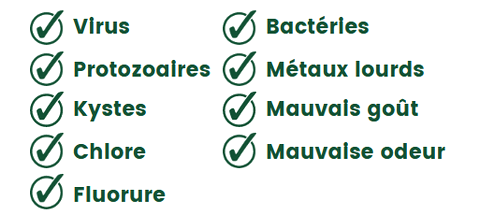
This 3-in-1 technology filters 99.99% of contaminants from fresh water, including non-potable water sources such as rivers, natural springs, and public fountains in tropical countries. In particular:
> viruses and bacteria : E.Coli, cholera, typhus, dysentery, botulism, polio, hepatitis A...
but also Norwalk, Tota Virus, Adenovirus, Enterovirus, Reovirus, Coliforms, viral botulism, Vibrio disease, Campylobacteriosis, Leptospirosis - Weil's disease, Legionella.
> potentially deadly parasites: Cryptosporidium, tapeworm, Giardia, Guinea worm, threadworm...
but also Echinariasis to schistosomiasis, Cysticercosis schistosomiasis, Hookworm nematode, Pinworms Onchocerca, Fasciola Hepatica.
> heavy metals and toxic chemicals: Chlorine, fluoride, lead and mercury, gold and silver, nickel, copper, iron, aluminum, volatile organic compounds, including formaldehyde... the filter removes more than 90% of natural arsenic 3 and arsenic 5, a major achievement for a non-industrial filter.
> microplastics
These results come from several studies conducted by different laboratories in various countries. They all agree on the effectiveness of the filter and, therefore, on the non-harmfulness of the filtered water for the body. Find the 4 studies to download here :
• London School of Hygiene and Tropical Medicine (ENGLAND)
• Bangalore Test House (INDIA)
• BCS Laboratories (UNITED STATES)
• IMI (CHINA)
Tested in the laboratory and in the field since 2016
The filtering water bottle has been tested by tens of thousands of people around the world since 2011. Anonymous users, as well as high-level athletes, mountaineers, extreme adventurers, and survivalists:
- Ash Dykes used the filter bottle to drink throughout the entire course of the highly polluted Chinese Yangtze River.
- Holly Budge has climbed Everest and traveled over 1000km on horseback in Mongolia. She has used the water bottle in her expeditions around the world.
- Éric & Aurélie Viard, during their travels to Costa Rica, India, Sri Lanka, Thailand, and Mexico ;)
"Water To Go bottle purchased for my sons who, since then, no longer lack quality water during the day."
- Anne C. ⭐⭐⭐⭐⭐ (Trustpilot)
"I have been ordering regularly for 3 years! Sea water, barley grass juice powder, filtered water bottle… These are rare products that I only find at Biovie!"
- Samantha M. ⭐⭐⭐⭐⭐ (Google)
Still not convinced? Watch this video that will reassure you in 50 seconds:
(The bottle used is the transparent plastic model and not the bottle sold by Biovie, the filter is exactly the same however, only the container changes)
For more videos on using the Water To Go bottle, we recommend this real-world test of the "Sports Technicians" (EN) or this test with the water from a pond (in English).
Filter use and replacement
The water bottle is equipped with a removable filter that screws onto the bottle cap.
During the first use, it is important toACTIVATE the filter : fill the bottle with water (unsalted), turn the bottle upside down so that the filter is completely submerged, let it sit for 15 minutes, then open the spout and release all the water through the neck by squeezing the sides of the bottle.
Some carbon granules may be visible; if so, simply continue rinsing the filter until the water is clear. Please note that the carbon granules are not harmful to health.
Your filter is activated and ready to use !
> This same method should be used if you do not use the bottle for a certain period and the filter dries out.
Classic use:
1) Remove the lid with the filter
2) Fill the bottle with water (not saltwater)
3) Replace the lid and the filter
4) Open the cap and drink !
Attention: Do not let unfiltered water come into contact with the outer lid or the spout !
The filter controls the flow. Do not squeeze the bottle while drinking, as this can create excess pressure on the filter, and in extreme cases, can pressurize the cap and cause a leak between the cap and the bottle.
Filtration capacity = 200 L
Knowing that a person's water needs are on average 1.5L to 2L of water per day, the filter can last 100 days, or a little over 3 months for daily use.
The filter needs to be changed when it becomes difficult to pump water for drinking. The filter will become clogged more or less quickly depending on the quality of the water being filtered.
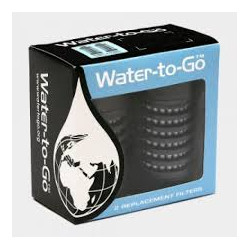
Then simply replace it with a new one., available here in the shop. The filter is recyclable.
A bio-based filtering water bottle: sugarcane instead of plastic
This water bottle is entirely made from bioplastic derived from sugarcane fibers. Development is still ongoing to ensure that our lids and filter caps are also made from biomaterials.
The sugarcane used is harvested from farms certified by the independent company. Bonsucro. Bonsucro issues a very rigorous certification that has existed for 15 years, overseeing the production conditions of its 300 members spread across 50 countries. It certifies responsible, social, and fair production for all stakeholders in the industry, emphasizing learning and continuous improvement.
Thanks to innovative procedures, the fibrous residues left after sugar extraction are reprocessed to create a new "green" material from agricultural waste, used to make robust and durable sugarcane bottles.
1 filter = 400 single-use plastic bottles avoided
"Can't wait to try it during my world tour!"
- Eva D. ⭐⭐⭐⭐⭐ (Trustpilot)
Frequently Asked Questions about the Water To Go Filter Bottle
Does the Water To Go bottle really filter viruses ?
Yes. Thanks to its positively charged nano-alumina technology, the Water To Go bottle captures negatively charged viruses, including the polio virus (0.03 microns), which simple mechanical filters cannot do. The results are confirmed by four independent laboratory studies (London, India, United States, China).
What water can be drunk with a filtered water bottle ?
The Water To Go bottle is designed for all fresh water: tap water, river water, public fountains, natural springs. It is not suitable for seawater (saltwater), juices, syrups, or hot drinks.
How long does the Water To Go filter last ?
The filter has a capacity of 200 liters, which is approximately 3 months of daily use (1.5 to 2L per day). It should be replaced when the resistance to pressure significantly increases. The used filter is recyclable: the filtering membrane is compostable, and the plastic part goes into the recycling bin.
Why is the Water To Go bottle bio-based ?
Unlike traditional plastic filtering bottles, the version offered by Biovie is made from Bonsucro-certified sugarcane biopolymer. This material is derived from agricultural waste (post-sugar extraction residues), is recyclable, and does not impart a plastic taste to the water.
What is the difference between the Water To Go bottle and other filtering bottles ?
Most of the filtering water bottles on the market filter out bacteria and protozoa but not viruses. The Water To Go also filters viruses thanks to its NASA nano-alumina technology - a rare level of protection in non-industrial portable filters. Additionally, the Biovie version is bio-sourced from sugarcane, which further distinguishes it from conventional plastic competitors.
🚰 Join our discussion group on the Biovie Forum
Volume : 750 mL (75 cL)
Filter capacity : 200 liters (equivalent to 3 months of continuous daily use)
Filter only sold here.
To know when to change the filter: it will become increasingly difficult to drink as the filter becomes loaded with impurities. When it becomes very hard to pump the water, you can change the filter.
Flow : 10 to 12 ml per second
Do not squeeze the bottle to drink.
Dimensions : 22.5 cm x 7 cm
Curb weight : 145 g
Cleaning:
The bottle is dishwasher safe.
The stopper is to be cleaned by hand ONLY.
Wash your bottle and cap regularly to avoid any risk of contamination.
Composition:
Bottle (body of the flask) = sugarcane biopolymer (Does not give a plastic taste to the water)
Lid and neck = Polypropylene (FDA approved). These components are expected to be quickly replaced by a biopolymer as well.
Headband = food-grade approved silicone
All materials are 100% recyclable.
To be recycled, the filter must be disassembled and then cut: the filtering membrane can go into the compost, while the plastic part that holds it must be thrown into the recycling bin. Find the procedure (in English) in the video here.
BPA free.
Not suitable for filtering seawater. Do not filter anything other than fresh water (syrups, juices, hot drinks, etc.).
 |
|
💧 You will also find articles about water filtration on our blog:
> Why filter shower and bath water ??
> Hydration in Summer
> How to filter tap water ? ?
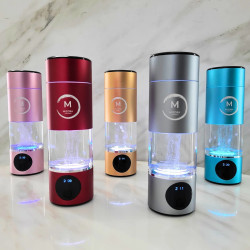
> The benefits of hydrogenated water for better health ,a scientifically sourced article where Eric shares the latest discoveries about hydrogen water, its potential health benefits, and the high-quality technologies that allow its production at home and on the go using a device that Biovie has personally selected from all other devices available on the market, the device Mizora, for which you can receive a discount of €31.25 by using our partner code with them: "BIOVIE"."
> Filtering Water While Camping and Hiking: The Complete Guide
> Microplastics in Drinking Water: The Complete Guide
> Filtered pitcher or reverse osmosis system: which filtration system should you choose ?
Update: March 2026. Article approved by Éric Viard, founder of Biovie and engineer ISTOM, co-author of " Seaweed in everyday life "(Gallimard, 2024) -" Best cookbook in the world, Gourmand Cookbook Awards 2025, and Best cookbook in France, National Academy of Cuisine 2025.
Wondering… ?
Everything you need to know before ordering.
Be the first to ask a question about this product!
Question about the product
Ask a question