Fast delivery
.png)
 Fair prices



Kombucha SCOBY: The Complete Guide to Making, Feeding, and Storing Your Mother (2026 edition)
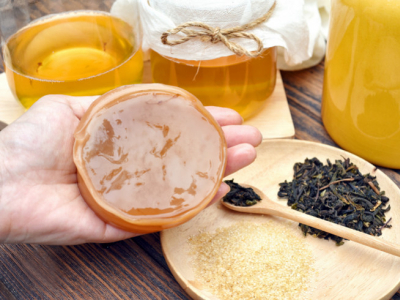
A kombucha SCOBY is a symbiotic culture of bacteria and yeast (the acronym stands for Symbiotic Culture Of Bacteria and Yeast): a living cellulose matrix that turns a simple sweet tea into fizzy, tangy kombucha. It is also called the "mother", the "starter culture" or the "tea fungus". Here, in practical terms, is how to recognise it, make it, feed it, store it, and tell a healthy mother apart from one that is genuinely contaminated.
You pull a bottle of kombucha out of the fridge, you turn it over without thinking, and there — at the bottom — is that thing. A sort of small translucent jellyfish, gelatinous, floating. The first time, almost everyone has the same reaction: a slight flinch. "What is that? Is it supposed to be there?"
Yes. It is supposed to be there. And it is in fact the living heart of your whole drink.
Behind that little disc hides a vocabulary that breeds confusion, a biology that research has only really decoded over the past five years, and a handful of simple gestures that make all the difference between a mother that lives for years and one you throw out by mistake. I have been brewing kombucha for a long time, and together with Aurélie we have seen plenty of SCOBYs come and go — gorgeous ones, odd ones, plenty of needless panics. Let me share what I have learnt.
Kombucha SCOBY: what does the acronym really mean? The complete glossary
Let's start by untangling the words, because that is where 90% of the questions come from.
SCOBY is an English acronym: Symbiotic Culture Of Bacteria and Yeast. Literally, then, it means "symbiotic culture of bacteria and yeast". The term describes a community of micro-organisms that live together and cooperate. It is not a species, nor a single organism: it is a consortium.
The trouble is that we use a dozen different words for the same thing — or nearly. Let's sort them out:
- SCOBY: the scientific, international term. It refers to the symbiotic culture as a whole.
- Mother (or "kombucha mother"): the most common everyday term, by analogy with the "mother" of vinegar. It generally refers to the visible disc.
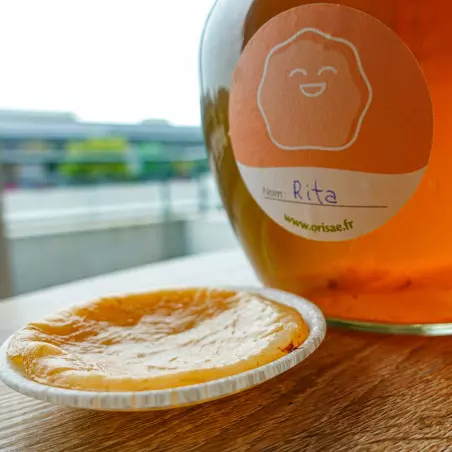
- Pellicle: the most precise term for naming only the cellulose pancake that floats on the surface. It is the part you see and touch.
- Starter culture: this emphasises the "seed" role — what you pass on to launch a new fermentation.
- Disc, pancake, kombucha mushroom: friendly, casual names, but not very rigorous.
- Tea fungus: an old, misleading name. There is no fungus in the mycological sense in there. Just yeasts (which are single-celled micro-fungi) and bacteria.
And among our neighbours? In German, you say Teepilz or Kombuchapilz. In Spanish, hongo de té or disco SCOBY. English speakers readily distinguish the pellicle (the visible pancake) from the liquid starter (the starter liquid). And that distinction is crucial.
The point almost nobody grasps first time round: the pellicle you see floating is not the most important element for fermenting. The real engine is the micro-organisms suspended in the liquid starter — that already acidic, living kombucha you keep back to launch the next batch. The pellicle itself is mostly a visible consequence of bacterial activity: a kind of cellulose "biofilm". In practice, you can perfectly well start a kombucha with a good liquid starter and no large pancake — and conversely, a pancake on its own, rinsed and without its liquid, is a far poorer seed than people think.
Keep this idea in mind: it is the liquid that does most of the work. We'll come back to it when we talk about storage, because it changes everything.
The microbial make-up of a kombucha SCOBY: what science revealed in 2021-2025
For a long time, we talked about the SCOBY a little blindly. "There are bacteria, there are yeasts, it ferments." Since 2019-2021, genetic sequencing has let us see much more clearly, and it is fascinating.
On the yeast side, the genus that very often dominates is not the humble baker's yeast you might imagine, but Brettanomyces (also called Dekkera) — the same family of yeasts that gives certain Belgian beers and certain wines their character. You also find Zygosaccharomyces, Lachancea, Starmerella and sometimes Saccharomyces. They are the ones that consume the sugar and produce alcohol and CO₂ (the bubbles).
On the bacteria side, the star genus is called Komagataeibacter (formerly classed under Gluconacetobacter), accompanied by Acetobacter. These are acetic bacteria: in the presence of oxygen, they oxidise the ethanol produced by the yeasts and turn it into acetic acid. That is what gives kombucha its sharp acidity — and it is also Komagataeibacter that weaves the famous cellulose pancake.
Do you see the mechanism? The yeasts make the alcohol, the bacteria turn it into acid. A loop. A genuine symbiosis. According to the review work of Harrison & Curtin (2021) and of Villarreal-Soto and colleagues (2020), it is this two-way dance that structures the whole ecosystem.
The concrete result of all this activity: the pH of the kombucha drops to a range of 2.5 to 3.5. And that figure, behind its technical look, says something very reassuring. A pH that low is an environment naturally hostile to unwanted bacteria. Put into everyday terms: that is exactly why a well-run kombucha fermentation is one of the safest there is for a beginner. The acidity protects the culture from itself. You are not dealing with a fragile medium that gets contaminated at the slightest draught — you are dealing with an acid fortress.
This is precisely the rigour I love in fermentation: it is not magic, it is the chemistry of living things, something you can understand and reproduce. (My background as an agronomist has a lot to do with it — I have always needed to know why something works before I trust a method.)
How to make a kombucha SCOBY from scratch (the unpasteurised kombucha method)
Good news: you don't need to buy a mother. With a single bottle of unpasteurised shop-bought kombucha, you can grow your own SCOBY in 14 to 21 days. The only real prerequisite is that the kombucha be alive — unpasteurised, unfiltered, ideally plain (no flavouring).
What you need:
- 1 L of filtered water (unchlorinated — chlorine holds the microbes back)
- 8 g of black or green tea, unflavoured (the equivalent of 3 to 4 teabags)
- 80 g of organic sugar (the fuel for the yeasts — most of it will be consumed)
- 200 ml of unpasteurised shop-bought kombucha, plain
- A 1.5 L glass jar, a clean cloth (muslin, fine tea towel) and an elastic band
- Never any metal in prolonged contact with the fermentation — glass, wood or food-grade plastic only
The main steps, condensed:
- Brew the tea in the just-simmering water for 10 to 15 minutes, then remove it.
- Dissolve the sugar in the still-warm infusion.
- Let it cool completely to room temperature (above 30 °C, you risk killing the microbes — that's mistake number 1).
- Pour the cold sweet tea into the jar, add the 200 ml of kombucha starter.
- Cover with the cloth, secure the elastic band. The culture needs to breathe, but not to let flies in.
- Place the jar away from direct light, between 21 and 26 °C, without touching it.
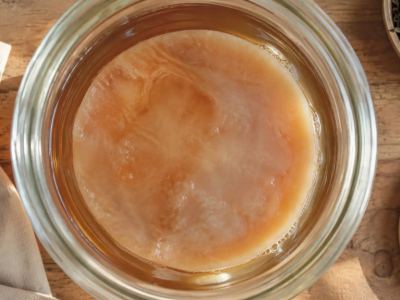
- Wait. Around day 7, a translucent film forms on the surface. Over the days it thickens and whitens. Around day 14-21, you have a pellicle a few millimetres thick: your SCOBY is born.
For the truly step-by-step version, with day-by-day photos and the detail of the ratios, I'll point you to my detailed method for making a kombucha mother, which breaks down every step. And if you would rather get your very first batch right without fumbling, my complete guide to homemade kombucha takes you through it all from the very beginning.
If you want to start with everything to hand — equipment, tea, flavouring and a living mother ready to use — the complete pack brings together the essentials.
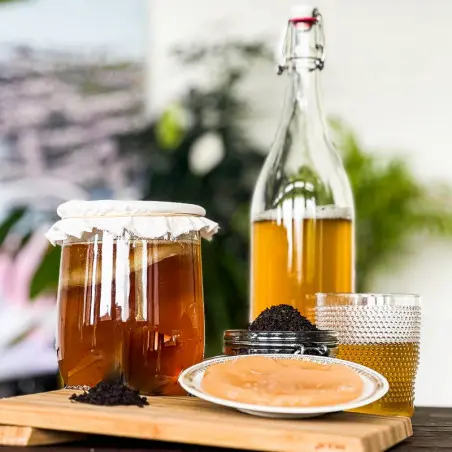
A word of honesty: don't expect a thick, even disc on your first attempt. The first pellicles are often thin, irregular, sometimes a little translucent. That's normal. It will thicken with each cycle.
Feeding and looking after your SCOBY day to day
Once your mother is established, looking after it is almost ridiculously simple. A SCOBY isn't "fed" every day like a pet — it is fed with each new batch of sweet tea.
The benchmarks to remember:
- The cycle: a fermentation usually lasts 7 to 14 days, depending on the temperature and your taste (the longer it goes, the more acidic and the less sweet it is).
- The fuel: reckon on 50 to 70 g of sugar per litre and 5 to 8 g of tea per litre. The sugar isn't "in" your finished kombucha — it is largely eaten by the yeasts.
- The temperature: the ideal sits between 21 and 26 °C. Below 18 °C, the fermentation drags; above 30 °C, it races and the flavour suffers.
- The air: always covered with a breathable cloth, never sealed airtight during the first fermentation.
How do you know it's in good health? You'll see a new white pellicle form with each cycle on top of the old one, and often brownish strands hanging beneath it or floating in the liquid. These strands worry beginners enormously — and yet they are simply yeasts (Brettanomyces) doing their job. Don't panic. It's actually a good sign.
In concrete terms, what that means when you lift the cloth in the morning: a fresh, vinegary smell, a new pale layer on the surface, a few bubbles. That is what a happy mother looks like.
Storing your SCOBY: short, medium and long term + the SCOBY hotel
This is the question that comes up most often: "I'm going away for two weeks / two months / I'm taking a break — what do I do with my mother?" Three scenarios.
Short term (1 to 2 weeks)
You do nothing special. You simply launch a normal fermentation. The kombucha will just be more acidic when you get back — perfect for turning into vinegar or a vinaigrette base, if not for drinking as is.
Medium term (2 to 8 weeks)
This is the moment for the SCOBY hotel. The principle is dead simple: you place your mother or mothers in a jar, you cover them generously with already-fermented kombucha (the famous liquid starter), you cover with a cloth, and you leave it at room temperature, away from light. The microbes slow down but stay alive. Remember to top up with a little sweet tea every 3-4 weeks to feed them.
Long term (2 to 12 months)
Same SCOBY hotel principle, but you can place it in the fridge to slow the activity down even further. Check it once a month and add some sweet tea if the level drops. When it comes out, it will need a cycle or two to recover its full vigour — that's normal, it wakes up gently.
The golden rule: never freeze your SCOBY. Ice crystals tear the cell walls of the micro-organisms, and you risk ending up with a dead or badly weakened culture. The cold of the fridge, yes; the freeze of the freezer, never.
Remember what I said earlier — that the liquid does most of the work? That is exactly why the SCOBY hotel works: it isn't primarily the pancake you're preserving, it's the bath of living microbes it sits in.
Dividing and sharing your SCOBY
With each cycle, your mother will thicken: a new layer forms with every fermentation, and the layers stack up. When the disc reaches 3 to 4 cm thick (generally after 4 to 6 cycles), it's time to divide it.
How to do it, cleanly:
- Wash your hands thoroughly — with water and ordinary soap, definitely no hand sanitiser or antibacterial soap: you would pass on residues that have no business near a living culture.
- Separate the layers by hand, or cut the disc with clean scissors (brief contact with metal is not a problem).
- Each piece that keeps a whole layer can become a new, self-sufficient mother.
And this is where one of the loveliest sides of fermentation comes in: you give your SCOBYs away. It's a culture that multiplies all on its own, so the kombucha community has got into the habit of passing it round. A gift kit is dead simple: a piece of mother, 200 ml of liquid starter and a little sheet of instructions. You are literally giving someone a living drink.
To find a mother for free, by the way, that is often the best route: local fermentation groups, farmers' markets, community-garden networks. Someone near you is bound to have a mother to spare.
Healthy or sick SCOBY? Reading the visual signs
Let's be clear, because this is panic source number one: the vast majority of "mould" reported by beginners isn't mould at all. The brown strands, the deposits at the bottom, the darker areas, the bubbles, the uneven texture on the surface — all of that is perfectly normal.
Here is how to read your mother for real.
What is normal (no cause for concern)
- A beige, cream-coloured pellicle, sometimes marbled or with smooth brownish patches.
- Brown strands hanging down: these are the yeasts.
- A cloudy deposit at the bottom of the jar: sedimented yeasts.
- A new pale layer forming on top of the old one.
- A vinegary, sharp smell, sometimes slightly alcoholic.
What is a genuine warning sign (here, you throw everything out)
- Fuzzy, hairy, dry patches, sitting on the surface — typically white, green, blue or black, with a cottony look that resembles the mould on a loaf or a forgotten piece of fruit. Real mould is dry and fuzzy, never submerged and gelatinous.
- A rotten, cheesy or musty smell that is frankly unpleasant (nothing to do with the normal vinegary smell).
The most useful distinction to remember: mould grows on the surface, dry, and it is fuzzy. Anything smooth, gelatinous, submerged or stringy is part of the culture. When in doubt, two objective markers: pH strips (you should be between 2.5 and 3.5; above 4, the acid barrier hasn't set) and the simple rule "when in doubt about genuine fuzzy mould, don't risk it — throw out the mother and the liquid, and start again".
Where to buy a kombucha SCOBY
Three main routes to get hold of a mother.
In health-food shops: more and more retailers offer SCOBYs in the chilled section or as fermentation kits. Reckon on around £10 for a mother with its liquid. Ask at your local organic shop — the offering varies from store to store.
Online: several fermentation specialists ship living mothers with their liquid starter and instructions. It's handy if you don't have anyone around you to give you one, and you start off with an already-robust culture.
For free: as we saw, fermentation groups, markets and local networks are a goldmine. It's also a chance to meet people who can help you out if your first batch leaves you with questions.
At Biovie, our logic is always the same: we would rather teach you to keep your culture alive for years than have you keep buying again and again. A well-tended mother is potentially a lifetime of kombucha from a single purchase. If you want to start off with a quality organic culture, ready to use the moment it arrives, this is the way.
FAQ — the essential questions about the SCOBY
Are SCOBY, mother and tea fungus the same thing?
Yes, in everyday language these three words refer to the same symbiotic culture of bacteria and yeast. "SCOBY" is the international scientific term, "mother" the common everyday term, and "tea fungus" an old, misleading name — there is no fungus in the mycological sense in a SCOBY.
Can you eat a SCOBY?
Yes, it is edible. Its gelatinous texture isn't to everyone's taste, but some people chop it into a smoothie (with hemp or tiger-nut milk, never oat milk), dehydrate it into sweets, or use it in cooking. Nothing compulsory, but nothing dangerous.
Why does my SCOBY stay at the bottom of the jar?
There's nothing worrying about it. A SCOBY can float, sink or sit at an angle — its buoyancy depends on the pockets of CO₂ it traps. What matters is that a new pellicle forms on the surface, where there is oxygen. And it will form, even if the old mother is at the bottom.
How long does a SCOBY live?
Years, if it is well looked after. There is no use-by date as long as you feed it and no genuine mould appears. Many brewers use mothers descended from cultures that are decades old.
Is there alcohol in a SCOBY?
A fermentation naturally produces a small amount of alcohol — generally well below 0.5% vol. in the finished kombucha, gradually turned into acetic acid by the bacteria. People who must avoid all alcohol, and sensitive groups, take this into account.
Can you make kombucha without a SCOBY?
Yes — provided you have a good liquid starter (live, unpasteurised kombucha). It is the liquid that holds most of the micro-organisms; a new pellicle will form by itself over the course of the fermentation. The pancake isn't strictly essential, but the living liquid is.
Is kombucha suitable for everyone?
No. As a precaution, kombucha is not recommended for pregnant or breastfeeding women, children under 12, or people who are immunocompromised, diabetic or on anticoagulants. The French food-safety agency (ANSES) recommends sticking to roughly 100 to 300 ml a day, as part of a varied and balanced diet and a healthy lifestyle. If in doubt, ask a healthcare professional for advice.
Do you need to rinse your SCOBY?
No, and above all not under the tap (the chlorine is harsh on the culture) and never with vinegar or soap. If you want to clean it, do so briefly with a little of its own kombucha liquid. Most of the time, you simply don't rinse it.
To finish
A SCOBY is neither a mystery nor a fragile organism to be handled with kid gloves. It is a robust community of bacteria and yeast that asks only for sweet tea, a little warmth and a clean cloth to produce a living drink for years. Once you have grasped the vocabulary and read the signs properly — the normal versus the genuine warning sign — you have hardly any reason left to panic.
To try it is to adopt it. And the day you give your first piece of mother to someone, you'll understand why that little translucent pancake, the one you eyed warily at the start, ends up becoming a member of the household.
References
- Harrison, K., & Curtin, C. (2021). "Microbial Composition of SCOBY Starter Cultures Used by Commercial Kombucha Brewers in North America". Microorganisms, 9(5), 1060.
- Villarreal-Soto, S.A., et al. (2020). "Metabolome-microbiome signatures in the fermented beverage, Kombucha". International Journal of Food Microbiology, 333, 108778.
- Marsh, A.J., et al. (2014). "Sequence-based analysis of the bacterial and fungal compositions of multiple kombucha (tea fungus) samples". Food Microbiology, 38, 171-178.
- Antolak, H., et al. (2021). "Kombucha Tea — A Double Power of Bioactive Compounds from Tea and Symbiotic Culture during Kombucha Fermentation". Antioxidants, 10(10), 1541.
- ANSES — Consumption benchmarks and precautions relating to fermented drinks.
Updated: June 2026. Article reviewed by Eric Viard, founder of Biovie and tropical agricultural engineer (ISTOM), co-author of "Algues au quotidien" (Gallimard, 2024) — Best Cookbook in the World, Gourmand World Cookbook Awards 2025, and Best Cookbook in France, National Academy of Cuisine 2025.
The information presented in this article is provided for informational purposes and does not constitute medical advice. Kombucha is part of a varied and balanced diet and a healthy lifestyle. Consult a healthcare professional before making any change to your diet, particularly in the event of pregnancy, breastfeeding, medical treatment or an existing condition.