






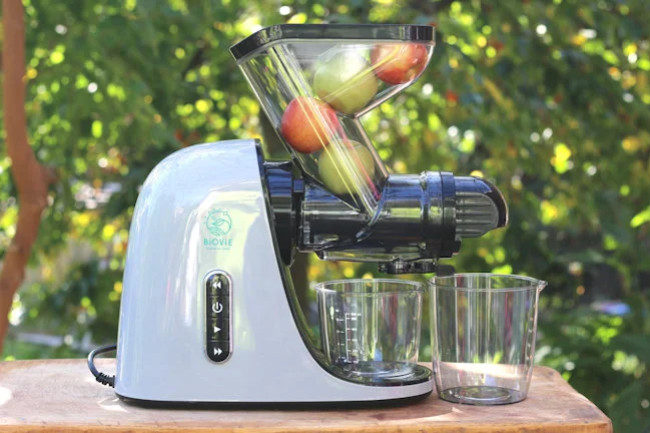
A few years ago, fresh fruit and vegetable juices were touted as a panacea to be used excessively. Of course, these raw juices are of much better quality than the pasteurized juices available in stores. We ourselves have several juicers at home, and we even market our own Biovie juicer.
Juice cleanses: yes, but... when science sets the record straight
Share this article

Every year, as spring approaches or after busy holiday periods, I see the enthusiasm growing around juice cleanses. The idea is certainly appealing: to give your body a break, cleanse it, boost your immune system, and revitalize it with an infusion of vitamins and minerals. But at Biovie, our mission is not to settle for preconceived ideas without questioning them. The idea is also to embrace scientific progress. That's why we always explore new scientific discoveries to better understand the complexity of life.
It is in this spirit that I discovered a study just published in the scientific journal Nutrients by a team of researchers led by Maria Luisa Savo Sardaro. The title is precise: "Effects of Vegetable and Fruit Juicing on Gut and Oral Microbiome Composition". In other words, it examines the impact of juice cleanses on a crucial player in our health that we cherish so much: our microbiome. And what the authors discovered gives us pause for thought.
The study dissected: when science examines our juices
This research examined the effects of a short-term intervention diet, primarily based on fresh vegetable and fruit juices, on the composition of the microbiome of the mouth and intestines of several participants. The results were particularly telling regarding two distinct areas of our body.
First, the oral microbiome. The researchers observed significant changes in the composition of bacteria present in the saliva and on the cheeks. More specifically, they noted an increase in families of potentially pro-inflammatory bacteria. There was even a decrease in the Firmicutes family and an increase in Proteobacteria, an imbalance often associated with oral health issues. This is a surprising point, as we often tend to overlook the impact of juices on our oral flora.
Next, the gut microbiota. The results on this point are more nuanced, and this is where the analysis is most interesting. The study did not detect significant changes in the overall composition of the gut microbiota of the participants. However, upon closer examination, the authors found that specific bacterial taxa, meaning particular types of bacteria, saw their relative abundance increase. And these bacteria are those "associated with intestinal permeability, inflammation, and cognitive decline." This is a fundamental point: even if the juice cleanse did not disrupt the overall balance of the gut flora, it was enough to stimulate the growth of potentially problematic bacteria.
Further Studies: What Science Confirms
This study is not isolated. Other research reinforces this idea of caution:
> Assessment of the Gut Microbiota during Juice Fasting with and without Inulin Supplementation (Nutrients, 2022)
This is a pilot study on participants practicing juice fasting that shows a temporary decrease in bacterial diversity (alpha-diversity), especially in the absence of prebiotic fibers like inulin.
The authors conclude that the microbiota becomes more fragile when solid intake is interrupted, and that the addition of fibers partially compensates for this imbalance.
> Dietary Fiber and the Human Gut Microbiome: Reconsidering Fiber in Modern Nutrition (Cell Host & Microbe, 2022)
This is an in-depth review of the scientific literature that highlights that the elimination of fibers in modern diets (including liquid cleanses) alters the structure and function of the microbiota.
It also shows that fiber acts as a metabolic regulator, supporting butyrate-producing bacteria, essential for the integrity of the intestinal mucosa.
These two studies provide a solid basis for understanding why juices alone are not sufficient to nourish the flora - and why whole foods remain the biological reference.
Analysis and Nuance: The Wisdom of Life
So, why can a drink made from fruits and vegetables, supposed to be synonymous with vitality, have these effects?
The answer lies in a key element that is sorely lacking in juices: fiber.
The process of juice extraction results in the removal of most of the insoluble fibers present in whole fruits and vegetables. However, these fibers are the preferred food for the "good" bacteria in our microbiota. By eliminating them, we end up with a drink high in natural sugars but without the "counterbalance" of fibers to slow down their absorption. This imbalance between high sugar intake and an almost absence of fibers promotes the proliferation of pro-inflammatory bacteria in the mouth and intestine.
For me, this study is a scientific validation of the Biovie philosophy, which is to offer you the most raw foods possible. Nature gives us fruits and vegetables in a perfect balance, where sugars are trapped in a fiber matrix. It is this combination that allows for harmonious digestion and optimally nourishes the bacterial ecosystem of our body. Breaking this balance by removing the fiber deprives our body of a precious ally.
Of course, it's essential to add nuance. Other studies have shown beneficial or neutral effects of 100% fresh fruit and vegetable juices on health, particularly in terms of cardiovascular system protection. The important thing is not to demonize juices, but to understand that they do not constitute a complete substitute for whole foods and that a strict 100% juice detox regimen may not be the ideal solution for the microbiome.
My advice: prioritize whole, living, and organic foods, and use juices in addition to our diet
At Biovie, we love juices, but we use them in addition to, never in place of, whole foods. They can be valuable allies for:
- correcting a temporary nutritional deficiency,
- supporting a period of fatigue,
- or providing enzymatic and antioxidant support.
But they do not replace the fundamental act of chewing, digesting, and nourishing the flora. For my part, I have adopted a gentle approach for several years: a morning smoothie made of banana, spirulina, red fruits, or acai powder - rich in fiber, polyphenols, and prebiotics. This formula combines vitality and respect for the microbiome.
This new perspective invites us to rethink our approach to vitality and "detox". The idea is not to abandon everything, but to adopt methods that respect the complexity of the living.
To illustrate my point, I would like to highlight the differences between various liquid and solid approaches. First, there are fruit and vegetable juices. Juice extraction results in the removal of most insoluble fibers. This explains why their sugar content, although natural, is concentrated and absorbed quickly. This imbalance can potentially have a negative impact on the microbiome by promoting the proliferation of pro-inflammatory bacteria. This is also why they provide very low satiety. However, juices remain very interesting in my view for specific and occasional needs, such as providing massive nutrition in case of deficiencies. But for my part, I keep them in addition to my diet, and I never do juice cleanses for several days.
Then, a healthy alternative to juice consumption is smoothies (this is the approach I have adopted for years, with a morning smoothie of organic bananas, spirulina, frozen organic red fruits, or acai berry powder). By blending the whole fruit or vegetable, you preserve all its fibers, pulp, and nutrients. It's a perfect way to consume superfoods and take care of your microbiome gently. The preserved fibers help dilute the sugar concentration, reduce hunger sensations, and offer much higher satiety.
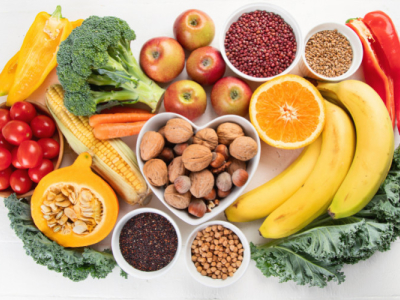
But beyond smoothies, my deep conviction is that nothing replaces living, whole, and organic food. Chewing an apple, biting into fresh spinach, or savoring a pear offers our digestive system a natural task. This is the optimal approach because nature provides us with foods in perfect balance. Their complete composition is the best source of fiber for an optimal and positive effect on our microbiome, with slow and moderate sugar absorption. Whole foods offer by far the highest satiety, confirming that wisdom lies in respecting the food in its entirety.
An effective "cure" simply consists of prioritizing a diet rich in unprocessed products, organic vegetables, and fiber, while hydrating with water or draining herbal teas.
Conclusion: the living, in all its complexity
This study reminds us of an essential thing: the complexity of the living cannot be simplified. Juice cures, however well-intentioned, can disrupt a natural balance. For sustainable vitality and optimal health, true wisdom lies in respecting foods in their entirety, as nature has offered them to us.
FAQ: Your questions, our answers for top digestive health!
Are juice cures really effective for detoxification?
The science is nuanced on this subject. The body naturally "detoxifies" thanks to two main excretory organs: the liver and kidneys, as well as through the lymphatic system and blood circulation, which support the elimination of toxins. While juices provide nutrients, the absence of fiber can alter the microbiome, which plays a key role in waste elimination. The most effective approach to support the detoxification process is to have a healthy, balanced, and fiber-rich diet, and to avoid processed products and alcohol.
Can fruit and vegetable juices harm intestinal health?
According to a recent study published in the journal Nutrients, yes. The study found that the consumption of juices, due to their low fiber content, can promote the increase of bacteria associated with inflammation and intestinal permeability, thus disrupting the microbiome.
What is the difference between a juice and a smoothie for the microbiome?
The major difference lies in the presence of fiber. Juices, obtained by extraction, remove the pulp and insoluble fibers from raw fruits and vegetables, essential elements in a plant-based diet to support the intestinal microbiome. Smoothies, by blending all the ingredients, retain these fibers, which act as a natural prebiotic for the good bacteria in our gut.
How can I optimize my digestive health if I'm doing a detox cleanse?
For optimal digestive health, prioritize whole foods and smoothies over juices. Include fiber-rich foods such as leafy green vegetables (spinach, kale), whole fruits (apples, pears, berries), and healthy fats (avocados). You can also consume fermented foods like sauerkraut or kefir, and reduce processed foods and excess sugar.
Are there any risks in consuming certain detox vegetable juices?
Yes, especially with exclusive and prolonged consumption, such as during an extended juice cleanse. Some vegetables like spinach, rhubarb, or beets are high in oxalic acids. Excessive consumption in the form of concentrated juice can, in some predisposed individuals, promote the formation of kidney stones.
The full range Spirulina
Biovie organic spirulina comes in 4 formats: fresh, grown in a greenhouse by Etika; frozen fresh, produced in northern France by Etika Spirulina; powder, from organic aquaculture; and phycocyanin, the concentrated extract of the blue pigment, almost tasteless but intensely colorful. To start a regular routine, powder is the most economical and the easiest to dose; for freshness, choose fresh or frozen spirulina of French origin, closer to the harvest. Phycocyanin suits anyone looking for a concentrated extract with a discreet taste, to add to a preparation without changing its flavor., 4 products



References
Study 1 - Savo Sardaro M.L. et al. Effects of Vegetable and Fruit Juicing on Gut and Oral Microbiome Composition. Nutrients, 2025.
Study 2 - Keszthelyi D. et al. Assessment of the Gut Microbiota during Juice Fasting with and without Inulin Supplementation. Nutrients, 2022.
Study 3 - Sonnenburg E.D. & Sonnenburg J.L. Dietary Fiber and the Human Gut Microbiome: Reconsidering Fiber in Modern Nutrition. Cell Host & Microbe, 2022.
Share this article
Related articles