









The first morning of November when the city air stings your throat, and the urge comes back to work out how to clean your lungs. No programme can do it, and that is good news: the lungs clear themselves, day and night, and what you eat supports the body without doing that job in its place. At Biovie, we built this page on figures from Santé publique France and the WHO, then on four studies carried out in humans.
How to clean your lungs: can you really do it?
Not in the sense of a programme. The airways clear themselves all the time: mucus catches the inhaled particles, and microscopic cilia move it up towards the throat. This is called mucociliary clearance. What you can do, on the other hand, is reduce what you breathe in and support the body through food.
Think of an airport baggage belt, sloping and never stopping. A thin film of mucus where the dust comes to settle, pushed towards the throat by millions of cilia beating together, like the rowers of a galley. Day and night, no breaks. So why would anyone want to scrub an organ that already does the housework on its own?
The 3-day or 72-hour lung "flush" plans therefore make little sense. This mechanism already runs continuously, and no drink speeds it up with a wave of a magic wand. To the question "how to clean your lungs naturally", the honest answer fits in a few words: fewer particles coming in, and a plate that supports the body as a whole. It sells less well than a programme, but it is just common sense: observe nature before trying to correct it.
I have been growing sprouted seeds since my teens, at my parents' place first, long before Biovie, and my engineering studies at ISTOM left me with a habit: understand a living mechanism before putting your hands on it. You do not help your lungs by scrubbing them, you help them by giving them less work. We had followed the same approach applied to the liver, separating myths from real habits.
Urban pollution: what your lungs really breathe in
PM2.5 are particles smaller than 2.5 micrometres, far finer than a hair, which travel deeper into the airways than larger dust.
In mainland France, nearly 40,000 deaths a year are attributable to PM2.5 over the period 2016 to 2019, among people aged 30 and over, or 7% of total mortality (Santé publique France, 2021). Put another way, out of a hundred deaths, seven are tied by calculation to the air we breathe. Seven in a hundred. The agency also puts the loss of life expectancy at nearly 8 months: little for one person, enormous for a whole country. And meanwhile, it is the lungs we look to for a fix, as if the problem sat in the bronchial tubes rather than in the air of the street.
Of course, the air is getting better, and that needs saying. That share was 9% in 2007 to 2008, and Santé publique France honestly specifies that the gap also comes from a more precise method and better data, not only from cleaner air. Still, the most telling figure remains that of the spring 2020 lockdown: around 2,300 deaths avoided thanks to the drop in particles.
Worldwide, the World Health Organization estimates 4.2 million premature deaths linked to outdoor air pollution in 2019, and 99% of the population then lived above its guideline values (WHO, 2024). And those values were lowered markedly in 2021 (WHO, 2021).
| WHO guideline value for PM2.5 | 2005 guidelines | 2021 guidelines | What changes |
|---|---|---|---|
| Annual average | 10 µg/m³ | 5 µg/m³ | Value cut in half |
| 24-hour average | 25 µg/m³ | 15 µg/m³ | Ceiling markedly lowered |
To picture five micrograms: five millionths of a gram of dust in the volume of air in a large wardrobe, invisible to the naked eye. Even below these guideline values, no safe threshold has been established. There is no "good" dose of particles, only less bad doses.
What food can do: the human studies
Let us turn to the plate, without promises, and look closely at what researchers actually measured.
Cruciferous vegetables: the Qidong broccoli sprout trial
Qidong is a region of China heavily exposed to air pollution. In a randomized placebo-controlled trial (chance decides who drinks what), 291 adults drank every day for 12 weeks a broccoli sprout beverage providing 600 µmol of glucoraphanin and 40 µmol of sulforaphane, or a placebo (Egner et al., 2014). Urinary excretion of benzene derivatives rose by 61% and that of acrolein by 23% compared with placebo, with no significant effect on crotonaldehyde. In other words, one and a half times more than under placebo.
For the picture, I like my workers in blue overalls: imagine them in a warehouse, sticking a "to be removed" label on some of the parcels. Sulforaphane puts to work enzymes that play this role, and the kidneys handle the exit. A second study in Qidong, on 170 adults over 10 days, found a rise of 63.2% at the full dose, and no significant effect at half the dose or one fifth of the dose (Chen et al., 2019). When the effect follows the dose, it is a serious clue.
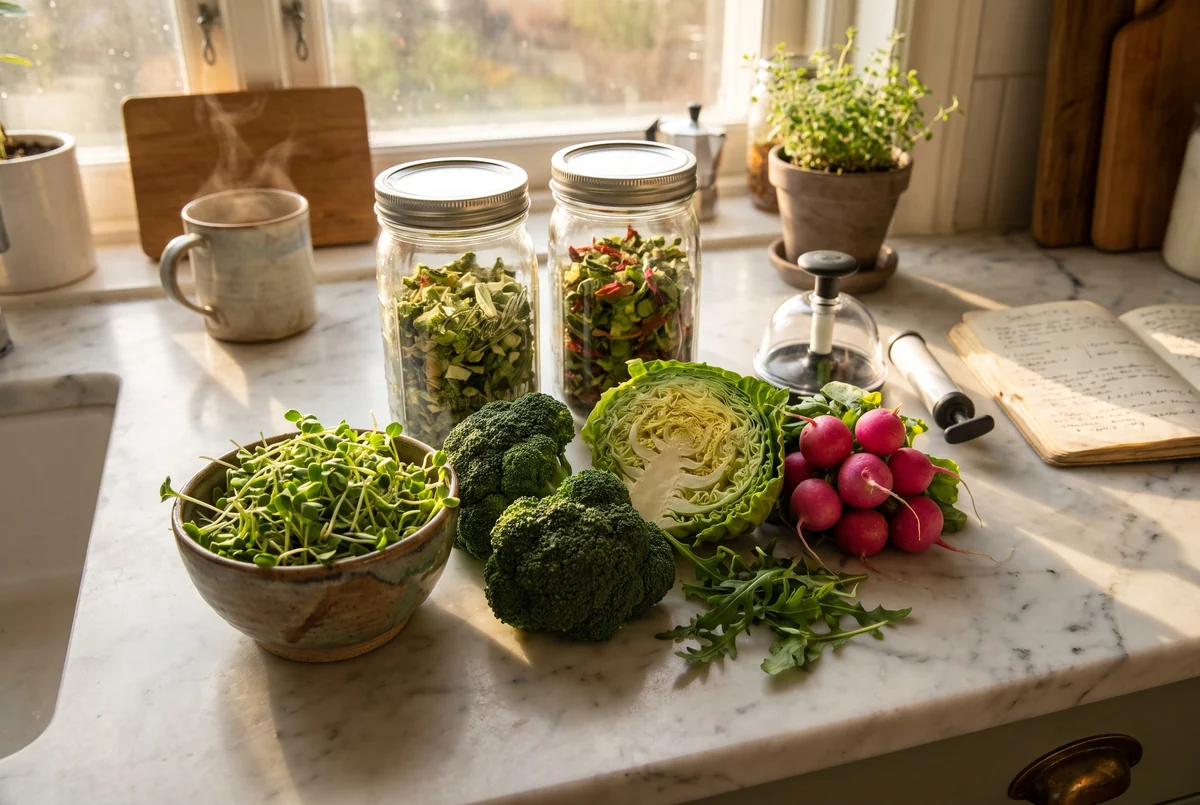
One honest limit, though, because I do not want to sell you dreams in a sachet. This is a concentrated, standardized drink, very different from a portion of broccoli, and the study measures the excretion of pollutants without assessing respiratory health: this result is not an EFSA-validated claim. Anyone wondering how to clean your lungs from air pollution through food will find here a research lead, not a fix. For my part, I take away a very simple invitation: regularly put a variety of cruciferous vegetables on your plate (broccoli, cabbage, radish, arugula, young homegrown sprouts), as part of a varied and balanced diet and a healthy lifestyle.
Fruit, tomatoes and lung function
A second lead, European this time: the ECRHS cohort followed 680 adults from three countries, with an average age of 43.8 years, with spirometry (the test where you blow as hard as you can into a mouthpiece) ten years apart (Garcia-Larsen et al., 2017). Among the biggest tomato eaters, forced vital capacity (FVC) declined more slowly, by 4.5 ml per year, the only association that remained significant after statistical correction. Apples (3.59 ml/year on FEV1, the air breathed out in one second) and bananas (3.69 ml/year on FVC) showed a trend that did not survive this correction. A few millilitres a year, you will say. Yes, but over years, and these are the only lungs you will have.
The effect was mostly visible in ex-smokers, and an observational study shows an association without proving a cause. For the lungs of a former smoker, the first step remains having quit, and fruit comes on top of that quitting without replacing it.
Antioxidants: what a review concludes
A narrative review from 2018 (Whyand et al., 2018) judges the data more favourable for carotenoids, vitamin D and vitamin E against pollution-related damage; vitamin C, curcumin, choline and omega-3 might play a role. The Mediterranean diet appears there as beneficial in airway diseases, with no direct evidence against pollution. These are research leads, not EFSA-validated claims.
Translated onto the plate, without any supplement, this gives colourful vegetables, fruit, nuts and seeds, and plant sources of omega-3 such as walnuts or ground flaxseed. Carrots and squash, almonds and sunflower seeds, a little turmeric in the soup: nothing exotic, as part of a varied and balanced diet and a healthy lifestyle. We add, we do not remove anything, and everyone goes at their own pace.
What food cannot do
No food, no juice, no herbal tea erases what we breathe. The lockdown reminded us of this in its own way, with its 2,300 deaths avoided: a whole country had to be brought to a standstill to move that figure. Imagining that a cup could do better is asking a lot of an infusion.
Herbal tea or juice to clean the lungs: none of the sources used here shows any cleaning. A hot drink can soothe an irritated throat, and that is all we can honestly say about it. And that is already something, on a winter evening. For syrups and homeopathy, the right person to ask remains the doctor. The same goes for water: drinking to thirst is part of a normal healthy routine, and no data used here shows that drinking more speeds up the clearance.
That leaves tobacco, and here I will not beat around the bush. There is no natural drink to clean smokers' lungs: stopping smoking remains, by a very long way, the first step, and nothing in a cup replaces it. If you are asking how to clean your lungs from smoking, that is the whole answer. It is the same logic as for the idea of an organ to "scrape clean", already examined for the gut: looking for a product that repairs, rather than tackling the cause.
Pollution peak days: which everyday habits?
The first step is a low one. Check the air quality index for your region before going out, the way you check the weather, and on peak days, move jogging and cycling away from main roads. Airing the home every day, preferably at times when traffic is light, and not smoking indoors already make a real difference. No equipment is needed.
And then there are the signals that do not belong to the kitchen, and that you should not leave hanging. A persistent cough, breathlessness, coloured sputum or congested bronchial tubes that last call for medical advice rather than a home regimen.
A pollution peak week: preparing your vegetables ahead
Preparing raw cruciferous vegetables, a seasonal soup and a few sprouts in one go, then keeping everything cool in jars, makes the week simpler. The complete BocUp kit vacuum-seals these jars with a bell and a small hand pump, with no electricity and no plastic bag, on the glass jars you already have, if they have "shoulders" and a 65 or 84 mm lid. Pure low tech: a pump, a bell, and physics does the rest.
According to the manufacturer, fresh food keeps up to 5 times longer this way, a vegetable soup lasting 8 to 10 days instead of 2. Let us be clear, vacuum does not replace the fridge or the freezer, and it does not sterilize. Here at Biovie, our activated almonds end up in vacuum jars, by the big basinful, enough to last several months; we do not spend the weekend on it, but we do spend time on it. Everything is detailed in our article on vacuum sealing at home.
City air is getting better, slowly, too slowly for my taste. Let us hope our children will one day look at pollution peaks the way we look at old photos of factory chimneys today. Until then, a soup ready in a jar and a jog moved to another time is already a real step. And if you have your own tricks for getting through those days, write to me!
Frequently asked questions
Which drink is good for the lungs?
No drink cleans the lungs; water drunk to thirst is simply part of a normal healthy routine. The only drink tested against a placebo in the face of air pollutants is a concentrated broccoli sprout beverage: in China, it increased urinary excretion of benzene derivatives by 61% over 12 weeks.
Is there a home remedy to clear congested bronchial tubes?
No home remedy has been shown to clear the bronchial tubes. A hot drink or slightly humidified air in the bedroom brings comfort, which is already welcome, with no therapeutic value. If the congestion lasts, or comes with fever or breathlessness, it is better to seek medical advice.
Which signs should lead you to see a doctor when your bronchial tubes are congested?
A persistent cough, breathlessness, fever or coloured sputum should lead you to see a doctor, especially if the congestion of the bronchial tubes lasts. These signs call for medical advice rather than a home regimen or an herbal tea. The doctor can look for the cause and suggest what is appropriate.
Can an herbal tea clean the lungs?
No, no herbal tea has been shown to clean the lungs in the sources used here. The airways clear themselves thanks to mucus and cilia. A hot herbal tea remains a moment of pleasure and warmth that can soothe an irritated throat, with no demonstrated effect on lung clearance.
Which foods should you favour when you live in a city?
Cruciferous vegetables and tomatoes are the best-documented foods in humans against urban pollution. Chinese trials tested a broccoli sprout drink, a European cohort associated tomatoes with a slower respiratory decline, and a review cites carotenoids and vitamin E. No food replaces cleaner air.
How can you support the lungs of a former smoker?
The first step is having quit smoking, and not starting again. In a European cohort of 680 adults followed for ten years, the biggest tomato eaters had a slower respiratory decline, especially among ex-smokers. This is a statistical association, which does not prove a cause and effect link.
References
- Santé publique France, 2021. Pollution de l'air ambiant : nouvelles estimations de son impact sur la santé des Français. Santé publique France, press release of 14 April 2021.
- World Health Organization, 2021. WHO global air quality guidelines: particulate matter (PM2.5 and PM10), ozone, nitrogen dioxide, sulfur dioxide and carbon monoxide. World Health Organization.
- World Health Organization, 2024. Ambient (outdoor) air pollution. World Health Organization, fact sheet updated on 24 October 2024.
- Egner PA, Chen JG, Zarth AT, et al., 2014. Rapid and sustainable detoxication of airborne pollutants by broccoli sprout beverage: results of a randomized clinical trial in China. Cancer Prevention Research.
- Chen JG, Johnson J, Egner P, et al., 2019. Dose-dependent detoxication of the airborne pollutant benzene in a randomized trial of broccoli sprout beverage in Qidong, China. American Journal of Clinical Nutrition.
- Garcia-Larsen V, Potts JF, Omenaas E, et al., 2017. Dietary antioxidants and 10-year lung function decline in adults from the ECRHS survey. European Respiratory Journal.
- Whyand T, Hurst JR, Beckles M, Caplin ME, 2018. Pollution and respiratory disease: can diet or supplements help? A review. Respiratory Research.
Updated: November 2026. Article written and validated by Éric Viard, founder of Biovie since 2007 and ISTOM engineer, co-author of « Algues au quotidien » (Gallimard, 2024), Best Cookbook in the World, Gourmand Cookbook Awards 2025, and Best Cookbook in France, Académie Nationale de Cuisine 2025.
The information presented in this article is provided for information purposes only and does not constitute medical advice. Consult a healthcare professional before making any change to your diet or supplementation.