


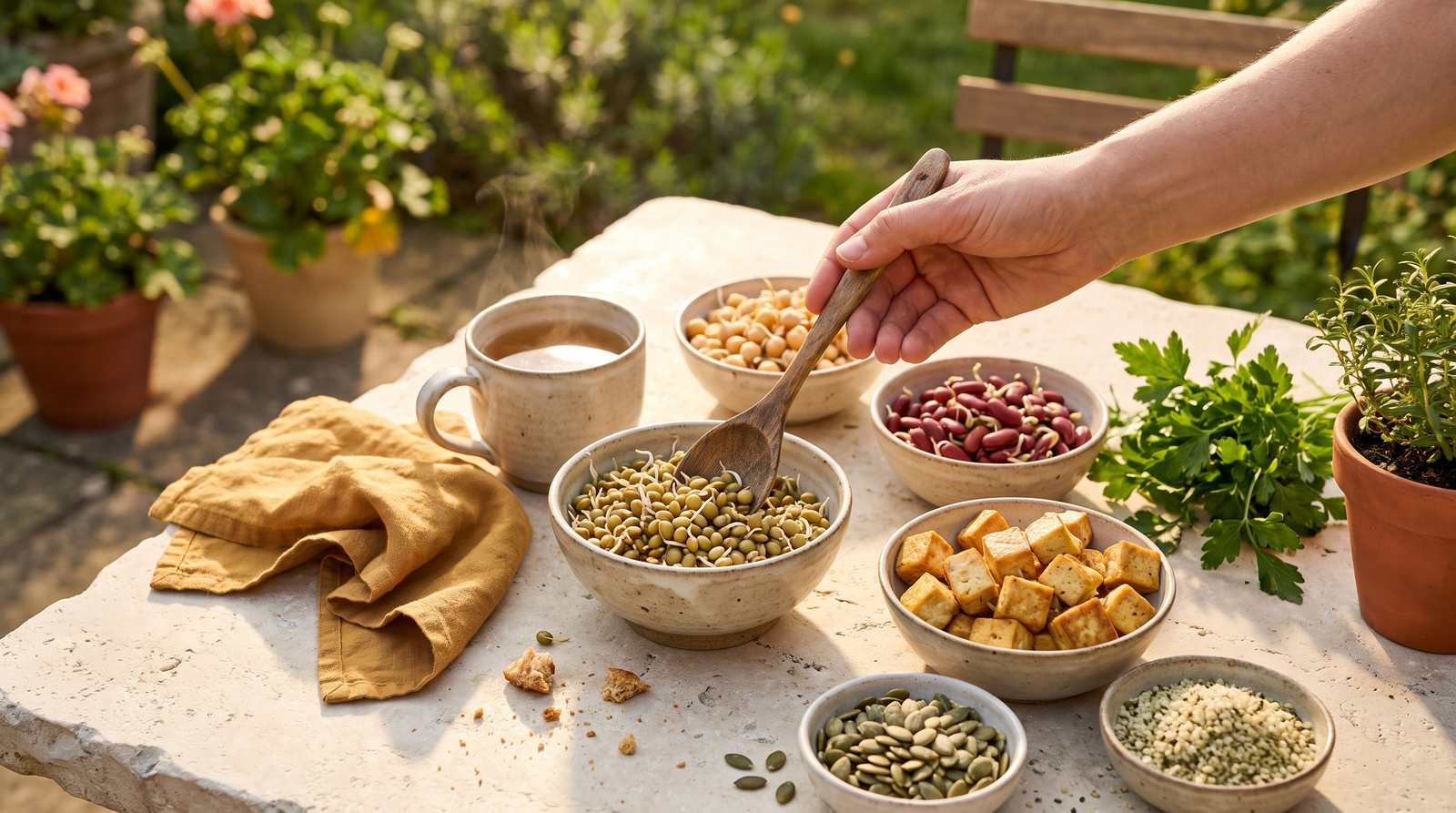
Where to get protein as a vegetarian or vegan? In legumes, soy, seeds and nuts, the high protein vegan foods that are easiest to find, in sufficient amounts as soon as you vary your choices: about 50 g a day covers the need of a 60 kg adult. All of them are prepared soaked overnight at the minimum, or sprouted for 48 hours. At Biovie, we brought every value down to the same official database and to the serving, relying on EFSA and scientific reviews.
Try it yourself: type "lentils protein" into a search engine. One site announces 24.6 g per 100 g, the next one 9 g. Who is wrong? Nobody. One is talking about dry lentils, the other about cooked lentils. You just have to know it.
I have been vegan since 1992. Around the age of 20, I met someone who had eaten plant-based since birth, and it was a shock, because I had always been led to believe that you needed animal products to be healthy. As an engineering student at ISTOM, I then spent a first year with no kitchen in my room, no right to use the shared kitchen, and a university restaurant with no vegetarian option. I had to get inventive: I got into sprouted seeds in a big way, to have something fresh. You can start with no resources at all.
How much protein do you really need?
Let's start with the need, since everything else follows from it. EFSA, the European Food Safety Authority, sets the reference intake for adults at 0.83 g of protein per kilo of body weight per day, seniors included (EFSA, 2012). For 60 kg, that gives 49.8 g, or about 50 g. At 70 kg, you get to 58 g. It is not a mountain. Knowing where to get protein from as a vegetarian starts with knowing how much you actually need.
Still, you need to know what a "reference intake" is. Think of a door frame: you don't set it at the average height of the family (the tallest would bump their forehead every morning), but high enough for almost everyone to walk through without ducking. The reference intake covers the needs of almost the whole population, with room to spare. The average requirement estimated by EFSA is lower, by the way: 0.66 g per kilo per day.
As for vegetarians, a systematic review of 141 observational and intervention studies concludes that their protein intakes are lower than those of omnivores, but remain within recommendations (Neufingerl and Eilander, 2022). Lower, yes. Insufficient, no. As part of a varied and balanced diet and a healthy lifestyle, there is no need to get the calculator out at every meal.
One nuance is needed. In older people, the question is more complex, according to Mariotti and Gardner (2019): there, it is a matter for a healthcare professional.
High protein vegan foods: the per-serving table
By raw content, among the high protein vegan foods, hemp seeds (31.6 g per 100 g) and pumpkin seeds (30.2 g) come first, ahead of tempeh (20.3 g) and firm tofu (17.3 g). Only, nobody eats seeds by the plateful. At the serving you actually eat, legumes and soy provide the most.
All the values in the table come from a single database, the U.S. Department of Agriculture (USDA) FoodData Central. I insist on that "single": picking one figure here and another there is comparing apples and oranges. The servings, for their part, are simple examples, chosen for illustration.
| Food | Protein per 100 g | Example serving | Protein per serving |
|---|---|---|---|
| Cooked lentils | 9.02 g | 200 g | 18.0 g |
| Cooked chickpeas | 8.86 g | 200 g | 17.7 g |
| Cooked kidney beans | 8.67 g | 200 g | 17.3 g |
| Firm tofu | 17.3 g | 100 g | 17.3 g |
| Tempeh | 20.3 g | 100 g | 20.3 g |
| Prepared edamame | 11.9 g | 100 g | 11.9 g |
| Pumpkin seeds | 30.2 g | 30 g | 9.1 g |
| Hulled hemp seeds | 31.6 g | 30 g | 9.5 g |
| Raw peanuts | 25.8 g | 30 g | 7.7 g |
| Almonds | 21.2 g | 30 g | 6.4 g |
| Cooked quinoa | 4.4 g | 150 g | 6.6 g |
| Whole raw egg (vegetarians) | 12.6 g | 100 g | 12.6 g |
Legumes
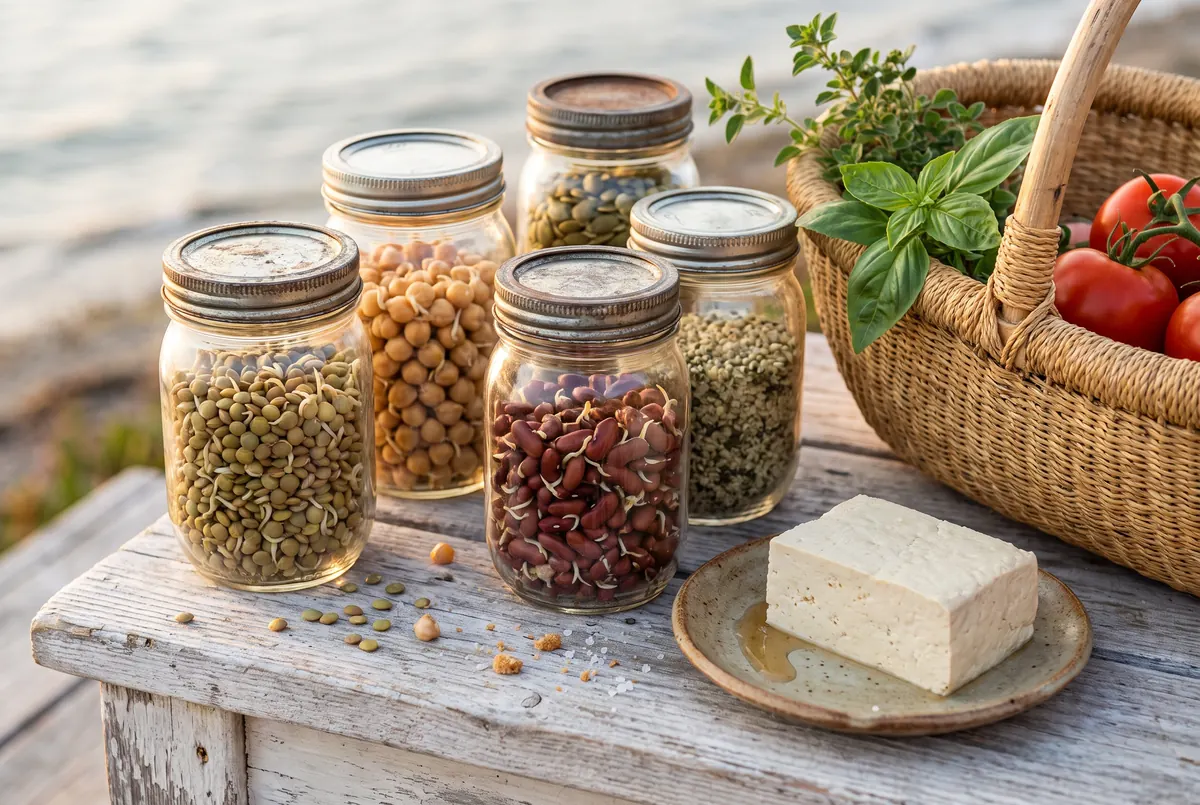
Once cooked, lentils, chickpeas and kidney beans all hover around 9 g per 100 g. Modest by weight, generous on the plate. A 200 g plate of cooked lentils provides 18 g of protein, more than a third of a day at 50 g. These figures are USDA reference values for cooked seeds: at our place, these legumes are first soaked overnight, then sprouted for 48 hours (see below).
Soy
Soy plays in another category: 20.3 g per 100 g of tempeh (fermented soy, a compact cake where you can still make out the beans), 17.3 g for firm tofu and 11.9 g for edamame, those soybeans harvested while still green.
Seeds and nuts
Seeds are the most concentrated: 31.6 g per 100 g of hulled hemp, 25.8 g for raw peanuts, 21.2 g for almonds. But let's be serious, who eats 100 g of pumpkin seeds for breakfast? With 30 g, a nice handful, you get from 6.4 to 9.5 g of protein depending on the seed. Not spectacular, but regular, and that is what counts. As part of a varied and balanced diet and a healthy lifestyle, these handfuls add up over the course of your meals. They also belong among the best plant based protein sources for everyday cooking.
Grains and pseudo-grains
Cooked quinoa tops out at 4.4 g per 100 g, or 6.6 g for a 150 g bowl. That is modest. Grains do not carry the plate on the protein side, but they add to the rest.
For vegetarians: eggs and dairy
For those who eat eggs, a whole raw egg shows 12.6 g of protein per 100 g. I do not give figures for cheeses and yogurts: without a common value, I would rather keep quiet than hand you a shaky number. As for seaweed, it deserves an article of its own, see our article on the protein in nori.
Raw, cooked, dry: why the tables contradict each other
How can the same food show 24.6 g of protein on one site and 9 g on another? Raw lentils, meaning dry ones, contain 24.6 g per 100 g, against 9.02 g once cooked (USDA). Nothing disappeared in the pot.
Dip a dry sponge in water: it gets much heavier, and yet it is the same sponge. Lentils do the same when cooked: they soak up water, and their protein is diluted in it without disappearing. Hence the 23 to 25 g displayed by some sites and the 9 to 10 g of the others, which contradict each other without anyone really being wrong.
Same story with spirulina: the USDA database gives 57.5 g of protein per 100 g of dried spirulina, while other sites announce 65 g, because values vary with the sample and the database. Impressive on paper. Only, nobody ever eats that much. Brought down to a small dose of 5 g, spirulina provides about 2.9 g of protein. You are better off adding it to a smoothie for its taste and overall composition.
In short, to compare high protein vegan foods, always take the same database and the serving you actually eat.
Are plant proteins "worse"?
A classic objection, and a legitimate one. It deserves better than a shrug.
The quality of a protein comes down to two things: its content of essential amino acids (the ones the body cannot make) and its digestibility. Think of a game of Scrabble: to write your words, you need certain letters, and each bag, the lentil one or the seed one, does not hold them in the same proportions. Draw from several bags, and the words come. Since 2013, the FAO has recommended measuring this quality with a score called DIAAS, which replaces the old PDCAAS.
Of course, amino acid profiles vary from one plant to another, and that is where the objection comes from: it is not absurd. But the review by François Mariotti and Christopher Gardner, focused on adults in Western countries, concludes that legumes, nuts and seeds are enough to cover the needs, and that the risk of amino acid deficiency has been "largely overestimated" (Mariotti and Gardner, 2019). Largely overestimated.
My advice, which comes from practice and not from a study: vary your sources over the day. For the mechanism of assimilation, see our article on how the body assimilates plant proteins.
You are not what you eat, but what you assimilate.
Soaked, then sprouted: the rule for all legumes
A clarification that changes how you read everything else. At Biovie, no legume is eaten dry and unprepared: soaked overnight at the minimum, and preferably soaked overnight then sprouted for 48 hours, whether you eat it raw or cooked. The tables in this article describe ordinary cooked seeds, because that is what databases measure. On the plate, we do it differently.
A dry seed is a sleeping seed, solidly protected. As soon as water arrives, its own enzymes wake up and go after the reserves, but also after the substances that get in the way of digestion. Here is what the studies say.
- Antinutrients go down. Germination activates enzymes (amylases, phytases) that break down antinutritional factors: trypsin inhibitors, which slow the digestion of proteins, and phytates, which hold on to minerals (Nkhata et al., 2018). In lentils, germination lowers phytic acid (Rico et al., 2021).
- Proteins are better assimilated. In sprouted lentils and fava beans, storage proteins are cut into peptides and free amino acids, and protein digestibility increases, more or less depending on the variety (Bautista-Expósito et al., 2021).
- New nutrients appear. The seed makes vitamin C from its sugars: in lentils, ascorbic acid content rises with germination time, up to about 3.5 days, as does that of GABA (Rico et al., 2021). In chickpeas, GABA is multiplied by 18 in a few days (Pencheva et al., 2026).
In practice: soak for 8 to 12 hours in fresh water, rinse, then 48 hours in a sprouter or a jar, with two rinses a day. Lentils, chickpeas or mung beans then give a barely visible sprout, which you can crunch raw or cook in just a few minutes.
One safety rule is non-negotiable: germination does not replace cooking for kidney beans and other dry beans, nor for soy. Those, even sprouted, are always cooked for a long time. And like all sprouts eaten raw, sprouted legumes should be cooked for vulnerable people: young children, pregnant women, older people or the immunocompromised. As for red lentils, already hulled, they do not sprout: choose whole lentils.
A vegetarian day at 50 g of protein
No need to weigh every lentil. Here is a simple day, built with USDA values, that reaches 51.0 g of protein, the reference need of a 60 kg adult according to EFSA.
| Time | Food and quantity | Protein |
|---|---|---|
| Lunch | 200 g of lentils sprouted for 48 h then cooked (USDA value for cooked lentils) | 18.0 g |
| Dinner | 100 g of firm tofu | 17.3 g |
| On a salad or in a bowl | 30 g of pumpkin seeds | 9.1 g |
| As a side | 150 g of cooked quinoa | 6.6 g |
| Total | Benchmark: 49.8 g for 60 kg | 51.0 g |
The values are those of cooked seeds in the USDA database: after germination, they vary with the variety and the duration, which is why I speak of benchmarks.
And I did not count the rest: bread and vegetables included, it provides even more on top. As part of a varied and balanced diet and a healthy lifestyle, the real total for the day therefore exceeds these 51 g.
What can replace meat?
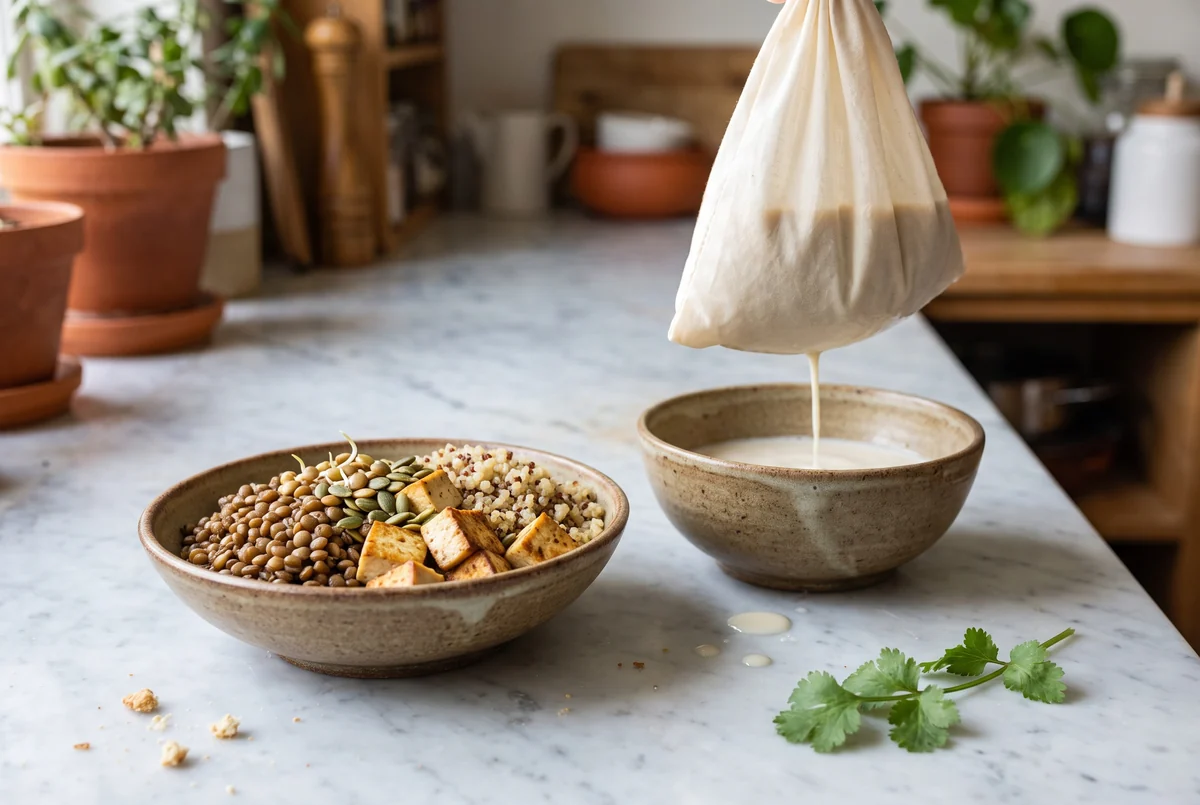
Per serving, 200 g of cooked lentils provide 18 g of protein and 100 g of firm tofu 17.3 g. No food "replaces" meat in every respect, and that is not the point: each one brings its own amount of protein. A dahl of green lentils sprouted for 48 hours, a chili with kidney beans soaked overnight, sprouted then cooked for a long time, or a marinated then grilled tempeh do the job very well. And lentils sprouted in a sprouter can be eaten raw in a salad, without even getting the pot out.
Which protein for dinner?
No reference source imposes a particular protein in the evening. It is the total for the day that counts, and EFSA reasons in daily intake anyway. Lentils at noon and tofu at dinner, or the other way round: up to you, depending on your appetite.
Homemade soy milk and okara
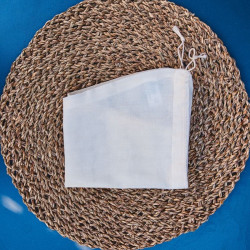
Making your own soy drink takes little equipment, and you finally know what you are drinking: soybeans soaked overnight at the minimum, blended with water, then strained through a plant milk bag. The resulting drink must then be cooked before you drink it, this is the step not to skip. The pulp left in the bag, the okara, can be cooked into patties: nothing goes to waste. An unsweetened store-bought soy drink contains 2.86 g of protein per 100 g; the homemade version varies with the amount of water. It is all detailed in our guide on how to choose and use a plant milk bag.