Fast delivery
.png)
 Fair prices


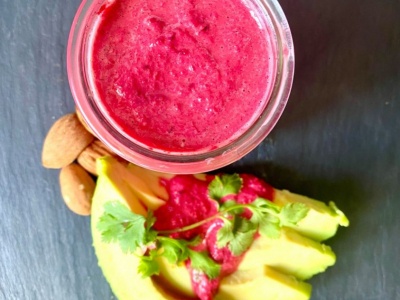

Industrial salad dressings that flood the shelves are too often full of added sugars, refined oils, and preservatives. In contrast, this 100% raw almond-ginger seasoning — from the ebook Living cuisine for optimal health Hippocrates Institute of Florida — concentrates the benefits of carefully selected living ingredients into a single sauce.
Creamy, colorful, naturally gluten-free, and with no added oil, this vegan sauce can be prepared in less than 10 minutes using a blender. It transforms a simple raw vegetable salad into a complete meal and makes your raw wraps or zucchini noodles truly addictive. In this guide, you will find the original recipe, the nutritional details of each ingredient, the scientific studies supporting their benefits, and the best ways to incorporate this dressing into your daily living cuisine.
What is raw almond-ginger seasoning?
The almond-ginger seasoning is a raw, vegan, and gluten-free sauce whose recipe comes to us from theHippocrates Institute of Florida, a global reference in raw food for over 60 years. It is featured among the 170 recipes in the ebook. Living cuisine for optimal health, a classic of raw cuisine popularized in Europe by Biovie.
Unlike traditional dressings, this seasoning is prepared entirely cold, without cooking or added oil. This preserves the entirety of the enzymes, heat-sensitive vitamins, and active principles of each ingredient — exactly what living cuisine seeks.
The result is a smooth sauce with burgundy-orange hues, featuring a flavor that is both sweet (almond), spicy (ginger), slightly earthy (beetroot), and umami (tamari). It pairs well with a wide variety of dishes: raw vegetable salads, raw wraps, vegetable noodles, appetizer dips, or quick marinades.
Ingredients and their health benefits
Each ingredient in this seasoning was chosen not only for its taste but also for its documented nutritional properties. Let's review what science says about each one.
Raw almond puree — an exceptional protein base
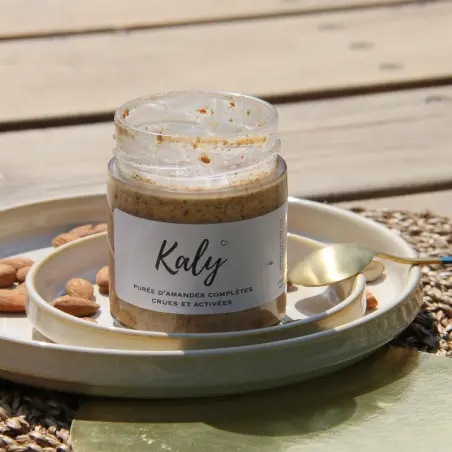
The raw almond puree (or raw almond butter) is the backbone of this sauce. It provides creaminess and remarkable nutritional density. For 100 g, almonds provide approximately:
- 22.6 g of plant-based proteins complete
- 12.5 g of fiber Foods that promote satiety
- 34.4 g of monounsaturated fats (oleic acid), beneficial for cardiovascular health
- An excellent content in Vitamin E, in magnesium and calcium
The meta-analyses published in recent years confirm that a regular consumption of 30 to 50 g of almonds per day contributes to the reduction of LDL cholesterol and the stabilization of blood sugar levels. At Biovie, we systematically prioritize the activated almonds — previously soaked and then dehydrated at low temperature — for better digestibility and increased nutrient bioavailability.
To go further: activate your almonds before consuming them to maximize their benefits..
"The purchased products are delicious: activated almonds, almond and hazelnut paste, Brazil nuts. Effective communication, perfect packaging, and fast delivery."
— Sandy, Trustpilot review 5/5
Ginger — the anti-inflammatory spice of raw cuisine
Fresh gingerZingiber officinale) is among the most studied spices in herbal medicine. Its active compounds — the gingerol and the Shogaols — exert a recognized anti-inflammatory action by inhibiting COX enzymes (cyclooxygenase), which are responsible for the synthesis of pro-inflammatory prostaglandins.
A clinical study involving 247 patients suffering from arthritis showed that 63% of them saw their symptoms improve. after 6 weeks of treatment with concentrated ginger extract, compared to only 50% in the group on synthetic anti-inflammatory drugs. The data compiled by the MSD Manuals also confirm that ginger inhibits the production of pro-inflammatory cytokines (TNF-α, IL-1β, IL-6).
Consumed raw, In this seasoning, the gingerol is fully preserved. Cooking partially transforms it into shogaol, a molecule with different properties. This is why raw cuisine always favors fresh ginger, grated or blended cold.
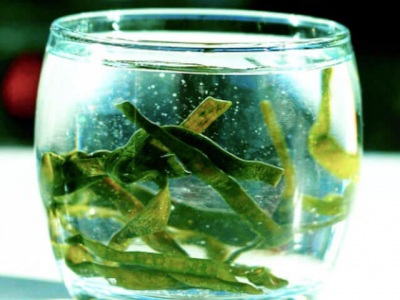
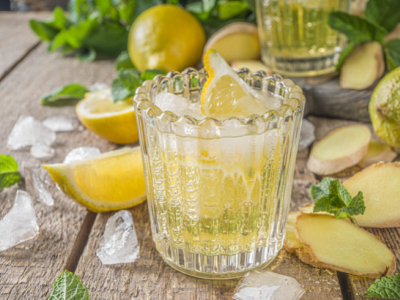
To explore other uses of raw ginger: Ginger-lemon water, a detox recipe with 6 benefits or even 4 ways to store ginger for a long time.
Caution: Ginger is not recommended in high doses for people on anticoagulant treatment or those suffering from severe gastroesophageal reflux. The EFSA recommends not exceeding 5 g of ginger powder per day.
The red bell pepper — the all-around champion of vitamin C
Raw red bell pepper is one of the richest food sources of vitamin C: approximately 127 mg per 100 g, which is more than double that of an orange (54 mg/100 g) according to the data Ciqual of ANSES. It is also rich in carotenoids (lycopene, beta-carotene) and antioxidants. Used raw in this sauce, it fully retains its heat-sensitive nutrients while adding color and freshness.
Red beetroot — nitrates and vitality
Red beetroot is rich in natural nitrates which the body converts into nitric oxide—a molecule that helps dilate blood vessels, improve circulation, and support physical performance. Its pigments, the betalains, are powerful antioxidants with documented anti-inflammatory properties. It gives the sauce its characteristic beautiful burgundy hue.
Tamari — the gluten-free soy sauce of living cuisine
The Tamari is a traditionally fermented Japanese soy sauce without wheat, which makes it naturally gluten-free (unlike traditional shoyu, which contains wheat). Derived from a long fermentation of soybeans, it is rich in amino acids and provides an incomparable umami depth to raw recipes. In this seasoning, it advantageously replaces salt while adding minerals and flavor.
Advice: Choose an organic and unpasteurized tamari to preserve the enzymes from fermentation.
The complete recipe — ingredients and preparation steps
This sauce can be prepared in less than 10 minutes in a high-speed blender. Here is the original recipe as taught at the Hippocrates Institute in Florida.
Ingredients (for about 500 ml of sauce):
- 2 cups of red bell pepper cut into pieces
- 1 cup of organic raw almond puree (not roasted)
- ½ cup of chopped shallots
- ¼ cup of red beet cut into pieces
- 1 to 2 cm of fresh grated ginger (adjust according to desired intensity)
- 1 clove of garlic
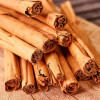
- ½ teaspoon of ground cinnamon
- 2 to 4 tablespoons of water (to adjust the texture)
- 2 tablespoons of tamari (or shoyu if gluten tolerance is possible)
- The juice of 1 fresh lemon (about 3 tablespoons)
Preparation:
- Place all the ingredients in a high-speed blender.
- Blend at full power for 45 to 60 seconds until you achieve a perfectly smooth and creamy texture.
- Taste and adjust: more tamari for saltiness, more lemon for acidity, more ginger for spiciness.
- Add water spoon by spoon to achieve the desired consistency (more fluid for a dressing, thicker for a dip).
- Pour into an airtight glass jar and store in the refrigerator.
Conservation: 3 to 5 days in the refrigerator in an airtight glass jar. Stir before each use. Avoid freezing, which alters the texture of the almond puree.
How to use this seasoning in your dishes?
This versatile sauce naturally fits into a wide variety of dishes, both raw and cooked. Here are our usage suggestions:
- Vinaigrette for raw vegetable salads: Generously coat a salad of massaged kale, spiralized zucchini, or grated carrots. The creamy texture clings to the leaves and vegetables.
- Sauce for raw wraps: Spread on a cabbage leaf, nori, or romaine lettuce, top with raw vegetables, and roll. A complete meal in just a few minutes.
- Dip for raw vegetables: Serve in a small bowl with celery sticks, cucumber, radish, or carrot. Ideal for an appetizer or snack.
- Sauce for vegetable noodles: mix with spiralized zucchini, raw spaghetti squash, or konjac noodles for a lively pad thai-style dish.
- Express Marinade: Marinate mushrooms, zucchini, or eggplants in thin slices for 1 to 2 hours before dehydrating or serving them raw.
To complete your raw menus, also discover our spicy raw falafels and our homemade almond ricotta, which pair perfectly with this type of sauce.
Variants and customization
This recipe is a base that you can adapt according to your tastes and the available ingredients:
- Softer version: Replace the red bell pepper with a carrot and reduce the ginger to ½ cm. A tablespoon of raw agave syrup adds a balancing sweet note.
- Spicy version: Add ½ deseeded red chili pepper to the blender. The combination of ginger and chili creates an anti-inflammatory and thermogenic synergy.
- Asian version: Incorporate 1 tablespoon of tahini (sesame paste) and the zest of one lime. Perfect with cabbage salads or rice noodles.
- Nut-free version: Replace almond puree with sunflower seeds that have been soaked for 4 hours and blended. This is a suitable solution for nut allergies.
Frequently Asked Questions about Almond-Ginger Sauce
Can peanut butter be used instead of almond paste?
Yes, peanut butter can replace almond puree for a more affordable and slightly sweeter version. Opt for raw and organic peanut butter, without added sugar or palm oil. The taste will be more pronounced and different, but the texture will be similar. Note that the peanut is a legume and not a nut, with a different nutritional profile (richer in omega-6).
How long does this almond-ginger seasoning last?
The seasoning can be stored for 3 to 5 days in the refrigerator in an airtight glass jar. Avoid freezing, as it alters the texture of the almond puree. Stir before each use because the components may separate slightly over time — this is completely normal for a sauce without artificial emulsifiers.
Is this seasoning suitable for people who are gluten intolerant?
Yes, provided you use tamari (and not shoyu or regular soy sauce). Tamari is made from fermented soybeans without wheat, making it naturally gluten-free. Always check the label to confirm the absence of gluten traces if you have celiac disease.
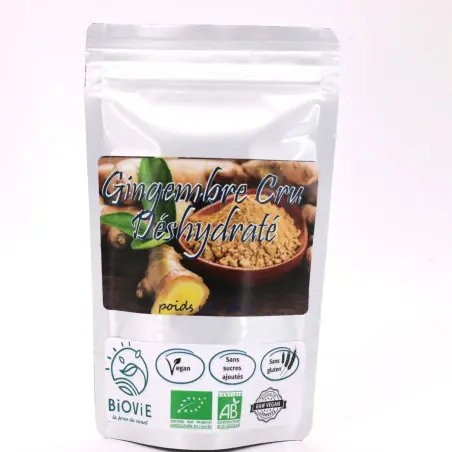
Can powdered ginger be used in place of fresh ginger?
Fresh ginger is highly recommended in this recipe because it contains gingerol, the active anti-inflammatory compound that partially transforms into shogaol when dried. Ginger powder can be used as a substitute (about ½ teaspoon for 1 cm of fresh ginger), but the flavor and benefits will be less intense. For truly vibrant seasoning, always opt for fresh and organic ginger.
What are the benefits of raw ginger in this sauce?
Raw ginger contains gingerol, a molecule with anti-inflammatory properties documented by clinical studies. Research shows that ginger reduces arthritis-related pain in 63% of tested patients—more effectively than some synthetic anti-inflammatory drugs. It also aids digestion, stimulates blood circulation, and has antioxidant properties. In its raw form, these active compounds are fully preserved, making it an ideal ingredient in raw food cuisine.
Can I drink or consume ginger in the evening without risk?
Ginger is generally well tolerated in the evening for most people and can even aid digestion after a meal. However, in cases of gastroesophageal reflux, it is better to consume it during the day and in moderate amounts. To learn more: Can you drink ginger in the evening?
About the author
"This almond-ginger sauce is, for me, the very essence of vibrant cuisine: three minutes in the blender, no cooking, and you get a nutrient-dense condiment that transforms any bowl of raw vegetables into a complete meal. It is this simplicity, this density, and this nutritional intelligence that I have been advocating at Biovie for nearly 20 years."
Éric Viard — Tropical agronomist engineer, co-founder of Biovie.fr Since 2007, 33 years of veganism, co-author with Aurélie of the book Seaweed in Everyday Life (Gourmand World Cookbook Award + National Academy of Cuisine Prize).
Update: April 2026.
Warning: The information presented in this article is provided for informational purposes only and does not constitute medical advice. Consult a qualified healthcare professional before making any significant changes to your diet or supplementation, especially if you are on anticoagulant treatment or suffer from a digestive disorder. This article contains almonds (major allergen).
Discover the activated organic almond puree at the Biovie store..