The amino acid profile: as complete as the egg
The quality of a protein is measured by its PDCAAS score (Protein Digestibility-Corrected Amino Acid Score) or more recently by the DIAAS score (Digestible Indispensable Amino Acid ScoreThese indices assess both the amino acid composition and their digestibility.
Research published in Food Chemistry have demonstrated that algae of the genus Porphyra present a Protein digestibility greater than 80%, which is remarkable for a plant source (Wong & Cheung, 2000).
In reality, the protein profile of nori is closer to that of an egg than that of legumes. This is information that often surprises, but the scientific data is clear.
The low-temperature drying we practice at Biovie (below 45°C) helps maintain this optimal digestibility. Industrial high-temperature drying would not only degrade heat-sensitive amino acids but also reduce the overall bioavailability of proteins.
Beyond Proteins: The Nutritional Bonuses of Nori
Vitamin B12: The Vegan Advantage
Here is a topic that particularly interests vegans and vegetarians. Vitamin B12 is almost exclusively found in animal products... except in certain algae, including nori.
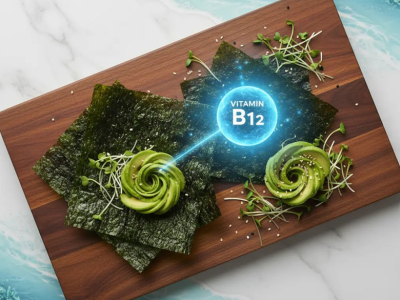
A major study published in Nutrients demonstrated that dried nori contains significant amounts of Vitamin B12 in bioactive form (cobalamin). The analyses reveal an average content of 30 to 60 µg per 100g of dried nori, which is well above the recommended daily intake of 2.4 µg for an adult (Watanabe). and others., 2014).
However, caution is advised: the bioavailability of this B12 is still a subject of debate within the scientific community. Some studies suggest that a portion might be in the form of inactive analogs. However, Watanabe's research has shown that the B12 in nori Porphyra is predominantly in active form and effectively helps improve the B12 status of deficient individuals (Watanabe and others., 2014).
Frankly, even though nori cannot completely replace supplementation for strict vegans, it makes a valuable contribution to the daily intake of B12. It is one of the few plant sources that can claim this benefit.
Omega-3, iron, iodine: a nutrient concentrate
Nori is not limited to proteins and B12. This seaweed offers an impressive range of nutrients:
Omega-3 EPA : Unlike most plants that only contain ALA-type omega-3s (which our body converts very poorly into EPA and DHA), nori directly containsEPA (eicosapentaenoic acid). It is exceptional in the plant world. Research published in Food Chemistry quantified the presence of EPA in the algae Porphyra (Kumari and others., 2010).
Iron : With 10 to 15 mg per 100g, nori is an excellent source of iron. Admittedly, it is non-heme iron (less well absorbed than the iron from meat), but the simultaneous presence of vitamin C in the seaweed promotes its absorption (MacArtain). and others., 2007).
Iodine : It is often the primary concern regarding seaweed. Good news: nori is the seaweed with the most moderate iodine content, with about 16 to 20 µg per gram according to ANSES. This is much less than kombu (1500+ µg/g) or wakame (100-300 µg/g). Regular but reasonable consumption of nori (a few sheets per week) poses no problem for the thyroid of healthy individuals.
Our fresh nori BRETALG, resulting from our exclusive partnership with Breton producers, particularly preserves these nutrients well thanks to optimal harvesting and conservation.
The environmental impact: 50 times less CO2 than beef
Carbon footprint compared
Beyond nutritional considerations, the environmental aspect deserves attention.
Cattle farming is one of the sectors that emits the most greenhouse gases. According to data from ADEME and FAO, the production of one kilogram of beef generates between 28 and 60 kg of CO2 equivalent, taking into account farming, animal feed, transport, and processing.
Studies published in Frontiers in Marine Science have demonstrated that algaculture has one of the lowest carbon footprints among all protein sources. Even better: algae act as carbon sinks and absorb dissolved CO2 in the water during their growth, thus contributing to climate change mitigation (Duarte and others., 2017). They have a negative carbon footprint.
No land, no pesticides, zero fresh water
Nori grows in the sea, on nets or floating structures. This cultivation does not require:
- No agricultural land used (a significant argument when considering that 70% of the world's agricultural land is dedicated to livestock)
- No pesticides, fungicides, herbicides used, nor chemical fertilizers used (the algae feeds on the nutrients naturally present in the water)
- Zero fresh water (increasingly valuable resource)
In a context where 31% of French people now identify as flexitarians. (against 16% in 2022 according to the Protéines France 2024 barometer), these environmental arguments make perfect sense.
At Biovie, we have been convinced since 2007 that algae represent the nutritional food of the future. And scientific data confirm this intuition a little more each year. The global market for edible algae is growing by more than 8% per year, a sign that this awareness extends far beyond our borders.
How much nori do you need ?
Let's be concrete. If nori contains 40% protein, how much do you need to consume for a significant intake ?
A realistic portion of 10 to 15 sheets of nori (approximately 30 to 40 grams of dry weight) provides between 12 and 16 grams of protein. This is equivalent to a small 80-gram steak or two eggs. Of course, you are not going to consume 10 to 15 sheets of nori per day, but you can consume fresh nori or nori flakes. The sheets, however, are very easy to transport if you go on a trip.
Obviously, nori will not completely replace your usual protein sources. However, it can significantly contribute to your daily intake, especially if you are looking to reduce your meat consumption.
Nutritional recommendations suggest about 0.8 to 1 gram of protein per kilogram of body weight for a sedentary adult, and up to 1.5 to 2 grams for athletes. A few sheets of nori per day can easily cover 15 to 20% of these needs.
5 ways to consume nori (beyond sushi)
Nori is not just for makis! Here's how I personally incorporate it into my daily life:
1. In flakes in salads : Simply crumble nori sheets over your salads. Two to three tablespoons add a touch of umami and a subtle yet real protein boost.
2. In raw soups and broths : Add pieces of fresh or dehydrated nori to your miso soups, homemade ramen, or even your vegetable soups. The seaweed rehydrates and releases its nutrients.
3. A natural snack : Lightly toasted nori sheets make for a crispy and satisfying snack. Some people add a touch of salt or sesame to them.
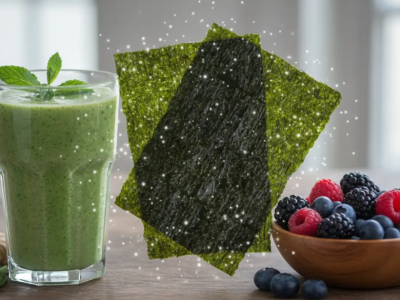
4. In the smoothies : Yes, it may be surprising, but a sheet of nori or mixed nori flakes in a green smoothie goes completely unnoticed while enriching the preparation.
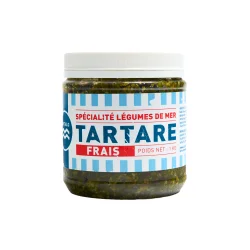
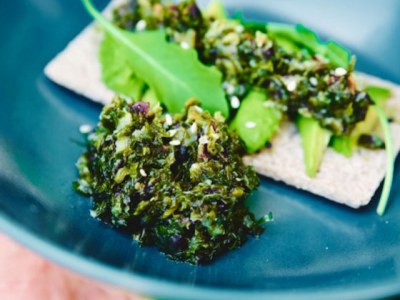
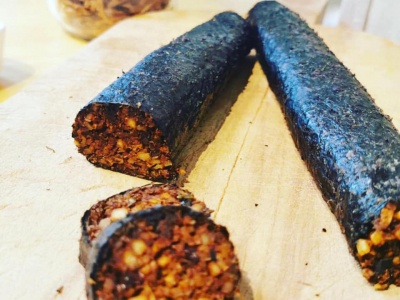
5. In "seaweed tartare": Our gourmet seaweed mix (Dulse, nori, sea lettuce) allows for the preparation of plant-based tartares with exceptional nutritional richness.
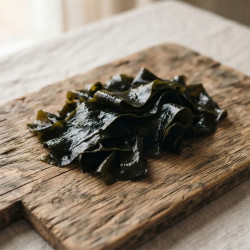
The advantage of our low-temperature dried organic nori sheets, it is their versatility. Gentle drying not only preserves the nutrients but also the texture and flavor, allowing for a wide range of uses.

FAQ - Your questions about nori and proteins
How much protein does nori contain ?
Dehydrated nori contains 30 to 50% protein. of its dry weight, an average of 40%. This is twice as much as raw beef (17-23%) and one of the highest contents in the plant kingdom, just behind spirulina (Fleurence). and others., 2012).
Is nori a complete protein ?
Yes, nori contains the 9 essential amino acids. that our body cannot synthesize. Studies published in Marine Drugs and Food Chemistry confirm that its protein profile is comparable to that of an egg (Peñalver and others., 2020; Wong & Cheung, 2000). Lysine is slightly limiting but easily compensated for by a varied diet.
How much nori to eat per day for protein ?
A serving of 10 to 15 sheets of nori (30-40g) provides 12 to 16 grams of protein., which is equivalent to a small 80-gram steak. In flakes, add 2 to 3 tablespoons to your salads, soups, or smoothies for a daily protein boost.
What is the difference between nori and spirulina in terms of protein ?
Spirulina is more concentrated in proteins (60-70%). but nori offers unique benefits: bioavailable vitamin B12 (Watanabe and others., 2014), directly assimilable omega-3 EPA (Kumari and others., 2010), and superior culinary versatility. Nori is easily cooked on a daily basis, whereas spirulina is more commonly used as a supplement.
Is nori suitable for athletes ?
Yes. Its high content of complete proteins, richness in iron (which aids in the transport of oxygen to the muscles), and magnesium (which contributes to normal muscle function) make it an interesting ally for athletes. Additionally, its omega-3 content supports the proper functioning of the body after exertion (MacArtain). and others., 2007).
Does nori contain vitamin B12 ?
Yes, nori is one of the few plant-based sources of bioactive B12. Dr. Watanabe's studies published in Nutrients confirm a content of 30 to 60 µg per 100g of dried nori, which is well above the recommended daily intake of 2.4 µg (Watanabe). and others., 2014). It is a major asset for people following a vegan or vegetarian diet.
Are there any risks with the iodine in nori ?
Nori is the seaweed with the most moderate iodine content. (16-20 µg/g), much less than kombu (1500+ µg/g). Regular consumption of a few leaves per week poses no problem for healthy individuals. In case of thyroid disorders, consult your healthcare professional.
Do you really need to combine rice and lentils? The story of a persistent myth
Almost everyone knows the rule: a grain plus a legume at the same meal, or the protein is "incomplete". This recommendation has a precise origin, and it was corrected by its own author.
It comes from Diet for a Small Planet, published in 1971 by Frances Moore Lappé, a book that did a great deal for the plant-based cause. From the 1981 revised edition onward, the author withdrew the rule and wrote that she had wrongly complicated something simple. Yet the original message had already travelled around the world, and it still circulates fifty years later.
What we understand better today comes down to one sentence: the liver constantly maintains a pool of free amino acids, which evens out intake over the whole day - an amino acid supplied in the morning stays available for protein synthesis in the afternoon. The constraint, then, is not the meal, but the day. Eating a varied diet is enough; timing your plates adds nothing.
Why does the myth persist? Because it's memorable, because it offers a simple rule where reality is diffuse, and because it has been copied from one leaflet to the next without anyone going back to the source. None of this takes away from the grain-and-legume pairing, which remains excellent in taste and nutrition - it simply isn't compulsory.
Antinutrients: what legumes ask of you that seaweed doesn't
There is, however, a real difference between legumes and seaweed, and it isn't about the amount of protein but about what comes with it.
Legumes and whole grains contain phytic acid, a molecule that binds to iron, zinc, calcium and magnesium and forms complexes with them that the gut absorbs poorly. They also contain lectins and protease inhibitors - trypsin inhibitors in particular, targeting the enzyme that cuts up long protein chains. These aren't poisons: they are the seed's natural preservatives, protecting it until the conditions for germination are met.
The good news is that we know how to disarm them. Overnight soaking, sprouting and extended cooking clearly reduce phytic acid and neutralise most enzyme inhibitors - sprouting being the most effective of the three. This is exactly what traditional cuisine has done for centuries, without needing to know the chemistry behind it.
Seaweed doesn't have this problem: it isn't a storage seed, it has nothing to protect from premature germination. Its minerals and amino acids are directly available, with no soaking or prior cooking needed - which explains part of the digestibility gap mentioned earlier. As part of a varied and balanced diet and a healthy lifestyle, the two food families complement each other very well: there's no need to choose.
What about other seaweeds? Spirulina, chlorella, dulse
Nori has the advantage of being the easiest to get used to, but it isn't alone on the protein front. Here is how the other three we're asked about most often compare, and who each one suits.
Spirulina: 55 to 70% protein
This is the most protein-concentrated food in our catalogue. It's aimed first at people looking to boost their protein intake, those with high iron needs, and athletes. Its blue pigment, phycocyanin, also makes it a food very rich in antioxidants. A teaspoon of spirulina powder in a morning smoothie is enough to get started.
Chlorella: 55 to 60%, and a different profile
The other protein-rich microalga provides 18 amino acids and a remarkable chlorophyll concentration. Its distinctive cell wall is associated with supporting the body's natural elimination functions. The simplest approach is to alternate with spirulina, or combine them: their profiles complement each other well. Chlorella powder is dosed the same way as spirulina.
Dulse: 17 to 47%, and a bacon-like taste
Dulse is the ultimate transition seaweed: lightly pan-fried, it develops a smoky flavour reminiscent of bacon. It's often the one that wins over sceptics, before they move on to nori and the rest of the range.
Taming the iodised taste, without forcing it
The taste can be off-putting at first, and that's perfectly normal. Four benchmarks that work:
- Mix the powder into a fruity smoothie - banana and mango mask it very effectively
- Pan-fry the dulse: its smoky taste is far more familiar
- Start with nori, the mildest of them all
- Sprinkle small amounts onto everyday dishes rather than swallowing a large dose at once
And above all, give yourself time: your palate adjusts within a few weeks. What seems strange today often becomes a daily habit.
Seaweed and sport: why vegetarian athletes are interested
The question of recovery always comes up with athletes cutting back on meat. Spirulina is naturally rich in branched-chain amino acids - leucine, isoleucine, valine, the very ones involved in muscle protein synthesis. Add its iron content, which contributes to normal oxygen transport in the body, and its antioxidants, and it's easy to see why it has found a place in endurance routines - as part of a varied and balanced diet and a healthy lifestyle.
Conclusion
The data is there: with 40% complete proteins, an exceptional richness in B12 and iron, a carbon footprint 50 times lower than that of beef, nori fully deserves its title as a superfood.
Honestly, after 18 years of working with seaweed at Biovie, I am still impressed by the nutritional density of this little green leaf. It's no coincidence that the Japanese, among the longest-living populations in the world, have been consuming it daily for centuries.
Of course, nori will not completely replace meat in your diet, and that is not the goal anyway. But it can serve as a partial alternative, delicious and environmentally responsible to diversify your sources of protein.
And there you have it, you now have all the keys to incorporate nori into your diet with full understanding. If you wish to discover our low-temperature dried organic nori sheets or our fresh nori BRETALG, you will find them in our store.
A varied and balanced diet and a healthy lifestyle are important. The information presented in this article does not replace personalized medical advice.
Bibliographic references
Duarte, C. M., Wu, J., Xiao, X., Bruhn, A., & Krause-Jensen, D. (2017). Can Seaweed Farming Play a Role in Climate Change Mitigation and Adaptation? Frontiers in Marine Science, 4, Article 100.
DOI : https://doi.org/10.3389/fmars.2017.00100
Fleurence, J., Morançais, M., Dumay, J., Decottignies, P., Turpin, V., Munier, M., Garcia-Bueno, N., & Jaouen, P. (2012). What are the prospects for using seaweed in human nutrition and for marine animals raised through aquaculture? Trends in Food Science & Technology, 27(1), 57-61.
DOI : https://doi.org/10.1016/j.tifs.2012.03.004
Holdt, S. L., & Kraan, S. (2011). Bioactive compounds in seaweed: functional food applications and legislation. Journal of Applied Phycology, 23(3), 543-597.
DOI : https://doi.org/10.1007/s10811-010-9632-5
Kumari, P., Kumar, M., Gupta, V., Reddy, C. R. K., & Jha, B. (2010). Tropical marine macroalgae as potential sources of nutritionally important PUFAs. Food Chemistry, 120(3), 749-757.
DOI : https://doi.org/10.1016/j.foodchem.2009.11.006
MacArtain, P., Gill, C. I., Brooks, M., Campbell, R., & Rowland, I. R. (2007). Nutritional value of edible seaweeds. Nutrition Reviews, 65(12), 535-543.
DOI : https://doi.org/10.1111/j.1753-4887.2007.tb00278.x
Peñalver, R., Lorenzo, J. M., Ros, G., Amarowicz, R., Pateiro, M., & Nieto, G. (2020). Seaweeds as a Functional Ingredient for a Healthy Diet. Marine Drugs, 18(6), Article 301.
DOI : https://doi.org/10.3390/md18060301
Watanabe, F., Yabuta, Y., Bito, T., & Teng, F. (2014). Vitamin B12-Containing Plant Food Sources for Vegetarians. Nutrients, 6(5), 1861-1873.
DOI : https://doi.org/10.3390/nu6051861
Wong, K. H., & Cheung, P. C. K. (2000). Nutritional evaluation of some subtropical red and green seaweeds: Part I - proximate composition, amino acid profiles and some physico-chemical properties. Food Chemistry, 71(4), 475-482.
DOI : https://doi.org/10.1016/S0308-8146(00)00175-800175-8)