


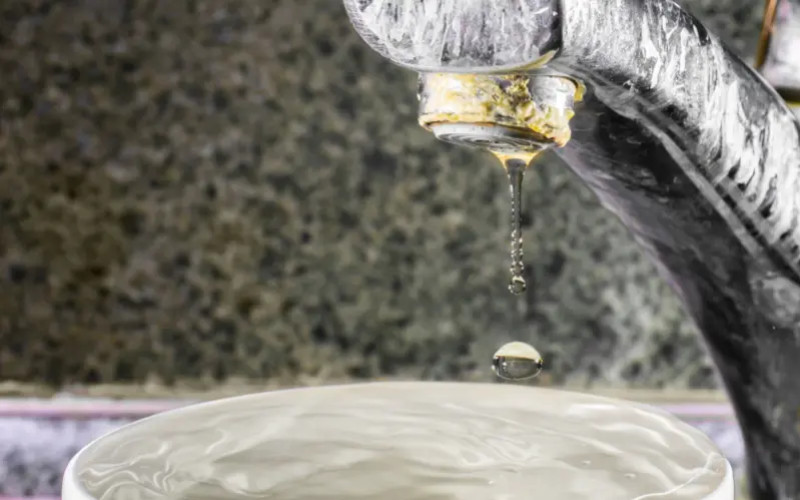

Limescale water is the kind of thing that drives me crazy. You know, when you clean your shower and two days later, the white traces are already back? Or when your kettle makes a strange noise because it's full of deposits? That's exactly what limescale is.
I remember, a few years ago, I lived in a region where the water was so hard you could almost chew it. We spent our time descaling the faucets, the kettle... It was a constant battle.
Specifically, Hard water is water rich in minerals, primarily calcium and magnesium.. These minerals are not dangerous for the health - on the contrary, they are even beneficial - but they cause quite a few inconveniences in the house. Limescale deposits everywhere: on shower walls, in pipes, on the heating elements of household appliances...
In this article, I will share with you what we have learned about hard water: how to recognize it, why it is problematic, and most importantly, how to naturally and sustainably reduce limescale in tap water. No bullshit, just concrete solutions that we have tested and that really work.

Understanding Hard Water: Composition and Origin of Lime in Water
Alright, to understand how to combat limescale, you first need to know where it comes from and what it actually is. Because no, limescale doesn't magically appear in your water.
Where does the limestone in tap water come from ?
Here's how it goes: Rainwater seeps into the ground and passes through limestone rocks. (like limestone and chalk). As it passes through these rocks, it naturally becomes enriched with calcium and magnesium. The longer it remains in contact with these rocks, the more it becomes enriched with minerals.
That's why The hardness of water varies greatly depending on the region.. If you live in an area with a lot of limestone - like the Paris Basin, the North or the East of France - your water will probably be very hard. Conversely, in granite regions like Brittany or the Massif Central, the water is generally softer.
The chemical composition of limestone
Technically, when we talk about limestone in water, we are mainly referring to two minerals:
- Calcium (Ca²⁺) : it is the main cause of white deposits
- Magnesium (Mg²⁺) : it also contributes to the hardness of the water
These minerals are dissolved in water in the form of ions. As long as the water is cold and moving, they remain dissolved. But as soon as it heats up or becomes stagnant, Calcium carbonate precipitates and forms these famous white deposits. that we find everywhere.
That's exactly what happens in your kettle: the water heats up, the calcium solidifies, and you end up with that whitish layer at the bottom. Not very appetizing, even though it's completely harmless.
Water hardness: what does it mean ?
The hardness of water is simply calcium and magnesium concentration. It is measured in French degrees (°f or °TH for "Titre Hydrotimétrique"). The higher the number, the harder your water is.
Here is how water hardness is generally classified:
- 0 to 7 °F : very soft water (low in limestone)
- 7 to 15 °f : fresh water
- 15 to 25 °F : moderately hard water
- 25 to 42 °F : hard water
- More than 42 °F : very hard water (warning danger for appliances!)
In France, the average hardness is around 20 to 30 °f, but some regions easily exceed 40 °f. Honestly, when we lived in the North, our water was at 38 °f... let me tell you, it was a constant battle against white deposits.
The visible consequences of hard water on your daily life
Alright, now that we know what hard water is, let's talk about the real problems it causes on a daily basis. Because it's not just an aesthetic issue.
On your household appliances
That's where it really hurts the wallet. Limescale is the number one enemy of your appliances.. Here is what is happening concretely:
- Kettle and coffee maker Deposits accumulate on the resistances, which lengthens the heating time and increases electrical consumption. Worse, it can even burn out the resistance.
- Washing machine Limescale builds up in the drum, on the seals, and in the pipes. As a result, your laundry smells less fresh, your clothes become rough, and the machine may break down prematurely.
- Dishwasher : White traces on dishes, clogged wash arms, dirty filters... Limescale reduces washing efficiency.
- Water heater : It is probably the most affected device. Limescale accumulates at the bottom of the tank and on the heating element, which can reduce its lifespan by half !
Moreover, a study by UFC-Que Choisir showed that In regions where the water is very hard, the lifespan of household appliances can be reduced by 30 to 50%.. It makes you think when you've just invested in a new washing machine for €600...

On your skin and hair
Well, this is a topic that comes up often. Many people - myself included - have noticed that hard and chlorinated water dries out the skin and makes the hair dull.
Why? Because limestone forms a sort of film on the surface of the skin which prevents natural hydration. No matter how much cream you apply, your skin still feels tight. And for the hair, it's the same: they become rough, difficult to untangle, and they lose their natural shine.
On your plumbing installation
Visually, it is the most obvious: these white traces everywhere. On the faucets, the shower walls, the sinks... It's ugly, it's difficult to clean, and it always comes back.
But the problem goes beyond aesthetics. Limescale also accumulates in pipes., which can reduce the water flow and eventually completely block the pipes. Showerheads get clogged, faucets become hard to turn...
And then there are the tile joints. Limescale gets embedded in them and can promote the growth of mold. Not great for the hygiene of your bathroom.
On your consumption of household products
Something we don't necessarily think about: With hard water, you need to use much more soap and detergent.. Why? Because calcium reacts with soap and forms insoluble residues instead of creating lather.
Concretely, that means:
- More detergent for the same result
- More dish soap
- No more shampoo
- More shower gel
In short, you spend more for a result that is often worse.
How to measure the hardness of your tap water
Alright, now that you know what hard water is and the problems it causes, the question is: how to know if your water is hard ?
Because frankly, there's no point in investing in a water softening system if your water is already naturally soft. Here are the different methods to check it.
Consult the data of your municipality
The simplest method: directly ask your town hall or check the website of your water supplier. In France, water suppliers are required to publish an annual report on water quality, and hardness is one of the parameters measured.
You can also visit the Ministry of Health's website, which lists water quality data for all French municipalities. Simply enter your postal code to get the information.
It's free, it's reliable, and it gives you a good general indication. However, Caution: hardness may vary within the same municipality., especially if you live in a large city with multiple supply sources.
Use test strips
To get a more accurate measurement of YOUR water, it's best to use test strips. The kit costs between 5 and 15 €, and it's super easy to use:
- Dip a strip into a glass of tap water.
- Wait a few seconds
- Compare the color of the strip with the provided scale.
- And there you go, you know your hardness in °f !
We did that at our place, and honestly, it was very informative. We thought our water was moderately hard (around 20 °f), but in fact, it was at 28 °f. That explained why we had so many deposits on the shower...
You can find these strips in pharmacies, hardware stores, or online. Prefer kits that measure between 0 and 50 °f for good accuracy.
Observe the visual signs
Even without precise measurement, there are unmistakable signs:
- White traces on faucets, shower walls, glasses
- Deposits in the kettle after a few uses
- Soap that lathers little
- Rough laundry after washing
- Tight skin after the shower
- Dull and difficult-to-style hair
The more boxes you check on this list, the more likely it is that your water is hard. And the more urgent it becomes to find a solution to reduce the limescale in the water.
Effective solutions to reduce limescale in water
Now, let's get down to business: how do you concretely reduce limescale in your water ? I will present to you the different solutions, from the least expensive to the most comprehensive.
Natural tips for daily maintenance
We will start with the simplest and most economical solutions. They do not address the problem at its source, but they allow for limit the damage on a daily basis.
White vinegar: your best ally
Honestly, if you had to keep only one cleaning product, it would be white vinegar. It is an ultra-effective natural descaler. and it costs next to nothing.
How do I use it:
- For the kettle : I fill halfway with white vinegar, heat it, let it sit for 30 minutes, and rinse. Perfect.
- For the showerhead : I take it apart and let it soak overnight in pure vinegar. The next day, all the holes are unclogged.
- For the faucets : I soak a cloth in vinegar, wrap it around the faucet, and leave it for a few hours. No more traces.
- For the washing machine : Once a month, I run an empty cycle with 1 liter of white vinegar at 60°C. It cleans the entire interior.
On the other hand, Avoid vinegar on marble, granite, and certain joints. Acidity can damage them.
Lemon and citric acid
The lemon is somewhat like vinegar but more fragrant. The citric acid it contains dissolves limescale very well.. You can use it to clean faucets, shower walls, or even descale your coffee machine, if you have one.
For an effective descaling, mix 2 tablespoons of citric acid powder in 1 liter of hot water. You can find citric acid in organic stores or pharmacies, it's really inexpensive.

Water filtration systems
Now, if you really want to address the problem at the source, we need to move on to more technical solutions. We will talk about water filtration.
Filtered carafes
It is the most financially accessible solution. A water filter pitcher costs between 20 and 40 €, and replacement cartridges are around 5-6 € each (to be changed approximately every month).
These carafes generally use a filter to activated charcoal combined with an ion exchange resin which captures some of the calcium and magnesium. Result: your water is a little less hard, and above all, it tastes better.
On the other hand, no miracles. A water filter pitcher will not transform very hard water into soft water. It slightly reduces hardness, improves taste, and removes certain contaminants like chlorine. It's already quite good for drinking water, but it won't protect your appliances.
Faucet filters
A notch above, filters that attach directly to your faucet. They operate on the same principle as carafes (activated carbon + resin) but with a much higher flow rate.
The advantage: you have filtered water directly from the tap, without having to fill a pitcher. The disadvantage: the cost is higher (between 50 and 150 € for the filter, plus the cartridges that need to be changed every 3-6 months).
Under-sink filtration systems such as reverse osmosis systems
There, we go up another level. Under-sink filters are more comprehensive systems. that are installed directly on the cold water supply under your kitchen sink.
These systems can combine multiple technologies:
- Mechanical filtration (sediments, particles)
- Activated charcoal (chlorine, pesticides, bad tastes)
- Ion exchange resin (calcium, magnesium, heavy metals)
- Sometimes even thereverse osmosis for ultra-advanced filtration
Investment is more substantial (between €200 and €800 depending on the systems), but you obtain very high-quality water for all your daily consumption. However, it only treats the kitchen water, not the entire house.
Water softeners
Here is the most radical solution: water softener. It is a system that treats ALL the water in your house, not just the kitchen's.
How does it work ?
A water softener uses the principle of ion exchange.Ion exchange. Specifically, the water passes through a resin that captures calcium and magnesium ions (responsible for limescale) and replaces them with sodium ions.
Result: yourWater becomes much softer., ...or even completely softened depending on the settings. No more white marks, no more deposits in appliances, softer skin and hair...
The advantages
- Total protection of all your appliances (water heater, washing machine, dishwasher...)
- Economies on cleaning products and energy (less limescale = better appliance performance)
- Comfort on a daily basis: less dry skin, softer hair, more supple laundry
- No more descaling chore
The disadvantages
Because yes, there are some:
- High initial investment : between €800 and €2000 for a complete system
- Regular maintenance : it is necessary to regularly refill the regenerating salt
- Water consumption : the system discharges water during the regeneration cycles
- Increase in sodium in the water (a point to consider if you need to limit your salt intake)
- Professional installation recommended (connection to the main water supply)
Who is it suitable for ?
Honestly, A water softener is particularly relevant if your water is really very hard (more than 30 °f). and that you regularly have problems with your devices. If your water is moderately hard, local filtration solutions may be sufficient.
At our place, we didn't opt for a complete water softener. We prefer a more targeted approach with natural filters at strategic water points (kitchen and bathroom). It's less invasive, more ecological, and suits us perfectly.
Alternative solutions
There are also other technologies, less widespread but which can be interesting:
Magnetic and electronic systems
These devices claim to modify the structure of limescale to prevent it from depositing, without removing the minerals from the water. Honestly, the effectiveness of these systems is a subject of debate.. Some people swear it works, others haven't seen any difference.
Scientific studies are contradictory. Personally, I remain cautious with this kind of "miracle" solution. If you want to try it, choose a system with a satisfaction or money-back guarantee.
Shower filters
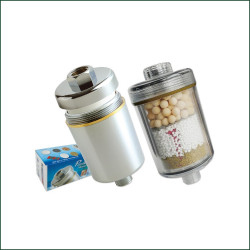
If your main concern is the impact on your skin and hair, A shower filter can be a good solution.. It installs in a few minutes between your faucet and the shower hose, and it costs between €20 and €50.
These filters reduce chlorine and limescale will also have less impact.