



The day I received a surprise tax audit, my terrace was covered with 125 kilos of mangoes. A supplier had called me a few days earlier: a large unsellable batch was about to be thrown out, so he added it to a pallet for me. The inspector, for his part, had come to check something else entirely - my books were so clean he thought I must be dead. He left, weeks later, with a crate of mangoes given wholeheartedly, the first he had ever accepted in his career. What that period reminded me is that stress isn't managed on the day it strikes: it's prepared in the years before, on the plate and in daily habits.
I've been eating a plant-based diet for 34 years, and I've been supporting people through dietary transitions since founding Biovie in 2007. What follows isn't a theoretical list: these are the nine levers I actually use - including the ones I tried and dropped, because an honest account is worth more than a promise.
What exactly is stress? Cortisol and "fight-or-flight" mode
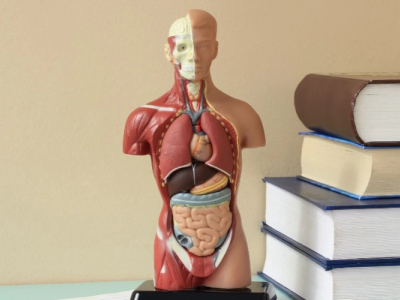
Faced with tension, the brain triggers a hormonal cascade via the hypothalamic-pituitary-adrenal axis: the adrenal glands release cortisol, the hormone that mobilizes the body's energy in "fight-or-flight" mode. It's a remarkable survival mechanism when it lasts a few minutes. The problem starts when this alarm stays switched on for weeks on end: disrupted sleep, unstable mood, upset digestion, creeping fatigue.
The distinction between acute and chronic stress is therefore the key to reading this whole article: the goal isn't to suppress a normal bodily reaction, but to prevent it from becoming a permanent state. Everyone at their own pace, and by adding habits rather than imposing bans on themselves.
The three phases: why occasional stress has nothing to do with entrenched stress
We use the same word for two very different realities, and that's what makes the topic confusing. Physiology, on the other hand, distinguishes three stages - a model described as far back as the 1930s and never disproven since.
Phase 1, the alarm. Faced with a demand, the adrenal glands release adrenaline and noradrenaline. The heart speeds up, blood pressure rises, breathing quickens, the vessels in the muscles dilate: the body prepares to run or fight. This phase is useful, effective, and perfectly reversible - it's what makes you react at the right moment. It lasts a few minutes.
Phase 2, resistance. If the demand persists, a second hormonal axis takes over and releases glucocorticoids, cortisol chief among them. Their role is to mobilize energy: they raise blood sugar and put anything non-urgent on standby - digestion, repair, immune defenses. It's already a compromise, but the body holds on. Many people live for entire months in this phase without naming it.
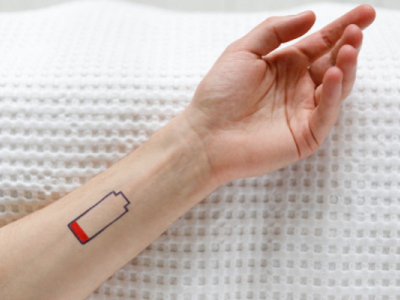
Phase 3, exhaustion. When the demand doesn't stop, the overstimulated systems become dysregulated. The sign that marks this shift is easy to remember: cortisol stays elevated even after the stressful situation has ended. Within a few weeks, the manifestations everyone recognizes then appear - sleep disorders, upset digestion, diffuse aches, nervousness, difficulty concentrating.
Why does this distinction change anything? Because the levers aren't the same: in phase 1, a single breath is enough; in phase 3, no one-off technique makes up for a lack of recovery. That's exactly the logic behind the nine points that follow - they're not meant to eliminate stress, but to prevent the shift from phase 2 to phase 3, as part of a varied, balanced diet and a healthy lifestyle.
1. Simplify your plate when pressure rises
This has been my first reflex for three decades, and the most counter-intuitive: in tense periods, I don't eat more "comforting" - I eat simpler. Food that's easy to digest leaves the body available, and the mind a clarity I find nowhere else. Irène Grosjean called the opposite "the glue": that mental fog of the days after heavy meals.
I experienced the reverse against my will, during a stay on the outskirts of Ho Chi Minh City: noodle soup shops for two kilometers around, very little fruit. After a few days, I could literally feel a filter settling in between me and the outside world - and it lifted once I went back to a simple plant-based plate.
In practice, when I need to make an important decision, I observe a short mono-diet period - a single fruit I love, over one day - or I simply leave more space between meals. This is a personal practice, not a prescription: if you're undergoing treatment or living with a specific condition, talk to a health professional first. As part of a varied, balanced diet and a healthy lifestyle, dietary simplicity is, in my experience, the most underrated anti-stress lever.
2. Go outside several times a day, in contact with nature
If a very stressed person could only change one thing for thirty days, this is the one I'd suggest first. You lose mental clarity when you stay shut indoors too long - and you get it back surprisingly fast outdoors. Several short outings are worth more than one big weekly one.
Japanese research on shinrin-yoku (forest bathing) has documented what many people notice empirically: physiological measurements taken on forest walkers show lower stress indicators than in an urban environment (Park et al., 2010). I've lived in the countryside for thirty years, and I consider that choice a health decision on the same level as what's on my plate.
3. Box breathing
Breathing is the only lever of the autonomic nervous system you can steer at will. The technique I recommend to beginners is box breathing: inhale for 4 seconds, hold for 4 seconds, exhale for 4 seconds, hold for 4 seconds - and repeat for two to three minutes. You can practice it anywhere, with no app or equipment.
For those who prefer a set framework, "3-6-5" heart coherence (3 times a day, 6 breaths per minute, 5 minutes) rests on the same principle of slowing the breathing rate, whose mechanisms have been studied through heart rate variability research (Lehrer et al., 2014). What matters isn't the method chosen, it's consistency: a short daily practice beats a long occasional session.
4. Move - even ten minutes are enough to shift your inner state
For me, anti-stress movement takes one specific form: a rebounder trampoline, which I jump on regularly, and which gets circulation moving again within minutes when the day has been spent sitting down. Walking in nature stacks the benefits of points 2 and 4 - it's the combination I practice most.
Reviews of studies on physical exercise and anxiety point the same way: regular activity, even moderate, is associated with reduced anxiety symptoms (Aylett et al., 2018). No need for an ambitious sports program that would itself become a source of stress: ten minutes of bouncing, brisk walking, or stretching, several times a day, already shift your inner state.
5. Seek warmth - not snacking
Here's what has never worked for me: using food as an emotional buffer. Eating to avoid feeling stress doesn't calm it - it adds a digestive load on top of an emotional one. I've tested it enough to write this without hesitation.
What actually meets the need for comfort behind that reflex, for me, is warmth: exposure to the warm light of the infrared LED panels I use at home, a hot bath, or simply a moment in the sun. The need to feel reassured is legitimate - it's the response you give it that makes the difference.
6. Take care of your magnesium intake
The link between magnesium and stress runs both ways, something researchers have described as a vicious circle: stress increases magnesium loss, and low magnesium status increases sensitivity to stress (Pickering et al., 2020). It's one of the reasons tense periods dig their own hole.
On the plate, nuts, seeds, raw cacao, and leafy greens are among the interesting sources of magnesium - and they're foods that are easy to add to what already exists, without upending your habits. As part of a varied, balanced diet and a healthy lifestyle, it's a quiet but real foundation.
7. Lighten your dinner and support digestion
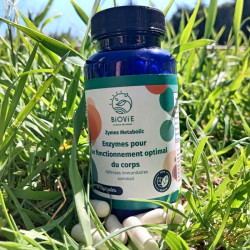
This is the discovery that has changed my nights the most in recent years. I already had good sleep; since discovering enzymes - an intellectual encounter with the work of Viktoras Kulvinskas, a pioneer of the living-foods movement - I've noticed even deeper sleep when I take metabolic enzymes at bedtime, and digestive enzymes during heavy meals. It's been my personal routine for years: Metabolic in the evening, Assimil at the table.
The principle is simple to understand: the less energy the body spends digesting late at night, the more the night is free for everything else. A light dinner eaten early remains the first measure - enzymes come as support, not a replacement. As part of a varied, balanced diet and a healthy lifestyle, it's the small evening adjustment that has brought me the most.
You'll find our Metabolic and Assimil enzymes in our Enzymes range.