Organic raw cacao nibs - Nacional variety
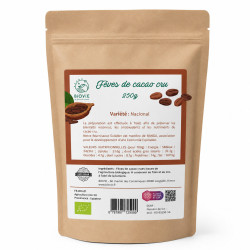
Raw cocoa nibs
(shelled and crushed beans in the form of nibs)
Nacional Variety
Certified Organic
Not roasted
Bag of 250g or 1kg
No queries yet, leave the first!
Price:
€13.90
Tax included


Organic raw cacao nibs - Nacional variety images


ORGANIC raw cacao nibs - Nacional variety
(available in 250g or 1kg bags)
Cacao nibs slip in anywhere. To add crunch to your cakes and crumbles, as a topping on your smoothie bowls or nice cream, and why not try them in your savoury dishes: cacao can also be used as a spice!
These nibs can also be used to add a comforting touch to your infusions.
Arriving at the Spanish court in 1528, Europeans added sugar, vanilla and cinnamon to the cacao drink to reduce its bitterness. In the 17th century, cacao consumption gradually spread throughout Europe, roasting then became essential for preserving the beans and little by little cacao became the chocolate we all know today.
Today, our knowledge and techniques allow us to skip the roasting stage and preserve cacao without any health and safety problem.
☀️ The beans we offer you here come from cacao trees of the Nacional variety from the Ecuadorian forest of Esmeraldas. This area has had very little cultivation of Trinitario cacao trees (hybrid species between the Nacional and Criollo varieties), so pure Nacional cacao is found there.
It is a cacao highly prized for its fragrant floral and fruity aroma, which reveals subtle notes of wood, earth and ash. Nacional cacao is uncommon (estimated at 2% of world production); it has floral notes of jasmine and orange blossom, which makes it particularly interesting. The Nacional variety also has a very characteristic taste known as the "arriba" taste.Note that there are mainly 3 varieties of beans:
- Forastero : the most widely grown in the world, it has a high yield and is very disease-resistant. However, it has little aroma and a pronounced bitterness. It is the one used in industrial chocolates.
- Trinitario : a hybrid of the other 2 varieties, it accounts for roughly 10/15% of world production. It is characterised by its cocoa butter content and much more developed aromas.
- Criollo : the noblest variety, its yield is low and climate change disrupts its production, which makes it exceptional. It has a powerful, fine and aromatic taste. Very low in acidity and almost without bitterness, Criollo is the most interesting from an aromatic point of view. Criollo is also interesting for its secondary fruity aromas that linger on the palate, with notes of nuts, caramel and even blueberries! (it is the one closest to Nacional in terms of quality)
For us, beyond the quality of the final product, choosing a little-known variety also means helping small producers, preserving the ancestral know-how of local communities and helping this original ancient variety to thrive.
☀️ You will find in our Raw Cacao Ebook and on our blog various recipes using cacao:
Raw cacao yoghurt
Vegan chocolate mousse
Raw cacao and barley grass brownie
3 ways to eat raw cacao
Composition of raw cacao nibs
These nibs are made from 100% raw cacao beans, fermented and dried, without roasting. The average nutritional values per 100 g are in the Practical info tab.
☀️ To find out more about raw cacao, also see our blog article:How to use cacao powder?
Our supplier: SolAlter
SolAlter, a member of MINGA, an association for the development of a Fair Economy, was created to take part in a change in trading practices. It is not simply about paying producers in the South more, but about building lasting relationships based on trust built through communication and time.
Its founder and director Tomas Landazuri explains, in the lines that follow, the reasons behind the existence of SolAlter:
" Born in Ecuador and the product of migration from the Andean countryside to the capital, I have always been confronted with the enormous social differences of a South American capital. These differences are often accepted as coming from "fate".
Wanting to discover other ways of life, I spent a few years in Brazil, France and then Belgium. Encounters, discussions, reading and exchanges shaped my view on "fate": "disadvantaged" people are, for the most part, not so by chance. Their situation results from a long history in which certain groups of people have conquered and kept abusive economic power. This reality is stronger in third world countries, as is the case in Ecuador where 40% of the population lives below the poverty line.
I managed to study at university in France. I obtained an engineering degree in food industries. My professional experience took place in various companies in Ecuador, France and Belgium. I was a researcher in the laboratory of a Belgian group manufacturing ingredients for the food industry. For five years I was immersed in that world. I saw up close the tactics of big industrial players to increase their profits: a race to cut production costs, at the risk of sacrificing product quality, or even the long-term health of the consumer. All of this always accompanied by carefully calculated marketing tactics to "seduce the consumer". After this experience I understood that when all a company's efforts are directed towards profit, the human being remains a production tool. This is a source of political, economic, social, environmental and even nutritional imbalance.
So I turned to the INBP (Institut National de la Boulangerie) in France, where my position as project officer allowed me to develop projects to defend the interests of artisan bakers. At that time, the creation of SolAlter was inevitable. I left that institution to devote myself fully to this project."
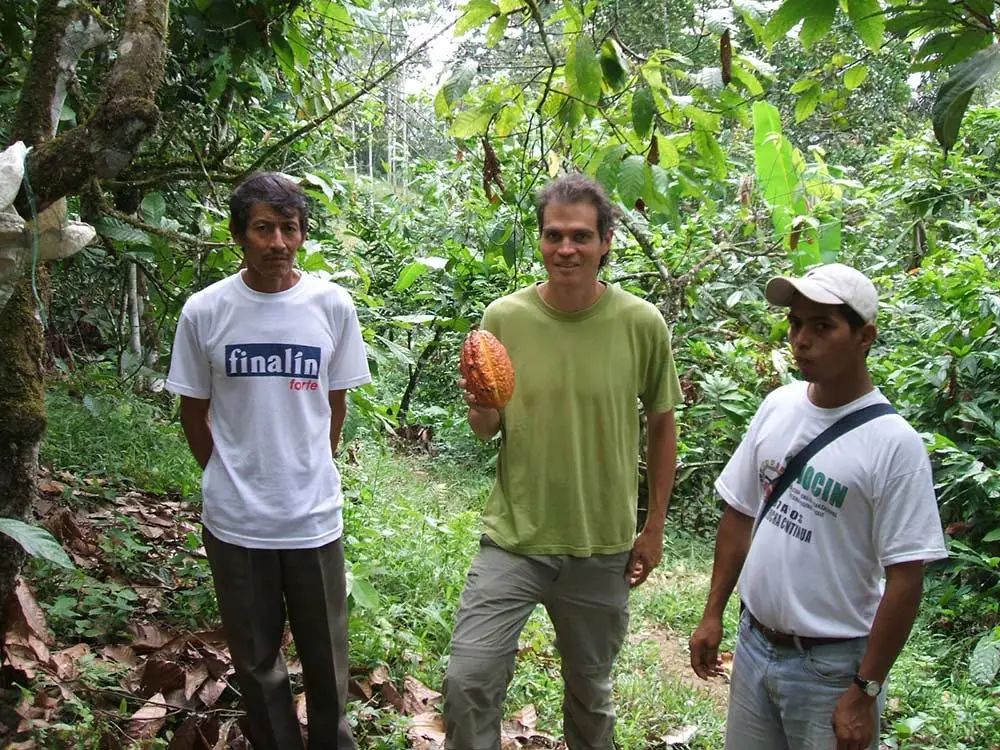
SolAlter is also a member of the SPP system (Small Producers' Symbol), which is a demanding guarantee of Small Producer Fair Trade. 100% of the cacao bought by SolAlter is guaranteed by the SPP.
Best before: 28/02/2028
Ingredients : Raw cacao beans from organic farming
Packaging: Resealable bag of 250 g or 1 kg
Sustainable, recycled packaging, certified "Plastic neutral by CSR"

Store in a cool, dry place, away from moisture
| Average nutritional values | 100 g |
| Energy value
Energy |
588 kcal
2423 kJ |
| Fat of which saturated fatty acids: |
51.6 g 32.3 g |
| Carbohydrates of which sugars |
4.7 g (of which sugar 0.1 g) |
| Protein | 14 g |
| Salt | 0.015 g |
Frequently asked questions about raw cacao nibs
What are raw cacao nibs?
Raw cacao nibs are pieces of crushed cacao beans, here from the Ecuadorian Nacional variety. Unlike classic roasted nibs, these beans do not go through the roasting stage: they are only fermented and dried, which preserves their original aromatic richness.
Are raw cacao nibs really "raw", without roasting?
Yes. Our current knowledge and techniques now make it possible to skip the roasting stage while guaranteeing the cacao keeps without any health and safety problem. It is this process that distinguishes raw cacao from the roasted cacao used in classic chocolate.
What is the difference between whole beans, nibs and raw cacao paste?
Whole beans are eaten as they are, nibs are those same beans crushed into small pieces, handy for sprinkling over your preparations, and raw cacao paste is obtained by finely grinding the nibs until a smooth texture is obtained, mostly reserved for sweet preparations or cacao ceremonies. Three complementary ways of eating the same raw cacao depending on the intended use.
How to use raw cacao nibs every day?
The nibs slip easily into a living-food diet: as a crunchy topping on a smoothie bowl or nice cream, mixed into cake or crumble batter, slipped into an infusion for a comforting touch, or even used as a spice in some savoury dishes.
Is raw cacao suitable for young children?
Raw cacao is not recommended for young children. It contains theobromine, a molecule also present in maté and guarana, which stimulates the central nervous system. As part of a varied and balanced diet, it is therefore reserved for adults and teenagers.
How to store raw cacao nibs?
The nibs are delivered in a resealable 250 g or 1 kg bag, in sustainable, recycled packaging. They keep in a cool, dry place, away from moisture, to best preserve their floral and fruity aromas.
Updated: July 2026. Article validated by Éric Viard, founder of Biovie and ISTOM, co-author of Algues au quotidien (Gallimard, 2024) - Best cookbook in the world, Gourmand Cookbook Awards 2025, and Best cookbook in France, Académie Nationale de Cuisine 2025.
Disclaimer: The information presented in this article is provided for information purposes only and does not constitute medical advice. Consult a qualified health professional before making any changes to your diet or supplementation. As part of a varied and balanced diet and a healthy lifestyle.
Wondering… ?
Everything you need to know before ordering.
Be the first to ask a question about this product!
Question about the product
Ask a question