
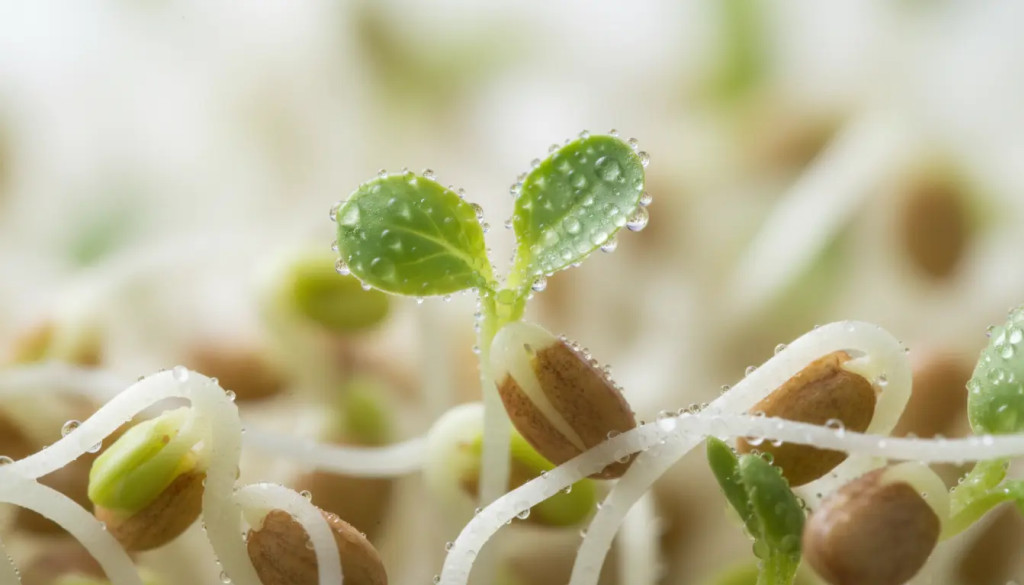
Sulforaphane is a sulfur-containing compound naturally found in cruciferous vegetables—and broccoli sprouts are the most concentrated source in the world, with 10 to 100 times more precursor than the mature broccoli on your plate (Fahey et al., Proceedings of the National Academy of Sciences, 1997). This molecule, studied for over three decades by Johns Hopkins University, is generating increasing interest for its role in activating natural cellular defenses.
However, in France, sulforaphane remains largely unknown. Most articles simply mention "eat broccoli" without explaining why the sprouted form radically changes the situation. Others direct towards capsule supplements whose bioavailability is significantly lower than that of a simple handful of fresh sprouts.
After 18 years of supporting our clients at Biovie in their approach toliving food, I wanted to lay out everything that science tells us about sulforaphane — and especially, how to make the most of it daily with organic sprouted seeds.
What exactly is sulforaphane ?
Sulforaphane is an isothiocyanate, a small sulfur-containing molecule produced by plants in the cruciferous family (broccoli, cabbage, radish, mustard). It does not exist as such in the seed or vegetable: it forms at the moment you bite, chew, or crush the plant. It is this enzymatic reaction that makes it such a unique compound — and so dependent on the method of preparation.
Sulforaphane is the subject of more than 3,000 scientific publications. The foundational work of Dr. Paul Talalay, followed by his successor Dr. Jed Fahey at Johns Hopkins, demonstrated that this molecule is capable of activating the NRF2 pathway — a cellular defense mechanism that regulates more than 200 cytoprotective genes (Dinkova-Kostova & Abramov, Free Radical Biology & Medicine, 2015). In other words: sulforaphane acts as a master switch that simultaneously activates the protective systems of your cells.
The glucoraphanin → myrosinase → sulforaphane cascade
Sulforaphane is not directly present in broccoli seeds. What they contain is its precursor: the Glucoraphanin, a stable and inactive glucosinolate. The transformation requires a specific enzyme, the Myrosinase, stored in a separate cellular compartment.
Here is what is happening concretely:
- The broccoli seed contains glucoraphanin (the "reservoir") and myrosinase (the "detonator"), each in separate cellular compartments.
- When you chew or crush the sprouted shoots, the cell walls break. Glucoraphanin and myrosinase come into contact.
- Myrosinase then converts glucoraphanin into sulforaphane — the active form that interacts with your cells.
This waterfall explains two essential things. First, Cooking beyond 70°C destroys myrosinase. and sharply cut off the reaction. Then, fresh sprouted seeds consumed raw represent the most effective source: they simultaneously contain the precursor and the enzyme is active in optimal proportions.
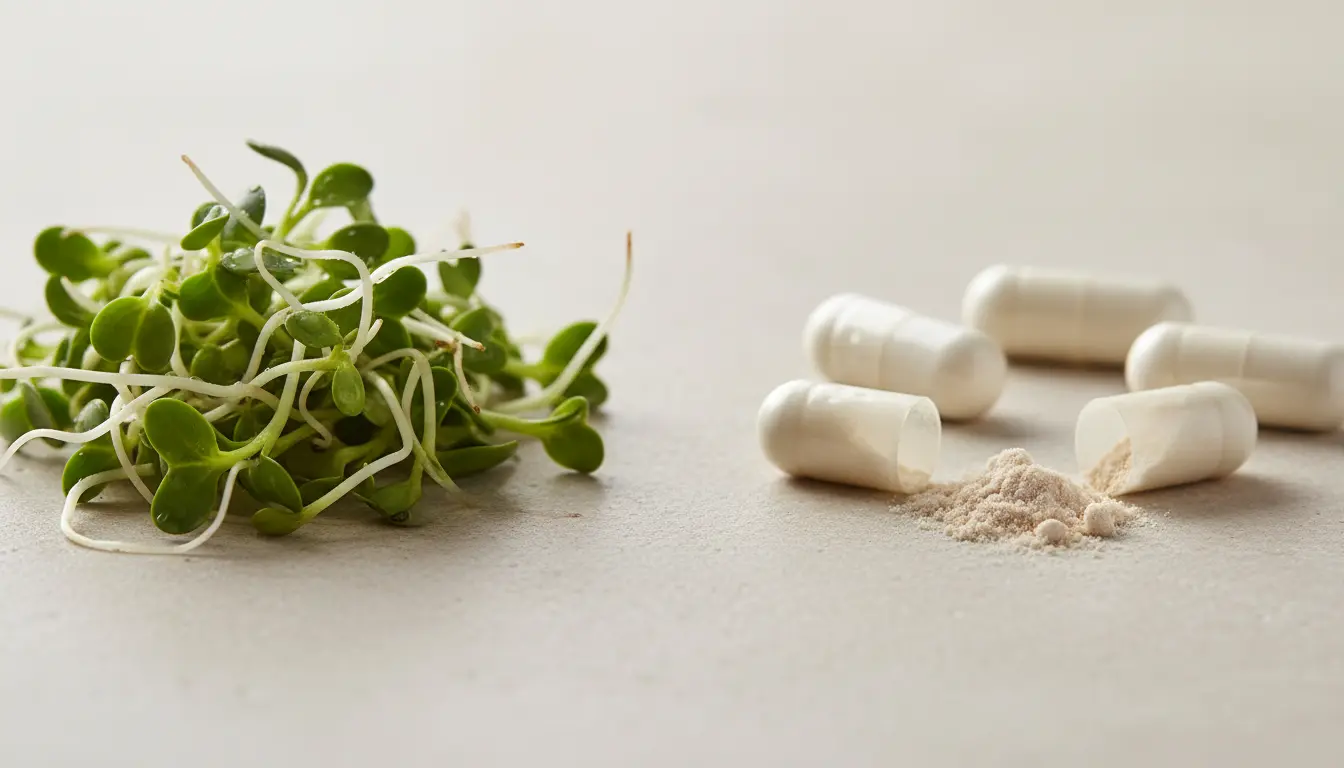
This is also the reason why many capsule supplements turn out to be disappointing: the industrial process (drying, encapsulation, heat) destroys the myrosinase. Without it, the conversion to sulforaphane drops by half, or even more.
The organic broccoli seeds we offer at Biovie — from the Bavicchi company, an Italian seed producer since 1896 — retain their full enzymatic potential. With a germination rate of over 95%, the glucoraphanin-myrosinase-sulforaphane cascade is fully active from the third day of germination.
Why do sprouted seeds contain 100 times more sulforaphane than mature broccoli?
It is the discovery that triggered everything. In 1997, Dr. Jed Fahey's team at Johns Hopkins published in Proceedings of the National Academy of Sciences a study that has become a reference: 3-day-old broccoli sprouts contain 10 to 100 times more glucoraphanin that the mature broccoli head purchased at the market (Fahey et al., Proceedings of the National Academy of Sciences, 1997). As we explain in detail in our dedicated article, the Broccoli sprouts contain 100 times more of this precursor than the mature vegetable.
The explanation is logical when understood. In the early days of germination, the plant concentrates its chemical defenses to protect itself from external threats — insects, fungi, UV rays. Glucoraphanin is part of this defensive arsenal. As the plant grows and develops other protective mechanisms (walls, stems, leaves), the concentration of glucoraphanin becomes diluted in the increasing plant mass.
To give a concrete order of magnitude:
Source Glucoraphanin - (μmol/g dry weight) - Active Myrosinase
Broccoli sprouted seeds (Day 3-Day 5) - 10 to 100 μmol/g - ✅ Yes, intact
Raw mature broccoli - 0.5 to 3 μmol/g - ✅ Yes
Steamed broccoli - (>70 °C) 0.5 to 3 μmol/g - ❌ Destroyed
Standard capsule supplement - Variable - ❌ Most often absent
This concentration factor has a direct consequence: to reach the dose used in clinical studies (about 50-100 μmol of sulforaphane per day, according to the Johns Hopkins protocol), it is enough to 30 grams of fresh sprouts at D3-D5 — a handful. Obtaining the same amount from cooked broccoli would require consuming between 600 g and 3 kg per day, which is neither practical nor realistic in culinary organization.
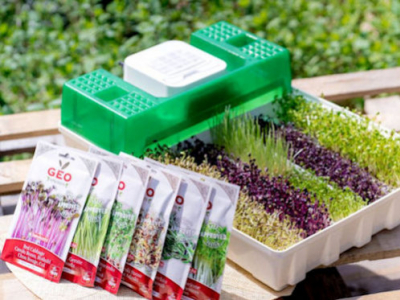
This is precisely what makes germination so interesting: in 3 to 5 days, from a tablespoon of seeds, you can produce at home the equivalent of several kilos of broccoli in terms of sulforaphane potential. With a sprouter like the EasyGreen available on Biovie, the process is automated: fill the water tank, wait, harvest. No need for soil, no need for light, 2 minutes a day.
The 7 benefits of sulforaphane studied by science
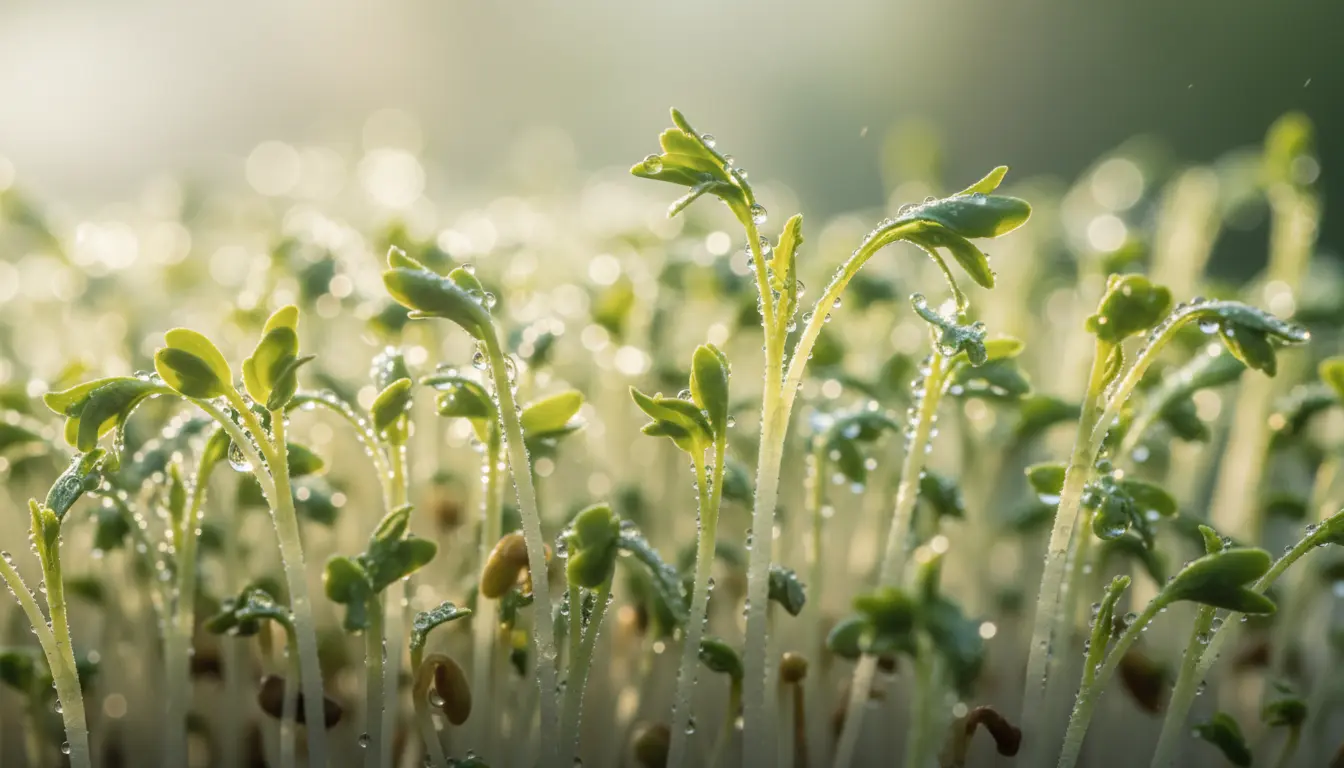
Sulforaphane is the subject of more than 3,000 publications in the scientific literature. The research, conducted primarily at Johns Hopkins University but also in dozens of other laboratories around the world, covers a wide range of fields. For a general overview, see our article on the Benefits of broccoli seeds. Here are the seven most documented areas to date.
Cellular protection: activation of the NRF2 system
The most studied mechanism of sulforaphane is its ability to activate the NRF2 pathway (Nuclear Factor Erythroid 2-Related Factor 2). Specifically, NRF2 functions as a central regulator: when activated, it triggers the expression of more than 200 genes involved in antioxidant defenses, detoxification, and cellular repair (Dinkova-Kostova & Abramov, 2015).
Under normal circumstances, NRF2 remains "on standby." Sulforaphane acts as an activation signal—much like turning an ignition key that simultaneously starts a whole network of systems. It is this cascading mechanism that sets sulforaphane apart from conventional antioxidants: whereas vitamin C neutralizes one free radical at a time, NRF2 activation stimulates the endogenous production of hundreds of protective enzymes.
This is precisely the reason why researchers at Johns Hopkins have focused on broccoli sprouts: they represent the most effective food source for providing sulforaphane in sufficient quantities to activate this pathway. The Benefits of sprouted seeds They actually go beyond just sulforaphane — but it is this molecule that has the most spectacular concentration. A handful of 30 g of fresh sprouts from organic seeds like those from Bavicchi covers the dose used in the majority of research protocols.
Brain health: promising avenues
Several research teams are exploring the effect of sulforaphane on the brain. The most publicized study remains that of Singh et al.Proceedings of the National Academy of Sciences, 2014): in a group of 40 young men with autism spectrum disorder, supplementation with sulforaphane for 18 weeks was associated with a significant improvement in social behaviors and communication. These encouraging results remain preliminary and require larger-scale studies.
Other studies, still at the preclinical stage, are focusing on the potential role of sulforaphane in neuro-inflammation and cerebral oxidative stress — two mechanisms involved in cognitive aging. Research is progressing, but it would be premature to draw definitive conclusions.
Hepatic detoxification: results of the Chinese study
This is one of the most telling studies. In 2014, the team of Egner et al. conducted a clinical trial in China, in a region heavily exposed to air pollution. Participants who consumed a beverage made from broccoli sprouts showed an increased excretion of benzene (+61%) and acrolein (+23%) compared to the control group.Cancer Prevention Research, 2014).
Sulforaphane appears to stimulate phase II liver detoxification enzymes — those that make pollutants water-soluble to facilitate their elimination through urine. This is a mechanism directly related to the NRF2 activation described above.
For those interested in detox and cellular regeneration, sprouted broccoli seeds represent a simple and well-documented dietary approach. At Biovie, we incorporate them into a comprehensive living food strategy that also includes other sprouted seeds — radish, alfalfa, fenugreek — each with its own unique nutritional profile.
Joint health and anti-inflammatory action
Sulforaphane is being studied for its ability to modulate inflammatory pathways, particularly by inhibiting the NF-κB factor, a central player in the chronic inflammatory response. Several preclinical studies suggest a protective effect on joint cartilage, which has led to research on osteoarthritis.
This research largely remains at the animal and in vitro stage. However, the anti-inflammatory mechanism of sulforaphane is well-documented and consistent with the activation of the NRF2 pathway, which also regulates inflammatory responses.
Metabolism: glucose, cholesterol, and weight
Preliminary clinical studies have explored the effect of sulforaphane on glucose management in obese individuals with poorly controlled type 2 diabetes. The results, published in Science Translational Medicine (2017), suggest an effect on hepatic glucose production — but these data require confirmation through larger-scale trials.
Other studies focus on the link between sulforaphane and lipid metabolism. The common denominator remains the activation of NRF2 and its cascading effects on oxidative stress and inflammation, two factors involved in metabolic disorders.
Digestive health and microbiome support
Sulforaphane is the subject of recent research regarding its interaction with the gut microbiota. In vitro and animal studies indicate a potential effect on the composition of the intestinal flora, particularly by promoting certain beneficial bacterial strains.
An interesting point: the conversion of glucoraphanin to sulforaphane can also partially occur thanks to intestinal bacteria, even in the absence of plant myrosinase. This is a secondary conversion pathway, less efficient, but it explains why even cooked broccoli retains some potential — much less than fresh raw sprouts.
At Biovie, we observe that many of our customers incorporate sprouted broccoli seeds as part of a broader digestive support approach, for example, by combining them with sprouted alfalfa or fenugreek seeds, known for their richness in fiber and enzymes.
Skin and hair: studied protective effects
Latest research area in full development: sulforaphane and the skin. Studies have shown that topical application or oral consumption of sulforaphane can activate skin antioxidant defenses via NRF2, particularly against UV-related damage (Talalay et al., Proceedings of the National Academy of Sciences, 2007).
More recent studies explore the link between sulforaphane, hair follicles, and epigenetic mechanisms.Frontiers in Genetics, 2012). These results, still preliminary, open up interesting prospects but do not allow for specific recommendations to be made at this stage.
What is documented, however, is that oxidative stress plays a role in skin and hair aging — and that the NRF2 pathway is one of the most well-studied defense mechanisms against this stress.
→ Discover the organic broccoli seeds Bavicchi on Biovie.fr
Dr. Jed Fahey and Johns Hopkins: 30 years of research on sulforaphane
It is difficult to talk about sulforaphane without mentioning the man who made it his life's work. Dr. Jed W. Fahey, a biochemist and nutritionist at the Johns Hopkins School of Medicine, leads the Cullman Chemoprotection Center — the laboratory that identified and characterized sulforaphane in the 1990s.
It all began with Prof. Paul Talalay, Fahey's mentor, who was searching in the 1980s for dietary compounds capable of stimulating phase II detoxification enzymes. In 1992, his team isolated sulforaphane from broccoli. In 1997, Fahey published the groundbreaking study: young broccoli sprouts contain 10 to 100 times more glucoraphanin than the mature vegetable.Proceedings of the National Academy of Sciences, 1997). It is this publication that places germination at the center of the subject.
The landmark clinical studies
Since then, Fahey's laboratory and its collaborators have produced or contributed to dozens of human clinical trials. Among the most cited:
- Autism (2014) : Singh et al., Proceedings of the National Academy of Sciences — improvement in social behaviors among 40 young adults after 18 weeks of sulforaphane.
- Air pollution (2014) Egner et al., Cancer Prevention Research — accelerated excretion of benzene (+61%) and acrolein (+23%) thanks to a broccoli sprout-based drink, in participants exposed to pollution in China.
- Dose Safety (2006) : Shapiro et al., Nutrition and Cancer — no toxicity reported up to 200 μmol/day in healthy adults.
This research has established sulforaphane as one of the most well-documented dietary phytochemical compounds in the world.
The dosage from the research: 50-100 μmol/day
The protocol that appears in the majority of clinical studies from Johns Hopkins corresponds to an intake of 50 to 100 μmol of sulforaphane per day. Translated into practical terms, this represents approximately 30 g of fresh broccoli sprouts harvested between D3 and D5 germination.
This is an important point: this dosage can be achieved with home-sprouted seeds, without resorting to concentrated extracts. A tablespoon of organic Bavicchi broccoli seeds, sprouted for 3 to 5 days in a simple sprouter, produces this amount. Sulforaphane is not a supplement reserved for laboratories — it is a dietary compound accessible to anyone who sprouts their own seeds.