









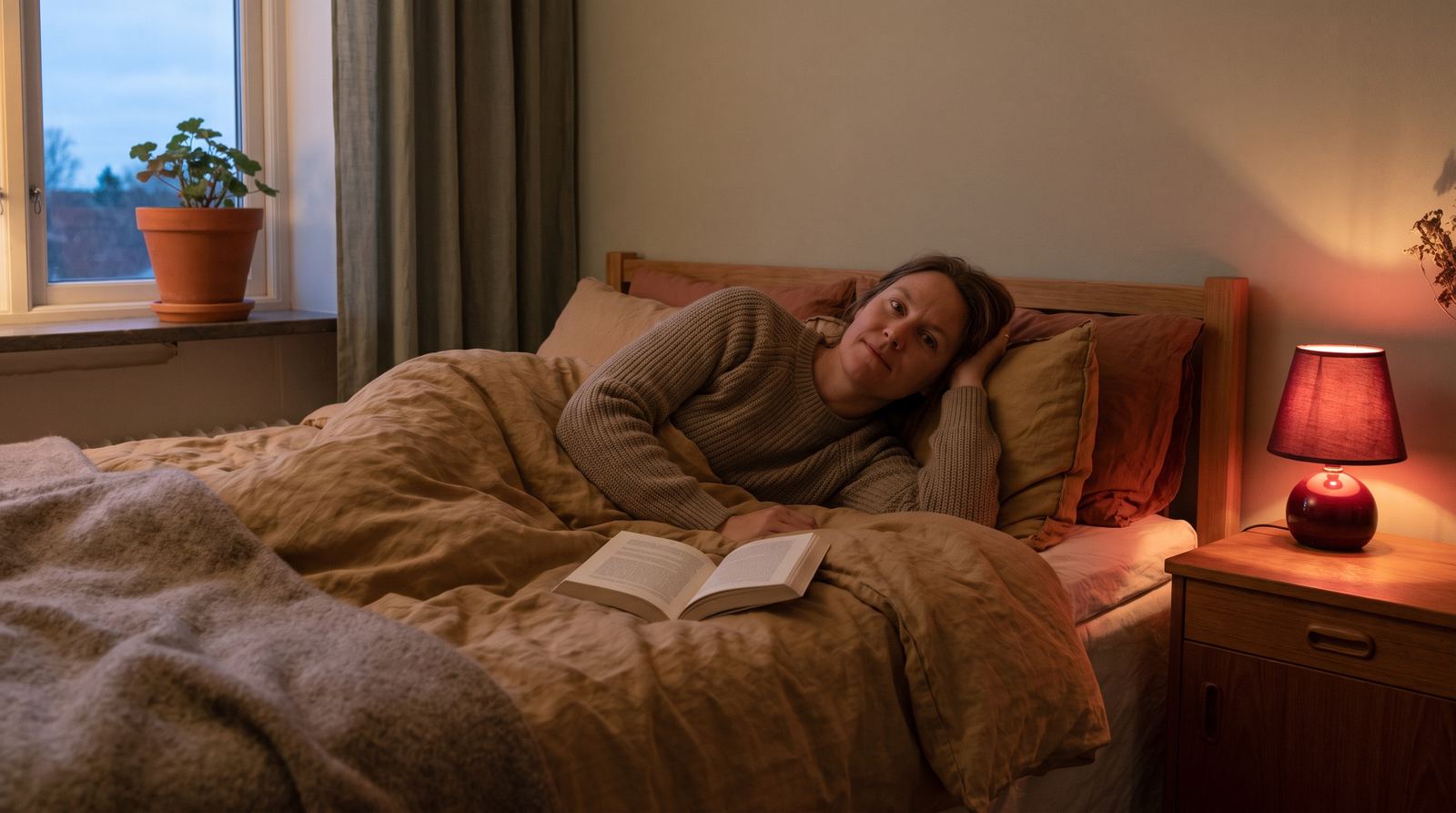
Every month, hundreds of people search for “red light therapy for sleep”. The honest answer: a 2026 meta-analysis finds a small effect on perceived sleep quality, in trials run mostly with lasers and near-infrared light, and a dimmed red lamp is first of all a way to disturb the evening body clock less. At Biovie, this page draws on seven sources, read one by one.
Transparency: Biovie is an affiliate of PlatinumLED and earns a commission through this partner link, which changes nothing about the studies cited.
Does red light help you sleep? The short answer
Small trials suggest a modest effect on perceived sleep quality, but the evidence remains thin. An ambient red bulb, for its part, disturbs the body clock less than white or blue light. The most useful thing is still to cut back on screens and bright lights in the evening.
Does red light therapy help with sleep, then? A little, maybe. And I say so as someone who uses a panel myself.
Three lights not to mix up
Online, everything gets lumped together. A red night light and a photobiomodulation panel have almost nothing in common, apart from the color.
| Light | Everyday example | What it does in the evening | What the research says |
|---|---|---|---|
| Blue or white | Screen or white LED ceiling light | Slows melatonin and shifts the body clock | Peak action between 446 and 477 nm; e-reader: evening melatonin down 55% |
| Dimmed ambient red | Night light or low red bulb | Disturbs the body clock less, without making you sleepy | Less active than blue on melatonin, effect not zero |
| Photobiomodulation panel | Red and near-infrared LED panel | Measured dose of light on the skin, a few minutes | No LED panel among the 5 trials of the 2026 meta-analysis |
Blue and white evening light (the kind to avoid)
Deep in the eye, a blue-sensitive sensor plays night watchman: it tells the internal clock when to release melatonin, the hormone of the night. Out of 8 wavelengths tested in healthy volunteers (440 to 600 nm), melatonin reacts most between 446 and 477 nm (Brainard et al., 2001). The blue of a midday sky, in short.
Twelve adults read in the evening in a lab, first on a light-emitting e-reader and then on paper: with the screen, their evening melatonin dropped by 55% and falling asleep took about 10 minutes longer (Chang et al., 2015). More than half of the night's signal wiped out, just by changing the medium. ANSES (2019) points the same way, even for very faint blue light.
The ambient red bulb
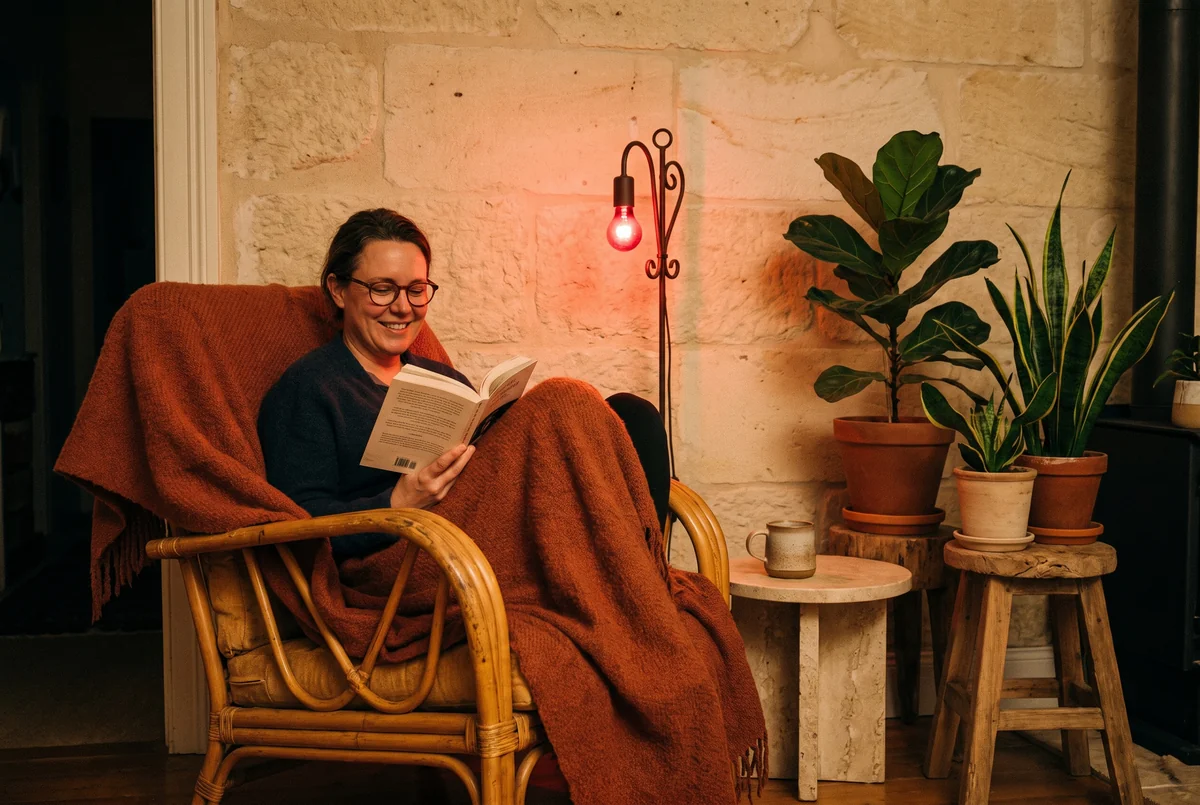
The further the wavelength slides toward red, the less melatonin reacts: less, not zero, because the study stops at 600 nm (Brainard et al., 2001). Expert benchmarks for healthy adults, measured at the eye: at most 10 melanopic lux from 3 hours before bedtime, at most 1 lux during sleep (Brown et al., 2022). Ten lux is a discreet night light in a corner; one lux, a bedroom where you can barely make out the furniture.
Which color of light for sleeping, then? None, ideally: outdoors, at night, it is dark. For the last hour of the evening, a well-dimmed red lamp disturbs the body clock less than a white LED at the bedside.
The photobiomodulation panel
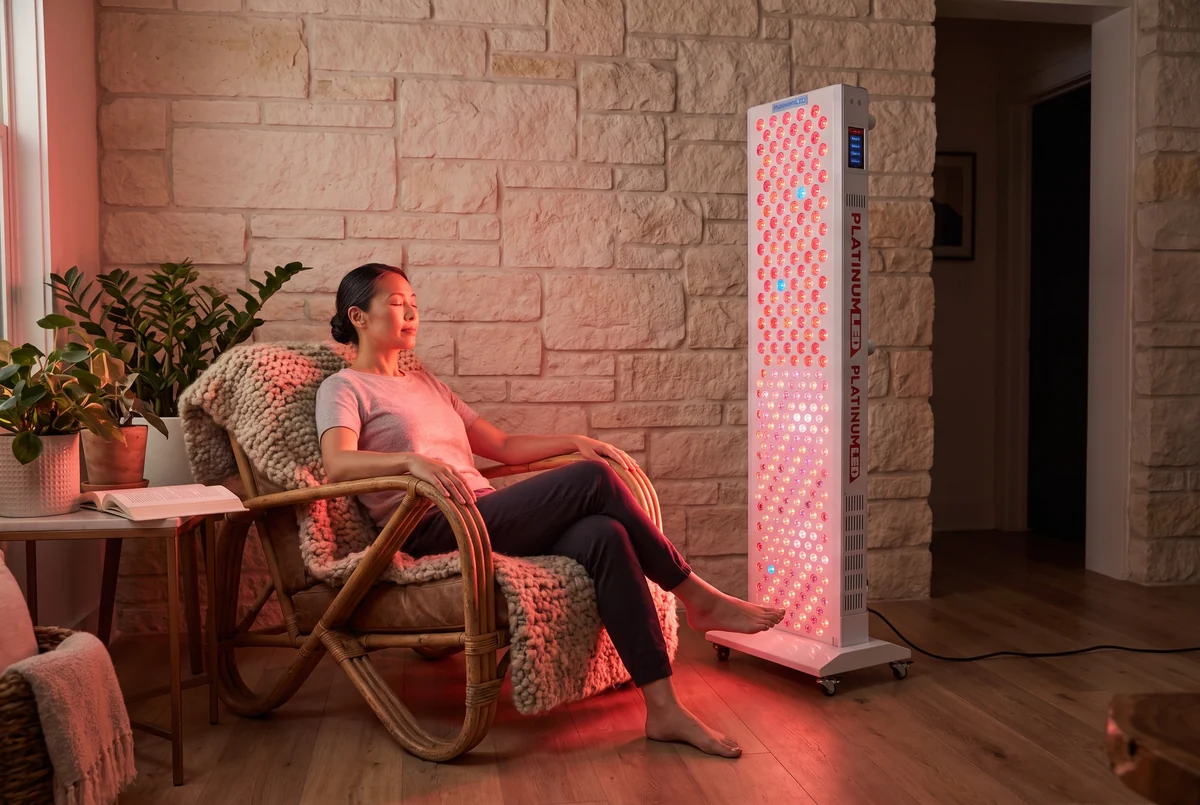
The panel, for its part, does not light up the room: for a few minutes it sends red and near-infrared light of measured intensity onto the skin (the kind behind searches for “red light therapy sleep”). This non-ionizing LED light belongs to an entirely different range from the radiofrequency electromagnetic waves I talk about in my advice on protecting yourself from waves.
Red light therapy for sleep: what the research really shows
Meta-analysis, PSQI questionnaire, placebo: three terms explained
A meta-analysis is like putting five imprecise kitchen scales side by side: together, they get it wrong less often. The PSQI is a sleep quality questionnaire (the lower the score, the better you sleep); the placebo (“sham”) imitates the session without delivering the light.
The 2026 result and its confidence interval
Five randomized trials published up to September 2025, 240 participants: barely a small concert hall. Against placebo, the PSQI score drops by 1.25 points on average (Vital de Azevedo et al., 2026), which means sleep judged a little better, no more. The 95% confidence interval runs from -2.38 to -0.11 (p = 0.03; I² = 36.2%): the true value hides somewhere between almost nothing and a bit over two points.
A p = 0.03 means a gap like this would show up by chance about 3 times in 100 if the devices did nothing. The authors say so themselves: precision is limited, and the gap may not reach the threshold generally considered clinically significant.
Short versus long protocols
At 4 weeks or less, the score drops by 1.20 points (CI -2.29 to -0.11; p = 0.03). At 5 weeks or more, it drops by 1.23 points (CI -2.87 to 0.41; p = 0.14), which is not significant. Same order of magnitude, but the interval for the long protocols crosses zero: no conclusion is possible beyond a month.
Who and what was tested
The five trials involve patients followed for a variety of health problems, with lasers on acupuncture points or glands, a forehead headband at 850 nm, and even violet-light glasses (360 to 400 nm). It is mostly near-infrared (810 to 850 nm): no trial reports visible red, none uses an LED panel, and all are judged at high risk of bias. How could such trials prove that “red light makes you sleep”?
Other leads
A 2025 review (17 studies, including 4 randomized trials, small and mostly clinical) sees a promising lead here, in a literature “in its early days” (Gaggi et al., 2025). Among 20 female basketball players, the ten exposed to red light for 30 minutes every evening for 14 days report a better PSQI score and higher blood melatonin than the ten without light (Zhao et al., 2012). Without a light placebo, this small trial is intriguing. The signal remains fragile.
My take on red light therapy for sleep therefore fits in one line: a serious lead, still poorly lit.
What is not proven
Here is what current research does not allow us to claim:
- that a home LED panel improves sleep: the 2026 meta-analysis tests none;
- that a red bulb makes you sleep, because disturbing the body clock less is not the same as putting you to sleep;
- that red light “raises melatonin” in everyone, when a single small trial in athletes measured it;
- that an effect lasts beyond 4 weeks;
- which dose, timing or distance settings would be the right ones.
Okay, that is a lot of “not yet”. A lead can be real and poorly measured at the same time, and that is exactly where research on red light therapy for sleep stands in 2026.
A sensible evening routine
How to use red light therapy for sleep, then? Before any device, there are the basics of restorative sleep. On the light side, the simplest is also the most solid: as little light as possible in the evening, darkness during the night.
To start tonight, the first step is a low one: switch off the ceiling light an hour before bedtime and read on paper, by the glow of a small warm lamp. Nothing to buy. The real effort is elsewhere: leaving your phone in another room.
The evening the screen wins, it is not a big deal: like the roly-poly toys of my childhood, those weighted figurines that always right themselves, you come back the next day.
I use a PlatinumLED panel myself, following the manufacturer's instructions (duration, distance), with my eyes protected, without promising you any result: the data remain limited and how people feel about it varies.
Sleep depends on an overall healthy lifestyle: regular hours, calm evenings, a dark bedroom. In the card game of sleep, red light remains a small card.
Precautions: who should ask for advice first?
Before using a panel, ask a doctor for advice in any of these situations:
- a sleep disorder that persists: consult before buying anything;
- pregnancy;
- photosensitivity, or photosensitizing medication;
- a history of skin cancer;
- photosensitive epilepsy.
Children and teenagers are more sensitive to evening light (ANSES, 2019): for them, good sleep rests first on calm evenings and a truly dark bedroom.
In front of a panel, protect your eyes and never stare at the LEDs. Do not confuse it with an infrared heat lamp either, which is made to warm the skin. Nothing alike.
How to choose a panel without getting fooled?
The trials of the 2026 meta-analysis use very different parameters, from 360 to 850 nm: no “right” wavelength for sleep has been established (Vital de Azevedo et al., 2026). A seller who promises one is moving faster than the science. What I look at, as an engineer, before the design:
- the advertised irradiance, and above all the measured one, with the measurement distance;
- the wavelengths stated;
- the recommended usage distance;
- the CE marking, which attests electrical compliance and does not make the device a health device;
- the warranty, and an after-sales service you can reach in Europe
Mine is a PlatinumLED.
The same criteria apply when choosing an LED panel for muscle recovery.
Let's hope that a real trial with a home panel, in healthy sleepers, settles the question one day: I will be the first to rewrite this page.
Frequently asked questions
What is the best light for sleep?
Darkness during the night: at most 1 lux in the bedroom, according to an expert consensus published in 2022. In the evening, a faint, warm light, at most 10 melanopic lux from 3 hours before bedtime. A dimmed red light disturbs the body clock less than a blue light.
Does red light raise melatonin?
Nothing establishes it. A single small trial, in 20 female basketball players, measured higher blood melatonin after 14 days of evening red light, without a light placebo. What is solid concerns blue: a light-emitting e-reader reduced evening melatonin by 55%.
What are the contraindications to red light?
Ask a doctor for advice before using a panel in case of a persistent sleep disorder, pregnancy, photosensitivity, photosensitizing medication, a history of skin cancer or photosensitive epilepsy. Children are more sensitive to evening light. Always protect your eyes.
Can you sleep with red light therapy or a red lamp on?
A very faint red night light bothers less than white light, but the ideal remains darkness: at most 1 lux in the bedroom according to expert benchmarks, 10 lux if you have to get up. A photobiomodulation panel is never used while sleeping: it is a short session, with your eyes protected.
What is the difference between red light and infrared?
Red light is visible, around 600 to 700 nm, whereas near-infrared, beyond it, is invisible to the eye. The trials of the 2026 meta-analysis mostly use devices between 810 and 850 nm, so near-infrared, and none reports visible red.
Why do some people sleep worse after a session?
Nobody knows: no solid data explains this experience, which varies from one person to another. The most reasonable approach is to move the session earlier in the day and stop if the discomfort persists. If the problem sets in, ask a doctor for advice.
Can a device replace good sleep habits?
No. No trial shows that a home panel replaces good habits. Sleep rests on an overall healthy lifestyle, starting with regular hours and a dark bedroom; a red lamp or a panel comes at best as a complement.
References
- Vital de Azevedo W.M., de Souza K., Defante M.L., Salgado A.S.I., Lopes-Martins R.A.B., Gomes da Silva S., Gonzalez-Lima F., Cardoso F.D.S. (2026). Photobiomodulation and sleep quality: systematic review and meta-analysis. Lasers in Medical Science, 41(1):122.
- Gaggi N.L., Parincu Z., Peterson A., O'Brien C., Kam K., Tural U., Ayappa I., Varga A.W., Iosifescu D.V., Osorio R.S. (2025). Enhancing sleep, wakefulness, and cognition with transcranial photobiomodulation: a systematic review. Frontiers in Behavioral Neuroscience, 19:1542462.
- Brown T.M., Brainard G.C., Cajochen C., Czeisler C.A., et al. (2022). Recommendations for daytime, evening, and nighttime indoor light exposure to best support physiology, sleep, and wakefulness in healthy adults. PLoS Biology, 20(3):e3001571.
- Chang A.M., Aeschbach D., Duffy J.F., Czeisler C.A. (2015). Evening use of light-emitting eReaders negatively affects sleep, circadian timing, and next-morning alertness. PNAS, 112(4):1232-1237.
- Brainard G.C., Hanifin J.P., Greeson J.M., Byrne B., Glickman G., Gerner E., Rollag M.D. (2001). Action spectrum for melatonin regulation in humans: evidence for a novel circadian photoreceptor. Journal of Neuroscience, 21(16):6405-6412.
- ANSES (2019). Avis et rapport relatif aux effets sur la santé humaine et sur l'environnement (faune et flore) des systèmes utilisant des diodes électroluminescentes (LED). ANSES.
- Zhao J., Tian Y., Nie J., Xu J., Liu D. (2012). Red light and the sleep quality and endurance performance of Chinese female basketball players. Journal of Athletic Training, 47(6):673-678.
Updated: November 2026. Article written and validated by Éric Viard, founder of Biovie since 2007 and ISTOM engineer, co-author of “Algues au quotidien” (Gallimard, 2024), Best cookbook in the world, Gourmand Cookbook Awards 2025, and Best cookbook in France, Académie Nationale de Cuisine 2025.
The information presented in this article is educational and does not constitute medical advice. A red light panel is a wellness device, not a medical device. If you have a persistent sleep disorder, are pregnant, are photosensitive or take photosensitizing medication, ask a healthcare professional for advice.