



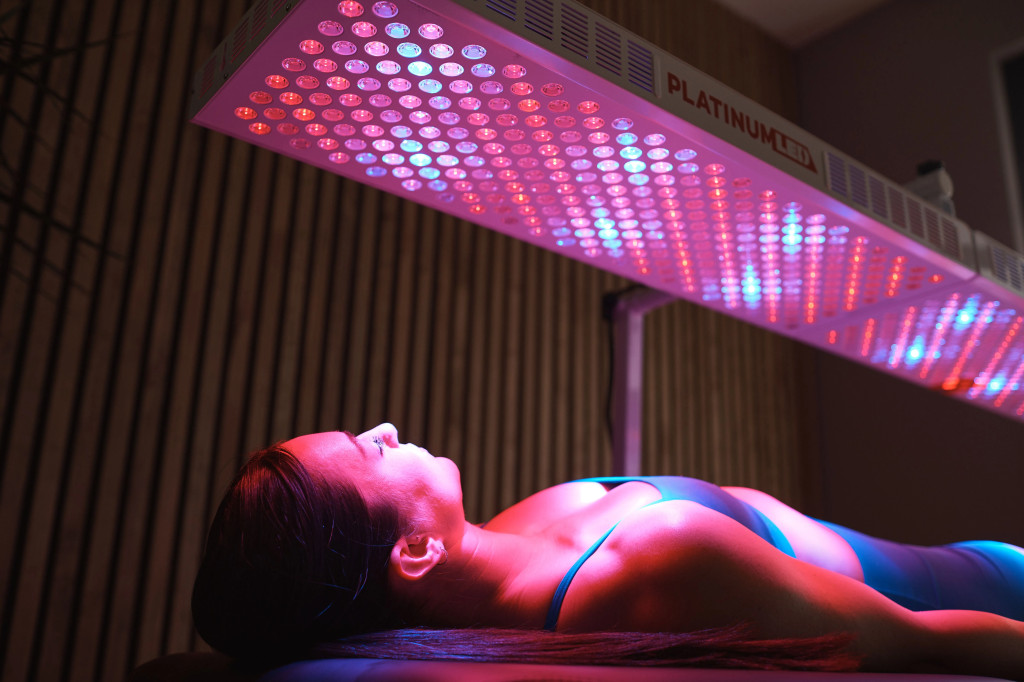
The Photobiomodulation by LED panels: also known as red light therapy or red phototherapy, is the subject of numerous studies related to muscle recovery. High-level athletes, amateur sports enthusiasts, physiotherapists, osteopaths, and sports coaches are embracing it as the scientific literature expands. A meta-analysis published in 2025 includes 14 controlled studies on delayed onset muscle soreness (DOMS) in athletes exposed to red light; its results remain to be confirmed. Another umbrella review in 2025 (PubMed Central) lists the published work on PBM.
How does this technology work? What does science say in 2026? How to use it, how often, at what distance, with what precautions? This article provides a comprehensive overview of the use of LED light therapy panels applied to muscle recovery: biological mechanisms, scientific evidence 2024-2025, quality criteria, usage protocol, and precautions.
How does photobiomodulation work?
When bare skin is exposed to red or near-infrared light emitted by a LED light therapy panel, wavelengths, typically 660 nm (visible red) and 810 to 850 nm (near infrared): penetrate the tissues and are absorbed by the muscle cells, particularly by their mitochondria. This mechanism, called Photobiomodulation In scientific literature, it is based on the activation of mitochondrial cytochrome c oxidase. Red light primarily acts on the skin and the superficial layers of the dermis; near-infrared, which is less absorbed by water and hemoglobin, penetrates deeper and reaches the muscle layer, fascia, and tendons up to about 5 cm deep. This differentiated penetration explains why multispectral panels exist, combining red and near-infrared.
This light absorption is at the heart of current research, which focuses in particular on:
- Researchers also measure biological markers after exercise in athletes exposed to red light; these results remain to be confirmed.
The For an overview of the published work on skeletal muscle, also see the 2025 review published in ScienceDirect.
What studies report about muscle recovery
Several recent studies examine the use of LED panels in muscle recovery, with results that vary depending on the protocols and remain to be confirmed.
A major review from 2017, encompassing 46 studies and 1,045 participants, looked at the use of red light photobiomodulation in competitive athletes. Source: PubMed 29090398.
The 2025 meta-analysis on muscle soreness (DOMS) covers 14 controlled studies (wavelengths 660 to 950 nm) conducted in athletes exposed to red light; its results remain to be confirmed. The tested protocols generally apply the light within an hour following the effort, at a distance of 15-30 cm from the worked muscle area, for a duration of 10 to 20 minutes. Source: MDPI Journal of Functional Morphology and Kinesiology, 2025.
In these studies, the researchers measured objective parameters:
- Creatine kinase (CK): a reference biomarker for muscle damage. Its blood concentration rises after any intense effort (long-distance running, eccentric weightlifting, combat sports) and indicates fiber rupture. Some photobiomodulation studies report lower post-exercise CK than in the placebo group; these results remain to be confirmed.
- Blood lactate: a marker of muscle effort, measured in several protocols.
- Maximum isometric forcemeasured 24 and 48 hours after exercise in several studies.
- Joint range of motion and perception of effort: the mobility of the engaged joints (knee, shoulder, ankle) and the rate of perceived exertion (RPE) are also measured in the days following exposure.
Stanford Medicine University published in February 2025 a summary on red light, which mentions a favorable safety profile in healthy adults. Source: Stanford Medicine, February 2025.
A PubMed study published in 2020 also tested the 940 nm wavelength in athletes, compared to a placebo group. Source: PubMed 33273302. Also note this MDPI review 2021 which lays the conceptual foundations of PBM, distinguishing the key parameters: wavelength, fluence (energy per unit area), irradiance (power per unit area), exposure duration, pulsed or continuous mode.
The Red light is also being researched in cardiovascular health, on glucose metabolism, a subject that particularly interests endurance athletes, and on post-operative recovery in the event of a sports injury requiring surgery.
A short but rich scientific story. Photobiomodulation has a unique history: it all began in the late 1960s when Hungarian physician Endre Mester accidentally observed that low-level red laser light accelerated hair regrowth in mice. Over the decades, the concept evolved from laser (LLLT, Low-Level Laser Therapy) to LED, which is more accessible. The 2010s saw PBM become established in professional physiotherapy centers, and the last decade has democratized LED panels for home use by the general public. By 2026, PBM is the subject of over 700 clinical trials recorded, a portion of which focus on skeletal muscle.
How to choose a quality LED panel for muscle recovery
Faced with the growing popularity of red light therapy, many brands offer LED panels. Not all are created equal, and a low-quality panel (with too low irradiance, imprecise wavelengths, high EMF) will not produce the expected results. Here are the technical criteria to require for serious muscular use:
- Wavelengths 660 nm + 810/850 nm: the combination of visible red and near-infrared covers the skin, fascia, and deep muscles. A panel that emits only in red (660 nm) will primarily be active on the surface; an infrared panel alone (850 nm) will not address skin microcirculation. Multispectral synergy is optimal for sports.
- Sufficient irradiance: aim for at least 50 mW/cm² at a distance of 15 cm. High-end panels (such as Platinum LED BioMax) reach ~90 mW/cm². This power directly determines the duration of the sessions: with double the irradiance, the same energy dose is delivered in half the time.
- High LED density: more LEDs = larger and more homogeneous exposure surface, essential for covering large muscle groups (thighs, back, buttocks).
- Measurable EMF levels: prioritize signs indicating an EMF (electromagnetic field) close to zero at the recommended usage distance. A criterion of comfort and manufacturer reliability.
- Pulsed modes (optional): Certain clinical protocols use specific pulsed frequencies. High-end panels offer multiple modes.
- Minimum 3-year warranty and French or European customer service, a guarantee of durability and after-sales service in case of a breakdown.
- Certifications CE, FCC, RoHS: markers of electrical and environmental compliance.
Among the brands studied in 2024-2026, Platinum LED (BioMax range) stands out: irradiance up to ~90 mW/cm² at 15 cm, low measured EMF, wide spectral band combining 630, 660, 810, 830, and 850 nm, 3-year warranty, support available in French via the European store. Independent comparisons conducted by Alex Fergus and Light Therapy Insiders regularly place the BioMax range in the global top 3 of high-performance panels. Discover the Platinum LED BioMax range, or via the European boutique in French.
To go further on independent comparisons: Light Therapy Insiders, Best Panel 2024.
When and how to use an LED panel for recovery?
The protocols used vary depending on the timing and duration of the sessions. Here are the recommendations based on the 2024-2025 literature and the experience accumulated by sports coaches who incorporate PBM into their training:
- Pre-effort (5 to 10 minutes, 30 minutes before training): it is the protocol most studied in the literature. It is applied before exertion, including in competition between several efforts during the day.
- Immediate post-effort (10 to 20 minutes, within the hour following the session): it is the protocol most used in studies on muscle soreness (DOMS).
- Higher frequency (1 to 2 sessions/day, 10-15 min): protocol encountered in overload phases during competition or intensive training camps. In the event of injury or rehabilitation, use is a matter for the healthcare professional following you.
- Exposure distance: 15 to 30 cm from bare skin depending on the panel's irradiance. High-end manufacturers always specify the optimal distance in the instructions. Too close: risk of thermal discomfort. Too far: insufficient irradiance for a biological effect.
- Frequency: every day is possible, with no documented toxicity in healthy adults. The protocols studied generally provide for at least 3 sessions per week for 4 to 8 weeks.
- Exposed area: the light does not pass through clothing. Expose the bare skin of the targeted muscle area (thighs, calves, back, lower back, shoulders depending on the sport).
Photobiomodulation is part of a holistic approach to recovery, with good hydration and sufficient sleep. The ideal: make the post-exercise LED session a short but regular ritual, integrated into the cooldown.
Case studies: photobiomodulation according to your discipline
Not all sports engage muscles in the same way, and photobiomodulation protocols benefit from being adjusted. Here are the most common use cases observed among regular users of LED panels.
- Running / trail running / marathon: primarily target the quadriceps, hamstrings, calves, and glutes. Long-distance runners often use the post-exercise window (10-15 minutes on the legs in the evening after a long run). Ultra-trail runners in intensive training often have two sessions per day.
- Bodybuilding, CrossFit, weightlifting: target the muscle groups worked in a split routine (legs, back, chest depending on the session). PBM is often used after slow tempo or eccentric sessions. Several strength training coaches schedule the LED session right before the post-workout shower.
- Combat sports (boxing, MMA, judo): target areas of repeated impact (shoulders, back, abdominals, thighs), notably during the loading phase before a fight.
- Team sports (football, rugby, basketball, handball): targeting the legs (lower limbs) between matches. PBM is increasingly being integrated by the medical staff of professional clubs, in addition to cold therapy and traditional recovery treatments.
- Cycling and triathlon: target quadriceps, hamstrings, lower back, and neck (often strained by the aerodynamic position). During a training camp, two 10-minute sessions per day are sometimes practiced.
- Yoga, Pilates, dance, climbing: target specific areas (hips, shoulders, hands for climbers). PBM is used here more in regular sessions, on heavily strained areas.
- Post-injury rehabilitation: Some physiotherapists include photobiomodulation in their treatment. This use is a decision for the healthcare professional following you, never a self-prescription.
For most amateur athletes, a medium-sized panel (300-1000 W) permanently installed in a dedicated room (home gym, yoga corner, locker room) allows for the integration of PBM without constraints. Portable compact panels are an alternative for travel and training camps.
Precautions, contraindications, and proper use
Photobiomodulation by LED panel is generally considered a safe technology. The safety profile has been confirmed by several recent reviews (Stanford 2025, umbrella review 2025, clinical meta-analyses): no documented DNA damage, no acute or chronic toxicity in healthy adults, wide margin between the doses used and the problematic doses. However, some common-sense precautions remain essential, especially for repeated home use:
- Eye protection: never look directly at the LEDs, especially in near-infrared where the light is not perceived by the eye but remains energetic. Wear appropriate glasses (provided with high-end panels) during exposures of more than 5 minutes or if the panel is facing the face.
- Bare skin exposed: Red light does not penetrate clothing. Apply the exposure directly to the skin. Remove sunscreens and makeup containing titanium dioxide, as they can reflect light.
- Photosensitivity linked to certain treatments : certain treatments increase the skin's sensitivity to light: St. John's wort, isotretinoin (acne), antibiotics from the tetracycline family (doxycycline) or quinolones, certain diuretics (hydrochlorothiazide), certain anti-inflammatories. Seek medical advice before starting if you are taking any of these treatments.
- Pregnancy: as a precaution, in the absence of solid data on pregnant women, seek medical advice before any use, even if no harmful effects have been reported to date.
- Active skin cancers or non-healing skin lesions: do not expose the affected area without prior dermatological advice. Known melanoma areas must be protected.
- Photosensitive autoimmune diseases: systemic lupus erythematosus in particular, as a precaution, seek medical advice.
- Reported adverse effects: extremely rare, temporary mild skin dryness, transient redness, exceptionally headaches in case of overexposure. Reducing the duration of sessions and increasing the distance generally resolves the issue.
Warning: Red light is not a medical treatment and does not replace professional advice. In the case of a serious muscle injury (extensive tear, deep contusion with hematoma), persistent pain beyond 7 days, or chronic pathology, consult a physiotherapist, sports doctor, or cardiologist depending on the context.
FAQ, LED Panels and Muscle Recovery
What do studies say about red light and recovery after sports?
Study results vary depending on the protocols. Several studies, including a 2025 meta-analysis of 14 controlled studies, observed less perceived muscle soreness in athletes exposed to red light after exercise. These are study results, not a promise for every user. High-level athletes use it in their recovery routine.
How long should a LED panel be used for muscles?
Red light therapy sessions are generally short: 10 to 20 minutes per muscle area are most often practiced. For post-exercise recovery, aim for 10-15 minutes on the targeted area (thighs, calves, back, etc.). For pre-conditioning, 5-10 minutes 30 minutes before training. If the session is too long, it may cause slight thermal discomfort.
How often can one do red light therapy sessions for recovery?
One session per day, or even two during intense training phases, competitions, or injuries, is generally well tolerated in healthy adults. The protocols studied generally provide for at least 3 sessions per week for 4 to 8 weeks.
Should red light be used before or after training?
Both protocols are used, with different logic. The literature from 2024-2025 suggests that pre-conditioning (5-10 minutes, 30 minutes before exertion) is the most studied protocol. Immediate post-exertion (10-20 minutes within the hour) is the protocol most used in studies on muscle soreness. The ideal approach: combine both according to availability and context.
Is red light therapy safe for muscles?
Yes, recent scientific reviews confirm the absence of toxicity in healthy adults. No DNA damage, no harmful thermal effect on muscle fibers, no negative interaction with physical effort. The main precautions concern the eyes (wearing appropriate glasses), photosensitivity linked to certain treatments, and pregnancy. In case of doubt, seek medical advice, especially if you are on regular medication.
What is the difference between red light and infrared for muscles?
Visible red light (660 nm) primarily acts on the surface, affecting the skin and the superficial layers of the dermis. Near-infrared light (810-850 nm) penetrates deeper, reaching the muscles, fascia, and tendons (up to about 5 cm). For muscle recovery, the combination of both wavelengths is ideal: this is what high-end multispectral LED panels offer. A "red-only" panel reaches deep muscle groups less well.
Can a LED panel be used on muscles every day?
Yes. Daily use (10-20 minutes) is the most commonly practiced and poses no known problem for healthy adults. For athletes in competition, injured sportspeople, or individuals in rehabilitation, two sessions per day are possible, spaced at least 4-6 hours apart.
Synergies: Photobiomodulation in a Holistic Approach
The muscle recovery does not depend on a single factor. Here are a few habits to combine with LED sessions.
- Quality sleep (7 to 9 hours per night)No technology can compensate for degraded sleep.
- Hydration and electrolytes: remember to drink regularly, depending on the effort and the amount of sweating.
- Protein and amino acid intake: plant-based sources (legumes, algae, sprouted seeds, pseudo-cereals) are part of a varied diet.
- Active recovery: gentle walking, stretching, self-massage with a foam roller, hot-cold baths. PBM fits perfectly into this toolbox; it does not replace it.
In the studies, the protocols generally span several weeks.
Update: April 30, 2026.
Warning: The information shared in this article is for educational purposes and does not replace medical advice. In the case of a serious muscle injury, persistent pain, or chronic condition, consult a qualified healthcare professional.
