Fast delivery
.png)
 Fair prices




Kombucha: 12 Science-Backed Health Benefits (2026 Guide)
In 2026, twelve kombucha benefits are now documented by research — from rebalancing the gut microbiome to supporting digestion, plus the tea's antioxidants and a genuine low-sugar alternative to soda. None of them is a miracle: several are solid, a few still exploratory. Here they are, with their sources and their limits, explained by Éric Viard, agronomy engineer and founder of Biovie.
You've been drinking kombucha for months, you enjoy it — fizzy, a little vinegary on the finish — and somewhere in the back of your mind, a small voice asks: is this actually doing anything for me, or am I telling myself a story?
Honestly, that's a fair question. And until recently, I couldn't have answered it properly. But the science moved fast between 2022 and 2025. Late 2024 even brought the first genuine randomized clinical trial in humans — not a study on rats, not a test tube: real people, over several weeks.
I'm going to walk you through these twelve kombucha health benefits one by one, with the sources, the mechanisms, and above all the limits. Because I trained as an agronomy engineer (ISTOM), and since I founded Biovie in 2007, I've seen plenty of "miracle" foods come and go. Kombucha isn't a miracle. It's better than that: it's a living drink whose effects — modest but real — are finally being measured. No empty promises here. Just the facts, and what they actually change in your morning glass.
What kombucha really is
At its core, it's almost too simple. Tea (green or black), sugar, and an odd gelatinous disc called a SCOBY — Symbiotic Culture Of Bacteria and Yeast. You let it ferment for 7 to 14 days, and the microbial magic does the rest.
During fermentation, the yeasts and bacteria eat the sugar and transform it. The brew fills with living probiotics (lactobacilli, acetic bacteria), organic acids (glucuronic, acetic, lactic), polyphenols from the tea, B and C vitamins, and enzymes. The pH drops to around 2.5–3.5 — slightly acidic, hence that lively edge on the palate.
Here's the concrete picture: that amber, fizzy glass you're holding is an entire ecosystem in a bottle. The starting sugar has been largely digested by the micro-organisms — which is why well-fermented kombucha is far less sugary than soda, more on that below.
The origin? People have been drinking it for roughly 2,000 years, most likely in China and East Asia, long before it reached Europe in the 20th century. A reference review published in Bioengineered in 2022 (Selvaraj et al.) lays it all out clearly if you want to dig in.
12 science-backed kombucha benefits
One quick note before we start. When I say "proven," I always separate three levels: what we see in a test tube (in vitro), what we see in animals, and what we see in humans. The human level is the gold standard, and it's the rarest. I'll flag it for each benefit.
1. It rebalances the gut microbiome
Unpasteurized kombucha delivers living bacteria — notably lactobacilli and Weizmannia coagulans. These micro-organisms join the billions already settled in your colon and add to the diversity of that ecosystem.
That's exactly what the first serious randomized controlled trial in humans measured, published in late 2024 in Scientific Reports (Tran et al., 2024). Over several weeks, drinking kombucha shifted the composition of the participants' microbiome.
In practice, what that covers in people's lived experience is often the sense of a "more regular" transit, a gut that makes itself felt less. The honest nuance: the effect is subtle and dose-dependent. You don't rebuild a microbiome in three sips. It's a long-haul companionship, not a magic wand.
2. It supports digestion and gut comfort
The organic acids and enzymes produced during fermentation give digestion a small nudge. A 2025 systematic review (Fermentation, MDPI, 2025) pooling eight clinical trials points the same way.
Beyond the figure, here's what it means after a heavy meal: that tangy glass that "wakes up" the stomach, the feeling that things "go down easier." A lot of people drink it for precisely that reason, at the table.
One question comes up often: is kombucha good for diarrhea? A cautious answer — in an acute phase, an acidic, fizzy drink isn't necessarily what your gut needs. More on that in the FAQ.
3. It supports the immune system
Here's a point that always surprises: about 70% of your immune cells live in your gut. So anything that takes care of your microbiome indirectly takes care of your defenses.
Through its probiotics and polyphenols, kombucha contributes to that gut balance (de Oliveira et al., 2023). I'm deliberately measured here: we're talking about tending the soil, not strapping on a shield. As part of a varied, balanced diet and a healthy lifestyle, it's one more building block among others.
4. It's a strong antioxidant
Green tea is one of the richest polyphenol sources there is — EGCG, catechins. And fermentation, far from destroying them, makes a portion more available. The journal Bioengineered (Selvaraj et al., 2022) documents this antioxidant activity.
To put it back in your daily life: antioxidants are what help your body cope with oxidative stress — the kind that builds up with pollution, fatigue, nights that are too short. You don't "feel" it directly, but it's background work, sip after sip.
5. It may support the liver's natural detoxification
Kombucha contains glucuronic acid, a molecule your liver uses in its natural elimination processes. Hence its "detox" reputation.
Let's be clear, because it matters: your liver needs no one to do its job. It "detoxifies" itself perfectly well, 24/7. Kombucha is not a liver cleanser, and no drink is. What research suggests is possible support for normal functions, nothing more. Be wary of anyone promising a "brand-new liver" in a bottle.
6. It may help regulate blood sugar (with a real caveat)
Acetic acid — the same one in vinegar — has shown, in several studies, an influence on insulin sensitivity and the post-meal blood-sugar response.
But I owe you full honesty: the 2024 randomized trial (Tran et al.) actually observed a slight rise in a marker of insulin resistance (HOMA-IR) among participants. The results are therefore mixed. Put simply: it's an interesting lead, not a certainty. If your blood sugar is a concern, kombucha replaces neither your monitoring nor your doctor's advice.
7. It has natural antimicrobial action
In a test tube, kombucha curbs the growth of several unwanted micro-organisms, including certain pathogenic bacteria and the yeast Candida, thanks to the combination of polyphenols + acetic acid + low pH (de Oliveira, 2023).
The caveat — and it counts: what's true in vitro doesn't transfer mechanically into your body. It's a clue to the drink's potential, not a therapeutic promise.
8. It may improve some cardiovascular markers
A few studies report a drop in "bad" cholesterol (LDL) and a rise in "good" cholesterol (HDL) with regular fermented-tea consumption.
I'll put the caveat right up front: most of this data comes from animal models. In humans, it's still thin. File it under "promising, to be confirmed" rather than "demonstrated."
9. It helps calm chronic low-grade inflammation
This quiet, permanent inflammation — the kind you don't feel but that settles in with poor diet and stress — is at the heart of current research. Polyphenols and a balanced microbiome seem to work against it, and kombucha brings both (2025 systematic review).
What participants report most often, in this register, is a diffuse sense of "feeling better in their body," less of that dull heaviness on waking. Hard to quantify, but it keeps coming up.
10. It's a genuine low-sugar alternative to soda
Here's a benefit people forget because it isn't "health" in the medical sense — and yet. A well-fermented kombucha contains between 2 and 6 g of sugar per 100 ml, against roughly ten grams for a regular soda.
In practice: you swap a drink that spikes your blood sugar for a living, fizzy drink that actually refreshes. For someone trying to break a daily soda habit, it's often the perfect bridge. My tip: aim for a kombucha fermented at least 14 days — that's where residual sugar is lowest.
11. It provides B vitamins
During fermentation, the yeasts synthesize B vitamins (B1, B2, B6, and sometimes traces of B12). Amounts vary with the process, but the contribution is real.
Personally, after 33 years as a vegan, I know how much B vitamins deserve attention in a plant-based diet. And I'll say it plainly: kombucha does not replace a B12 supplement when one is needed — it would be irresponsible to suggest otherwise. But as a small complementary contribution within an already well-built plate, it earns its place.
12. It may support mood through the gut-brain axis
This is the most exploratory benefit, and the most fascinating. Your gut and your brain are in constant dialogue, and your microbiome takes part in producing neurotransmitters like serotonin and GABA. By supporting that gut ecosystem, kombucha fits into a research field that is very active in 2026.
I'll stay cautious: it's a lead, not a conclusion. But the idea that a glass of fermented drink might play a modest part in that gut-head conversation — honestly, I find that thrilling.
How to drink kombucha every day
Good news: it's one of the easiest living foods to adopt. No fancy equipment, no heavy ritual.
How much? Between 100 and 300 ml a day (roughly 3 to 10 oz) is plenty — that's the benchmark both ANSES and the Mayo Clinic land on. No need to drink liters; your gut doesn't like abrupt excess.
When? Two schools of thought. In the morning on an empty stomach, to wake up digestion. Or with meals, to accompany them. Try both, keep the one that works for you.
And above all — start small. For the first week, stick to half a glass, around 50 ml, without changing anything else in your diet. Your microbiome needs to adjust. It's thirty seconds in the morning, right when you're making your tea or coffee.
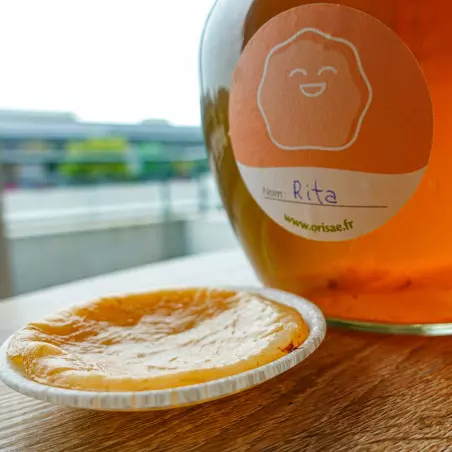
If you want truly living, unpasteurized kombucha every day, the safest route is to make it at home: you control everything, from the sugar to the fermentation time. All you need is a healthy mother to get started — ours is cultivated in France.
Precautions and contraindications
Kombucha is a drink, not a medicine — but like any active fermented food, it isn't for everyone. Here are the real kombucha side effects and points to watch:
- Pregnant and breastfeeding women: not advised, as a precaution (a small dose of caffeine from the tea + a trace of natural alcohol, under 0.5%, from fermentation — the same threshold the FDA uses for non-alcoholic labeling).
- Children under 14: for the same reasons.
- Immunocompromised people: an unpasteurized product contains living micro-organisms, which calls for caution when defenses are fragile.
- Gastritis, ulcers or acid-sensitive stomachs: the drink is acidic and may bother you.
- People sensitive to histamine: fermentation produces it, and some react to it.
- On anticoagulants or diabetes medication: seek medical advice before regular consumption.
A frequent question: when should you not drink kombucha? The answer is in this list. Outside these cases, for a healthy person, reasonable consumption poses no problem. When in doubt, the rule is simple: talk to your doctor. Always.
Store-bought or homemade kombucha?
Both have a case, truly. It depends on you.
Homemade is economical and deeply satisfying — you feed your own mother (the SCOBY), you control the sugar, the fermentation time, the flavors. The flip side: hygiene must be spotless. Poorly cleaned equipment, and you grow what you didn't want. It's learnable (I detailed the whole method in the complete homemade kombucha guide).
Store-bought, on the other hand, is safe and consistent. The trap: many brands pasteurize their production to stabilize it… which kills the living probiotics. Before buying, turn the bottle around and check: "unpasteurized," "organic," sugar under 5 g/100 ml, a long fermentation, and a brand that's transparent about how it's made.
If you want to start brewing at home without chasing down equipment, we've gathered everything you need — jar, bottles, selected tea, mother and starter liquid — in a turnkey kit made in France.

Kombucha vs kefir: what's the difference?
I get asked this a lot, because both are stars of the fermented-drink world. And they're two different planets.
Kefir starts from grains (milk or water), ferments fast — 24 to 48 hours — and stands out for its richness in probiotic strains: up to around forty different micro-organisms, sometimes more. It's the champion of microbial diversity.
Kombucha, meanwhile, starts from a SCOBY, ferments longer — 7 to 14 days — and draws its strength from the tea's polyphenols and antioxidants. Fewer strains, but an antioxidant dimension kefir doesn't have.
Which to choose? Both, ideally, alternating. If you want the full breakdown, I wrote a complete guide to choosing between kefir and kombucha.
3 Biovie-inspired homemade recipes
Once you have your plain kombucha, the flavored second fermentation is the fun part. Here are three variations we love at home, all vegan and in the Biovie spirit:
- Ginger-lemon kombucha — the digestion classic. A few slices of fresh ginger and the juice of half a lemon in the bottle, 2 to 3 days of second fermentation at room temperature. Lively, bracing, perfect after a hearty meal.
- Hibiscus-goji kombucha — the antioxidant reflex. A spoonful of dried hibiscus flowers and a handful of goji berries. Deep red color, tangy taste.
- Matcha-orange blossom kombucha — morning energy. Half a spoon of matcha whisked in and a touch of orange blossom water. Soft, floral, elegant.
And if a recipe calls for a plant milk, skip the oat milk: go for hemp or tigernut milk, more nutritionally interesting and more in tune with a living-food approach. Almond or coconut milk also work very well.
Kombucha FAQ
What does kombucha do for your body?
It brings living probiotics and tea polyphenols that contribute to gut balance, digestion and antioxidant intake — as part of a varied, balanced diet. The effects are real but modest, not miraculous.
Is it okay to drink kombucha every day?
Yes, for a healthy person, a daily intake of 100 to 300 ml is perfectly reasonable. Start gently and listen to your body.
What happens when you first start drinking kombucha?
Often a discreet adjustment of digestion. That's exactly why you start with half a glass (about 50 ml) the first week: to let your microbiome adapt without abrupt change.
What are the pros and cons of kombucha?
Pros: living probiotics, tea antioxidants, low sugar, a real alternative to soda. Cons: acidity, a trace of natural alcohol and caffeine, and contraindications for some people (see the precautions section).
Does kombucha help with belly fat?
Not magically, let's be honest — it's not a weight-loss shortcut. By replacing sugary sodas and supporting a balanced microbiome, it can fit into an overall approach, but no glass melts abdominal fat on its own.
Is kombucha alcoholic?
Only a trace, under 0.5%, naturally produced by fermentation — comparable to a very ripe fruit juice, and within the FDA's non-alcoholic threshold. Commercial versions respect this limit.
Can pregnant women drink kombucha?
It's not advised during pregnancy and breastfeeding, due to the caffeine, the trace of natural alcohol and the unpasteurized nature of the product. Ask your doctor.
How long until I feel the effects?
It varies. Digestive comfort can be felt within a few days; the deeper microbiome effects play out over several weeks of consistency.
In closing
Twelve benefits, then — from rebalancing the microbiome to supporting mood, by way of digestion, antioxidants and that fine alternative to soda. None of them is miraculous. Several are solid, a few still exploratory, and I've given them to you without inflating anything.
What I take away, after all these years observing living food: kombucha isn't a solution, it's a habit. A living glass, regular, slipped without pressure into an already varied diet. Your body handles the rest.
If you want to test for three weeks what it changes for your digestive comfort and your afternoon energy, start with half a glass and observe. That's the finest way to make up your own mind.
References
- Selvaraj, S., & Gurumurthy, K. (2022). "An overview of probiotic health booster-kombucha tea". Bioengineered, 14(1).
- Tran, T., et al. (2024). "Modulating the human gut microbiome and health markers through kombucha consumption". Scientific Reports, 14.
- de Oliveira Souza, P. V., et al. (2023). "Kombucha: benefits, risks and regulatory frameworks". Food Chemistry Advances.
- Systematic Review (2025). "Health effects of kombucha: a systematic review of clinical trials". Fermentation, 11(6), 353.
- Mayo Clinic — Kombucha tea: Is it good for you?
Last update: June 2026. Article written by Éric Viard, founder of Biovie since 2007 and agronomy engineer (ISTOM), co-author of "Algues au quotidien" (Gallimard, 2024) — World's Best Cookbook, Gourmand World Cookbook Awards 2025, and French National Academy of Cuisine Award 2025.
The information in this article is provided for informational purposes only and is not a substitute for medical advice. Consult a healthcare professional before making any changes to your diet or supplementation. As part of a varied, balanced diet and a healthy lifestyle.