


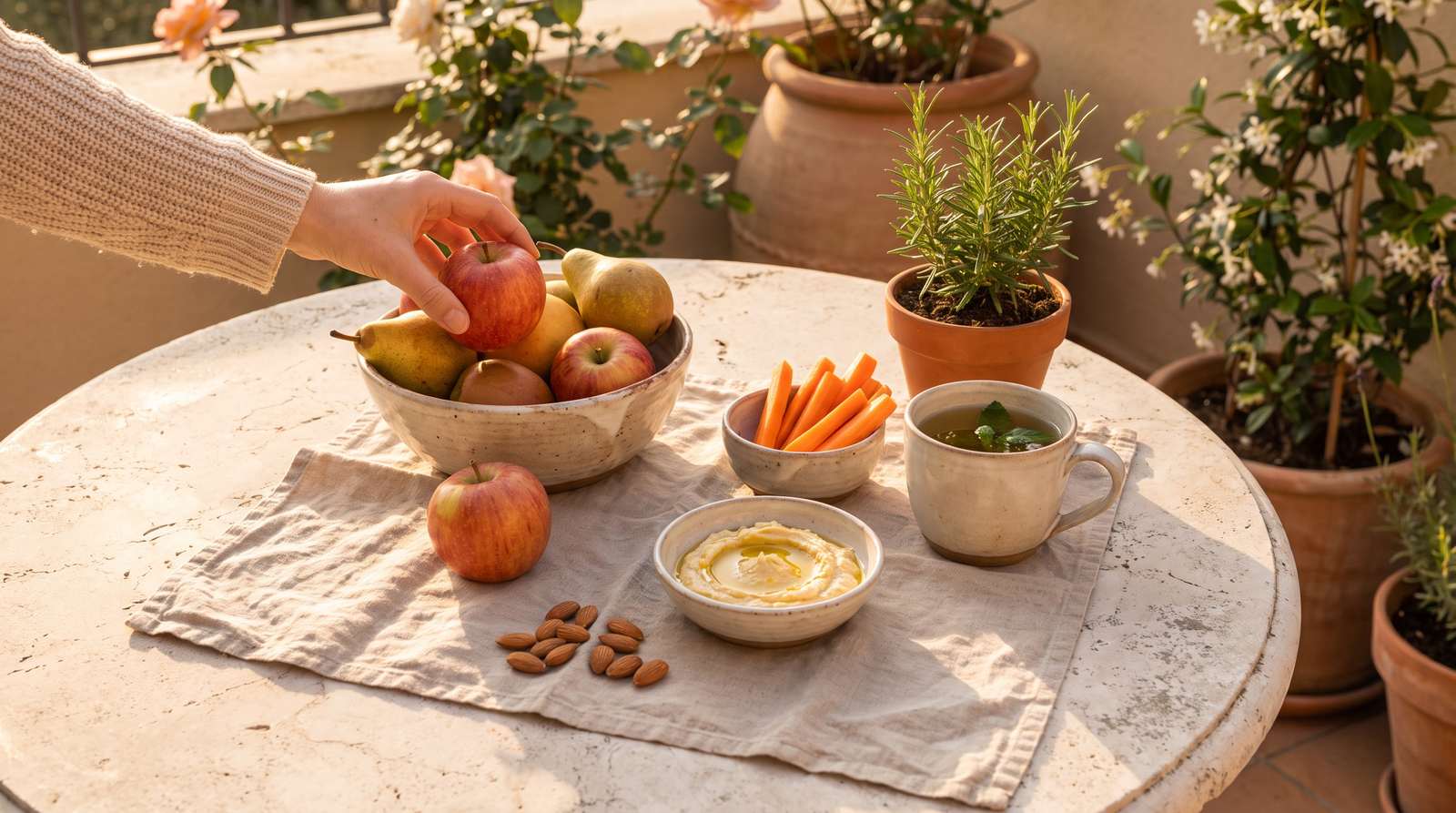
It's 4:30 pm, hunger strikes and the cupboard offers up its cookies: yet the best idea for healthy snacks comes down to two simple moves, a whole fruit and something more filling (whole-grain bread, plain yogurt or a handful of almonds), with no ultra-processed product. At Biovie, we built these 12 ideas on WHO and Santé publique France guidance.
I'm the son of a baker who was a Meilleur Ouvrier de France and of a Dutch mother: in other words, I was raised on bread and milk, like many children of my generation. Since then (vegan in 1992, ISTOM engineer, founder of Biovie in 2007), one thing hasn't changed: here, we add rather than take away, and everyone moves at their own pace.
What is the healthiest snack?
The healthiest snack pairs a whole fruit with something more filling, such as whole-grain bread, a plain dairy product or a small handful of nuts, all without any ultra-processed product. You lose nothing in pleasure: a ripe fruit and a good slice of bread never needed packaging to look appealing.
For children aged 4 to 11, Santé publique France suggests bread with a few squares of chocolate, or a little butter or jam, along with a fruit, a compote or a dairy product (Santé publique France, 2024). Pastries and sweet, fatty foods are best limited, and as for cookies, the main thing is to avoid those rated Nutri-Score E. Nothing exotic, then: it's our grandparents' snack, put down in black and white by a public health agency.
A fruit and a simple food, as part of a varied and balanced diet and a healthy lifestyle, are enough to make a complete snack. It's an old conviction of mine: we're not here to fill a stomach, but to nourish an organism.
Unprocessed, minimally processed, ultra-processed: telling the difference
The NOVA classification, plainly
Put three things on your kitchen counter. An apple. A compote made on Sunday with those same apples. And a fruit bar bought at the train station, whose ingredient list runs to two tightly packed lines.
The NOVA classification sorts foods into four groups according to the degree, and above all the purpose, of their industrial processing (Monteiro et al., 2019). The apple belongs to the first group, the bar to the last. And the homemade compote? It remains a kitchen preparation: a fruit was cooked and mashed, nothing more, nothing hidden. Processing a food is nothing worrying in itself: cooking, blending or drying, every kitchen has always done it. The question isn't the saucepan, then, it's the purpose. And not all processing methods are equal, as I explained in detail for vegetables.
Reading a label in 30 seconds
My method boils down to one slightly naive question. Who has ever seen a tub of emulsifier sitting next to the salt and the flour in their grandmother's kitchen? Nobody, and that's exactly the right filter: according to the authors of NOVA, a single ingredient that is rarely or never used in cooking is enough to spot an ultra-processed product (Monteiro et al., 2019):
- glucose-fructose syrup;
- hydrogenated or interesterified oils;
- hydrolyzed proteins, which no family recipe calls for;
- and so-called “cosmetic” additives, which work on appearance or texture: flavorings, colorings, emulsifiers, sweeteners, thickeners.
Thirty seconds, no more, just the time to turn the package over in the aisle. The shorter and more readable the list, the closer you stay to a healthy homemade snack. I've explained elsewhere why most shop-bought snacks are ultra-processed.
What the studies say
Does all this really change anything? In 2019, a randomized trial enrolled 20 hospitalized adults (Hall et al., 2019). Each followed two two-week diets, one ultra-processed, the other unprocessed, in a randomly assigned order, with meals matched for calories and nutrients and the freedom to eat as much as they wanted. In this crossover trial, each participant is their own control.
On the ultra-processed diet, participants ate on average 508 kcal more per day (± 106), and gained 0.9 kg (± 0.3), versus a loss of 0.9 kg (± 0.3) on the unprocessed diet. Five hundred kilocalories is a small extra meal every day, swallowed without noticing, even though the plates on offer were equivalent on paper. It gives you pause. Let's be honest, though: the sample is small, the trial lasted only four weeks and took place in a hospital.
On a very different scale, an umbrella review in the BMJ (Lane et al., 2024) gathered 45 pooled meta-analyses, that is 9,888,373 participants, almost ten million people. It finds unfavorable associations with 32 health outcomes, with evidence rated “convincing” for cardiovascular mortality, type 2 diabetes, anxiety and common mental disorders. These are observational studies: they show an association, not proof of cause and effect.
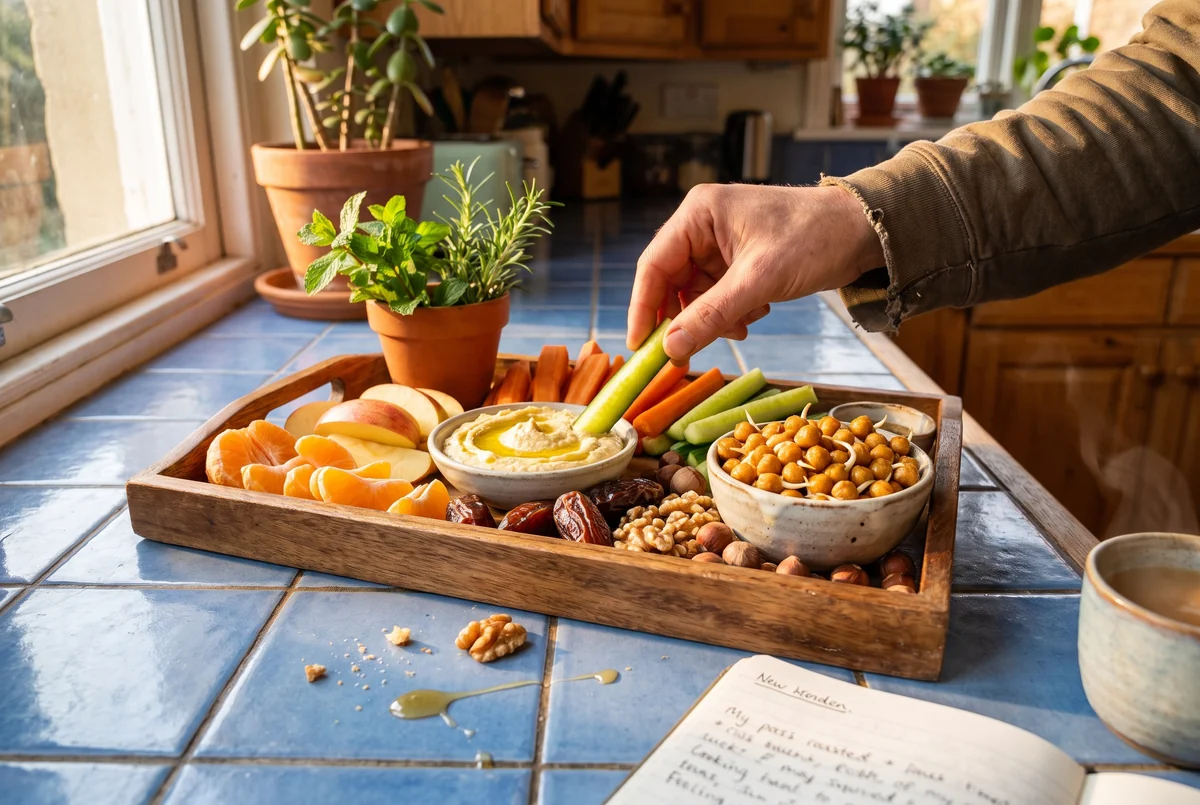
Healthy snacks: 12 unprocessed ideas, sweet and savory
Here are the twelve ideas, ranked from the most immediate to the one that takes a little planning.
| Idea | What you need | Preparation |
|---|---|---|
| 1. Fruit and nuts | A seasonal fruit, a small handful of almonds or walnuts | None |
| 2. Bread and dark chocolate | Whole-grain bread, a few squares of dark chocolate | None |
| 3. Nut butter on bread | Bread, 100% almond butter with no added sugar | None |
| 4. Yogurt and fruit | Plain yogurt or quark, cut fruit | Short |
| 5. Homemade compote | Seasonal fruit, a little water, no added sugar | Ahead of time |
| 6. Dried fruit and almonds | A few dried fruits with no added sugar, almonds | None |
| 7. Energy balls | Dates, nuts, cacao | Ahead of time |
| 8. Banana cake | Whole-wheat flour, very ripe banana for sweetness | Ahead of time |
| 9. Vegetables and hummus | Raw vegetable sticks, homemade hummus | Short |
| 10. Roasted chickpeas | Cooked chickpeas, spices, oven | Ahead of time |
| 11. Fresh cheese and sprouted seeds | Bread, fresh cheese, sprouted seeds | Short |
| 12. Hard-boiled egg and raw vegetables | An egg, seasonal raw vegetables | Short |
The sweet side
The first four ideas make a healthy, quick snack. Whole-grain bread with a few squares of dark chocolate appears in so many words in the Santé publique France guidance. For the nut butter, turn the jar around: only the name of the nut should be on the label.
And when you need a little more indulgence (it happens, and that's perfectly normal), homemade compote and energy balls can be prepared over the weekend. For the balls: dates, almonds, a little cacao, a spin in the food processor, and you roll little balls between your palms. A healthy cake for snack time does exist, provided you let the very ripe banana do the work of the sugar.
The savory side
Savory is the great forgotten among healthy food snacks, yet it changes the whole balance of the plate. Who decided a snack had to be sweet? Nobody, in reality. It's a bit like the ends of the roast in the old fable: we do it because we've always seen it done. Carrot sticks dipped in homemade hummus, roasted chickpeas with cumin, hard-boiled egg and raw vegetables, all of it is easy to crunch. And then there's the fresh cheese on bread topped with sprouted seeds, which brings crunch and freshness in every season.
Sugar at snack time: whole fruit, compote, juice or dried fruit?
Let's come to sugar, since that's often where the shoe pinches. The WHO recommends limiting free sugars to less than 10% of energy intake (strong recommendation), and ideally to less than 5% (conditional recommendation), that is about 25 g a day for 2,000 kcal (WHO, 2015). Free sugars include added sugars and those in honey, syrups, fruit juices and juice concentrates, but not those in whole fresh fruit or in milk.
Applied to snack time, the sugar in a crunched apple doesn't count toward this total, whereas the sugar in the same apple pressed into juice does. Same fruit, same tree, not the same status. That's the whole nuance. Santé publique France reminds us that juices “contain sugars and are low in fiber”, and advises half a glass a day at most before age 11, one glass after. This isn't a trial of juice, it's a question of dose.
Homemade compote with no added sugar keeps the fruit, simply cooked, whereas dried fruits concentrate their sugar as they lose their water: a few are enough. As part of a varied and balanced diet and a healthy lifestyle, whole fruit remains the simplest way to put something sweet in a snack.
Nuts: the small handful that changes snack time
Santé publique France advises a small handful a day of unsalted tree nuts: almonds, walnuts, hazelnuts or pistachios (Delamaire et al., 2019). A small handful is what fits in the hollow of a closed hand without forcing. Nothing to weigh: your hand does the job very well.
A dose-response meta-analysis of 20 prospective studies (Aune et al., 2016) observes that, for every 28 g of tree nuts a day, the relative risk is 0.79 for cardiovascular disease, 0.85 for cancers and 0.78 for all-cause mortality. A relative risk compares two groups: 0.79 means an observed risk about one fifth lower among those who eat more. These are observational studies, with strong heterogeneity, and the authors do not conclude that there is a cause-and-effect link. I'd rather tell you that plainly.
Tree nuts therefore have their place at snack time, as part of a varied and balanced diet and a healthy lifestyle. Two precautions: allergies, obviously, and in young children the risk of choking, which is why nut butters or nut powders are preferable.
How to prepare ahead and store your homemade snacks?
Making healthy snacks at home is often decided on Sunday: a hummus, a compote, energy balls, chopped vegetables, a cake, and nuts or dried fruit stored in jars for the week.
But here's the thing, a homemade preparation contains no preservative, so it keeps for less time. Nut-based preparations oxidize quickly: a sunflower pâté that has turned black, you don't bring it to friends' place, it just doesn't go down well. I know something about that. Hence vacuum sealing, in glass jars.
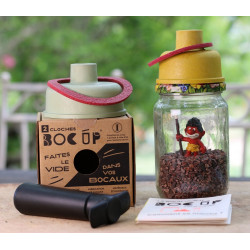
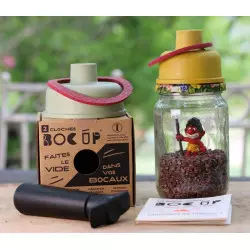
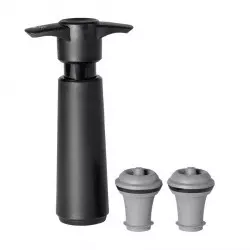
The complete BocUp vacuum kit that we offer consists of a bell and a small hand pump, with no electricity and no plastic bag: low tech in the noble sense of the term. It works with the glass jars you already have, if they have “shoulders” and a lid of 65 or 84 mm: nothing else to buy. According to the manufacturer, fresh products keep up to 5 times longer, a vegetable soup 8 to 10 days instead of 2, and dry foods stay protected from moisture and moths.
One clarification all the same. Vacuum sealing replaces neither the fridge nor the freezer, and it doesn't sterilize: hummus and compote stay refrigerated. I've detailed elsewhere the benefits of vacuum sealing at home.