

Yes, you can sprout seeds while hiking, camping, living in a van, or on a boat — with a simple hemp bag weighing just a few grams. Two rinses a day, potable water, dry seeds: that's all you need. No refrigeration, no electricity, no cooking. In 2 to 4 days of walking, you have fresh sprouts produced on the go. This guide explains how to do it well, which seeds to choose, and the 85/15 rule that no one tells you about mucilaginous seeds.
It was 6 a.m. somewhere on the GR10, in the Pyrenees. In the backpack — between the filtering water bottle and the nut bars — a small hemp bag hanging inside already contained, on the third day of hiking, beautiful fresh alfalfa sprouts. Fresh sprouts, without refrigeration, without cooking, without supply points. Just water, a little time, and a bag of a few grams. This image best sums up what nomadic living food can offer. And frankly, since that first crossing of the Pyrenees, we've never considered hiking any other way.
---
Why take sprouts on a trip?
Sprouts are undoubtedly the most travel-friendly food there is. Practically, you start with a few dozen grams of dry seeds — and you produce, along the way, fresh and nutrient-dense food. No cold chain to maintain, no cooking, no packaging waste to dispose of.
Here are a few reasons I find particularly convincing, after years of hiking with my sprouts:
- Maximum nutritional density: during germination, the levels of vitamins, enzymes, and bioavailable minerals increase significantly. You eat living food, even when camping at 2,000 meters.
- Zero logistics: no refrigeration, no cooking, no packaging waste. Just potable water — which you have anyway.
- Continuously renewable: by starting a new batch every two days, you have a continuous supply of fresh sprouts throughout your trip. It's the only food that "grows" in your bag while you walk.
- Negligible weight: 50 g of dry seeds yield about 150 to 200 g of sprouts. An unbeatable weight-to-nutritional value ratio for hikers.
- Food autonomy: you free yourself from fresh food supply points — crucial for remote areas, multi-day trips, or van life in rural areas.
To delve deeper into the nutritional benefits, read our article sprouts: essential foods and what are the benefits of sprouts?
---
The hemp sprouting bag: the tool designed for nomadism
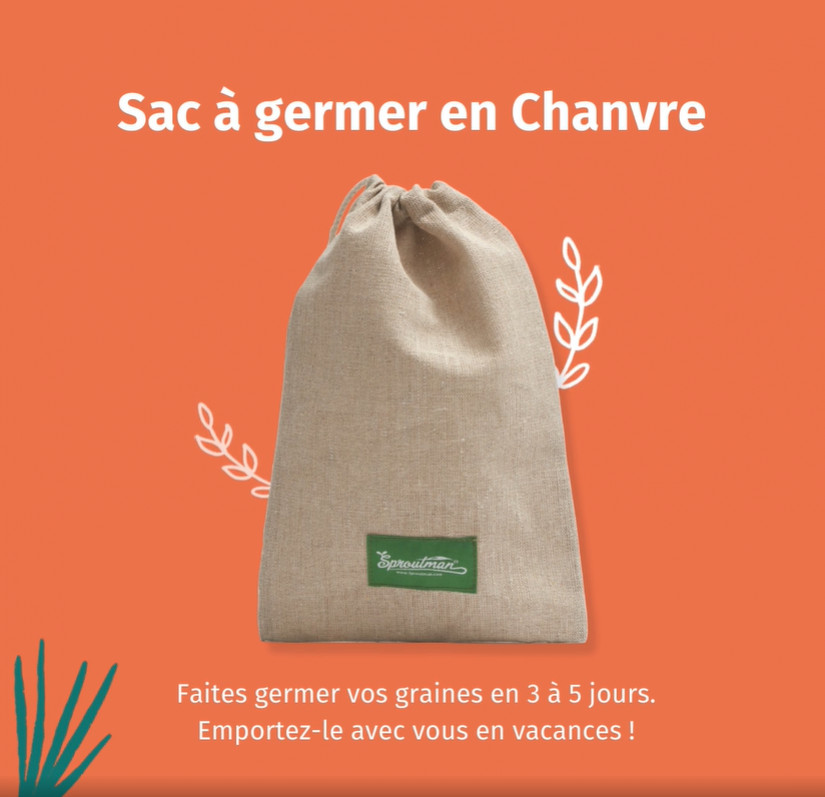
If you want to sprout while traveling, you need the right tool. Forget about jar sprouters (fragile, heavy), tray sprouters (bulky), and automatic sprouters (they need an electrical outlet). For the nomadic sprouter, only one tool stands out: the hemp fabric bag.
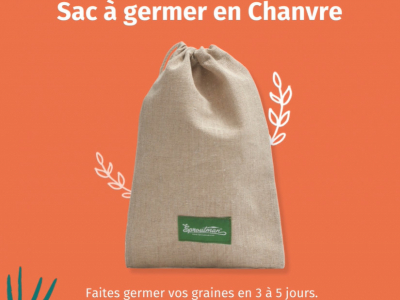
Hemp is not a random choice. It's one of the most robust plant fibers — as strong wet as it is dry. Its naturally porous weave ensures constant aeration and rapid water drainage, two essential conditions for mold-free germination. And it dries quickly, which is crucial when you can't leave the bag out in the open for hours. Conversely, cotton is to be absolutely avoided: it retains moisture, sticks to seeds, and promotes rot. Linen is acceptable but less durable than hemp over time.
What truly sets the sprouting bag apart for travel is its versatile attachment options: carabiner on backpack strap, tree branch, tent rope, van handle, camper van bars. Featherweight, zero fragility. It's the quintessential low-tech sprouter — marketed since 1979 in the United States, used by generations of hikers and nomads. And at home, if you produce in large quantities, the Easygreen automatic sprouter takes over.
➡️ Discover our Biovie hemp sprouting bag — dimensions 18×24 cm, hemp grown in organic agriculture, marketed since 1979 in the USA.
---
Which seeds to choose for sprouting while traveling?
Top 5 seeds for the nomad
Not all seeds behave the same way under travel constraints: variable temperatures, sometimes spaced rinses, spring water. Here are the five most suitable seeds, ranked by ease and speed:
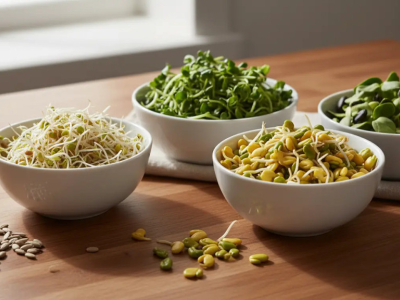
- Alfalfa (lucerne) — 4 to 5 days: the go-to for beginners. Extremely tolerant to rinsing variations, light, mild in taste. Ideal for all types of trips, including the first ones.
- Lentils — 2 to 3 days: the fastest and most robust. They forgive a missed rinse. An interesting protein source for hikers.
- Mung bean — 3 to 4 days: generous germination, crunchy texture, excellent in bivouac salad. Widely used in Asia for long hikes.
- Fenugreek — 3 to 4 days: tonic, slightly bitter (bitterness decreases with germination), rich in minerals. Its characteristic smell also diminishes.
- Quinoa — 1 to 2 days: the speed champion. Rinse thoroughly (surface saponins are bitter and must be removed). Ideal for short stays or weekends.
On multi-day hikes, I start a new batch every two days — ensuring a continuous flow of fresh sprouts throughout the trek. For the complete list of sproutable seeds, their soaking and germination times, check out our complete germination chart.
Mucilaginous seeds: the 85/15 rule you need to know
Here's something no one tells you — and that I learned the hard way. Chia, flax, basil, arugula, and cress are mucilaginous seeds: when in contact with water, they produce a thick, viscous gel. This gel is valuable in food (it binds preparations, enriches smoothies), but it poses a real problem in a sprouting bag.
Here's what happens if you fill a sprouting bag with 100% mucilaginous seeds: the gel quickly forms a compact mass. Air no longer circulates between the seeds. The natural heat of germination accumulates, unable to escape through the fabric. Within 24 to 48 hours, the seeds suffocate and rot. This is a common mistake, especially for beginners wanting to sprout chia while traveling.
The rule I systematically apply, and that I recommend to you: maximum 15% mucilaginous seeds to 85% standard seeds. At this ratio, the gel produced remains sufficiently diluted in the non-gelatinous mass to evacuate normally through the hemp fabric. Air circulation is preserved, and germination proceeds correctly.
Some travel mixes that work well:
- 85% lentils + 15% chia — germination 3 days, original texture
- 85% alfalfa + 15% brown flax — germination 4-5 days, pleasant nutty aroma
- 90% mung bean + 10% cress — germination 3-4 days, slightly peppery taste
For beginners traveling: avoid mucilaginous seeds for your first trips. Master pure legumes first — lentils and alfalfa — before experimenting. To go further: which seeds can be sprouted? The complete list by category.
---
The germination protocol on the go
The basic technique is described in detail in our guide how to use a sprouting bag. What follows is the adaptation to the specific constraints of travel and hiking.
Before leaving — the night before: start soaking your first seeds the night before. On the morning of departure, they are ready. Day 1 of walking = day 1 of germination. In 3 days of trekking, you already have your first fresh sprouts.
Spring water or untreated water: germination works with any potable water. If you filter your water while hiking (which I strongly recommend anyway), your seeds will be in an optimal environment. For choosing the right filter: our complete guide on filtering water in camping and hiking.
In high heat (+30°C): switch to 3 rinses per day. Heat accelerates microbial activity. Always hang the bag in the shade — never in direct sunlight. The seeds can withstand heat, but not passive cooking.
If you miss a rinse: don't panic if less than 24 hours have passed. Rinse as soon as possible and perform a second rinse within the next 6 hours. If the sprouts smell really bad, discard and start over. This is rare with lentils and alfalfa — much more likely with pure mucilaginous seeds, hence the 85/15 rule.
Cold night at altitude: seeds slow down below 15°C, but they don't die. Slip the bag into your tent or sleeping bag to maintain an acceptable temperature. In the morning, a good rinse with lukewarm water will restart the process.
Creative suspension: carabiner on an external strap, tent rope, branch, van handle, camper van bar... The key: never lay the bag flat. Gravity is your ally for draining. And the jostling from walking, by the way, poses no problem — some hikers hang the bag outside their backpack while walking, which even helps with aeration.
---
Field Feedback — Our Biovie Adventures with Sprouted Seeds
The idea of sprouting while hiking is not theoretical at Biovie. We have experienced it, Aurélie and I, and with other team members. During the crossing of the Pyrenees with sprouted seeds, the hemp bag was part of the basic equipment — hung every evening in the tent, rinsed at mountain springs. The sprouting worked flawlessly from the first to the last day. During the GR10, the experience confirmed the reliability of sprouting in extreme field conditions.
And here's what those who tried it say:
Denise K. ⭐⭐⭐⭐ — "I use the sprouting bag during my travels, especially for lentils, fenugreek, and mung beans. Its weak point is the lower area where the water drains, which can darken over time. This bag is super practical and lightweight."
Aurélie A. ⭐⭐⭐⭐ — "I am a nomad in a 4×4 and I can sprout my seeds, it's great, saves space, weight, etc."
---
Van Life, Boat, Slow Travel: Sprouting Without Being Sedentary
Nomadic sprouting is not limited to hiking. It adapts to all forms of contemporary travel — and this is where the hemp bag truly reveals its advantage over any other type of sprouter.
- Van life: hang the bag on a ceiling hook, near an air vent. The vibrations of the road pose no problem — they even promote slight micro-aeration. A rinse morning and evening is sufficient. Most van-lifers I know keep two bags in rotation to always have something in progress.
- Sailing boat: the natural movement of the boat creates an almost continuous micro-agitation, almost beneficial. Hang the bag in the galley, away from the engine's heat. Impeccable results every time.
- Train and plane (long layover): for transits, a mini glass jar with gauze is enough to keep sprouts going for a few hours. Not the sprouting bag — but a useful trick to not lose a batch on the way.
- Stay in a lodge or fixed camping: the bag remains the simplest and least cumbersome sprouter. No electricity, no complex maintenance. Trying it is adopting it.
To complete your natural travel kit: our natural first aid kit for vacations. And to better recover after exertion: our tips for better recovery after a hike.
---
FAQ — Your Questions About Nomadic Sprouting
Can any water be used to rinse seeds while hiking?
Any potable water is suitable for sprouting. Filtered spring water is ideal. Hard water is not a problem. Unfiltered river or lake water is not recommended, especially if it may contain pathogens — rinsing does not sterilize the sprouts. For long hikes in the wilderness, a portable water filter allows you to have safe water for yourself and your seeds.
How many seeds should I bring for a week-long hike?
Plan for about 20 to 30 g of dry seeds per day per person. For a week, 150 to 200 g is more than enough. Start a new batch every two days to maintain a continuous supply. Opt for fast-germinating seeds: lentils (2-3 days), quinoa (1-2 days), alfalfa (4-5 days).
Can I use chia seeds in my sprouting bag while traveling?
Yes, but only in a mix, with the following ratio: a maximum of 15% chia to 85% non-mucilaginous seeds (lentils, alfalfa, mung beans). At 100%, chia seeds form a gel that is too dense, blocking air circulation in the bag and causing the sprouts to suffocate. For beginners, avoid mucilaginous seeds while traveling and first master legumes alone.
What should I do if I forget to rinse my seeds for 24 hours or more?
If less than 24 hours have passed: rinse immediately and perform an additional rinse a few hours later. The seeds have probably slowed their germination but are not lost. If more than 36-48 hours have passed in warm weather, check the smell: a sour or putrid smell indicates they should be discarded and started over. At high altitudes or in cold weather, seeds can withstand 36-48 hours without rinsing because microbial activity is slowed.
Can the sprouting bag be attached to the outside of the backpack while walking?
Yes, it is perfectly possible. Attach it to the outside of your backpack with a carabiner, ensuring it is in the shade. The shaking from walking even slightly aids aeration. Avoid prolonged direct sun exposure (overheating) and protect it from rain if you are walking in wet weather. Several Biovie users employ this technique during multi-day treks.
---
Biovie References and Resources
- Crossing the Pyrenees with Sprouted Seeds — Episode 1 — Biovie Field Report
- GR10 and Sprouted Seeds — Adventure in the Pyrenees — Biovie Field Report
- How to Use a Sprouting Bag — Complete Technical Guide
- Complete Germination Chart — Soaking and Germination Times by Seed
- Which Seeds Can Be Sprouted? Complete List by Category
- Filtering Water in Camping and Hiking — Complete Guide
- 85/15 Rule on Mucilaginous Seeds — Proprietary Expertise Validated by Eric Viard, Biovie.fr
Disclaimer: The information presented in this article is provided for informational purposes only and does not constitute medical advice. Consult a qualified healthcare professional before making any changes to your diet or supplementation. As part of a varied and balanced diet and a healthy lifestyle.
Update: March 2026. Article validated by Éric Viard, founder of Biovie and ISTOM engineer, co-author of "Seaweed in Everyday Life" (Gallimard, 2024) — Best Cookbook in the World, Gourmand Cookbook Awards 2025, and Best Cookbook in France, National Academy of Cuisine 2025.