








The expression "cretin of the Alps" refers to a tragic medical reality: for centuries, hundreds of thousands of inhabitants of the Alpine valleys suffered from severe mental and physical delays caused by a simple iodine deficiency in their diet. This scourge, known as endemic cretinism, was only eradicated in the 20th century thanks to the iodization of salt - but the WHO warns: the problem is re-emerging in Europe¹.
When Captain Haddock calls someone a "cretin of the Alps" in The Treasure of Red Rackham, most readers smile and move on to the next box. Almost no one suspects that behind this insult lies one of the greatest health disasters in European history. A silent tragedy that affected entire valleys for centuries, and the key to which - a tiny trace element called iodine - was literally in the ocean, just a few hundred kilometers away.
Here is the story of this forgotten plague.
"Crétin des Alpes": when an insult hides a health disaster
The unexpected etymology: "crétin" comes from "chrétien"
Why do we say "cretin of the Alps"? The answer is both surprising and poignant.
The word "crétin" has nothing to do with stupidity as we understand it today. It derives from Franco-Provençal. Crestin, itself derived from Latin Christianus - "Christian"². This is the most solidly supported etymology, advocated notably by linguists Alain Rey and Walther von Wartburg³.
In the alpine valleys of Valais, Savoie, and Dauphiné, Crestin was an ordinary greeting word. We would say Crestin "my good man" or "fellow" - a reminder of humanity between neighbors. But the term has taken on a particular meaning over the centuries. When villagers referred to a child suffering from endemic cretinism - deaf, mute, deformed, bearing a prodigious goiter - as a Crestin, it was out of compassion. A euphemism, like saying "innocent" or "blessed." A way to remind that this person, despite their disabilities, remained a human being, a full-fledged Christian.
The semantic shift says everything about the tragedy. A word born from compassion has become one of the most common insults in the French language.
The first written record of the word in a medical context dates back to July 22, 1750. On that day, the physician and marquis Timoléon de Maugiron presented a report to the Royal Society of Lyon after a trip to Switzerland. He described beings that are called cretins In Sion, the capital of Valais: individuals who are deaf, mute, with goiters hanging down to their waists. Four years later, in 1754, Diderot and D'Alembert almost word for word included this text in theEncyclopedia, in the article "Cretins"⁶. The word officially enters the French language - and the history of medicine.
It will take another century for the word to appear in common usage dictionaries. The Académie française only included it in 1835, this time with an expanded meaning: "stupid person." The journey of the word alone summarizes the journey of the disease - from a documented medical reality to a mere insult emptied of its original meaning.
Victor Hugo, Balzac, Haddock: how the expression became popular
If the word "crétin" enters into theEncyclopedia In 1754, it was in the 19th century that it truly spread in French culture. The Alps became a fashionable destination for enlightened travelers, and the accounts of their expeditions fueled the public's fascination-often morbid-with these mountain populations.
Horace-Bénédict de Saussure, the famous Genevan naturalist, describes cretins in his Trips to the Alps (1779-1796)⁸. Later, the great names of French literature adopted the motif. George Sand, in a letter to the Countess d'Agoult dated January 2, 1838, uses the expression with a familiarity that speaks volumes about its trivialization: she signs "dear Cretin of Valais" as one would throw out an affectionate nickname⁹. Travelers flock to the valleys of Valais and Savoy to observe these "phenomena" with a curiosity bordering on voyeurism. Maurice Chappaz, a writer from Valais, recounted these encounters in The Portrait of the Valaisans (1965): deformed beings that were sometimes only brought out at night, their faces enclosed in a bag¹⁰.
Karl Marx himself helped to anchor the word in the political vocabulary. In 1852, in The 18th Brumaire of Louis Bonaparte, He coined the expression "parliamentary cretinism" to mock deputies who are unable to see beyond their procedures¹¹. Trotsky would later adopt the term. The medical insult became political, then commonplace.
But it is Hergé who gives the "cretin of the Alps" its second life - the one that everyone knows. In The Treasure of Red Rackham (1943), Captain Haddock hurls this insult during his first encounter with Professor Calculus. He uses it again in The Seven Crystal Balls (1948), alongside flavorful geographical variations: "Cretin of the Himalayas," "Cretin of the Balkans." Albert Algoud has cataloged more than 220 Haddockian curses - but "Cretin of the Alps" remains one of the most emblematic, probably because it carries within it, unbeknownst to most, the memory of a real tragedy.
What Hergé probably did not know when writing these lines is that at the very moment he was drawing them, the last cases of endemic cretinism were disappearing from Swiss valleys thanks to the iodization of salt, which had been widespread since 1922¹⁴. The insult outlived the disease. This may be the most cruel proof of the oblivion that has covered this history.

How iodine conquered cretinism - and why seaweed is the source that nature intended
Endemic cretinism was not defeated by a revolutionary drug, but by a disarmingly simple gesture: adding iodine to table salt.
As early as 1811, the French chemist Bernard Courtois isolated an unknown substance from kelp ashes-these brown algae collected on the Atlantic coasts to produce saltpeter during the Napoleonic era. By adding an excess of sulfuric acid to the ashes, he observed the release of a violet vapor that condensed into black crystals. The element would be named... Iodine by Gay-Lussac in 1814, from Greek ioeidḗs ("violet")¹⁶. No one yet knows that this body, born from the algae, holds the key to a millennial plague.
"Nine years later, in 1820, the Geneva physician Jean-François Coindet made the decisive connection. Inspired by the ancestral use of calcined sea sponges against goiter-a practice documented as early as the 12th century by Roger of Salerno-he administered iodine tincture to his goitrous patients. The results were spectacular: within eight days, the goiters softened and began to regress. Coindet published his observations in a memoir entitled" Discovery of a new remedy for goiter¹⁸. But the enthusiasm turns into excess: in Geneva, people rush to iodine without any notion of dosage, causing cases of hyperthyroidism. The Geneva authorities banned the sale of iodine without a prescription from 1821¹⁹. It would take another century for mass prevention to become a reality.
Switzerland is leading the way. On January 21, 1922, a "Goiter Commission" met in Bern, convened by the Federal Public Health Service. The findings were alarming: a survey conducted the same year on 9,000 schoolchildren in Bern revealed that half of them had goiters. The commission recommended the addition of potassium iodide to table salt. The cantons gradually adopted the measure. The results were immediate and astonishing: within a generation, goiter and cretinism disappeared from the valleys where they had been prevalent for centuries. France followed more slowly - iodized salt was only authorized there in 1952, and its distribution remained partial for a long time.
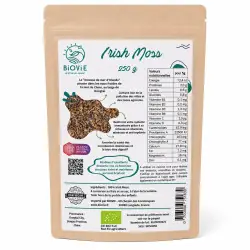
But here is the paradox that history has long obscured: the most concentrated and natural source of iodine has always been found in the ocean, in the form ofSeaweed. Coastal populations - Breton, Japanese, Korean - have never experienced cretinism. The contrast with the isolated Alpine valleys, deprived of any access to seafood, is striking. And it is no coincidence that Courtois discovered iodine precisely in the ashes of seaweed: these marine organisms concentrate iodine from seawater in extraordinary proportions - up to 100,000 times the concentration of the surrounding environment.
The brown algae, in particular, are true concentrates of natural iodine. Just one gram of dried kombuLaminaria digitata) can contain between 2,000 and 7,500 µg of iodine - which is 13 to 50 times the recommended daily intake of 150 µg for an adult²². Wakame (Undaria pinnatifida) offers a more moderate profile, with 118 to 347 µg per dry gram, while nori (Porphyra), the sushi seaweed, provides 67 to 188 µg per gram²². In Japan, where the daily consumption of seaweed is around 5 grams per person, iodine deficiency is almost non-existent²³.
There is something dizzying about this historical irony. Iodine was discovered grace to algae in 1811. Doctors understood its role against goiter as early as 1820. And yet, for another century, entire alpine populations continued to suffer from cretinism due to the lack of a simple nutritional supplement that seaweed could have provided all along. The solution was in the ocean. No one thought to look in that direction - until the industrial route of iodized salt was finally chosen.
Today, the WHO estimates that nearly two billion people worldwide remain at risk of iodine deficiency. Even in Europe, several countries have seen their iodized salt coverage decline in recent years, and the Organization warns of a possible resurgence of disorders related to this deficiency. In this context, seaweed - consumed with discernment and in appropriate quantities - represents a natural, sustainable, and remarkably effective source of iodine. A few grams of dried seaweed per week are sufficient to meet an adult's needs without resorting to industrial fortification.
The history of cretinism in the Alps reminds us of a simple truth: an invisible trace element, abundantly present in the oceans and naturally concentrated by algae, has the power to shape-or destroy-the development of a human brain. The "cretins of the Alps" were not fools. They were victims of a deficiency that the sea, just a few hundred kilometers away, could have remedied.
FAQ: your most frequently asked questions about iodine deficiency and cretinism of the Alps
Where does the word “cretin” in the expression “cretin of the Alps” come from?
The word cretin derives from the Franco-Provençal crestin, itself derived from the Latin christianus (Christian). In the Alpine valleys, it was originally a word of compassion used to refer to people affected by endemic cretinism, a euphemism recalling their full humanity despite their disabilities. Over the centuries, the term gradually shifted into a simple insult.
What is endemic cretinism?
Endemic cretinism refers to the severe mental and physical developmental delays caused by iodine deficiency in the diet, which for centuries affected hundreds of thousands of inhabitants of Alpine valleys deprived of access to seafood. This scourge was eradicated in the 20th century thanks to salt iodization.
How was cretinism defeated?
In 1922, a Swiss commission recommended adding potassium iodide to table salt, after a survey of 9,000 schoolchildren in Bern revealed that one child in two had a goiter. This simple measure allowed goiter and cretinism to disappear within a single generation from valleys where they had been rife for centuries. France did not authorize iodized salt until 1952.
Why is seaweed a natural source of iodine?
It was in fact from seaweed ash (kelp) that the chemist Bernard Courtois discovered iodine in 1811. Marine algae concentrate the iodine from seawater in considerable proportions, up to 100,000 times the concentration of the surrounding environment according to studies. Coastal populations who regularly consume it have never experienced cretinism.
Which seaweeds contain the most iodine?
One gram of dried kombu can contain between 2,000 and 7,500 micrograms of iodine, or 13 to 50 times the recommended daily intake of 150 micrograms for an adult. Wakame offers a more moderate profile with 118 to 347 micrograms per dry gram, and nori provides 67 to 188 micrograms per gram according to available studies.
Is iodine deficiency still a problem today?
Yes. The WHO estimates that nearly two billion people worldwide remain at risk of iodine deficiency, and warns of a possible resurgence in Europe, where iodized salt coverage has declined in several countries. A few grams of dried seaweed per week can help cover an adult's iodine needs.
Bibliography
-
OMS/IGN (2024). Prevention and control of iodine deficiency in the WHO European Region. Organisation mondiale de la Santé, Bureau régional pour l’Europe. [Rapport juin 2024]
-
Rey, A. (dir.) (2010). Dictionnaire historique de la langue française. Paris : Le Robert. Article « Crétin ».
-
Von Wartburg, W. (1928-2002). Französisches Etymologisches Wörterbuch (FEW). Bâle : Zbinden. Vol. II/1, article christianus.
-
CNRTL - Centre National de Ressources Textuelles et Lexicales (2012). Étymologie de « crétin ». https://www.cnrtl.fr/etymologie/crétin
-
Maugiron, T.G.F. de (1750). « Voyage en Suisse. 1750. Lettre et mélange de dissertation Ecritte à la Société Royale de Lyon ». Mémoire lu à la Société royale de Lyon, 22 juillet 1750. 12 p. - Cité dans : Cranefield, P. (1961). The discovery of cretinism. Bulletin of the History of Medicine, 36, 489-511.
-
Diderot, D. & D’Alembert, J. Le Rond (1754). « Cretins ». Encyclopédie, ou Dictionnaire raisonné des sciences, des arts et des métiers, 1ʳᵉ édition, tome 4, p. 459. https://fr.wikisource.org/wiki/L’Encyclopédie
-
Académie française (1835). Dictionnaire de l’Académie française, 6ᵉ édition. Paris : Firmin-Didot. Article « Crétin ».
-
Saussure, H.-B. de (1779-1796). Voyages dans les Alpes, précédés d’un essai sur l’histoire naturelle des environs de Genève. 4 vol. Neuchâtel : Fauche-Borel.
-
Sand, G. (1838). Lettre à la comtesse d’Agoult, Côme, 2 janvier 1838. - Citée dans : Infoméduse (2018). « Ces mots qui font des histoires - Crétin des Alpes ! ». https://www.infomeduse.ch/2018/02/03/ces-mots-qui-font-des-histoires-cretin-des-alpes/
-
Chappaz, M. (1965). Le portrait des Valaisans en légende et en vérité. Lausanne : Cahiers de la Renaissance vaudoise. - Cité dans : Felley, E. (2000). « Le mot ‘crétin’ a 250 ans ». Le Temps, 20 juillet 2000. https://www.letemps.ch/opinions/eclairage-cretin-250-ans-pris-naissance-valais
-
Marx, K. (1852). Le 18 Brumaire de Louis Bonaparte. New York : Die Revolution. Chap. V.
-
Hergé (1943). Le Trésor de Rackham le Rouge. Bruxelles : Casterman. - Hergé (1948). Les Sept Boules de cristal. Bruxelles : Casterman.
-
Algoud, A. (2004). Le Haddock illustré : l’intégrale des jurons du capitaine Haddock. Paris : Casterman.
-
De Baecque, A. (2018). Histoire des crétins des Alpes. Paris : La Librairie Vuibert. 283 p. ISBN 978-2-311-10203-1.
-
Courtois, B. (1811). Découverte de l’iode dans les cendres de varech. - Résultats communiqués par Clément, N. à l’Académie des sciences, 6 décembre 1813. - Voir : Toraude, L.-G. (1921). Bernard Courtois et la découverte de l’iode. Paris : Vigot. 164 p.
-
Gay-Lussac, J.-L. (1814). « Mémoire sur l’iode ». Annales de chimie, 91, 5-160.
-
Universalis (2024). « Hormones thyroïdiennes - Repères chronologiques ». Encyclopædia Universalis. https://www.universalis.fr/encyclopedie/hormones-thyroidiennes-reperes-chronologiques/
-
Coindet, J.-F. (1820). « Découverte d’un nouveau remède contre le goitre ». Bibliothèque Universelle, Sciences et Arts, Genève, 14, 190-198. - Également publié dans : Annales de Chimie et de Physique, Paris, 1820, 15, 49-59.
-
Dreifuss, J.-J. (2005). « Genève 1820-1836 : l’Affaire de l’iode ». Revue Médicale Suisse, 1, 2357-2358.
-
Tribune de Genève (2019). « La Suisse dit adieu aux crétins des Alpes ». https://www.tdg.ch/la-suisse-dit-adieu-aux-cretins-des-alpes-382259579949
-
Küpper, F.C. et al. (2011). « Commemorating two centuries of iodine research: an interdisciplinary overview of current research ». Angewandte Chemie International Edition, 50(49), 11598-11620. - Voir aussi : article « Iode », Wikipédia. https://fr.wikipedia.org/wiki/Iode
-
CEVA - Centre d’Étude et de Valorisation des Algues (2020). « Faut-il avoir peur de l’iode des algues ? ». https://www.ceva-algues.com/document/faut-il-avoir-peur-de-liode-des-algues/ - Voir aussi : Roleda, M.Y. et al. (2018). « Iodine content in bulk biomass of wild-harvested and cultivated edible seaweeds ». Food Chemistry, 254, 333-339.
-
Zava, T.T. & Zava, D.T. (2011). « Assessment of Japanese iodine intake based on seaweed consumption in Japan: a literature-based analysis ». Thyroid Research, 4, 14.