



Summary
- What does tap water in France really contain ?
- PFAS in drinking water: the extent of the contamination
- Pesticides and nitrates: the other pollutants in your water
- Which regions are the most affected ?
- How to check the water quality in your municipality
- Tap water or bottled water: which to choose ?
- How to protect yourself effectively: filtration solutions
- FAQ — Your questions about contaminated tap water
Tap water in France is contaminated by at least three families of pollutants: PFAS (known as "forever chemicals"), pesticides, and nitrates. According to 2024-2025 data from Anses and the Ministry of Health, 92% of drinking water samples contain traces of TFA, and more than 10 million French people receive water that does not meet pesticide standards. This is a chilling observation. However, accessible filtration solutions exist to protect your household, and I will also discuss this in the article.
I have been very closely interested in this issue over the past few decades, since the late 1990s, first as a consumer, then as a parent, and finally as an active participant in natural health at Biovie. Frankly, when you delve into the subject, you discover a reality that public authorities struggle to simplify and that the media often address in an alarmist manner, without providing concrete guidance. My goal here is to give you the tools to understand what is really happening with your water, check the situation in your community, and most importantly, take concrete action.
What does tap water in France really contain ?
The three families of contaminants to monitor
When we talk about tap water contamination in France, we are actually referring to three major families of pollutants that often coexist in the same glass of water.
PFAS, or "forever chemicals." These are per- and polyfluoroalkyl substances, massively used since the 1950s in industry: non-stick coatings, food packaging, waterproof textiles, firefighting foams... The problem? These molecules are almost indestructible in the environment, hence their nickname "forever pollutants." They accumulate in water, soil, and our bodies. According to the UFC-Que Choisir survey from January 2025, 96% of the tested municipalities contain PFAS in their drinking water. Yes, you read that right: 96%.
Pesticides. France is the largest consumer of pesticides in Europe, and these substances inevitably end up in the groundwater that supplies our taps. According to data from DansMonEau (Générations Futures / Data for Good), published in August 2025, 31.5% of water networks in France contain pesticides, and 5.7% of water distribution units (UDI) — which amounts to 1,377 UDIs — are outright non-compliant with current standards.
Nitrates. Primarily originating from agricultural fertilizers and intensive livestock farming, nitrates are a historical pollutant of drinking water in France. This pollution is particularly persistent in regions of intensive agriculture.
In concrete terms, these three families of contaminants are not anecdotal. They affect millions of French households and raise real public health concerns, particularly for the most vulnerable populations: pregnant women, infants, children, and immunocompromised individuals.
Is tap water dangerous for health ?
I want to be clear on this point: I am not here to scare you. Tap water in France remains one of the most monitored food products. However, "monitored" does not mean "free of contaminants." In reality, current standards do not cover all substances of concern, and some of these standards are much less strict than those of our neighbors.
Chronic exposure to low doses of PFAS is associated in the scientific literature with endocrine disruptions, effects on the immune system, and increased risks of certain diseases. For pesticides, the long-term effects of a cocktail of low-dose molecules remain poorly documented — this is known as the "cocktail effect," and it is precisely what concerns toxicologists.
So no, drinking a glass of tap water will not make you sick tomorrow morning, because this water would be "clean" from a bacteriological standpoint. But the question that arises is the accumulation over years, even decades, of these micropollutants in our bodies. And that, clearly, is a subject we can no longer ignore.
PFAS in drinking water: the extent of the contamination
What are PFAS and why are they called "forever chemicals" ?
PFAS form a family of more than 10,000 synthetic chemical substances. Their common feature: carbon-fluorine bonds, which are among the most resistant in organic chemistry. In short, these molecules hardly degrade in the environment. Neither in water, nor in soil, nor in your body. This is why they are nicknamed "eternal pollutants" or "forever chemicals" in English.
They are found everywhere: in non-stick pans, grease-resistant food packaging, waterproof clothing, cosmetics, fire-fighting foams... For decades, the industry has used these substances without concern for their persistence in the environment. And today, we are collectively paying the consequences.
TFA: The most widespread PFAS that no one measures
Here is a point that particularly caught my attention when I delved into the subject. TFA (trifluoroacetic acid) is an ultra-short-chain PFAS. It alone accounts for 98% of the PFAS found in French drinking water, according to data from PAN Europe and Générations Futures. And yet, it is not included in any monitoring standards, neither in France, nor in the United States, nor in Denmark.
The national study by Anses published in December 2025 is unequivocal: 92% of the drinking water samples analyzed contain TFA. And in some cases, the concentrations are staggering. In Salindres, in the Gard — not far from us in Nîmes — record concentrations of 25,000 ng/l have been measured. Twenty-five thousand nanograms per liter. This is 250 times the current French standard for other PFAS.
As an agronomist, I understand the difficulty of setting standards for such a ubiquitous substance. However, the fact that TFA is not even measured in routine checks, despite being present almost everywhere, poses a real issue of transparency and public health.
French standards vs international standards: a concerning gap
This is a point that I find truly revealing. Here are the current standards for PFAS in drinking water:
- France : 100 ng/l for 20 PFAS — TFA is not included
- United States : 4 ng/l for PFOA and PFOS individually — TFA is not included either
- Denmark : 2 ng/l for 4 PFAS — TFA is not included
- Germany : a proposal to classify TFA as a toxic substance is under discussion
In summary, the French standard is 25 to 50 times more permissive than the American and Danish standards. And no country yet includes TFA in its official standards, even though it accounts for 98% of the PFAS found in drinking water. Frankly, there is reason to question this.
This reminds me of what I described in my article about organic products and Ecocert controls: public authorities are often a step behind. We control what we know how to measure, not necessarily what poses a problem.
Pesticides and nitrates: the other pollutants in your water
31.5% of networks contain pesticides
PFAS are making headlines, and rightly so. But let's not forget about pesticides, a historical water pollutant in France. The data compiled by DansMonEau in August 2025 is telling: 31.5% of French water networks contain pesticides. Among them, 5.7% of distribution units (or 1,377 UDIs) do not comply with current standards.
Relative to the population, more than 10 million French people receive water that does not comply with pesticide standards. Ten million people. And for 3% of the UDI, health authorities have issued consumption restriction recommendations.
As an advocate for organic farming for nearly 20 years, this reality unfortunately does not surprise me. It is exactly what I regularly describe: the consequences of decades of intensive agriculture are found on our plates, but also in our glasses. Nitrogen fertilizers, herbicides, fungicides... all end up in the groundwater.
Desphenyl chloridazon, responsible for 86% of non-compliances
If I mention chloridazone desphenyl to you, you will probably look at me with wide eyes. And yet, this substance alone is responsible for 86% of pesticide non-compliance in drinking water in France. It is a metabolite of chloridazone, an herbicide primarily used in sugar beet cultivation. The herbicide itself has been banned in Europe since 2020, but its metabolite persists in the soil and groundwater for years.
This is a textbook example of what I call the "headlong rush" of chemical agriculture: a product is banned, but its residues continue to pollute the water for decades. And it is the consumers who suffer the consequences.
Nitrates: a persistent agricultural pollution
Nitrates in water are the pollutant we have known about for the longest time. Originating from nitrogen fertilizers and livestock effluents, they seep into groundwater and contaminate drinking water sources. The standard is set at 50 mg/l, a threshold that some regions with intensive agriculture regularly exceed.
What strikes me is that we've been talking about this pollution since the 1970s, and it still persists. As I explained in my article on Mediapart about organic farming: after World War II, the industry recycled military nitrogen stocks into agricultural fertilizers. Seventy-five years later, the consequences are still present in our groundwater. This shows the resilience of this pollution.
Which regions are the most affected ?
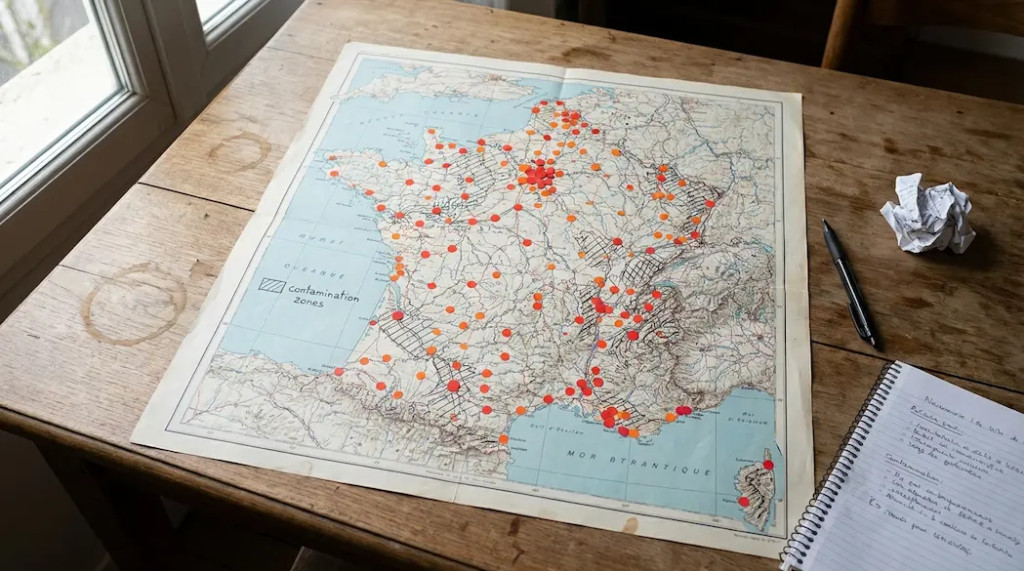
North and Grand Est: the most affected areas
The regions of Northern and Grand Est France have historically been the most affected by water contamination. This is not a coincidence: these are areas of intensive agriculture, particularly large-scale farming (wheat, beet, rapeseed) where the use of pesticides and nitrogen fertilizers has been massive for decades.
The Hauts-de-France region accumulates issues: pesticides, nitrates, and PFAS linked to certain industrial sites. The Grand Est is particularly affected by desphenyl chloridazon, due to the historical significance of beet cultivation in this region.
Île-de-France: persistent underground pollution
Île-de-France is a special case. Despite considerable investments in water treatment, the region continues to face persistent underground pollution. The aquifers in the Île-de-France are contaminated by a mix of old pesticides and nitrates, a legacy of decades of agriculture upstream of the Paris region.
PACA, Rhône-Alpes and the extreme local cases
Certain areas exhibit extreme local situations. The case of Salindres in the Gard, which I mentioned earlier with its 25,000 ng/l of TFA, is emblematic. The chemical valley, south of Lyon, is also a hotspot for PFAS contamination due to the historical presence of chemical factories.
In PACA, the combination of intensive agricultural activities and industrial sites creates concerning situations in certain areas. To know the precise situation of your municipality, I highly recommend using the tool DansMonEau.fr, which compiles official data from the ARS for each municipality.
How to check the water quality in your municipality
DansMonEau.fr: the reference tool by municipality
DansMonEau.fr is a tool developed by Générations Futures with the Data for Good collective. In my opinion, it is the most accessible and comprehensive resource for checking the water quality in your municipality. You enter the name of your city, and you access data on pesticides, PFAS, nitrates, and perchlorates present in your water.
Honestly, the first time I typed the name of our town, the result surprised me. I really encourage you to try the exercise: it's free, quick, and the results are presented in a very visual and understandable way.
eaupotable.sante.gouv.fr : the official results
The government website eaupotable.sante.gouv.fr allows access to the official results of the water health control in your municipality. It is the most official source, with comprehensive analyses conducted by the ARS (Regional Health Agencies). The interface is a bit less intuitive than DansMonEau, but the data is exhaustive.
Your town hall and your water bill: the information to look for
Your town hall is required to provide you with the results of water analyses upon request. And your annual water bill usually includes a section with the main results of the health inspection. Take a closer look at it next time, you might find some interesting information.
Tap water or bottled water: which to choose ?
Bottled water is not free from contaminants.
If you think bottled water is the miracle solution, think again. Recent studies have shown the presence of microplastics, pesticide residues, and even PFAS in some mineral and spring waters. Bottled water is not synonymous with pure water, far from it.
The environmental and financial cost of bottles
And then there is the environmental and economic question. In France, approximately 9 billion liters of bottled water are consumed per year. This represents millions of plastic bottles, a significant portion of which is not recycled. Not to mention the cost: bottled water is on average 100 to 300 times more expensive than tap water.
For me, who has been committed to an eco-responsible approach with Biovie since 2007, bottled water is clearly not a sustainable solution. Neither for your wallet nor for the planet.
The third way: filtering tap water at home
There is a third way, and it is the one we have adopted at home with Aurélie: the Home tap water filtration. The principle is simple: you use your tap water (which is already treated and controlled), and you pass it through a filtration system that will retain the residual contaminants.
It is the most economical, ecological, and autonomous solution. And it is also the most coherent when you think about it: instead of transporting water in plastic over hundreds of kilometers, we improve the quality of the water that already arrives at home.

How to protect yourself effectively: filtration solutions
Ceramic gravity filter: effective, eco-friendly, and economical
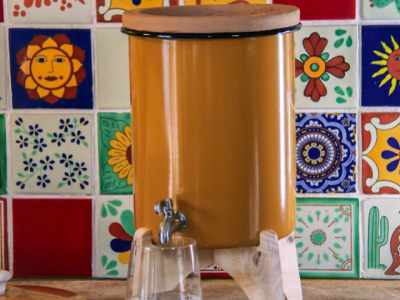
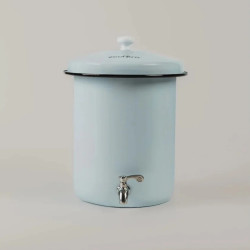
The ceramic gravity filter is the solution we have tested and adopted at home. The principle is low tech, and that's what I like: water passes by gravity through a microporous ceramic cartridge that retains bacteria, pesticides, chlorine residues, and some heavy metals. No need for electricity, no complicated connections, no water waste.
At Biovie, we have tested and adopted the Ecofiltro gravity filter, which effectively eliminates pesticides, chlorine residues, and significantly reduces contaminants thanks to its natural ceramic. After 2 years of daily use, we are fully satisfied. The taste of the water is incomparably better, and the cost is less than €0.02 per liter. Frankly, it's one of the most accessible and effective solutions we have found.
Reverse osmosis: for the heaviest contaminations
Reverse osmosis is the most advanced technology in domestic filtration. It uses a semi-permeable membrane that only allows water molecules to pass through, retaining almost all contaminants, including the smallest PFAS like TFA. It is the preferred solution if you live in a particularly contaminated area.
On the other hand, reverse osmosis has its drawbacks: it consumes water (some is rejected), it also removes beneficial minerals (the water then needs to be remineralized), and it is more expensive to purchase and maintain. For those looking to rebalance the mineral content of their filtered water, adding a sea water rich in bioavailable minerals may be an interesting option to explore.
Activated charcoal: a natural complementary purifier
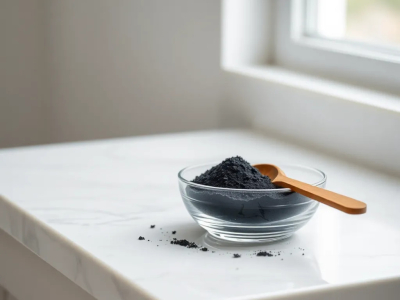
The activated charcoal is a natural purifier that humanity has been using for millennia. Its principle of action is adsorption: contaminants adhere to the porous surface of the charcoal. It is particularly effective for chlorine, pesticides, and volatile organic compounds.
The Japanese Binchotan activated charcoal, which we offer at Biovie, can simply be immersed in a water carafe. It is a complementary, simple, and accessible solution, even though it is less effective than a gravity filter or a reverse osmosis system for the most resistant contaminants.
Which solution to choose according to your situation ?
Specifically, here is what I recommend:
- You are looking for a simple, effective, and eco-friendly solution. for moderate contamination: the ceramic gravity filter (Ecofiltro type) is ideal. It's our daily choice.
- You live in a heavily contaminated area. (Elevated PFAS, industrial area): reverse osmosis is the most comprehensive solution, possibly combined with activated carbon.
- You want to start slowly with a small budget: Binchotan activated charcoal in a carafe is an accessible first step.
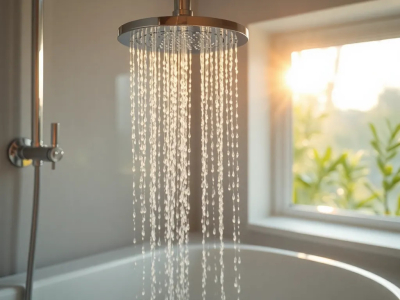
And don't forget: contaminated water is not just about your glass of water. Exposure to pollutants also occurs through the skin, in the shower and bath. Protecting your shower water is also an important step for your health. In fact, we have tested several anti-chlorine shower filters and the results on the skin and hair are really noticeable.
€41.80
Eco-friendly shower filter
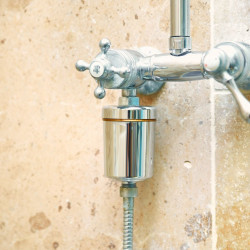
Want to take action ? Discover our full range of filtration solutions to find the one that matches your situation and your budget.
FAQ — Your questions about contaminated tap water
How can I tell if my tap water is contaminated ?
The simplest and fastest way is to visit the website DansMonEau.fr, which compiles official data from the ARS (Regional Health Agencies) for each municipality in France. There you will find analysis results for pesticides, PFAS, nitrates, and perchlorates. You can also visit the government website. eaupotable.sante.gouv.fr for the complete results of the health inspection.
Is it not recommended to drink tap water ?
Tap water in France is one of the most regulated food products and remains generally drinkable. However, "drinkable" does not mean "free of contaminants." Depending on your municipality and the contaminants present, using an appropriate filtration system can be a relevant precaution, especially for sensitive populations (pregnant women, infants, immunocompromised individuals).
Which regions in France have the most contaminated water ?
The most affected regions are Hauts-de-France, Grand Est, Île-de-France, and certain areas of PACA and Rhône-Alpes. These contaminations are linked to intensive agriculture (pesticides, nitrates) and the presence of industrial sites (PFAS). However, TFA contamination affects 92% of drinking water samples nationwide, making it a widespread problem.
Are PFAS filtered by home filtration systems ?
This depends on the type of filter and the specific PFAS in question. Ceramic gravity filters and activated carbon filters are effective against many contaminants (pesticides, chlorine, heavy metals) and some PFAS. For smaller PFAS like TFA, the most effective technologies remain reverse osmosis and high-performance granular activated carbon. The Ecofiltro ceramic filter offers an excellent efficiency-price compromise for the majority of households.
Is bottled water better than tap water ?
Not necessarily. Studies have shown the presence of microplastics, pesticide residues, and PFAS in some bottled waters. Additionally, bottled water costs 100 to 300 times more than tap water and poses a major environmental problem (plastic pollution, transportation). Home filtration is a more economical, more ecological, and often more effective alternative.
Why is the French standard for PFAS so high compared to other countries ?
The French standard is set at 100 ng/l for 20 PFAS, compared to 4 ng/l in the United States and 2 ng/l in Denmark. This discrepancy is explained by different regulatory approaches and varying levels of requirements. Furthermore, TFA, which accounts for 98% of PFAS found in drinking water, is not included in any international standard to date.
What can be done concretely to protect oneself ?
Three concrete actions: (1) check the quality of your municipality's water on DansMonEau.fr, (2) invest in a filtration system suited to your situationceramic gravity filter for most households, reverse osmosis for the most contaminated areas), and (3) also consider protecting the water from your shower with an appropriate filter. These are simple actions that can make a real difference for your health and that of your family.
In conclusion
Here, I hope this article has helped you gain a clearer understanding of this subject that concerns us all. Tap water contamination in France is a documented, measurable reality that affects the entire country. It's not a reason to panic, but it's a sufficient reason to get informed and take action.
What strikes me in this file is the discrepancy between the extent of the contamination — 92% of samples for TFA, 96% of municipalities for PFAS, 10 million French people for pesticides — and the lack of solutions proposed by public authorities for the ordinary citizen. It's a bit like with organic products: we monitor those who do well, and let those who pollute continue without too many constraints.
So, rather than waiting for standards to evolve (which will take years), I encourage you to take matters into your own hands. Check the quality of your water, invest in a filtration solution suited to your situation, and share this information with those around you. It's at our level that things change, and the water you drink every day deserves this attention.
Ready to take back control of your water quality ? Discover our range of Ecofiltro filtration solutions and our resources for a healthy hydration on a daily basis.