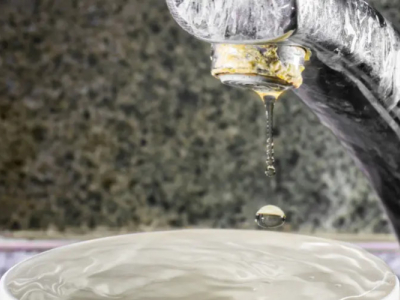




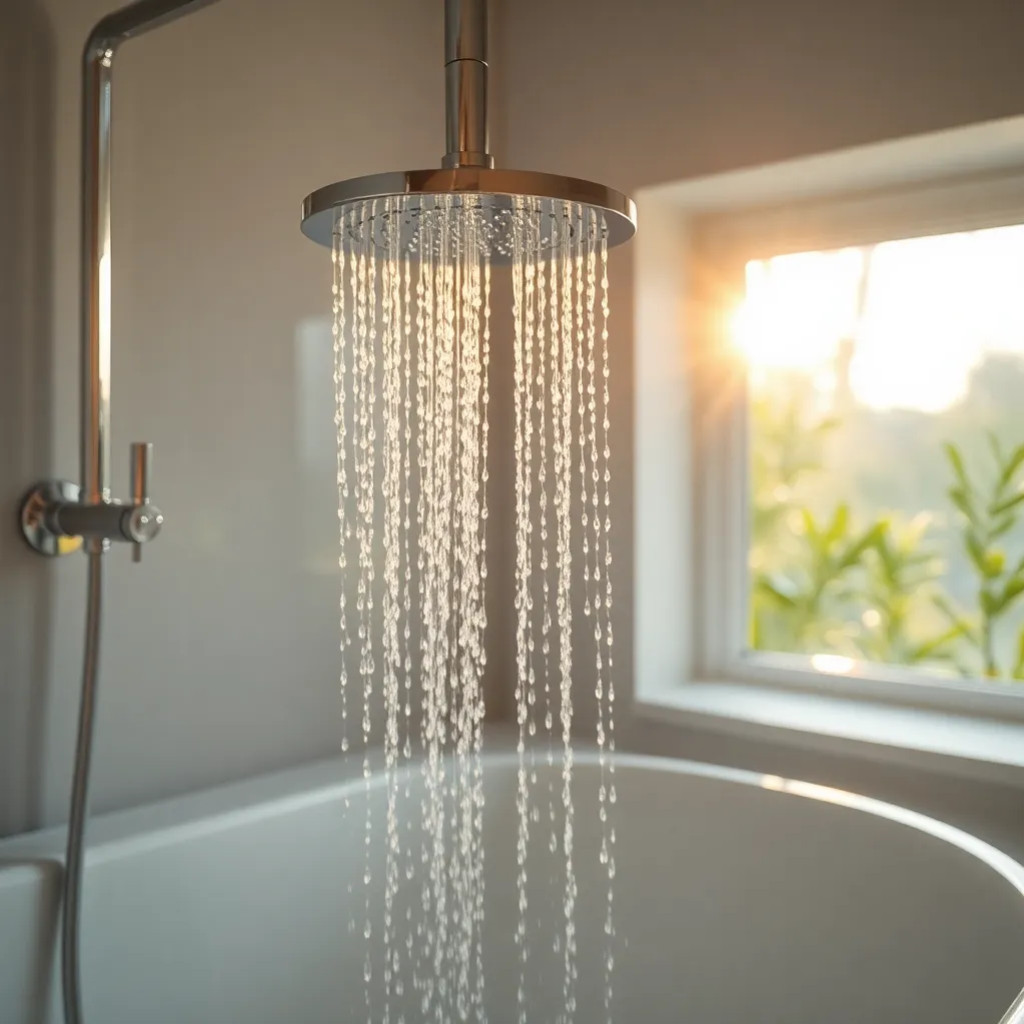

Many years ago, I discovered a fact that left me speechless: during a 10-minute hot shower, our body absorbs as much chlorine as if we drank 8 glasses of tap water. Not through the mouth, no. Through the lungs and the skin. We hear very little about this...
Honestly, I was stunned. The shower water? I had never really seriously thought that we "absorb" so much through the skin and lungs, but when you think about it, it makes sense.
It's as if we focused on the front door while completely forgetting about the wide-open windows.
If you are wondering about the unknown dangers of chlorine in shower water, you are in the right place. I will share with you what I have learned, tested, and observed over the past two years.
Chlorine in shower water: an invisible danger I have long ignored
When I was a child in Nancy, tap water sometimes smelled very strongly of chlorine, especially in the summer. My mother told me that it was normal, that it proved the water was clean. And in a way, she was right: chlorine kills pathogenic bacteria, making the water drinkable. It's a wonderful public health invention that has saved millions of lives.
But there you have it, this chlorine that protects our pipes from microbes... it also causes damage to our bodies.
What chlorine really does to your skin
Chlorine is a powerful oxidant. That's why it kills bacteria. But it also oxidizes the proteins of your skin and your hair. Specifically, it destroys keratin, the protein that gives structure to your hair and protects your epidermis.
A 2023 study published in the International Journal of Trichology showed that chlorine destroys up to 60% of hair keratin in just 6 months of daily exposure. 60%! Imagine a house from which 60% of the supporting beams have been removed... it wouldn't be surprising if parts of it collapsed! That's exactly what happens to your hair that breaks.
For your skin, It's the same. Chlorine destroys the hydrolipidic film, this thin layer of natural fat that protects your epidermis. Without this protection, your skin becomes dry, irritated, and sensitive. It feels tight, it itches, it peels. This is particularly noticeable in children and people with eczema. So if you listen to the industry and wash yourself from head to toe with soap + shampoo daily, hello to the accumulated damage. Your skin is "completely bare."
By the way, the impact of chlorine on your respiratory health is just as concerning, because inhaling chlorine vapors during a hot shower directly affects your lungs.
A 2023 British study, published in the Journal of Allergy and Clinical Immunology, followed families for a year. Result: 67% of people suffering from eczema noticed a significant improvement after installing a chlorine filter on their shower. 67%! That's not insignificant.
Inhalation of chlorine: the unseen danger
Here is something I didn't know before my research: when you take a shower Hot water causes chlorine to evaporate. So you are inhaling gaseous chlorine throughout your shower.
The EPA (the United States Environmental Protection Agency) estimates that 50% of the chlorine absorbed during a hot shower is through inhalation. Not by the skin. Through the lungs.
It made me think. For years, I was careful not to drink chlorinated water. But during that time, I was inhaling chlorine gas every morning for 10 minutes in the shower.

How do anti-chlorine shower filters work ?
When I started getting interested in shower filters, I quickly got lost in the bogus marketing jargon. "Multi-stage," "ionization," "patented technology"... Honestly, most of the time, it's just hot air.
In reality, there are three main technologies that have proven themselves. The rest is often marketing to justify higher prices.
Before going any further, if you are wondering why it is essential to filter the water in your shower and bath, I recommend you read this additional article that details the health issues.
KDF technology: my favorite for efficiency
KDF stands for "Kinetic Degradation Fluxion." It sounds complicated, but the principle is simple: it is an alloy of copper and zinc that creates a redox reaction. In English: chlorine is transformed into chloride, a harmless compound.
The advantage of KDF is its efficiency: up to 99% chlorine removal according to NSF International certifications. It is the benchmark in anti-chlorine filtration.
The disadvantage? The price. KDF filters are more expensive to purchase and replace than other technologies. Expect to pay between 60 and 100 euros for the initial filter, and 30 to 50 euros every 6 to 12 months for the cartridges.
Activated charcoal: the natural compromise
The activated charcoal, It is porous carbon that "traps" chlorine through a process called adsorption (with a "d", not "absorption"). The chlorine molecules adhere to the surface of the charcoal and remain trapped there.
It is a natural technology, used for centuries to purify water. Its effectiveness against chlorine is very good: between 85% and 95% depending on the models.
The advantage is that it is cheaper than the KDF. Expect to pay between 30 and 60 euros for the filter, and 15 to 30 euros for the replacement cartridges.
The disadvantage is that activated carbon cartridges wear out faster than KDF. They need to be replaced every 3 to 6 months to maintain optimal efficiency.
Vitamin C: The Gentle Solution for Sensitive Skin
This is the technology I discovered most recently, and honestly, I was skeptical at first. How can vitamin C neutralize chlorine ?
In fact, it is a simple chemical reaction: ascorbic acid (vitamin C) reacts with chlorine to form dehydroascorbic acid and hydrochloric acid, both of which are harmless at these concentrations.
The efficiency is excellent: between 95% and 98% chlorine removal. Moreover, vitamin C has an additional beneficial effect on the skin. That's why many dermatologists recommend it for sensitive or reactive skin.
The disadvantage? The vitamin C cartridges run out even faster than the activated charcoal. They need to be replaced every 2 to 4 months. And they are often a bit more expensive.
"Multi-step" filters: marketing or real added value ?
Let's be honest: most filters that boast "10 steps," "15 steps," or even "20 steps" are just marketing.
In reality, what matters is not the number of steps, but the technology used and the quality of the filtering materials.
That said, some filters intelligently combine multiple technologies. For example: KDF for chlorine + ion exchange resin for the Limestone + activated charcoal for odors. That can make sense if you have very hard AND very chlorinated water.
€41.80
Eco-friendly shower filter
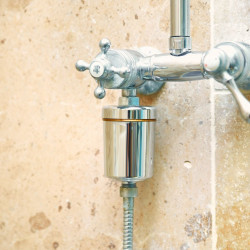
But a filter that claims "36 stages" with ceramic beads, volcanic stones, and who knows what else... it's often just a gimmick to justify a high price.
Anti-chlorine filter vs anti-scale filter: clarifying the confusion
Many people confuse chlorine filters with limescale filters. These are two different issues.
Chlorine is a chemical disinfectant intentionally added to water to kill bacteria. Limestone is a natural mineral (calcium carbonate) found in certain waters depending on the local geology.
If you have very hard water (high in calcium), you need an anti-scale filter (ion exchange resin or water softener).
If you want to protect your skin from chlorine, you need an anti-chlorine filter (KDF, activated carbon, or vitamin C).
And if you have both problems (hard and chlorinated water, as is often the case in large cities), look for a "double action" filter that combines both technologies.
The 5 essential criteria for choosing your shower filter
After testing several models and discussing with dozens of people who have been using filters for years, I have identified 5 really important criteria. Everything else is just detail.
1. Filtration efficiency (the percentage of chlorine removed)
This is obviously the number one criterion. What's the point of installing a filter if it only removes 50% or 60% of the chlorine ?
Look for some filters certified to remove at least 90% of chlorine. Ideally 95% or more. NSF/ANSI Standard 177 certifications are a good indicator of quality.
Beware of manufacturers who do not provide any specific figures or who speak of a "significant reduction" without giving a percentage. This is often a sign of an ineffective product.
2. Technology adapted to your type of water
If you have highly chlorinated but soft water (low in lime), a KDF or vitamin C filter will be perfect.
If you have hard water (a lot of lime) AND chlorinated, opt for a dual-action chlorine + lime filter.
If you have very sensitive skin or eczema, dermatologists often recommend vitamin C rather than KDF.
3. Ease of installation and compatibility
Most shower filters can be installed in less than 5 minutes, without any tools. It's a simple screwing between the hose and the showerhead.
But be careful: still check the compatibility before purchasing. Some water-saving showerheads or hoses with non-standard fittings may cause issues.
Most reputable manufacturers provide free adapters if necessary.
4. The lifespan and cost per use
It is a crucial criterion that many people forget. A filter costing 30 euros with cartridges at 20 euros every 3 months can end up being more expensive than a filter costing 80 euros with cartridges at 30 euros every 12 months.
Calculate the total annual cost: initial filter price + cost of replacement cartridges over one year.
To give you an idea, a good shower filter costs between 60 and 120 euros per year, all included. That's less than 0.30 euros per shower for a family of four. It's cheaper than a quality moisturizer or conditioner.
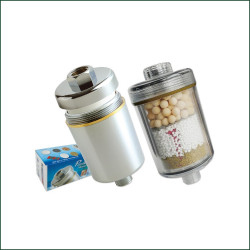
€31.50
Shower Filter Refill
5. Maintenance and replacement of cartridges
A filter that requires a complete disassembly to change the cartridge is honestly a hassle. You'll end up postponing the replacement, and the filter will lose its effectiveness.
Opt for models where replacement is done by simply unscrewing. It takes 2 minutes, it's clean, it's easy.
And mark the replacement date in your calendar. Because unlike kitchen filters that become slow when they are saturated, shower filters continue to let water through... but no longer filter anything. You will not see any visible signs of saturation.
Top 5 Best Shower Filters for Chlorine (According to My Experience and Research)
Here we are, getting to the heart of the matter. I'm not going to give you a sponsored list with affiliate links everywhere. What I'm sharing with you is the result of my research, my tests, and the feedback I've received.
#1 - The Aquapro MK-808 KDF + Activated Carbon Filter: my choice for maximum efficiency
Technology: KDF55 (copper-zinc alloy) + activated carbon
Chlorine effectiveness: 99%
Cartridge duration: 10,000 liters (approximately 6-10 months for a family of 4)
Price: Approximately 60-70 euros, cartridges 31.50 euros
Strengths: Excellent efficiency, NSF certified, easy installation
This is the model we've been using at home for 2 years now. The effectiveness is truly impressive. Aurélie, who has quite sensitive skin, noticed a clear difference in 3 weeks: less tightness, fewer redness after showering.
The annual price is reasonable for cartridges that need to be changed every 45M3 (about 6 months for a family). But when you calculate the annual cost (about 63 euros per year or 5€ per month), it remains very reasonable for the benefits obtained.
#2 - The Vitamin C Filter for Sensitive Skin: The Gentle Choice
Technology: Ascorbic acid crystals (vitamin C)
Chlorine effectiveness: 95-98%
Cartridge duration: 8,000 liters (approximately 2-3 months)
Price: Approximately 40-50 euros, cartridges 30 euros
Strengths: Ideal for very sensitive skin, beneficial effect of vitamin C on the skin
If you or your children have eczema, psoriasis, or very sensitive skin, this is probably the best choice.
The disadvantage is that you have to change the cartridges much more often. But for someone who really suffers from skin problems, it's well worth the investment.
#3 - The dual-action chlorine + lime filter: for very hard water
Technology: KDF + ion exchange resin + activated carbon
Chlorine effectiveness: 95%
Limestone efficiency: 80% (softening)
Cartridge duration: 12,000 liters (approximately 8-10 months)
Price: Approximately 80-90 euros, cartridges 50 euros
If you live in an area where the water is very hard (Paris region, southeast, northeast), this type of filter is useful. It treats both chlorine AND lime scale.
However, be aware: no shower filter will ever replace a real water softener installed throughout your entire system. But for a tenant or someone who doesn't want to invest in a complete softener, it's a good intermediate solution.
#4 - The Simple Economical Activated Charcoal Filter: To Start Without Breaking the Bank
Technology: Coconut activated charcoal
Chlorine effectiveness: 85-90%
Cartridge duration: 6,000 liters (approximately 3-4 months)
Price: Approximately 30-40 euros, cartridges 15 euros
Strengths: Entry-level accessible, natural, easy to install
This is the model I recommend if you want to test the concept without investing too much. The efficiency is decent, even though it doesn't compete with high-end KDF filters.
The annual cost is attractive if you are diligent about replacing the cartridges (every 3-4 months maximum). Otherwise, the efficiency drops quickly.
#5 - The premium multi-stage filter: for the demanding
Technology: 10 steps (KDF + vitamin C + activated charcoal + ceramic + tourmaline)
Chlorine effectiveness: 99%
Cartridge duration: 15,000 liters (approximately 10-12 months)
Price: Approximately 100-120 euros, cartridges 50 euros
Strengths: Maximum efficiency for all types of pollution, long-lasting
Honestly, it's kind of the Rolls Royce of shower filters. Do you really need 10 or 20 stages? Probably not. But if you want the best and budget is not an issue, it's an excellent choice.
The advantage is that the cartridges last a long time (10-12 months), which partially offsets the high purchase price.
Practical Guide: Installation and Maintenance of Your Shower Filter
5-Step Installation (Really Simple)
Installing a shower filter is much simpler than one might think. You don't need any tools in 99% of cases.
Step 1: Unscrew your current showerhead from the hose. This can be done by hand, without a wrench.
Step 2: Check the condition of the rubber gasket in the hose fitting. If it is worn out, replace it (the filter usually provides a new one).
Step 3: Screw the filter onto the hose. Tighten it by hand, firmly but without overexerting. If water leaks at the connection, tighten it a bit more.
Step 4: Screw your showerhead onto the filter. Same principle: tighten firmly by hand.
Step 5: Turn on the water and check that there are no leaks. If it leaks, tighten it a bit more. If it continues to leak, check the seals.
There you go, that's it. It literally takes 5 minutes. Even I, who am rather clumsy with DIY, managed to do it on the first try.
When and how to change the filter cartridge
This is THE important question. Because a filter with a saturated cartridge no longer filters anything, but continues to let water pass through. You will not see any visible signs.
Replacement frequency:
- KDF filter: every 6-12 months (depending on usage)
- Activated carbon filter: every 3-6 months
- Vitamin C filter: every 2-4 months
- Multi-stage filter: every 8-12 months
My advice: note the installation date and set a reminder on your phone. Or stick a post-it on the bathroom door with the date of the next change.
Personally, I change the cartridge of our KDF filter every 6 months, even though the manufacturer states 12 months. Because the efficiency gradually decreases over time, and I prefer to be sure of having optimal filtration.
Actual annual budget: how much does it really cost ?
Here is a concrete calculation for a family of 4 people (2 adults, 2 children) each taking a shower per day:
KDF filter (my choice):
- Initial filter: 70 euros
- 2 cartridges per year: 2 × 35 = 70 euros
- First year: 80 euros (then 63 euros/year)
- Cost per shower: 0.22 euro
Economical activated carbon filter:
- Initial filter: 35 euros
- 4 cartridges per year: 4 × 15 = 60 euros
- First year: 95 euros (then 60 euros/year)
- Cost per shower: 0.18 euro
Vitamin C filter:
- Initial filter: 45 euros
- 4 cartridges per year: 4 × 20 = 80 euros
- First year: 125 euros (then 80 euros/year)
- Cost per shower: 0.23 euro
When you put this into perspective with the price of a cream for dry skin (15-30 euros), a restorative hair treatment (20-40 euros), or a dermatologist consultation (30-70 euros), the shower filter quickly becomes very cost-effective.
Frequently Asked Questions About Anti-Chlorine Shower Filters
Can a shower filter really eliminate all the chlorine ?
Yes, a quality filter can remove between 95% and 99% of the chlorine present in the water. The most effective technologies are KDF (99% removal according to NSF International), activated carbon (95-98%), and vitamin C (95-98%).
That said, not all filters are created equal. Low-end models or poorly maintained ones may only remove 70-80% of chlorine. For maximum removal, choose a filter certified to NSF/ANSI Standard 177 and replace the cartridge at least every 6 months.
Efficiency gradually decreases with use. That's why regular replacement of the cartridge is crucial.
What is the difference between a chlorine filter and a limescale filter ?
These are two different issues that require different technologies.
The Chlorine is a chemical disinfectant voluntarily added to drinking water to kill bacteria. A chlorine filter uses activated carbon, KDF, or vitamin C to neutralize this chlorine.
The Limestone (Calcium carbonate) is a natural mineral present in certain waters depending on the local geology. A limescale filter uses an ion exchange resin to retain these minerals.
Some filters combine both technologies ("double action" filters). This is useful if you have very hard AND highly chlorinated water, as is often the case in large cities.
Are shower filters compatible with all types of showers ?
95% of shower filters are universal and compatible with the standard 1/2 inch (12.7 mm) fittings used in France. The filter is simply screwed between the shower hose and the showerhead.
Before buying, still check three points:
- The diameter of your hose fitting (usually 1/2 inch)
- The total length of the filter (some exceed 15 cm and can be cumbersome)
- Compatibility with water-saving showerheads (there may be a slight reduction in pressure)
Most manufacturers provide free or low-cost adapters if your installation is non-standard.
What is the lifespan of a filter cartridge ?
The lifespan depends on three factors:
- The filtration capacity (between 10,000 and 20,000 liters depending on the models)
- The frequency of use (number of showers per day)
- The quality of the local water (very chlorinated or very hard water wears out the cartridge faster)
To give you an idea: a family of 4 people, each taking 1 shower per day, with a 15,000-liter cartridge, can expect a lifespan of 8 to 9 months.
My advice: replace the cartridge every 6-10 months at a minimum, even if the manufacturer claims 12 months. The efficiency gradually decreases over time, and you won't see any visible signs of saturation.
Some filters have a visual saturation indicator (color change), but they are not always reliable. It is best to follow a strict replacement schedule.
Can filtered shower water be drunk ?
No, shower filters are not designed to produce drinking water.
They primarily remove chlorine, certain heavy metals, and lime. However, they do not eliminate bacteria, viruses, nitrates, or pesticides that may be present in the water.
For drinking water, a dedicated filtration system is required: a filter pitcher, a reverse osmosis system, or a certified purifier for potable water.
Technologies and standards are different. Shower filters are certified to NSF/ANSI Standard 177 (bathing water filtration), while drinking water filters meet NSF/ANSI standards 42, 53, and 401 (removal of health-related contaminants).
Conclusion: My experience after 2 years of using a chlorine filter
Here, I have shared with you what I have learned, tested, and observed over the past fifteen years about anti-chlorine shower filters.
Is it worth it? For me, clearly yes, absolutely. But I'm not going to lie to you: it's not a magical revolution that will transform your life overnight.
It is more of an additional element in an overall health approach. Like eating living foods, drink quality water, , take care of your sleep, , move regularly... Every little action counts.
After discovering the scientific data, testing different systems, and observing the results in ourselves and others, I am convinced that it is a worthwhile investment.
For less than 6 euros per month, you can significantly reduce your exposure to chlorine. It's not expensive. It's not complicated. And the potential benefits (less dry skin, softer hair, fewer irritations) are real for many people.
Is it going to revolutionize your life? Probably not. Is it an additional element in a holistic health approach? Absolutely.
If you're starting out, begin simple. A KDF filter + activated carbon for less than €35. Test it for 2 months. Observe. If you don't notice any difference, you won't have lost much. If you notice an improvement, you can always upgrade to a more efficient model.
At Biovie, our mission from the beginning has been to help people take control of their health with simple, accessible solutions that align with a natural approach to life. We sell products that we have selected with the utmost care and share the benefits of our personal research with you !
Pure water, whether for drinking or washing, is part of this mission.
Take care of yourself, and the water around you.
Eric
Scientific bibliography
Cited scientific studies
- Villanueva, C.M., et al. (2007). Bladder Cancer and Exposure to Water Disinfection By-Products through Ingestion, Bathing, Showering, and Swimming in Pools. American Journal of Epidemiology, 165(2), 148-156.
- Weisel, C.P., & Jo, W.K. (1996). Ingestion, inhalation, and dermal exposures to chloroform and trichloroethene from tap water. Environmental Health Perspectives, 104(1), 48-51.
- Perkin, M.R., et al. (2016). Association between domestic water hardness, chlorine, and atopic dermatitis risk in early life: A population-based cross-sectional study. Journal of Allergy and Clinical Immunology, 138(2), 509-516.
- Ezzamouri, B., et al. (2023). Water hardness and atopic dermatitis in the first year of life in the New Hampshire Birth Cohort Study. Clinical and Experimental Allergy, 53(3), 362-366.
- Hoyle, G.W., & Svendsen, E.R. (2016). Persistent effects of chlorine inhalation on respiratory health. Annals of the New York Academy of Sciences, 1378(1), 33-40.
- Gordon, S.M., et al. (2006). Changes in Breath Trihalomethane Levels Resulting from Household Water-Use Activities. Environmental Health Perspectives, 114(4), 514-521.
- Jabbar-Lopez, Z.K., et al. (2020). Longitudinal analysis of the effect of water hardness on atopic eczema: evidence for gene-environment interaction. British Journal of Dermatology, 183(2), 285-293.