It's been over 10 years now that we always travel with filtered water bottles during our trips abroad (we travel between 1/3 and 1/4 of the year). As you may know if you've been following the blog for a while, at Biovie we are very attentive to the quality of water, whether it is At home with our household filters like theEcofiltro, or on the move. Pure water is truly the foundation of health, and it becomes even more crucial when you are in the wilderness, far from any infrastructure.
Why hydration is critical in hiking
Before discussing solutions for purifying hiking water, I would like to share some figures that really struck me when I started delving into this topic. An adult at rest needs about 2.5 liters of water per day to maintain their water balance. But while hiking, these needs literally skyrocket.
When you walk in the mountains or in nature, your body sweats to regulate its temperature. During moderate exertion, you lose between 0.5 and 1 liter of water per hour just through sweating. This means that a three-hour hike can make you lose up to 3 liters of water, in addition to your basic daily needs. Specifically, on an average hike, you should plan for at least 3 liters of water per day. And I do mean "at a minimum," because under certain conditions, particularly in desert environments or at high altitudes, the needs can rise to 9 to 14 liters per day. It's colossal !
I was surprised to learn that even a slight dehydration of 1% of body weight already leads to a noticeable loss of performance. At 3-5% dehydration, you start to feel real fatigue, your urine becomes dark and strongly odorous, and walking becomes difficult. At 6-8%, it gets even worse: heavy legs, shortness of breath, risk of muscle injuries. Beyond 10%, you enter a really dangerous zone with risks of heart failure.
The problem is that carrying 5 liters of water in your backpack is heavy. Very heavy. 5 kilos to be precise. When you set out for several days of self-sufficiency, it's just impossible to carry everything. That's where portable filtration solutions become essential. They allow you to replenish along the way using natural sources, while ensuring that the water is safe.
The Invisible Dangers of "Clean" Water
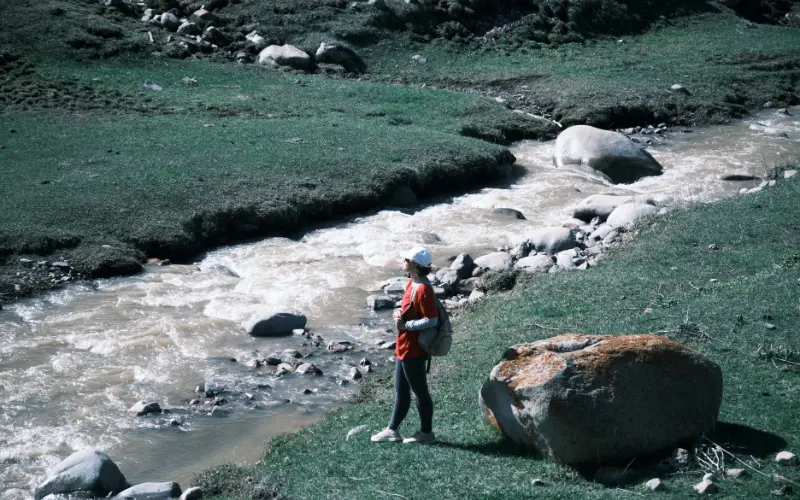
Let's now talk about a topic that many hikers underestimate: the microbiological risks of untreated water. For a long time, I thought, like many people, that spring water flowing quickly in the mountains was necessarily pure. In reality, this is a belief that can be costly.
Water in the mountains, even that which appears crystalline, can contain parasites and bacteria invisible to the naked eye. The two main culprits are Giardia and Cryptosporidium. These microscopic parasites come from animal excrement (sheep, cows, wild boars, and even small mammals like marmots). A single cow relieving itself a few hundred meters upstream from your water source can contaminate the entire river.
What is particularly insidious about Cryptosporidium is that it even resists standard chlorine. In 1993, in Milwaukee, USA, there was a huge outbreak where 403,000 people were infected by this parasite in tap water that was nevertheless treated. This is to give you an idea of how resistant it is. An infected person can excrete between 10 and 100 million oocysts (the "eggs" of the parasite) in their feces, and it only takes a few to infect you in turn.
The symptoms of a Giardia or Cryptosporidium infection are really unpleasant: severe diarrhea, abdominal cramps, nausea, dehydration. Imagine being on a multi-day trek, far from any civilization, with this kind of intestinal problems. It's really not an experience I would wish on anyone.
I remember talking with a refuge keeper in the Alps who told me something very wise: "If I don't personally assure you that water is pure because I've had it tested, consider that it isn't." He also added that even when a local tells you the water is good, it might be for them, as they have been accustomed to it for years, but not necessarily for you, whose gut flora is not acclimated.
Different solutions for treating water while hiking
Through my research and experiences, I have discovered that there are several families of solutions to make water drinkable in the wild. Each has its advantages and disadvantages, and the choice really depends on your type of hiking. Let's see how to filter camping water with the different methods available.
Straw filters
It is probably the most compact and lightweight system I have tested. A filter straw like the LifeStraw Personal weighs barely 56 grams and fits in a pocket. The principle is simple: you place one end of the straw in the water (river, lake, puddle) and you suck. The water passes through a membrane of 0.2 micron who stops 99.99% of bacteria and parasites.
It's really great for day hikes where you want to travel ultra-light. However, there are a few limitations. First, you have to kneel or lie flat to drink directly from the source, which is not always convenient. Then, you can't fill a bottle to drink later; you have to drink on the spot. And finally, sucking water through a filter requires a bit of effort, especially if the filter starts to clog.
Filtered water bottles
It is the logical evolution of the filtering straw. The filtering bottle integrates the filter directly into the cap or the body of the bottle. You fill the bottle with raw water, screw on the filtering cap, and drink comfortably. I have tested several models, and my favorite remains the Katadyn BeFree, which has a 1-liter flexible bottle.
Advantages of filtered water bottles:
Ultra-light (approximately 140 grams for the Katadyn BeFree)
Very practical: you can drink while walking
Fast flow: 2 liters per minute for the BeFree
Flexible water bottle that takes up little space once empty
Easy cleaning: simply shake the bottle to clean the filter.
Disadvantages:
Limited capacity (generally 0.5 to 1 liter)
Less effective with very murky water
Limited filter lifespan
For my multi-day outings alone, as a couple, or with family, this is truly my preferred solution. The weight-to-practicality ratio is unbeatable.
Pump filters are more robust and versatile. The principle is simple: you immerse a hose in the water source, pump with a handle, and the filtered water comes out through another hose that you direct into your bottle or water pouch. The Katadyn Hiker Pro is a very popular model that I have used several times.
Advantages of pump filters:
Very effective even with murky water
Allow filtering large quantities quickly
Ideal for a group or a family
Can be used even in shallow puddles
Long lifespan (minimum 750 liters for the Hiker Pro)
Disadvantages:
Heavier (approximately 300-500 grams depending on the models)
More cumbersome
Firefighting requires physical effort.
More parts to maintain
If you are traveling with family or in a group, it is really the most practical solution. One person can filter the water while the others set up the campsite.
Gravity systems
It is the most comfortable system, even if it is a bit heavier. The Platypus GravityWorks is the reference model. You have two pouches: a "dirty" one that you fill with raw water, and a "clean" one for the filtered water. You hang the dirty pouch up high (on a tree branch, for example), connect the two pouches, and gravity does the work. The water naturally flows from the higher pouch to the lower pouch through the filter.
Advantages of gravity systems:
No physical effort: gravity works for you
Large capacity (4 liters or more)
Fast flow: 1.75 liters per minute
Ideal for base camps
You can do something else during the filtration.
Disadvantages:
Heavier (approximately 300-400 grams)
Requires a high anchor point
Less convenient for filtering while walking
This is my preferred solution when I go trekking with a bivouac and know that I will be staying in the same place for several hours. In the evening at the camp, I hang my bag on a branch, and while the water is being filtered quietly, I set up my tent or prepare the meal.
How to choose the right solution for your hikes
Now that you know the different options, how do you choose the right system for your needs? Here are my recommendations based on my personal experience and that of many hikers I have met.
For a solo day hike:
Opt for a filtering straw (LifeStraw Personal) or our Biovie / Water to Go filtering bottle.
Straw: Ultra-light (56g)
Perfect if you want to travel minimalist
Budget: around 20-30€
For a multi-day trek solo, as a couple, or with family:
Choose our Biovie / Water to Go filtered water bottle
Good compromise between weight and practicality (approximately 140g)
You can drink while walking.
Budget: around €40
For a group hike:
Opt for a pump filter (Katadyn Hiker Pro)
Allows for quickly filtering large quantities
More robust for heavy use
Budget: around 80-100€
For a trek with a base camp:
Invest in a gravity system (Platypus GravityWorks)
Maximum comfort at the camp
Large filtration capacity
Budget: around 100-130€
Personally, for our 2-3 day nature outings, I always bring my Biovie filtering water bottle, which we also use for our trips outside of France. It's become a habit. It's so lightweight that I don't even feel it in my bag, and it has saved me more than once when I ran out of water earlier than expected.
An important tip: no matter which system you choose, test it at home before going on a hike. Make sure you understand how it works, how to clean it, and how to troubleshoot common issues. You don't want to find yourself in the wilderness reading the manual for the first time !
Usage and maintenance tips
Over the years, I have learned a few tips that really make a difference in optimizing the use and lifespan of your camping water filter.
Before use:
Always choose the best available water source.
Favor running water over stagnant water.
Avoid areas downstream of pastures or inhabited zones.
If the water is very cloudy, let it settle for 30 minutes in a separate container.
In case of high turbidity, pre-filter with a cloth or a coffee filter.
During use:
Never force it if the flow slows down significantly (risk of breaking the membrane).
Regularly rinse the filter with clean water.
For backflushing systems, clean them every 5-10 liters in turbid water.
Mentally note the amount of filtered water to know when to replace the filter.
After use:
Rinse your filter thoroughly with clean water.
Let it dry completely before storing it (prevents mold).
Store it in a dry and well-ventilated place.
Never let it freeze (residual water could damage the membrane).
In winter, keep it in your sleeping bag at night.
Signs that you need to replace your filter:
The flow becomes very slow even after cleaning.
Filtered water has an unusual taste or smell.
You have reached the maximum capacity indicated by the manufacturer.
The filter has frozen (even once, the membrane can be damaged).
A practical tip I learned from talking with a mountain guide: always carry purification tablets as a backup to your filter. They weigh just a few grams and can save you if your filter breaks down or if you lose it. It's not as comfortable as a filter (you have to wait 30 minutes and the water tastes like chlorine), but it's an excellent backup solution.
The connection with nutrition and superfoods
You may be wondering what the connection is between water filters and our philosophy at Biovie. It's an excellent question that several readers have asked me.
At Biovie, we have always believed that health starts with what we put into our bodies. Theliving food, the superfoods, the sprouted seeds... all of this is part of a holistic approach to natural health. But it all rests on a fundamental basis: pure water.
When you are hiking, your body is working intensely. Your muscles are engaged, your cardiovascular system is operating at full capacity, and your metabolism is burning calories. In this context, hydration becomes even more critical. Contaminated water can not only make you sick, but it can also disrupt your digestion and prevent your body from properly absorbing the nutrients from your food.
That's why we recommend associating a Conscious and living food to quality water, whether you are at home or in the great outdoors. The two go hand in hand.
By the way, when I prepare for my hiking trips, I always bring some superfoods light and nutritious: in particular activated almonds. These nutrient-dense foods pair perfectly with pure water to give your body exactly what it needs during exertion.
At home, before going on a hike, we use our Ecofiltro to prepare filtered water that we put in our starting water bottles. That way, we leave with already pure water, and we use our portable filters only to replenish along the way.
Hydration is also crucial for maintain a good digestive balance, especially when you eat differently while trekking. Drinking between 1.5 and 2 liters of pure water per day helps your body function well, even in the great outdoors.
FAQ: Your questions about camping water filters
How to filter water while camping ?
To filter water while camping, you have several options: straw filters (LifeStraw), filtering bottles (Biovie), pump filters (Katadyn Hiker Pro), or gravity systems (Platypus GravityWorks). Portable filters use a 0.1 to 0.2-micron membrane that removes 99.99% of bacteria and parasites. For optimal use, choose running water rather than stagnant water and rinse your filter after each use.
What is the best water filter for hiking ?
The best water filter for hiking depends on your usage. For a solo day hike, opt for the Bioivie bottle. For a multi-day trek, the same advice applies. For a group or family, a pump or gravity filter will be more effective for quickly filtering large quantities.
How to purify water in the mountains ?
To purify water in the mountains, use the Biovie bottle with a membrane of at least 0.2 microns, which eliminates Giardia and Cryptosporidium, the most common parasites at high altitudes. Preferably choose fast-flowing water (stream, spring) rather than stagnant water. Even if the water appears clear, it may contain parasites from animals upstream (sheep, cows, marmots). A reliable filter is essential to avoid intestinal infections.
Do water filters remove viruses ?
The Biovie bottle (Water To Go technology) eliminates more than 99.99% of viruses.
Why is this notable? Viruses are infinitely smaller than bacteria. Most hiking filters (0.1 or 0.2 micron) allow viruses to pass through.
Filtered virus examples: Hepatitis A, Polio, Norwalk, Adenovirus, Enterovirus, etc.
How does it work? (The 3-in-1 technology) Water-to-Go does not only use a mechanical "sieve" (pore size). The filter uses a combination of three technologies:
Mechanical filtration: A membrane with very fine pores. Electrical filtration (Nanotechnology): This is the key for viruses. The filter contains nano-alumina that emits a positive charge when wet. Since most viruses and bacteria have a negative charge, they are attracted like a magnet and trapped in the walls of the filter, even if they are small enough to pass through the pores. physiques.Charbon active: To improve taste and eliminate chemicals (chlorine, fluoride) and heavy metals.
What is the lifespan of a portable water filter ?
The lifespan of a portable water filter varies depending on the model. Entry-level filters can filter between 500 and 1,000 liters before needing replacement. High-end models, like some Sawyer filters, can filter up to 100,000 liters (several years of use). Factors that reduce lifespan include very murky water, lack of maintenance, and freezing. Regular maintenance (rinsing, complete drying, backflushing) significantly extends the lifespan. The filter of the Biovie bottle needs to be changed after 200 liters.
Can you drink river water with a filter ?
Yes, you can drink river water with a Biovie filtering bottle (water to go) because it has a membrane of 0.1 to 0.2 microns, but more importantly, it contains nano-alumina that emits a positive charge when wet. Since most viruses and bacteria have a negative charge, they are attracted like a magnet and remain trapped in the walls of the filter. Preferably choose running and clear water rather than stagnant or very murky water. Avoid areas downstream of inhabited zones, industries, or intensive pastures. Even with a good filter, always select the best possible water source.
How much does a hiking water filter weigh ?
The weight of a hiking water filter varies depending on the type. A straw filter weighs about 50-70 grams (LifeStraw Personal: 56g). A soft bottle filter weighs 100-150 grams (Biovie). A pump filter weighs 200-500 grams depending on the model. A gravity system weighs about 300-400 grams. For a lightweight trek, opt for a straw or bottle filter.
How to maintain your water filter ?
To maintain your water filter: 1) Rinse it with clean water after each use. 2) Allow it to dry completely before storing it (prevents mold). 3) Perform regular backflushing to unclog the membrane (run water through it in reverse). 4) In winter, protect it from freezing by keeping it in your sleeping bag at night. 5) Replace the filter according to the manufacturer's recommendations (usually after several hundred or thousand liters filtered).
Water filter or purification tablets ?
Water filters are generally preferable to tablets for camping and hiking. Filter advantages : immediate effectiveness (no waiting), elimination of bacteria and parasites, no chemical taste, reusable (economical and ecological). Advantages of lozenges : ultra-light (a few grams), can kill viruses, useful as a supplement. The tablets require a minimum wait of 30 minutes and impart a chlorinated taste. For most hikes, a portable filter is more practical and comfortable.
Where to buy a water filter for camping ?
You can purchase a water filter for camping at Biovie for our high-performance filtering bottle or at specialized outdoor stores: Decathlon (wide range of entry-level options), Au Vieux Campeur (expertise and personalized advice), or specialized e-commerce sites (Lyophilise.fr, Hardloop, Altitude Sports). Compare the technical features (weight, flow rate, lifespan) and read customer reviews. At Biovie, we recommend complementing your portable filtration system with our Ecofiltro to prepare your water before setting off on a hike.
Here you go, I hope this sharing of experience will be useful to you if you practice hiking or if you are considering getting into it. Hydration is truly a critical issue in the wilderness, and having a good portable filtration system completely changes the game. You are no longer limited by the weight of the water you can carry, you gain autonomy, and most importantly, you protect your health by avoiding intestinal infections that can really ruin an outing.
At Biovie, our philosophy has always been to support you in your quest for natural health and a life in harmony with nature. Whether at home with our domestic filtration solutions or in the great outdoors with the right portable equipment, pure water remains the foundation of everything.
If you have any questions or if you want to share your own experiences with water filters while hiking, feel free to leave a comment. I love discussing these topics with you.
And above all, if you are planning a hike soon, make sure to equip your bag with a good filtration system. Your body will thank you !