


Sea lettuce leaves in nori style, 100 sheets
Sea lettuce in sheets, to be used like nori: makis, wraps, raw vegetable rolls. Iodized taste, similar to sorrel. Pack of 100 sheets measuring 19 x 21 cm.
No queries yet, leave the first!
Price:
€49.00
Product availability:
In stock
Tax included
- New


Sea lettuce leaves in nori style, 100 sheets images


Sea Lettuce Sheets Nori Style, Pack of 100 Sheets
🌍 A rarity in Europe: sea lettuce in sheets, like nori. Until now, sea lettuce (Ulva lactuca) was mostly found fresh, salted, or in flakes. With our partner BRETALG, we offer it to you in the form of thin sheets ready to roll.
🌿 They are used like nori sheets: makis, raw vegetable rolls, wraps, or crumbled over a salad, a bowl of rice, or in a broth. The difference is in the taste: sea lettuce has an iodized and slightly tangy flavor, similar to sorrel, more vibrant than that of nori. Its dark green color also changes the look of your dishes.
🌿 Each sheet measures 19 x 21 cm and weighs about 4 g. It can be rolled as is, without cooking: in contact with a moist filling, it softens in a few minutes.
GREEN ROLLS WITH SEA LETTUCE
Preparation
-
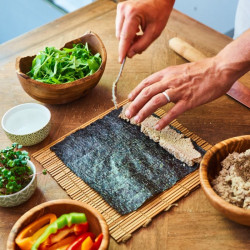
Place a sea lettuce sheet on a sushi mat (or a simple board), with the longest edge facing you.
-
Spread a horizontal line on the third closest to you with a creamy ingredient: mashed avocado, seed pâté, or hummus.
-
Add your vegetable sticks and a handful of sprouts on top, still in a line.
-
Moisten the opposite edge of the sheet with a little water using your fingertips, then roll tightly from the first turn.
-
Let rest for 5 minutes, seam side down, then cut into sections with a sharp, moistened knife.
Ingredients for 2 rolls (2 people):
2 sea lettuce sheets
1 ripe avocado
1 carrot and 1/4 cucumber in julienne
1/2 red bell pepper in sticks
1 handful of sprouts (radish, alfalfa, or broccoli)
a few coriander or mint leaves
Other Ideas:
- as a wrap: a sheet around a raw vegetable filling, to be eaten immediately
- crumbled over a salad, a bowl of rice, or in a broth when serving
- blended into a pesto or green sauce
- paired with our nori sheets for two-tone makis
✨ Discover the world of seaweed in cooking during Éric and Aurélie's appearance on the set of Télé Matin, the flagship show of France 2, and also watch a report filmed in Roscoff with Bretalg:
🌿 Also find our various books dedicated to seaweed:
- Seaweed Daily, a book by Aurélie and Eric Viard published by Gallimard, to better use seaweed in your diet. Voted best cookbook in the world at the Gourmand Awards 2025 (SeaFood category) and named best wellness cookbook 2025 in France by the National Academy of Cuisine.
- Cooking with Seaweed, a book and recipe notebook co-written with BRETALG published by Marie-Claire, with 80 recipes to make you love seaweed.
🎧 As well as our podcast Seaweed Daily!
🌿 Composition: 100% dehydrated sea lettuce sheets (Ulva lactuca). No preservatives, gluten-free, GMO-free, non-ionized.
🌿 Nutritional values per 100 g (technical sheet from our supplier BRETALG):
- Energy: 856 kJ / 206 kcal
- Fat: 2.03 g, of which saturated fatty acids: 0.36 g
- Carbohydrates: 13.8 g, of which sugars: 0 g
- Dietary fiber: 34.4 g
- Protein: 15.9 g
- Salt: 0.49 g
🌿 Minerals: averages for 100 g of dehydrated sea lettuce (sheet Ulva spp. from the Center for the Study and Valorization of Algae, December 2021 version). The actual content varies depending on the season and the place of harvest.
- Magnesium: 2,663 mg
- Calcium: 1,134 mg
- Potassium: 1,960 mg
- Iron: 70.9 mg (value varies greatly depending on the batch)
- Iodine: 8.5 mg on average
🌿 What this represents for a 4 g sheet: about 105 mg of magnesium, or 28% of the reference nutritional values (RNV), and on average about 340 µg of iodine, or more than double the RNV (150 µg).
Sea lettuce is rich in fiber and magnesium. Magnesium contributes to normal muscle function and the reduction of fatigue, as part of a varied and balanced diet and a healthy lifestyle.
High iodine content: moderate consumption is recommended. Not recommended for children, pregnant or breastfeeding women, and people with thyroid disorders.
Complete nutritional sheet from the Center for the Study and Valorization of Algae (for 100 g of dehydrated algae)
🌿 For more information, check out our Seaweed category on our blog.
🌿 Like our nori sheets, these sheets come from Asia: the technique that allows for thin and regular seaweed sheets is common there but almost absent in Europe. The sea lettuce in these sheets is of Chinese origin. It is selected and imported by BRETALG, our partner in Roscoff in Finistère, with whom we have been working for many years.
🌿 The BRETALG specifications ensure product quality: heavy metals (mineral arsenic, cadmium, lead, mercury, nickel) within the limits set by European regulations, controlled microbiological criteria, maximum humidity of 6%.
🌿 This product is not certified organic, and we do not present it as raw: we have no guarantee on the drying and sheet-making temperature.
Best before: 06/06/2028
- Ingredients: dehydrated sea lettuce sheets (Ulva lactuca).
- Allergens: may contain traces of crustaceans, fish, and mollusks.
- Origin: China. Imported by BRETALG, Roscoff (France).
- Content: 100 sheets of 19 x 21 cm, or 400 g.
- Best Before Date: 24 months after manufacture.
- Storage: in a dry place, at room temperature, and away from light. Reseal the package well after opening: in humidity, the sheets soften.
Frequently Asked Questions
What is the difference between sea lettuce sheets and nori sheets?
They are two different seaweeds. Nori (Porphyra / Pyropia) is a red seaweed with a mild and slightly smoky taste, almost black once dried. Sea lettuce (Ulva lactuca) is a green seaweed with a more vibrant, iodized, and tangy taste, similar to sorrel. Both sheets are used in the same way, to roll makis or make wraps.
Do sea lettuce sheets need to be cooked or rehydrated?
No cooking. For makis or wraps, the sheets are used as is: in contact with a moist filling, they soften in a few minutes. To crumble them into a salad, you can also rehydrate them for a few minutes in clear water.
Where do these sheets come from, and why aren't they organic?
They are made in China, from Chinese sea lettuce, like most seaweed sheets on the market. They are selected and imported by BRETALG, a company in Roscoff (Finistère) specializing in seaweed, with whom we co-wrote the book "Cooking with Seaweed". This supply chain is not certified organic. We chose to offer them to you anyway because sea lettuce sheets remain very difficult to find, and the BRETALG specifications control heavy metals and microbiological quality according to European limits.
How many sheets can be eaten per day?
Sea lettuce is rich in iodine. According to CEVA averages, a 4 g sheet provides about 340 µg, or more than double the reference nutritional value (150 µg per day), and the content varies greatly from batch to batch. We advise you not to exceed one sheet per day and not to consume it every day. The sheets are not recommended for children, pregnant or breastfeeding women, and people with thyroid disorders.
How to store the sheets after opening?
Reseal the package well and keep it in a dry place, at room temperature, and away from light. The minimum durability date is 24 months after manufacture.
Update: November 2026. Sheet written and validated by Éric Viard, founder of Biovie since 2007 and engineer ISTOM, co-author of "Seaweed Daily" (Gallimard, 2024), Best Cookbook in the World, Gourmand Cookbook Awards 2025, and Best Cookbook in France, National Academy of Cuisine 2025.
Wondering… ?
Everything you need to know before ordering.
Be the first to ask a question about this product!
Question about the product
Ask a question