









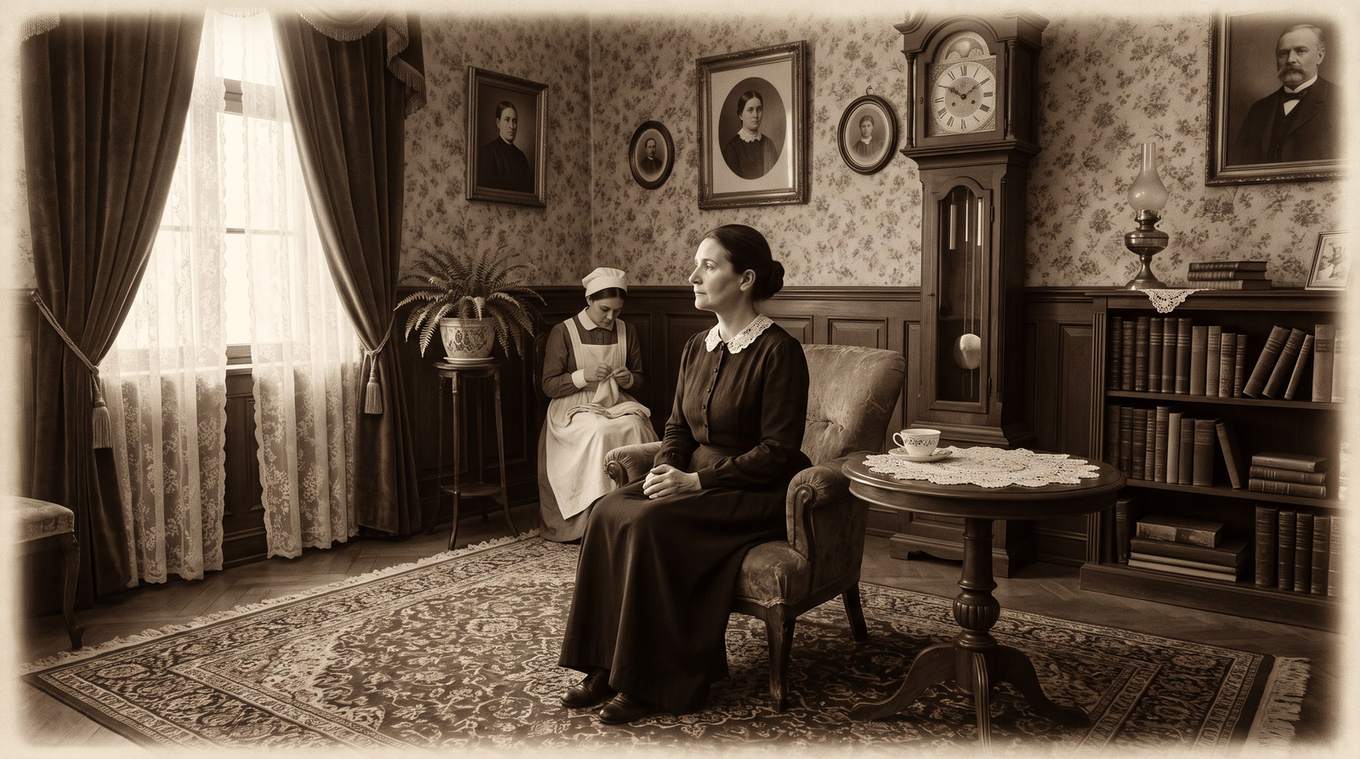
November 1901, in Frankfurt: Alois Alzheimer questions a patient who no longer knows where she is. Reread in 2026, the face-to-face between Auguste Deter and Alois Alzheimer calls for a two-part answer: the brain of the first Alzheimer's patient carries the typical lesions of the disease, but her early, rare form does not look like the late-onset Alzheimer's of today. This Biovie page draws on ten scientific publications, from 1976 to 2024.
The picture fits in a few lines: a woman in her fifties, an asylum in Frankfurt, a young doctor who writes everything down. More than a century later, a very simple question comes up: was the first Alzheimer's patient really affected by the disease that now bears her doctor's name?
On this blog I usually talk about seaweed and sprouted seeds, always as part of a varied and balanced diet and a healthy lifestyle. As an ISTOM engineer and not a neurologist, I have spent days and days hunting for studies to back up our seaweed articles, and I came away with one lesson: a famous case is often better told than read.
So let's reread it, piece by piece.
Who was Auguste Deter, the first Alzheimer's patient?
Auguste Deter was a patient at the Frankfurt asylum, examined by Alois Alzheimer on 26 November 1901 for memory problems and disorientation. She dies on 8 April 1906 and goes down in history as the first Alzheimer's patient on record (Hippius and Neundörfer, 2003).
Even her age varies depending on the account: 50 in Hippius and Neundörfer's historical review, 51 in most biographies. The gap simply comes from how the dates are counted, before or after her birthday.
She stays in hospital until her death. Alzheimer, for his part, leaves to work in Munich. Never mind: after her death, he has her brain sent to him so he can examine it. The story of Auguste Deter and Alois Alzheimer could have ended there, but without this stubborn doctor's gesture, there would be nothing left to reread today.
1906: a discovery of Alzheimer's disease that goes unnoticed
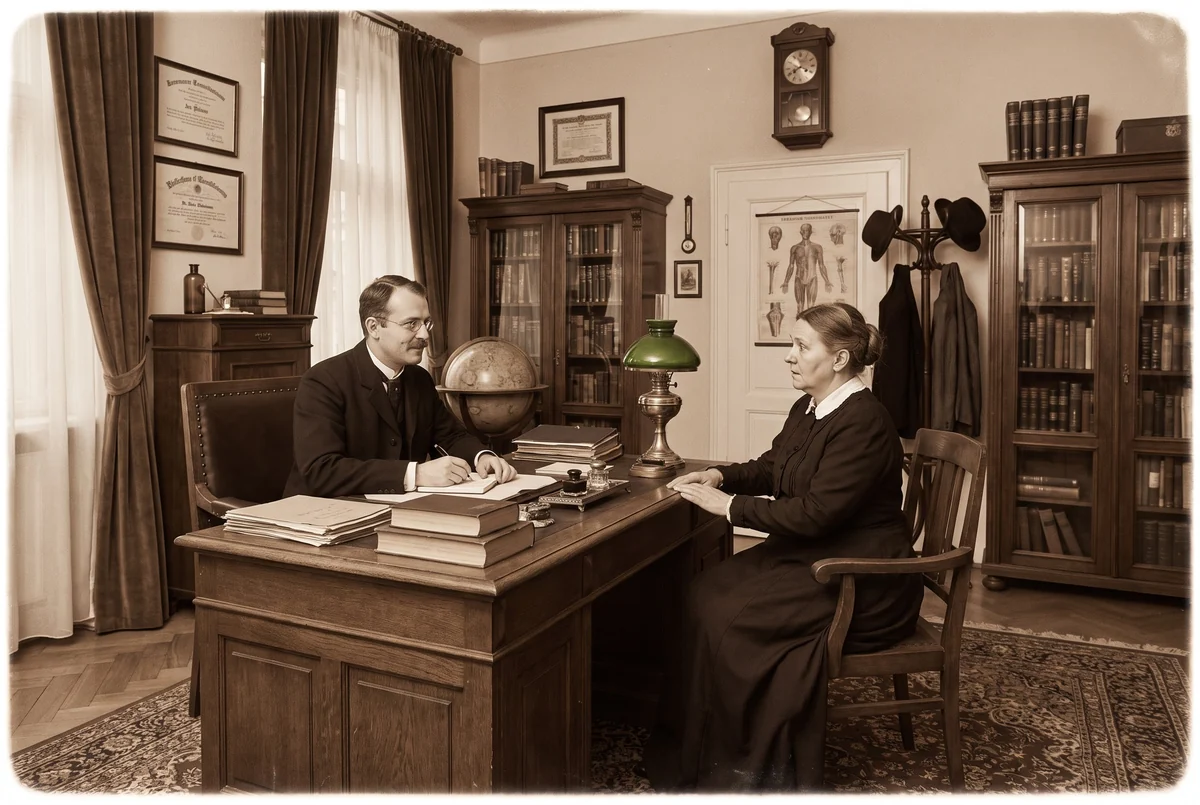
On 3 November 1906, in Tübingen, Alois Alzheimer finally presents the case at the 37th meeting of the South-West German psychiatrists. The chairman, Alfred Hoche, judges that there is "no need for discussion", and the local press gives it two lines (Hippius and Neundörfer, 2003). Two lines in the newspaper, for a name that everybody knows today.
Published in 1907, the text bears an almost modest title, "Über eine eigenartige Erkrankung der Hirnrinde" (on a peculiar disease of the cerebral cortex), in the Allgemeine Zeitschrift für Psychiatrie, volume 64, pages 146 to 148. Three pages in all.
Kraepelin proposes the name "Alzheimer's disease" in 1910, in the 8th edition of his psychiatry textbook. A disease is thus named after a handful of cases, for a so-called "presenile" dementia, meaning one that appears before old age.
And then, in 1911, Alzheimer publishes a second case, with plaques but without tangles. From the very start, the picture varies from one patient to another, and that detail matters for what follows.
Auguste Deter's file and slides, found again a century later
The clinical file, meanwhile, was sleeping in the Frankfurt archives. Konrad Maurer finds it in 1995, then publishes it with his colleagues in 1997 in The Lancet (Maurer et al., 1997). Ninety-four years in a cardboard box is three generations of doctors.
If you read 1993 or 1998 here and there, those dates come from errors in the abstracts of Hippius and Neundörfer's review, whose main text does give 1995. A date copied without going back to the source is the fable of the roast whose two ends were cut off, from mother to daughter, because the grandmother's pot was too small.
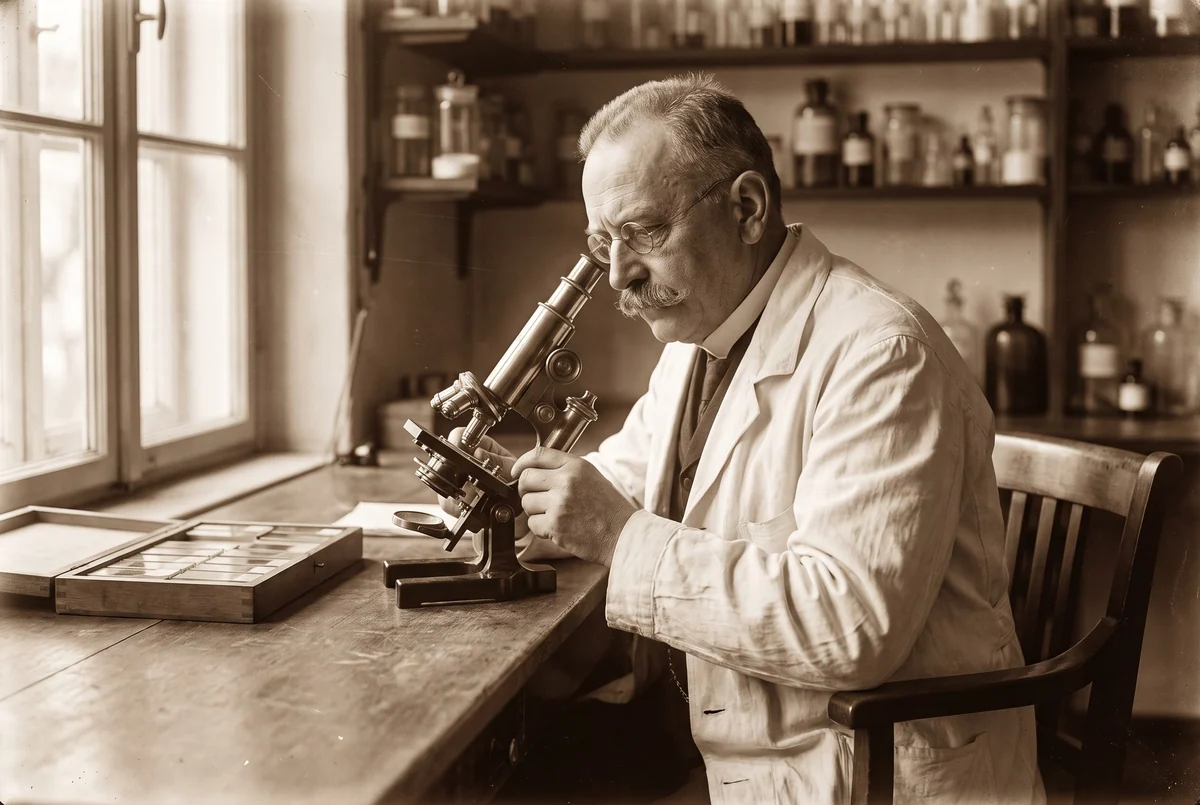
The histological slides, those thin slices of brain stained and mounted under glass, resurface in Munich in 1992 and 1997 (Graeber, 1999). Their reanalysis shows many neurofibrillary tangles and amyloid plaques, mostly in the upper layers of the cortex, with no vascular lesion at all (Graeber et al., 1998).
Two bits of jargon, two images. An amyloid plaque is a deposit that builds up between neurons, a bit like limescale at the bottom of a kettle. A neurofibrillary tangle forms inside the neuron instead: twisted fibres, like a ball of wool tangled at the bottom of a basket. The absence of vascular lesions rules out the idea of a brain damaged by small accidents in the vessels.
Her APOE genotype is ε3/ε3: no ε4 variant, the main genetic risk factor for the late-onset form. By today's criteria, these lesions are indeed those of Alzheimer's disease. There you go, that is already one half of the answer.
The genetic lead: a mutation found, then nowhere to be found
A dementia that starts around age 50 immediately suggests an inherited form. In the so-called autosomal dominant forms, a single carrier parent is enough, and each child has a one in two chance of inheriting the mutation, like a coin toss replayed at every birth.
Across 387 families, that is 3,275 people and 174 mutations, a meta-analysis shows that the age at onset depends strongly on the parent's age at onset and on the type of mutation (Ryman et al., 2014). Its r² above 0.38 means that a little over a third of the differences in age between patients is explained by the family and the mutation.
In Auguste Deter's case, the genetic lead was followed in three stages.
| Year | Team | What was looked for | Result |
|---|---|---|---|
| 2011 | Müller et al., 2011 | The PSEN2 N141I mutation of the Volga German families | Absent |
| 2013 | Müller et al., 2013 | Partial sequencing of PSEN1 (exons 5 and 6) | PSEN1 F176L mutation announced |
| 2014 | Rupp et al., 2014 | DNA from a histological section (nested PCR), known sites of APP, PSEN1 and PSEN2 | Mutation not found, no known explanatory mutation |
The rest is less straightforward. In 2013, the announcement of Auguste Deter's PSEN1 mutation rests on a partial sequencing (only two exons) of DNA extracted from tissue more than a century old (Müller et al., 2013). A result, but hanging by a thread. Still, in 2014, another team starts again from a histological section and finds neither this mutation nor any known explanatory mutation (Rupp et al., 2014).
I am not a geneticist and I will not name a good lab and a bad one. Century-old DNA is fragile: it breaks into small pieces over time, and the slightest trace of modern DNA can get mixed in. It is like a book left for a hundred years in a cellar, pages stuck together, words faded, readers' fingerprints all over it.
To replicate is to redo the experiment elsewhere, with other tools. As long as that has not been done successfully, an isolated result remains a hypothesis, not a certainty. A genetic cause remains possible, but nobody has identified it to this day.
Why "maybe not": the Alzheimer's of 1906 and the one of today
A rare disease that became a mass disease
Until the 1970s, people mostly talk about presenile Alzheimer's disease: a rare dementia, affecting people before old age. In 1976, Robert Katzman's editorial argues for merging senile dementia and Alzheimer's disease, and calls it "a major killer" (Katzman, 1976). With this merger, a neurologist's curiosity becomes, on paper, a mass disease.
I am not putting that choice on trial; I am noting what it changes for our story. The first Alzheimer's patient therefore belongs to the early-onset form, whereas the late-onset form dominates today.
A definition that became biological
A new turn in 2024: a working group of the Alzheimer's Association defines the disease by its biology, lesions detected through biomarkers. A single abnormal "Core 1" biomarker is enough for the diagnosis (Jack et al., 2024). Symptoms are described separately, in clinical stages ranging from 1, without symptoms, to 6, severe dementia. By these criteria, you can have Alzheimer's disease without feeling the slightest symptom. Admit it, that is disorienting. Other experts debate it, by the way.
So, did she have "our" Alzheimer's? By her lesions, Auguste Deter did have Alzheimer's disease (Graeber et al., 1998). By her age at onset, around 50, and by a cause that can be suspected to be genetic without having been found (Rupp et al., 2014), she did not have the form most families meet today. Yes and no, then. That is the whole meaning of the "maybe not": the story of Auguste Deter and Alois Alzheimer deserves that we keep both halves of the answer, rather than throwing one away to make a headline.
What Auguste Deter's case teaches us about reading science
I knew the era before computers, when you got your information at the library and in journals. Today, studies are a click away, and that is why I keep repeating, a bit bluntly I admit, that ignorance is a choice. Still, you have to know how to read what you find. This case offers three keys.
- A single case does not define a disease, and the second case of 1911 already did not look like the first.
- A study that has not been replicated remains a lead, like the mutation announced in 2013.
- Symptoms and biology do not always coincide: the 2024 criteria write it black on white by separating the two.
Keep them in mind the next time an article promises you that a food protects the brain, even when it is about the foods I love most. What I stand for on this blog, living foods added at your own pace as part of a varied and balanced diet and a healthy lifestyle, I will never present as a shield against a disease. Research is looking into the link between lifestyle and brain health, and it deserves the same patient reading as this old file.
These three keys will also serve you for the third part of our series on Tommy Wood. In 1906, the case fit in two lines of a newspaper; almost a century later, several teams reexamined her slides and her DNA with tools Alzheimer could not have imagined. In short, science moves forward by retracing its steps, and I see that as rather good news.
For my part, I will keep talking to you about seaweed and sprouted seeds, as part of a varied and balanced diet and a healthy lifestyle, reading the studies to the end. And if one of them intrigues you, write to me!
Frequently asked questions
Who was the first Alzheimer's patient?
Auguste Deter is the first described patient with Alzheimer's disease. Alois Alzheimer examines her at the Frankfurt asylum on 26 November 1901, for memory problems and disorientation. She stays in hospital there until her death on 8 April 1906, then her brain is examined by Alzheimer in Munich.
When was Alzheimer's disease discovered?
Alzheimer's disease was first presented on 3 November 1906, in Tübingen, at a meeting of German psychiatrists, where it aroused very little interest. The description was published in 1907, then Kraepelin proposed the name "Alzheimer's disease" in 1910, in his psychiatry textbook.
Who was Alois Alzheimer?
Alois Alzheimer was a German psychiatrist and neuropathologist. He examined Auguste Deter at the Frankfurt asylum in 1901, then, settled in Munich, he had her brain sent to him after her death in 1906 to study it under the microscope. He presented this case in 1906 and published it in 1907.
What is Alzheimer's disease today?
Alzheimer's disease is now defined by its biology, according to the criteria published in 2024 by a working group of the Alzheimer's Association: a single abnormal "Core 1" biomarker is enough for the diagnosis. Symptoms are described separately, in clinical stages from 1, without symptoms, to 6, severe dementia. This definition is still debated.
Can you have Alzheimer's disease when young?
Yes, early forms of Alzheimer's disease exist, including inherited forms passed on by a single carrier parent. A meta-analysis of 387 families shows that their age at onset depends strongly on the family and the type of mutation. Auguste Deter, the first described case, was about 50 when she was examined in 1901.
References
- Hippius H., Neundörfer G. (2003). The discovery of Alzheimer's disease. Dialogues in Clinical Neuroscience, 5(1), 101-108.
- Maurer K., Volk S., Gerbaldo H. (1997). Auguste D and Alzheimer's disease. The Lancet, 349(9064), 1546-1549.
- Graeber M. B., Kösel S., Grasbon-Frodl E., Möller H. J., Mehraein P. (1998). Histopathology and APOE genotype of the first Alzheimer disease patient, Auguste D. Neurogenetics, 1(3), 223-228.
- Müller U., Winter P., Graeber M. B. (2013). A presenilin 1 mutation in the first case of Alzheimer's disease. The Lancet Neurology, 12(2), 129-130.
- Rupp C., Beyreuther K., Maurer K., Kins S. (2014). A presenilin 1 mutation in the first case of Alzheimer's disease: revisited. Alzheimer's & Dementia, 10(6), 869-872.
- Müller U., Winter P., Graeber M. B. (2011). Alois Alzheimer's case, Auguste D., did not carry the N141I mutation in PSEN2 characteristic of Alzheimer disease in Volga Germans. Archives of Neurology, 68(9), 1210-1211.
- Katzman R. (1976). The Prevalence and Malignancy of Alzheimer Disease: A Major Killer. Archives of Neurology, 33(4), 217-218.
- Jack C. R. Jr., Andrews J. S., Beach T. G., Buracchio T., Dunn B. et al. (2024). Revised criteria for diagnosis and staging of Alzheimer's disease: Alzheimer's Association Workgroup. Alzheimer's & Dementia, 20(8), 5143-5169.
- Ryman D. C., Acosta-Baena N., Aisen P. S. et al., Dominantly Inherited Alzheimer Network (2014). Symptom onset in autosomal dominant Alzheimer disease: a systematic review and meta-analysis. Neurology, 83(3), 253-260.
- Graeber M. B. (1999). No man alone: the rediscovery of Alois Alzheimer's original cases. Brain Pathology, 9(2), 237-240.
Updated: November 2026. Article written and validated by Éric Viard, founder of Biovie since 2007 and ISTOM engineer, co-author of « Algues au quotidien » (Gallimard, 2024), Best cookbook in the world, Gourmand Cookbook Awards 2025, and Best cookbook in France, Académie Nationale de Cuisine 2025.
The information presented in this article is provided for information purposes only and does not constitute medical advice. Consult a healthcare professional before making any change to your diet or supplementation.