



The pack that cuts into your fingers on the stairs, the bag of empty bottles to take out every week: there is an easier way. A water filter without electricity, whether a filter jug or a gravity fountain, sits on the worktop with no plumber, and finding the best gravity water filter for your home starts with one check first: your tap water, whose test results are public. At Biovie, we built this page on public and scientific sources, without naming a single brand.
Water filter without electricity: the short answer
To stop carrying packs, with no electricity and no plumber, first check the quality of your tap water on the Ministry of Health website. If it is compliant, a glass jug in the fridge is enough; to improve the taste, a gravity filter fountain sits on the worktop.
That is the short version. What follows explains how to filter water without electricity and stop buying water packs, in the order I recommend: check first, and only then choose the water filter without electricity that fits your real need. Not the other way round.
I have a soft spot for low tech objects, the ones that run on gravity, a vacuum or the siphon effect you learn about at school rather than on a plug (our autonomous sprouters water their seeds in exactly this way). But the simplest object is often the tap itself, as long as you know what comes out of it.
Is your tap water safe to drink? Check before you buy
We carry supermarket water to our kitchens at arm's length, when there is already some flowing above the sink. Admit it, that is a strange round trip! As an ISTOM engineer by training and the founder of Biovie since 2007, I always start from the same principle: look at the resource before equipping it. In France, mains water is subject to public health monitoring, and the results are published town by town on eaupotable.sante.gouv.fr. So why pay for a filter before reading your own town's report?
I knew the time before computers, when we found information in the library and in journals, and I kept from it a slightly brutal phrase, I admit: today, ignorance is a choice. For tap water, that is literally true, since the results are online and free, a town name away.
On the report, you do not need to be a chemist. Look first at the overall health conclusion (water compliant or not with quality requirements), then at the bacteriological parameters, the nitrates and the sampling date.
That leaves the chlorine taste, the first reason people turn away from the tap. I understand, but chlorine is not an enemy: it is what keeps the water bacteriologically safe all along the pipes, right up to your glass. We are not going to blame it for doing its job. Letting the water rest in a glass jug in the fridge softens that taste, without buying anything.
If your water is declared non-compliant, follow the instructions of your town hall or of the regional health agency (ARS). A home filter is not the default answer to undrinkable water, and ANSES points out that filter jugs are not designed for that (ANSES, 2017).
Bottled or tap water: what do the studies really say?
A team in Barcelona asked a very simple question: what would happen if the whole city drank bottled water instead of tap water? They modelled it (Villanueva et al., 2021), and the result is dizzying: about 1,400 times more species lost per year, and about 3,500 times more resource extraction cost. All that for water we already had at home, bottled, trucked, then carried to the kitchen. For the same glass of water, the bottle therefore weighs more than a thousand times heavier on living things than the tap.
In that same model, filtering tap water at home reduced exposure to trihalomethanes, by-products of chlorination, without losing the environmental advantage; a result specific to the Barcelona context. As part of a varied and balanced diet and a healthy lifestyle, drinking water regularly is one of the basic habits; the question is which water.
As for microplastics, an analysis of 259 bottles from 11 brands, bought in 9 countries, found particles in 93% of them (Mason et al., 2018): 10.4 per litre above 100 µm, about 325 when counting those from 6.5 to 100 µm, the latter not confirmed by spectroscopy. Nearly all of them, then. And it does not stop there: in 2024, a much finer imaging method counted about 240,000 particles per litre (2.4 ± 1.3 × 10⁵), about 90% of them nanoplastics (Qian et al., 2024).
How can the same water show 10, 325 or 240,000 particles per litre? It is not a contradiction, it is the mesh of the net that changes. With a wide-meshed net, a fisherman brings up a few fish from his pond; with a mosquito net, he discovers thousands of fry he never suspected. The pond has not changed. Only the detection threshold has moved.
Of course, these figures are impressive, and we might be tempted to cry scandal. That would be a little hasty. The WHO judges the risk to health to be low, on a body of evidence that is still limited, and calls for more research (WHO, 2019). None of these studies measures an effect on health: they count particles. To cut down on plastic bottles, the strongest argument therefore remains the environment.
No-electricity, no-plumber solutions compared
Four solutions come up when you look for a water fountain without electricity or an alternative to packs, and one of them, reverse osmosis, falls outside the "no plumber" frame.
| Solution | Installation | What it offers | Points to watch |
|---|---|---|---|
| Tap water in a glass jug | None | Cool water, chlorine taste softened after resting in the fridge, no packaging | Check first that the water is compliant; jug to wash regularly |
| Filter jug | None, filled by hand | Improved taste, according to the performance stated on the leaflet | Fridge, water drunk within 24 h, cartridge to replace; often made of plastic |
| Gravity filter fountain | None, sits on the worktop | Larger reserve of filtered water, works without power | Upkeep of the filter element; performance to check through standardised tests |
| Reverse osmosis | Usually a connection to the sink and a drain | Treatment installed permanently | Falls outside the "no plumber" criterion |
The filter jug: useful for taste, needs upkeep
The filter jug is often the first one people buy. In an opinion of 13 March 2017, ANSES did not identify a risk in normal use, but a possible deterioration of the water's microbiological quality. Hence some simple rules: jug and water in the fridge, water drunk within 24 hours, cartridge replaced, jug cleaned. Efficiency is checked through standardised tests, and the jug is not meant for preparing baby bottles without medical advice. And, a small irony, many jugs are made of plastic, which goes a bit against the original goal.
The gravity fountain: how does it work?
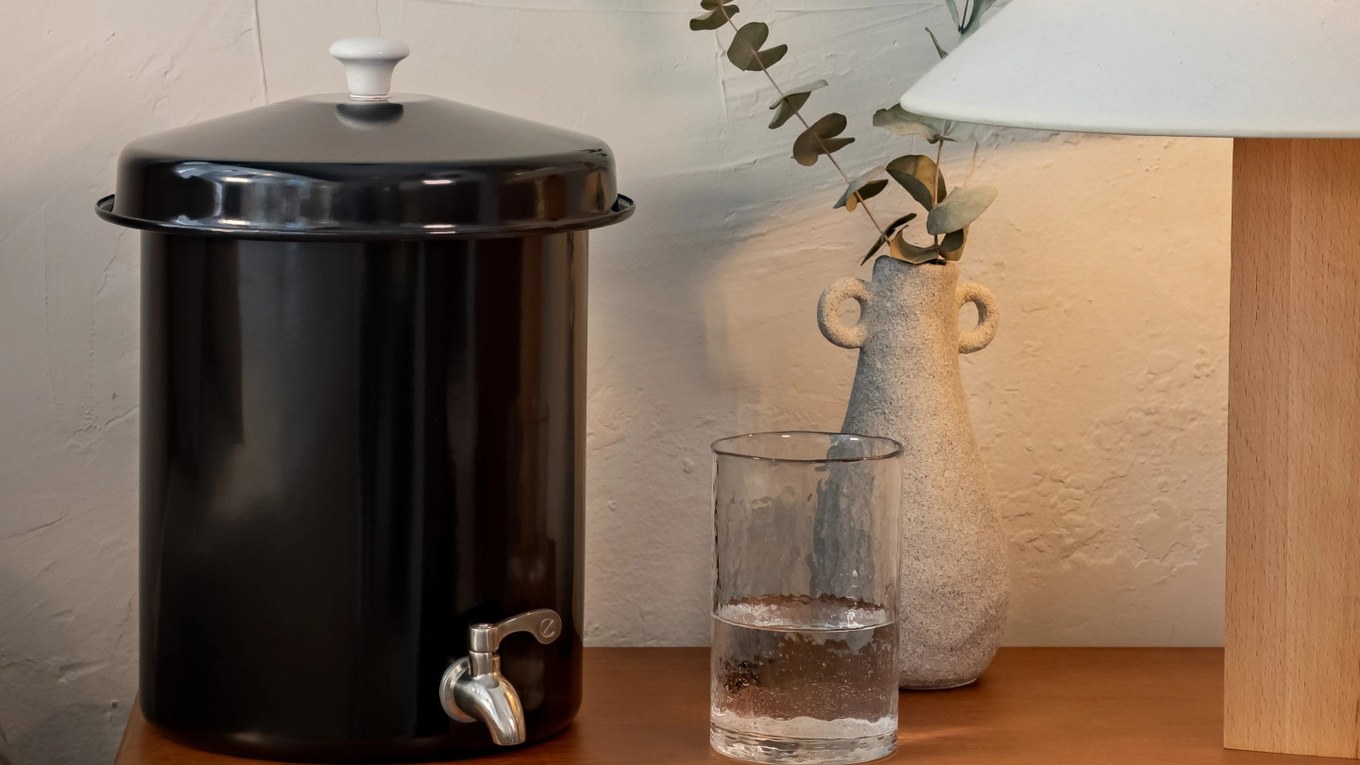
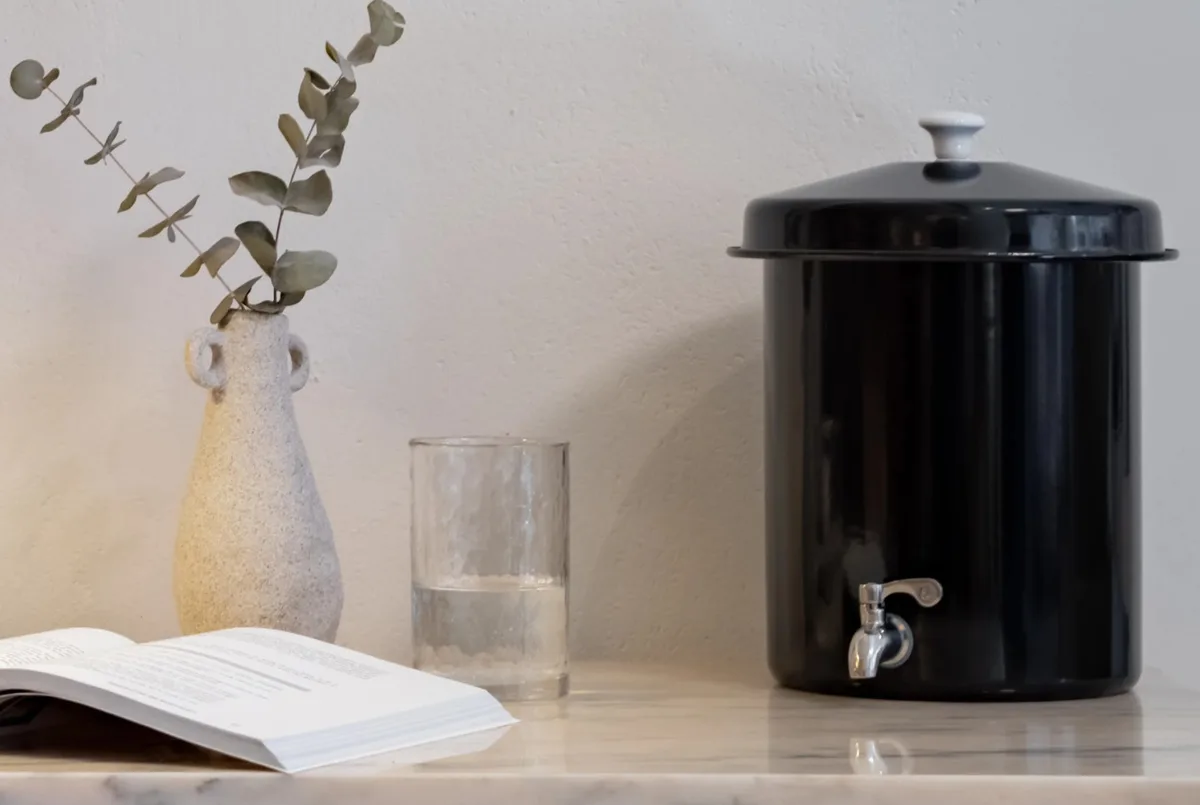
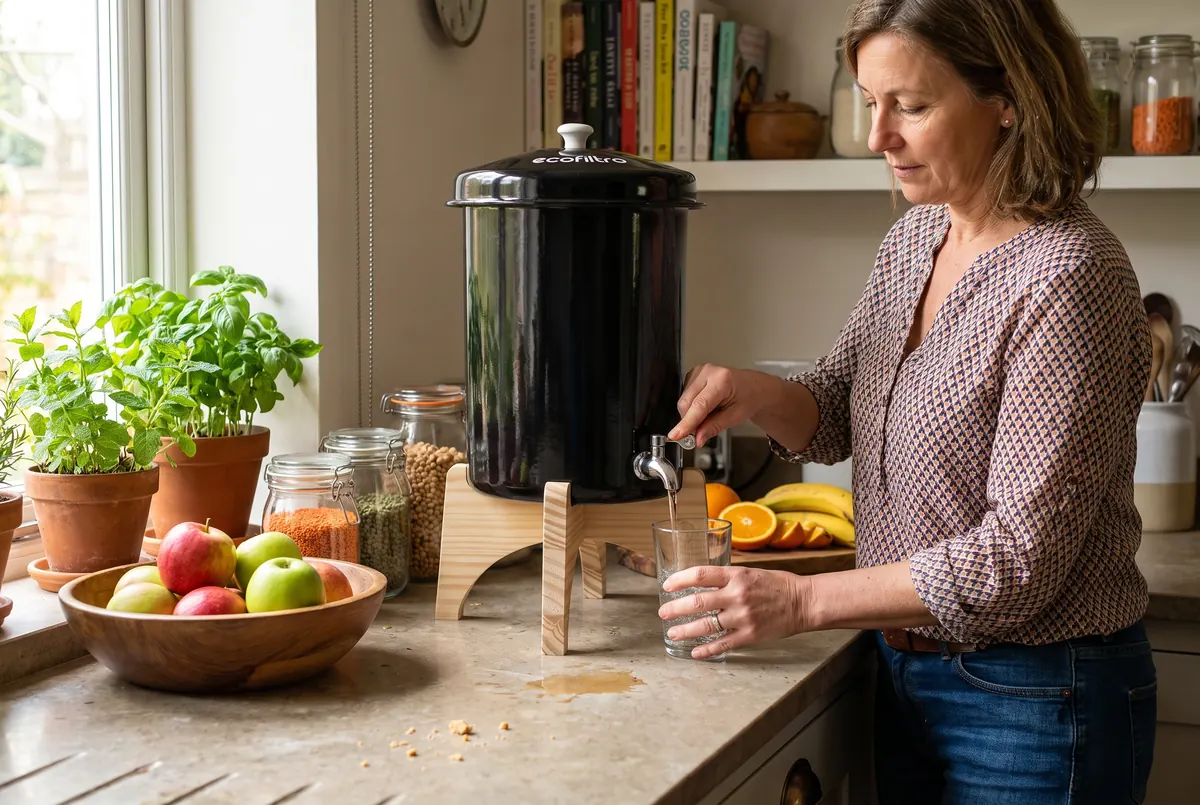
The principle is simple, and that is exactly what I like about it: a top reservoir receives tap water, which passes through the filter element (often ceramic, combined with activated carbon) before falling into the bottom reservoir, fitted with a small tap. The water goes down under its own weight, with no pump and no plug. The ceramic behaves like an extremely fine sieve that holds back particles as they pass, and the activated carbon like a sponge to which some of the molecules responsible for taste stay attached.
At heart, nothing new under the sun: it is what rain does as it crosses sand and rock before coming out as a spring. It is just common sense, observing nature. With no mains power, a gravity filter fountain keeps working during a power cut. With no installation either, which makes this water filter without electricity so easy to adopt.
What studies show about ceramic filters
A principle that appeals is not enough, you need evidence. The Cochrane review, which synthesises published trials, gathered 55 studies on ways to improve water quality (Clasen et al., 2015). For ceramic filters used at home (8 trials, 5,763 participants), households with a filter were associated with fewer episodes of diarrhoea, with an RR of 0.39 (95% CI: 0.28 to 0.53), on moderate-quality evidence.
The RR, or relative risk, is nothing complicated: it compares two groups. Here, 0.39 means that the risk observed with a filter was a little over a third of the risk observed without one. The confidence interval, for its part, gives the plausible range; even its upper limit, 0.53, stays far from 1, the value that would mean "no difference".
I insist on one nuance, because it changes everything. These trials were mostly run in low- or middle-income countries, where water is often contaminated, with diarrhoea reported by the participants themselves. The result shows that the technique really does filter. It does not carry over to tap water that is already drinkable.
Another benchmark: in its first round of laboratory tests, the WHO found 8 household water treatment products out of 10 compliant with its performance recommendations (WHO, 2016). Two out of ten did not pass, which is not nothing. Not all devices are equal, then, and it is the leaflet, with its tests, that makes the difference.
Choosing the best gravity water filter and looking after it
Once your water has been checked, choosing the best gravity water filter, or the best water filter for home without electricity, comes down to four criteria.
- Materials: glass or stainless steel if you want to cut down on plastic all the way.
- Performance shown by standardised tests and stated on the leaflet, rather than a mere slogan.
- A capacity suited to the household.
- The cost and frequency of refills, which we almost always forget at the moment of buying.
As for the price of a home water filtration system, I will not give you a figure, and it is not to dodge the question: it depends too much on the models, and I found no serious source setting an average. The only calculation that counts is the cost per litre: the price of the refill divided by the number of litres announced. Then compare it with the price per litre of your packs, till receipt in hand.
Upkeep comes down to a few gestures: clean the reservoirs regularly, replace the filter elements according to the leaflet, keep the filtered water cool, and drink it quickly, as ANSES recommends for jugs. Nothing complicated, but you still have to stick to it. A poorly maintained filter can degrade the microbiological quality of the water instead of improving it.
As part of a varied and balanced diet and a healthy lifestyle, water that tastes pleasant is drunk more willingly, and that is often what it takes to cut down on plastic bottles for good.
What a home water filter does not do
A home filter does not make unsafe water drinkable. ANSES points this out for jugs, and prudence says to reason the same way for a fountain. For well, spring or rain water, have the water analysed first, then choose a device tested for that use.
Nor does it have any health effect to claim, and I am wary of those who credit it with one. A filter improves the taste, and that is already a lot, since it is what lets you drink tap water with pleasure and do without bottles. As part of a varied and balanced diet and a healthy lifestyle, it remains a comfort measure.
The water pack, at heart, is a bit like the headlong rush our society is so prone to: we buy a packaged solution instead of looking at what already flows at home. The first step out of it is tiny. This week, type your town's name into the health monitoring site; if the water is compliant, fill a glass jug tonight and slip it into the fridge, it costs nothing. If the taste still bothers you after a few days, then and only then, look for the best gravity water filter for your kitchen.
Let us hope that in a few years, the water pack will be back to what it should never have stopped being: a stopgap. And if you have found another trick to do without it, write to me!
Frequently asked questions
What are the 3 ways to purify water?
The three main ways are boiling, chemical disinfection, such as chlorination, and filtration. The 2015 Cochrane review notably assessed home filters and chlorination, mostly in countries where water is contaminated. In France, mains water is already treated and monitored, with results published town by town.
What are the main types of water filters?
Filter jug, gravity fountain, tap-mounted filter and reverse osmosis are the main types of water filters. Only the first two do without any connection and any electricity: you fill them by hand, the jug goes in the fridge and the fountain sits on the worktop.
What is the price of a home water filtration system?
No reliable average price can be given, because everything depends on the model and above all on the refills. The right calculation is the cost per litre: price of the filter element divided by the number of litres announced, plus upkeep. Then compare that result with the price per litre of the packs you buy today.
How do you clean a gravity water filter?
You clean a gravity filter by first following the manufacturer's leaflet, which sets the frequencies. In practice, you empty and wash both reservoirs and the tap regularly, look after the filter element as directed and replace it when due. ANSES applies the same upkeep logic to filter jugs.
Reverse osmosis or gravity filter: which should you choose?
Without a plumber, the gravity filter wins: it sits on the worktop, with no installation and no electricity. Reverse osmosis usually needs a connection to the sink and a drain. In both cases, start by reading the analyses of your tap water: they tell you whether you really need a filter.
What is a gravity water filter?
A fountain with two stacked reservoirs: there you go, that is a gravity water filter. The water poured in at the top passes under its own weight through a filter element, often ceramic combined with activated carbon, then flows into the bottom reservoir, fitted with a small tap. It works without electricity or connection.
What is a water filter for?
A water filter is mainly for improving the taste of water that is already drinkable, for example by softening the chlorine taste according to the performance stated on its leaflet. It does not make unsafe water drinkable, ANSES points out for jugs. Its real benefit: drinking tap water with pleasure.
References
- Qian N., Gao X., Lang X., Deng H., Bratu T. M., Chen Q., Stapleton P., Yan B., Min W. (2024). Rapid single-particle chemical imaging of nanoplastics by SRS microscopy. PNAS, 121(3), e2300582121.
- Mason S. A., Welch V. G., Neratko J. (2018). Synthetic Polymer Contamination in Bottled Water. Frontiers in Chemistry.
- Villanueva C. M., Garfí M., Milà C., Olmos S., Ferrer I., Tonne C. (2021). Health and environmental impacts of drinking water choices in Barcelona, Spain: A modelling study. Science of The Total Environment, 795, 148884.
- ANSES (2017). Carafes filtrantes : l'Anses rappelle les règles de bon usage. ANSES, opinion of 13 March 2017, self-referral 2015-SA-0083.
- Clasen T. F., Alexander K. T., Sinclair D., Boisson S., Peletz R., Chang H. H., Majorin F., Cairncross S. (2015). Interventions to improve water quality for preventing diarrhoea. Cochrane Database of Systematic Reviews.
- World Health Organization (2019). Microplastics in drinking-water. WHO, technical report.
- World Health Organization (2016). Results of Round I of the Household Water Treatment Evaluation Scheme. WHO.
- Ministère chargé de la Santé (2026). Résultats du contrôle sanitaire de l'eau du robinet, commune par commune. Ministère chargé de la Santé.
Updated: November 2026. Article written and validated by Éric Viard, founder of Biovie since 2007 and ISTOM engineer, co-author of « Algues au quotidien » (Gallimard, 2024), Best Cookbook in the World, Gourmand Cookbook Awards 2025, and Best Cookbook in France, Académie Nationale de Cuisine 2025.
The information presented in this article is provided for information only and does not constitute medical advice. Please consult a healthcare professional before making any change to your diet or supplementation.