



The Lion's Mane, or Hericium erinaceus, is a medicinal mushroom that contributes to the normal functioning of cognitive abilities, supports the nervous system, and aids digestive health. Clinical studies have demonstrated its effectiveness on memory in individuals with mild cognitive impairments, with visible results after 8 to 16 weeks of treatment at a dosage of 1 to 3 g per day. This is an article that is very dear to me because this mushroom represents a true revolution in our understanding of the links between diet and brain health.
Honestly, when you have been interested in medicinal mushrooms for a few years like I have, you realize that the Lion's Mane holds a special place. To confide in you, I even tried to grow them at home with a special incubator, like an "easygreen for mushrooms," which I had high hopes for, but it turns out it's not that simple. Let's get back to the topic. It is the only mushroom capable of directly stimulating the synthesis of NGF (Nerve Growth Factor) in our body. The global market for medicinal mushrooms today represents 32 billion dollars and is expected to reach 68 billion by 2032, representing an annual growth of 8.9%. In France, the fungal supplements market now amounts to 48 million euros, with a spectacular growth of 38% in just two years. This explosion is not a coincidence: science is finally validating what ancient traditions have known for a long time.
What is Lion's Mane ?
The different names: lion's mane, hedgehog mushroom, hericium
This mushroom has several names that reflect its very distinctive appearance. In French, it is commonly called "lion's mane"or"Hedgehog hydnum". Its scientific name is Hericium erinaceus. In China, it is poetically named "Hou Tou Gu," which literally means "monkey head mushroom."
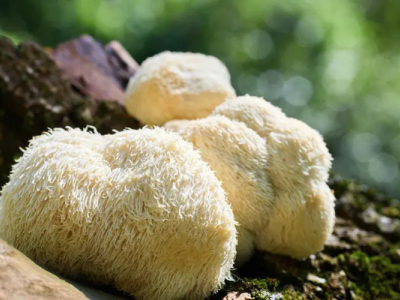
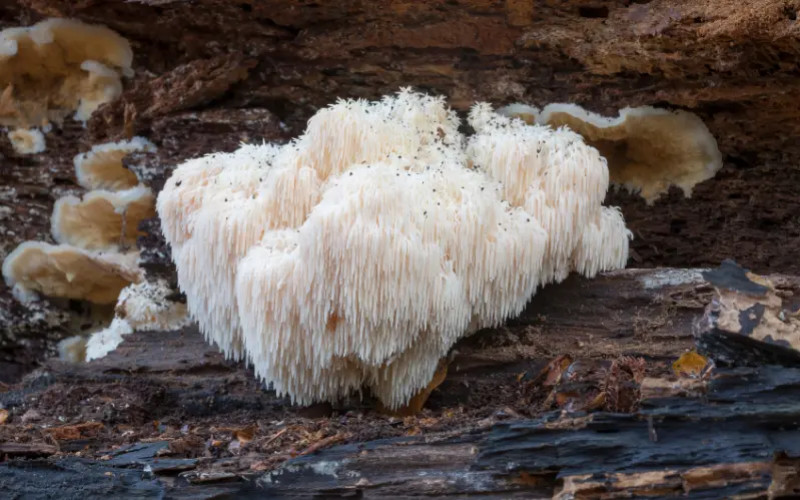
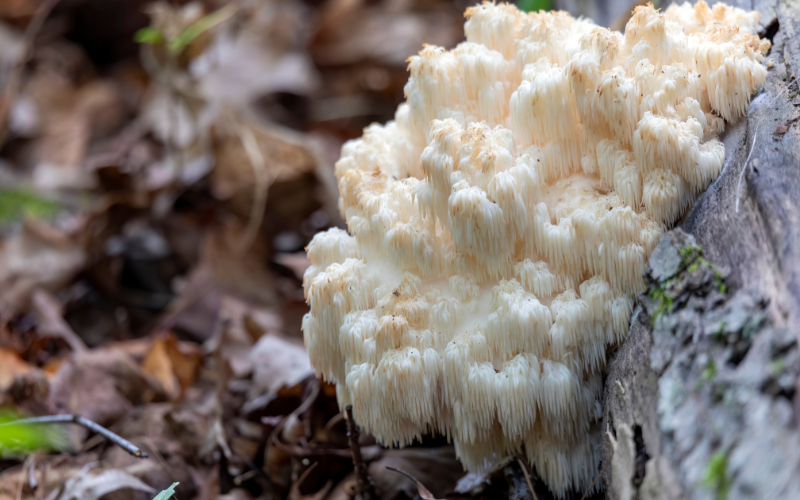
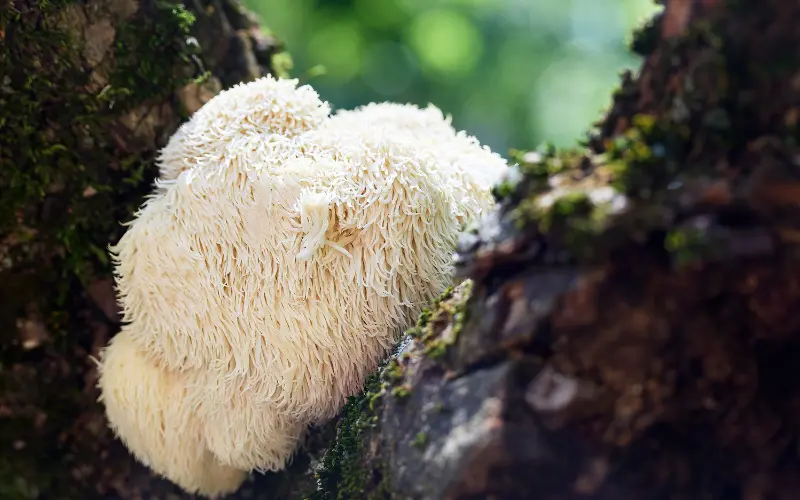
Specifically, when you see it for the first time, you immediately understand why it was given these names. It looks like a large white ball bristling with drooping filaments, like a cascade of white hair or a lion's mane. It is a mushroom that naturally grows on the trunks of deciduous trees, particularly oak and beech.
Origin and History: From Chinese Medicine to Modern Science
The history of the Lion's Mane dates back more than a thousand years. Zen Buddhist monks traditionally consumed it to enhance their concentration during meditation. It's fascinating to think that these monks had intuitively discovered what science confirms today: this mushroom has a real effect on cognitive functions.
In traditional Chinese medicine, it has been used for centuries to support digestive health. Moreover, the Chinese Ministry of Health has officially approved it to accompany chronic gastritis. This official recognition attests to its documented effectiveness on the digestive system.
And then, starting in the 1990s, Japanese researchers began to seriously investigate its neuroprotective properties. That's when everything changed: it was discovered that this mushroom contained molecules capable of crossing the blood-brain barrier and acting directly on the brain.
Unique composition: hericenones, erinacines, and beta-glucans
What makes the Lion's Mane so exceptional is its unique chemical composition. It contains two families of molecules that are found nowhere else in the realm of living organisms: the Hericenones and the Hericenones.
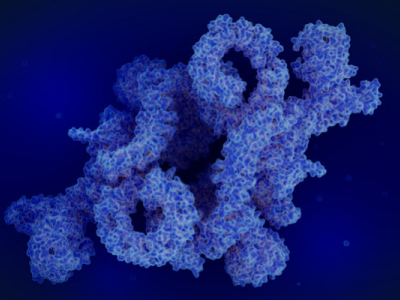
Hericenones are primarily present in the fruiting body (the visible part of the mushroom). Erinacines, on the other hand, are more concentrated in the mycelium (the underground part). Both types of molecules have a remarkable property: they stimulate the production of NGF (Nerve Growth Factor) and the BDNF (Brain-Derived Neurotrophic Factor), two essential proteins for the growth and survival of neurons.
The mushroom also contains beta-glucans, these immunostimulant polysaccharides found in other medicinal mushrooms. But it is truly its unique ability to stimulate NGF that sets it apart.
The 5 Proven Benefits of Lion's Mane
Improvement of memory and concentration
It is probably the most well-documented benefit of the Lion's Mane. A Japanese study published in Phytotherapy Research In 2009, Dr. Mori's team followed patients with mild cognitive impairments for 16 weeks. The group taking 3 g of Lion's Mane per day showed a significant improvement in cognitive abilities compared to the placebo group.
More recently, in 2023, a study published in the journal Nutrients by Docherty and his team showed improvements in cognitive speed in healthy young adults, and this from 28 days supplementation. This point is important: Lion's Mane not only benefits people who already have disorders, but it can also support the cognitive functions of people in good health.
For those who are looking to improve their memory naturally, , Lion's Mane represents a serious avenue validated by research.
In reality, when I talk to people who have done a Lion's Mane regimen, the most frequent feedback concerns the sensation of "mental fog" lifting. I am particularly thinking of this typical profile we often encounter: a 45-year-old executive, engaged in intensive remote work, who suffered from chronic mental fog. After two months of the regimen, he described a regained mental clarity.
Protection of the nervous system
Beyond improving cognitive performance, the Lion's Mane could play a role in protecting neurons against degeneration. A study published in 2020 in Frontiers in Aging Neuroscience by Li and his team followed patients with mild-stage Alzheimer's disease for 49 weeks. The results showed an improvement in cognitive abilities among participants taking a supplement enriched with erinacine A.
What is fascinating is that Lion's Mane acts differently from traditional nootropics. It does not temporarily "boost" the brain like a stimulant would. Instead, it promotes the production of nerve growth factors, which has cumulative and lasting effects on neuronal health.
To understand how support the nervous system Overall, it is important to consider Lion's Mane as a tool among others in a comprehensive approach.
Relief from anxiety and depression
A Japanese study published in Biomedical Research In 2010, Nagano and his team focused on postmenopausal women suffering from mood disorders. After only 4 weeks supplementation at a rate of 1.2 g per day, the participants showed a significant reduction in anxiety and depression symptoms compared to the placebo group.
I think of this profile we often encounter: a 55-year-old woman in perimenopause, facing mood and memory issues. Lion's Mane can provide natural support during this period of hormonal transition.
Clearly, for manage stress naturally, Lion's Mane is part of a holistic approach that also includes diet, sleep, and physical activity.
Support for digestive health and the microbiome
The gut-brain axis is now recognized as fundamental to our overall health. And this is where the Lion's Mane reveals all its versatility: it acts on both the brain AND the digestive system.
The mushroom has properties that help protect the gastric mucosa. This is why the Chinese Ministry of Health has officially recognized it in the management of chronic gastritis. Its polysaccharides also nourish the intestinal flora, which strengthens the gut-brain axis.
To optimize this gut-brain synergy, a balanced gut flora is essential. Plant-based digestive enzymes can set the stage for better assimilation. To understand how superfoods nourish our gut microbiota, it is interesting to consider Lion's Mane in a broader approach.
Strengthening the immune system
Like other medicinal mushrooms, the Lion's Mane contains beta-glucans that stimulate the activity of immune cells. Even though this is not its main action, it is an appreciable bonus that adds to its cognitive and digestive benefits.
These polysaccharides activate macrophages and stimulate the production of cytokines, thereby contributing to a more effective immune response. This is particularly interesting from a global health perspective.
Lion's Mane danger: side effects and contraindications
Reported side effects
Honestly, the Lion's Mane is remarkably well tolerated. The side effects reported in clinical studies are rare and generally mild: a few cases of mild digestive discomfort or skin itching in sensitive individuals.
That said, as with any supplement, it is important to start with a reduced dose to observe your body's reaction. If in doubt, consult your doctor.
Who should not take Lion's Mane ?
There are a few important contraindications to be aware of. The Lion's Mane is not recommended for people suffering from:
- Fibromyalgia : some testimonies report a worsening of symptoms
- Interstitial cystitis : same precaution
- Polycystic Ovary Syndrome (PCOS) : caution recommended
- Mushroom allergy : obvious contraindication
Pregnant or breastfeeding women should also avoid supplementation as a precaution, due to insufficient data on this population.
Drug interactions to be aware of
The Lion's Mane can potentially interact with certain medications, including:
- Anticoagulants (theoretical risk of additive effect)
- Antidiabetics (possible hypoglycemic effect)
- Immunosuppressants (immunostimulant effect of the mushroom)
If you are on medication, particularly antidepressants, it is imperative to consult your doctor before starting a treatment. This is not to discourage you, but to ensure safe supplementation.
How to take Lion's Mane: dosage and administration
Which form to choose: powder, capsules, or extract ?
The Lion's Mane comes in several forms, each with its advantages:
- Powder : the most convenient, economical, and versatile form, can be added to smoothies or hot drinks. Generally lower concentration, so larger quantities are needed.
- Capsules : most convenient format, precise dosage. Ideal for busy people who want a simple routine.
- Liquid extract : rapid absorption, high concentration. Less common format, more expensive but very effective.
- Standardized extract : the most concentrated form, with a guaranteed content of active ingredients (beta-glucans, hericenones).
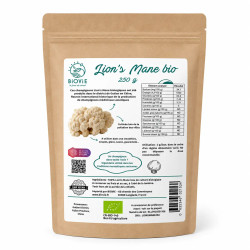
For my part, I recommend starting with the powdered form before moving on to the others.
Specifically, here are the dosages used in the main clinical studies:
- Mild cognitive impairment : 3 g per day for 16 weeks (Mori study 2009)
- Early-onset Alzheimer's : 1 g per day (enriched with erinacine A) for 49 weeks (Li study 2020)
- Anxiety and stress : 1.2 g per day for 8 weeks (Nagano study 2010)
- General maintenance : 0.5 to 2 g per day continuously
These dosages generally pertain to powder or extract. If you are using a concentrated extract (for example 10:1), the quantities will obviously be lower.
Take it in the morning or evening? Duration of treatment
The question often arises: is it better to take the Lion's Mane In the morning or in the evening? In reality, unlike stimulants, this mushroom does not disrupt sleep. Therefore, you can theoretically take it at any time of the day.
That said, taking it in the morning on an empty stomach is generally recommended to optimize effects on the nervous system. In case of gastric sensitivity, take it at the end of a meal instead.
Regarding the duration of treatment, the initial effects may appear as early as 2 to 4 weeks, but the optimal cognitive benefits are observed after 8 to 16 weeks of regular treatment. The neuroprotective effects gradually establish with continuous intake.
Before starting a Lion's Mane regimen, some experts recommend a preparation phase to optimize absorption. Understanding the Role of enzymes in digestion can help you maximize the benefits of your treatment.
How to choose a good Lion's Mane product ?
Essential quality criteria
In France, research on the Lion's Mane increased by 90% in one year. This explosion of interest has unfortunately led to the arrival of products of very variable quality on the market. Here are the essential criteria for making a good choice:
- Standardization in active ingredients : look for a product with a guaranteed beta-glucan content (ideally a minimum of 30%) and/or hericenones
- Toxicological analyses : the product must be tested for heavy metals, pesticides, and contaminants
- Organic certification : if it is organic, you can go for it (this is a convinced agronomist with 30 years of experience speaking)
- Complete traceability : you should be able to know where the product comes from and how it was grown
Origin Europe vs Asia: What You Need to Know
The question of origin is important. The majority of the Lion's Mane on the market comes from China, where the cultivation of this mushroom is an ancient tradition.
European or French-origin products are more expensive when they start. The French market for fungal supplements currently represents 48 million euros, with a growth of 38% in two years. This expansion has encouraged the development of high-quality local sectors. To be continued...
A good supplier should be able to tell you precisely where and how their mushroom was cultivated.
Discover our product sheet here
Carpophore, mycelium, or both ?
This is a question that comes up often. The fruiting body (the carpophore) mainly contains hericenones. The mycelium is richer in erinacines. Both compounds stimulate NGF, but through slightly different mechanisms.
A quality product ideally combines both parts for a complete action. Be wary of products based on mycelium grown on grains: they often contain a large proportion of starch and a low concentration of active ingredients. Prefer mycelium grown on a wood substrate.
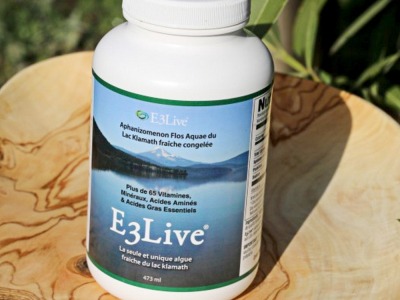
For a comprehensive action on cognitive functions, Lion's Mane combines perfectly with Klamath algae, known for its richness in phenylethylamine (PEA), a precursor of well-being neurotransmitters.
Lion's Mane FAQ
What are the benefits of Lion's Mane ?
Lion's Mane helps improve memory and concentration, supports neurons against degeneration, helps reduce anxiety, and supports digestive health. These effects are validated by human clinical studies. A course of 8 to 16 weeks at a dosage of 1 to 3 g per day generally shows measurable results.
Is Lion's Mane dangerous ?
Lion's Mane is generally well tolerated with few reported side effects. It is contraindicated in cases of fibromyalgia, interstitial cystitis, polycystic ovary syndrome (PCOS), or mushroom allergies. If you are on medication, consult your doctor before starting a course.
When to take Lion's Mane: morning or evening ?
Taking it in the morning on an empty stomach is generally recommended to optimize effects on the nervous system. If you have gastric sensitivity, take it at the end of a meal. Unlike stimulants, Lion's Mane does not disrupt sleep and can theoretically be taken in the evening.
How long before seeing the effects of Lion's Mane ?
The initial effects may appear as early as 2 to 4 weeks, but optimal cognitive benefits are observed after 8 to 16 weeks of regular treatment. The neuroprotective effects gradually develop with continuous use.
What is the difference between the fruiting body and the mycelium ?
The fruiting body (carpophore) contains hericenones, while the mycelium is richer in erinacines. Both compounds stimulate NGF. A quality product ideally combines both parts for a complete action.
Can Lion's Mane help with Alzheimer's ?
Clinical studies show improvements in cognitive abilities in patients with mild Alzheimer's after several months of supplementation. Lion's Mane is not a treatment, but it can be considered as a complement to medical care, with the doctor's approval.
How to choose a good Lion's Mane product ?
Favor a product of European or French origin, cultivated on a wood substrate (not cereals), with standardization in beta-glucans and/or hericenones, available toxicological analyses, and ideally an organic certification. Avoid imported products without traceability.
In summary
Here, I hope this comprehensive overview has allowed you to better understand this fascinating mushroom that is the Lion's Mane. Between ancient tradition and modern scientific validation, it represents a serious option for anyone wishing to naturally support their cognitive functions.
What particularly fascinates me is this unique ability to stimulate NGF and BDNF, these essential growth factors for our neurons. It's not a temporary stimulant like caffeine, but a true support for long-term neuronal regeneration.
For fight against fatigue and mental fog, Lion's Mane fits perfectly into a holistic health approach that also includes a living diet, quality sleep, and regular physical activity.
In a preventive health approach, understanding the mechanisms of autophagy and longevity can also help you optimize the benefits of your medicinal mushroom treatments.
Trying it is adopting it! But as always, do it wisely: choose a quality product, follow the recommended dosages, and don't hesitate to consult a healthcare professional if you have any doubts.
Update: March 2026. Article approved by Éric Viard, founder of Biovie and engineer ISTOM, co-author of " Seaweed in everyday life "(Gallimard, 2024) —" Best cookbook in the world, Gourmand Cookbook Awards 2025, and Best cookbook in France, National Academy of Cuisine 2025.