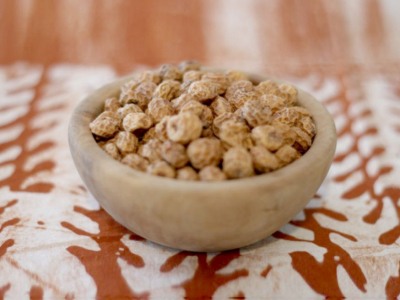
Tiger Nut: Composition, Uses and Precautions - Complete Guide
The tiger nut (Cyperus esculentus) is one of the foods I introduced among the first in France - and frankly, it wasn't easy to make it known at the time. This tiny tuber with a sweet hazelnut flavor was so unknown that even in organic stores, customers would walk past it without stopping. Today, science is catching up with what Mediterranean and African civilizations have known for millennia: the tiger nut is a true nutritional gem. Fiber, healthy fats, minerals: here is its composition, its culinary uses, the precautions to know and how we consume it at home.
What is the tiger nut?
The tiger nut (Cyperus esculentus) is the tuber of a perennial herbaceous plant from the sedge family - a distant cousin of the papyrus of ancient Egypt. That already gives it a certain character, doesn't it? There are three main varieties: yellow, brown, and black. The yellow variety dominates the market for its taste qualities: sweet, slightly sugary, with that little hazelnut taste that always pleasantly surprises those who discover it.
It is also known as "earth almond", "tiger nut", or "sweet pea". It was already consumed in ancient Egypt - archaeological traces attest to its presence in tombs dating back 4,000 years. In Spain, a drink similar to horchata de chufa is documented as early as the 15th century. In short, it's not a trendy food invented by marketers: it's a forgotten vegetable that has come back into favor, and it's no coincidence.
Origin and cultivation of organic tiger nut
The tiger nut originates from the Mediterranean basin. Today, it is mainly cultivated in Northwest Africa and in the province of Valencia in Spain - the historical cradle of horchata de chufa, that creamy drink found in all Spanish grocery stores and which captivates every tourist from the first sip. It has also acclimatized to various latitudes in Europe and California.
In France, the tiger nut remains rare enough in organic circuits to be considered a forgotten vegetable. This is precisely why we integrated it very early at Biovie, taking care to select producers practicing organic and fair agriculture. For us, traceability is not a marketing argument - it's a fundamental requirement.
"Sliced tiger nut, fresh coconuts... These are rare products that I only find at Biovie!" - Samantha Montalban ★★★★★ (Google)
Fair trade tiger nut from Niger, Amazon nuts from Bolivia, activated buckwheat from Brittany, and activated oilseed purées made in Alsace by Kaly: this range brings together oilseeds and seeds of raw quality, most of them soaked then dehydrated at low temperature (activation). To get started with activation, an activated almond or hazelnut purée is easier to use than a whole oilseed you have to soak yourself. For everyday raw cooking, tiger nut (whole, sliced or as a purée) comes in several formats suited to different uses, from homemade plant milk to crunchy snacks., 20
products
This is often the first question people ask me when they discover tigernut. And the answer is exciting: its culinary uses are much broader than the Spanish horchata that most imagine.
As a snack: to munch on raw and dry, or soaked for a few hours to soften it - ideal for an aperitif, like nibbling on hazelnuts
As homemade tiger nut milk: blend soaked tiger nuts with filtered water, then strain - a naturally sweet and creamy plant-based alternative, without additives
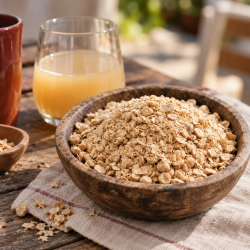
As tiger nut flakes: in porridge, muesli, or a smoothie bowl for breakfast - the simplest option to start with
As sliced tiger nuts for breakfast: sprinkled on a plant-based yogurt or in a bowl - a pleasant texture and a natural sweet note
As flour: blend dry tiger nuts - excellent for raw tart bases or gluten-free pastries, as a substitute for almond powder.
In cooking: risottos, raw desserts, energy bars - find all our ideas in our tiger nut flake recipes
For a complete comparison of plant-based alternatives, our article on plant-based milks will give you a useful overview.
“I recently ordered nori sheets and tiger nuts. High-quality products at affordable prices.” - Carole Sophie Walsser ★★★★★ (Trustpilot)
Gluten-free tiger nut: replacing rice, corn and oat flakes
Tiger nut is neither a grain nor a nut: it's a tuber. It therefore contains no gluten.
What it offers compared with other gluten-free options
The most common gluten-free alternatives are rice flour, corn semolina and starches. The naturally sweet flavour of tiger nut lets you cut the added sugar in a recipe: it is a winning swap in terms of taste and texture.
In place of oat flakes
This is the simplest substitution to make, and the most common among our customers:
In a muesli or granola: replace oat flakes with tiger nut flakes, measure for measure. Our raw mueslis - plain, cocoa or white mulberry - are in fact built on this base.
In a porridge: soak the flakes overnight in a plant-based milk or homemade tiger nut milk. They soften without cooking and the preparation stays raw.
At breakfast, as is: sliced tiger nut is sprinkled over a bowl of fruit or a plant-based yoghurt, exactly as you would with flakes.
In raw pastry: tart bases, truffles and bars
This is where tiger nut really shines, because it provides the binding, the crunch and the sweetness all at once.
A raw tart base: blend tiger nut flakes with dates and nuts until you get a dough that holds together when pressed, then press it into the tin. It works as the base for both a raw red-fruit cheesecake and a chocolate tart.
Raw cacao truffles: tiger nut ground into flour softens the bitterness of cacao and avoids the need to add sugar.
No-bake energy bars and biscuits: tiger nut flour (made simply by blending whole dried tiger nut) replaces almond powder.
A creamy filling: tiger nut purée is used like a nut butter, to spread or to fold into a dessert mixture.
If you are not used to eating a lot of fibre daily (which is often the case), start with 10 to 15 g instead and increase gradually over one to two weeks. This avoids the temporary bloating that can occur when a fibre-rich food is introduced too abruptly. Sliced tiger nut at breakfast is an excellent place to start.
How much tiger nut per day?
The recommended dose for an adult is 25 to 30 g per day - about a small handful of whole tubers, or 2 to 3 tablespoons of tiger nut flakes.
If you're not used to consuming a lot of fiber daily (and that's often the case), start with 10 to 15 g and gradually increase over one to two weeks. This avoids temporary bloating that sometimes occurs when introducing a fiber-rich food abruptly. Sliced tiger nuts for breakfast is an excellent starting point.
Are there any dangers with tiger nuts?
The question “tiger nut danger” generates a lot of searches - and honestly, it's a good question to ask before incorporating a new food. Here's an objective point on what you need to know.
Possible bloating at the start of consumption: the high fiber content can cause flatulence or digestive discomfort if introduced too quickly. It is not dangerous - it's a normal adaptation reaction of the microbiota. Start slowly.
Caloric density to consider: with about 460 kcal per 100 g, tiger nut is an energy-rich food. In the context of a strict low-calorie diet, moderate the quantities. It is not a "free-eating" food if caloric balance is your main constraint.
Caution for kidney pathologies: its richness in potassium requires caution for people suffering from kidney failure. Consult your doctor if this applies to you.
In summary: tiger nut is a safe food for the vast majority of healthy people, consumed in the recommended quantities (25-30 g/day). No particular danger - just common sense, as with any fiber-rich food.
How to store tiger nut?
Tiger nut is very easy to store - this is one of its practical advantages, similar to almonds or hazelnuts, thanks to its low natural water content. In its sliced form (which has a larger surface area exposed to air), storage is optimized under vacuum thanks to Biovie's Bocup system. Under good conditions - cool, dry, and away from light - tiger nut can be stored without issue for 6 to 12 months. A practical feature appreciated for a food consumed a little each day.
FAQ - Frequently Asked Questions about Tiger Nut
How much tiger nut to consume per day?
The recommended dose for an adult is 25 to 30 g per day, which is about a small handful of tubers. If you are not used to consuming a lot of fiber, start at 10-15 g and gradually increase over 1 to 2 weeks to avoid bloating.
Is tiger nut gluten-free?
Yes, tiger nut is naturally gluten-free. Tiger nut flour can replace almond powder or wheat flour in many recipes, in equal weight.
How to make homemade tiger nut milk?
Soak 100 g of tiger nut in water for 24 to 48 hours. Drain, then blend with 1 liter of filtered water for 2 to 3 minutes. Strain with a nut milk bag. You can add a date or a bit of cinnamon for natural sweetness. Check out our homemade tiger nut milk guide for all the tips.
Are there any contraindications for tiger nut?
Tiger nut does not present any major contraindications at normal dietary doses (25-30 g/day). Bloating may occur at the beginning of consumption due to the fibers - they disappear with gradual adaptation. People with kidney failure should monitor their potassium intake. In case of hormonal treatment or pregnancy, consult your doctor.
The information presented in this article is provided for informational purposes only and does not constitute medical advice. Consult a qualified healthcare professional before making any changes to your diet or supplementation. As part of a varied and balanced diet and a healthy lifestyle.









_1.JPG)