
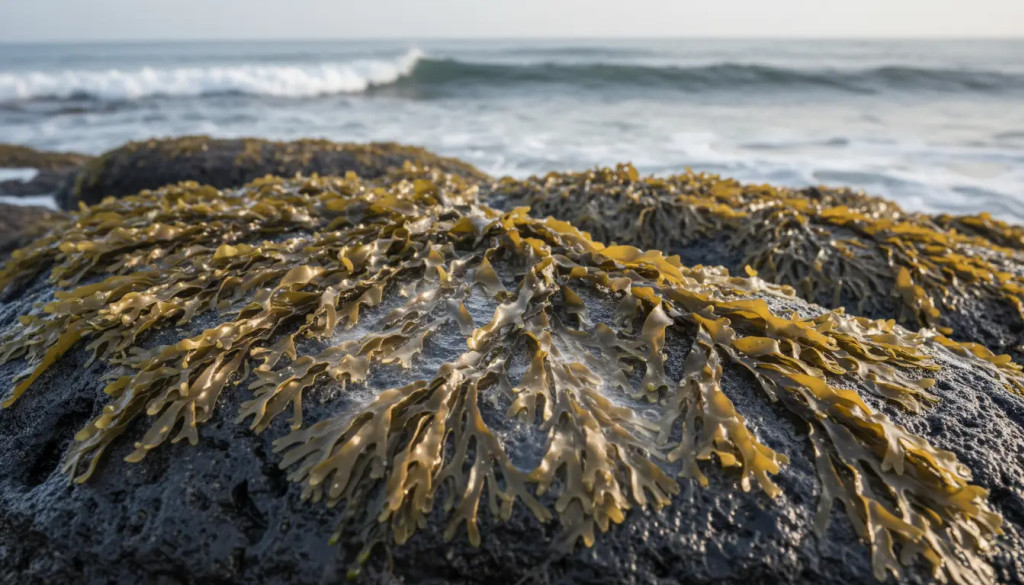
Fucoidan, a sulfated polysaccharide from brown algae, activates SIRT6 – the key enzyme for DNA repair and longevity – increasing the lifespan of male mice by 13% according to the study from the University of Rochester published in March 2025. This discovery partly explains why Japan and South Korea, major consumers of seaweed, have the highest life expectancies in the world.
But how exactly does this mechanism work? Which algae should be favored to benefit from fucoidan? And can these results be applied to humans? This article presents the current state of science on fucoidan and SIRT6, with all the necessary nuances to understand this major advancement in longevity research.
The Rochester 2025 Study: A Major Discovery for Longevity
Protocol and key results
The team of Dr. Andrei Seluanov and Dr. Vera Gorbunova from the University of Rochester (United States) published a landmark study in March 2025 in aging research.[1]. Their work, available on bioRxiv as a preprint, demonstrates for the first time that a pharmacological activator of SIRT6 can significantly extend the lifespan of aged wild-type mice.
The experimental protocol involved 80 C57BL/6 mice (40 males and 40 females) aged 15 months at the start of the study – equivalent to about fifty years in humans. The animals received approximately 278 mg of fucoidan per day through their water and food.
The observed results are remarkable:
- 13% increase in median lifespan in male mice
- Significant reduction of fragility (frailty) in males and females
- Reduction of epigenetic biological age about one year in both sexes
- Repression of LINE1 elements at the transcriptional and chromatin level
The specificity of fucoidan: a unique activator of SIRT6
What distinguishes fucoidan from other previously tested anti-aging compounds is its ability to simultaneously activate both enzymatic functions of SIRT6: deacetylation. and mono-ADP-ribosylation (mADPr)[1].
This dual activation is particularly significant because previous studies have shown that the mADPr activity of SIRT6 is naturally high in some human centenarians.[8]. Fucoidan could therefore mimic a natural longevity mechanism.
Notable fact: when the study was reproduced on SIRT6-deficient (knockout) mice, fucoidan showed no beneficial effect on the survival of the newborns, confirming that its effects indeed occur through the activation of this enzyme.
At Biovie, we observe that our regular seaweed customers report increased vitality – this study provides a potential scientific explanation for these empirical observations.
SIRT6: The longevity enzyme at the heart of the mechanism
What is SIRT6 ?
Sirtuins form a family of seven NAD+-dependent enzymes in mammals. Among them, SIRT6 holds a unique position in the regulation of cellular aging.[7].
Located in the cell nucleus, SIRT6 has a triple enzymatic activity:
- Deacetylase: It removes acetyl groups from histones, modulating gene expression.
- Deacylase: it eliminates the fatty chains from proteins
- Mono-ADP-ribosyltransferase (mADPr): she transfers ADP-ribose groups onto target proteins
Why is SIRT6 crucial for longevity ?
The evidence of the importance of SIRT6 in aging is manifold:
Loss-of-function studies: SIRT6-deficient mice develop a dramatic accelerated aging syndrome and generally die before the age of 30 days.[4]. They exhibit severe genomic instability, hypoglycemia, and lymphopenia.
Overexpression studies: Conversely, the overexpression of SIRT6 in male mice significantly extends their lifespan.[5].
Observations in human centenarians: Studies have shown that some centenarians exhibit naturally high SIRT6 mADPr activity, suggesting a direct link with exceptional longevity.[9].
Fucoidan: The most powerful natural activator of SIRT6 identified
In 2017, an international team including researchers from the NIH (National Institutes of Health) identified fucoidan as an activator of SIRT6.[3]. Their work, published in Marine Drugs, showed that the fucoidan extracted from Fucus vesiculosus increases the deacetylase activity of SIRT6 by 355 times at a concentration of 100 μg/mL.
This activation is remarkably specific: tested on other sirtuins (SIRT1, SIRT2, SIRT3), fucoidan showed no significant effect, confirming its targeted action on SIRT6.[3].
For comparison, other compounds sometimes presented as sirtuin activators—such as resveratrol or quercetin—have shown much more modest effects, or even inhibitory effects depending on the experimental conditions.[7].
The 4 anti-aging mechanisms of fucoidan via SIRT6
1. DNA Repair and Genomic Stability
The accumulation of DNA damage is one of the pillars of cellular aging.[18]. Fucoidan, through the activation of SIRT6, promotes the efficient repair of DNA double-strand breaks – a particularly deleterious type of damage.
SIRT6 facilitates this repair through several mechanisms.[6] :
- Deacetylation of histone H3K56, which allows the recruitment of repair factors BRCA1, RPA, and 53BP1
- Activation of the homologous recombination repair pathway (HR)
- Stimulation of the non-homologous end joining (NHEJ) pathway
The companion study published in April 2025 by Robbins and collaborators confirmed that fucoidan improves DNA repair in a SIRT6-dependent manner.[2].
2. Repression of LINE1 elements
LINE1 elements (Long Interspersed Nuclear Elements) are retrotransposons – sometimes referred to as "jumping genes" – that make up about 17% of the human genome. Normally silent, their reactivation with age contributes to genomic instability and chronic inflammation.[19].
The Rochester study demonstrated that fucoidan significantly represses the expression of LINE1 at the transcriptional, chromatin, and DNA methylation levels. This repression specifically depends on the mADPr activity of SIRT6.[1].
3. Sennomorphic activity
Senescent cells – these "zombie" cells that have stopped dividing but resist death – accumulate with age and secrete inflammatory factors that disrupt the surrounding tissues.[20].
The study of Robbins and others. (2025) identified fucoidan as a powerful senomorphic – that is, a compound that suppresses the secretory phenotype of senescent cells without necessarily eliminating them.[2].
Fucoidan reduces the expression of genes associated with inflammation (NF-κB, IL-6, IL-8 pathways), Wnt signaling, and extracellular matrix remodeling.
4. Modulation of chronic inflammation
Chronic low-grade inflammation – sometimes referred to as "inflammaging" – is recognized as a central driver of aging and associated diseases.[21].
The transcriptomic analysis of tissues from mice treated with fucoidan revealed a significant downregulation of inflammatory pathways in the liver and lungs, with a gene profile closer to that of young mice.[1].
Our organic wakame Dehydrated at a low temperature (40°C) preserves the integrity of sulfated polysaccharides like fucoidan, allowing one to fully benefit from its properties.
Fucoidan content by seaweed species: a comprehensive comparison
Not all brown algae contain the same amounts of fucoidan. Here is a comparison based on data from scientific literature.[10][11] :
Algae with fucoidan levels:
Mozuku, Cladosiphon okamuranus: 15-20% (very high)
Fucus (bladderwrack), Fucus vesiculosus 4-10%
Mekabu (wakame sporophyll), Undaria pinnatifida 1-4% Available Biovie ✅Yes
Wakame (blade) Undaria pinnatifida 0.5-1.5% Available Biovie: ✅ Yes
Kombu Saccharina japonica 0.5-1%, Available Biovie: ✅ Yes
Sea bean Himanthalia elongata, Variable Availability Biovie: ✅ Yes
Important notes:
- The fucoidan content varies according to the harvest season, geographical location, and extraction method.[11].
- The source used in the Rochester study was primarily fucoidan from Fucus vesiculosus. However, fucoidans from different species share similar chemical structures and comparable biological effects on SIRT6.[3].
- The mekabu, the reproductive part of wakame, has a concentration 2 to 3 times higher than the blade itself.[14].
Discover our organic wakame and our organic kombu, two brown algae rich in natural fucoidan harvested in Brittany.
Okinawa and Japan: the seaweed-longevity link validated by epidemiology
The centenarians of Okinawa and their consumption of seaweed
The Okinawa archipelago has one of the highest concentrations of centenarians in the world, with 68 centenarians per 100,000 inhabitants, which is more than three times the American average.[15].
The Okinawa Centenarian Study (OCS), founded in 1975 by Dr. Makoto Suzuki, has examined over 1,000 centenarians from the region.[16]. Their observations reveal a traditional diet rich in purple sweet potato (beni imo), green and yellow vegetables, soy-based products, and Brown algae, including kombu and wakame.
Kombu is used daily in dashi broth, the base of many traditional dishes.[15]. These algae are considered "food-medicine"(nuchi gusui) in Okinawan culture.
Epidemiological correlation
Japan and South Korea – the two largest consumers of seaweed in the world – have the highest life expectancies: 84.3 years for Japan in 2023 according to the WHO.[24].
This correlation does not prove direct causation. However, the researchers of the Rochester study explicitly suggest that the traditional consumption of seaweed rich in fucoidan could contribute to this exceptional longevity.[1].

From the lab to the plate: can these results be applied to humans ?
What we know
Solid evidence:
- Fucoidan powerfully activates SIRT6. In vitro[3]
- This activation extends the lifespan and improves the health of aged mice.[1]
- Dietary fucoidan is absorbed by the human intestine and detectable in the blood.[12]
- Populations that consume seaweed live longer (epidemiological data)
Which remains to be demonstrated:
- The effectiveness of dietary fucoidan (vs purified extract) on SIRT6 in humans
- The optimal dosage for measurable effects
- The translation of mouse results to humans through clinical trials
Bioavailability of dietary fucoidan
A Japanese study from 2018 demonstrated that dietary fucoidan is indeed absorbed by the human intestine.[12]. After consuming mozuku, researchers detected fucoidan in the blood serum of the participants, with a peak concentration approximately 6 to 9 hours after ingestion.
Our position
At Biovie, we do not claim that algae are a "fountain of youth." We simply observe that very recent science is gradually confirming the benefits of compounds found in algae, which have been empirically noted among people who consume them regularly, that these foods have been safely consumed for millennia, and that they naturally fit into a balanced diet.
How to incorporate brown algae into your diet
3 simple ways to start
1. Traditional (cooked) dashi broth
Soak 5 cm of kombu in 1 liter of cold water for 30 minutes to 2 hours. Heat gently without bringing to a boil (remove the kombu beforehand). This umami broth serves as a base for your soups, risottos, or cooking legumes.
2. The express wakame salad
Rehydrate a handful of dried wakame in cold water for 5 minutes. Drain, season with sesame oil, a dash of soy sauce, and sesame seeds. Ready in 10 minutes.
3. Seaweed flakes as a sprinkle
Add seaweed flakes to your salads, soups, vegetables, or even your toast. It's the simplest way to gradually increase your intake.
Our book "Seaweed in Everyday Life", elected the best wellness cookbook of 2025 and the best world cuisine book of 2025, offers 40 accessible recipes to help you get acquainted with these superfoods from the sea. Eric and Aurélie also offer a Training on this topic.
Precautions for use
Iodine and thyroid : Brown algae are naturally rich in iodine. In the case of thyroid disorders (hyperthyroidism, Graves' disease, Hashimoto's thyroiditis), consult your doctor before increasing your consumption of algae.
ANSES Recommendations: The National Agency for Food, Environmental and Occupational Health Safety recommends not exceeding 150 μg of iodine per day for adults. A 5 g serving of dried kombu can contain 1,000 to 3,000 μg. Vary the types of seaweed and moderate the quantities of kombu.[22].
Anticoagulants: Fucoidan has mild anticoagulant properties. If you are taking anticoagulants, inform your doctor about your consumption of seaweed.[13].
Frequently Asked Questions (FAQ)
Is fucoidan really effective in humans or only in mice ?
Studies demonstrating the increase in lifespan have been conducted in mice.[1]. However, several elements suggest a possible transposition in humans: the intestinal absorption of fucoidan is confirmed in humans.[12], SIRT6 plays a similar role in human aging, and epidemiological data from Okinawa show a correlation between seaweed consumption and longevity. Human clinical trials are still necessary.
Which algae contains the most fucoidan ?
MozukuCladosiphon okamuranus), Japanese seaweed, has the highest content (15-20% of dry weight). Among the seaweeds available in Europe, fucus contains 4-10%. Wakame and kombu, available at Biovie, contain 0.5-1.5% – significant amounts in the context of regular consumption.[10].
Can fucoidan be taken as a dietary supplement instead of in seaweed ?
Fucoidan supplements exist. However, the quality and biological activity vary significantly depending on the source and extraction process. Edible seaweeds offer the advantage of a millennia-long safety record and synergy with other bioactive compounds (fucoxanthin, alginates, minerals).
How much seaweed should be consumed to benefit from the effects of fucoidan ?
There is no official recommendation yet. In Okinawa, traditional consumption includes kombu daily.[15]. A portion of 5-10 g of dried seaweed per day, varied between wakame, kombu, and other brown seaweeds, represents a reasonable amount aligned with the habits of centenarian populations.
Is fucoidan safe for the thyroid ?
Fucoidan itself does not directly affect the thyroid. However, the brown algae that contain it are rich in iodine. For people without thyroid problems, this intake is generally beneficial. In the case of a pre-existing thyroid condition, consult your doctor.[22].
Does fucoidan work on sirtuins other than SIRT6 ?
No, fucoidan exhibits remarkable specificity for SIRT6. Tested on SIRT1, SIRT2, and SIRT3, it showed no significant activation.[3]. This specificity is an advantage because it allows for targeted action without interference with other metabolic pathways.
Was the Rochester study published in a peer-reviewed journal ?
In January 2026, the study is available as a preprint on bioRxiv. It has not yet been published in a peer-reviewed journal. However, the team of Seluanov and Gorbunova is internationally recognized in the field of aging research.
Conclusion
The Rochester 2025 study marks a significant advancement in our understanding of longevity mechanisms. For the first time, a natural compound – fucoidan from brown algae – has demonstrated its ability to extend the lifespan of mammals by activating SIRT6, a key enzyme in cellular repair.
This discovery provides a scientific basis for the empirical observations accumulated over millennia by cultures that consume seaweed, from Okinawa to Brittany.
At Biovie, we offer high-quality organic brown seaweeds – wakame, kombu, sea beans – harvested in Brittany using sustainable methods. Because longevity might just begin on your plate.
Explore our organic brown algae
Wakame, kombu, sea beans: natural sources of fucoidan harvested in Brittany.
→ Discover our seaweeds
"Algae in Everyday Life" – Voted Best Wellness Cookbook 2025
40 recipes to easily enjoy the benefits of seaweed.
→ Order the book
Bibliography
Primary sources
- Biashad SA, et al. (2025). SIRT6 activator fucoidan extends healthspan and lifespan in aged wild-type mice. bioRxiv. doi:10.1101/2025.03.24.645072
- Robbins PD, et al. (2025). Fucoidans are senotherapeutics that enhance SIRT6-dependent DNA repair. bioRxiv. doi:10.1101/2025.04.27.650852
- Rahnasto-Rilla M, et al. (2017). The identification of a SIRT6 activator from brown algae Fucus distichus. Marine Drugs, 15(6):190. doi:10.3390/md15060190
Studies on SIRT6 and longevity
- Mostoslavsky R, et al. (2006). Genomic instability and aging-like phenotype in the absence of mammalian SIRT6. Cell, 124(2):315-329. doi:10.1016/j.cell.2005.11.044
- Kanfi Y, et al. (2012). The sirtuin SIRT6 regulates lifespan in male mice. Nature, 483:218-221. doi:10.1038/nature10815
- Kugel S, Mostoslavsky R. (2014). Chromatin and beyond: the multitasking roles for SIRT6. Trends Biochem Sci, 39(2):72-81. doi:10.1016/j.tibs.2013.12.002
- You W, Bhatt R. (2022). Emerging therapeutic potential of SIRT6 modulators. J Med Chem, 65(14):9463-9480. doi:10.1021/acs.jmedchem.1c00601
- Klein MA, et al. (2020). Biological and catalytic functions of sirtuin 6. J Biol Chem, 295(32):11021-11041. doi:10.1074/jbc.REV120.011438
- Simon M, et al. (2022). LINE1 derepression in aged wild-type and SIRT6-deficient mice drives inflammation. Cell Metab, 29(4):871-885. doi:10.1016/j.cmet.2019.02.014
Studies on fucoidan
- Luthuli S, et al. (2019). Therapeutic effects of fucoidan: a review. Marine Drugs, 17(9):487. doi:10.3390/md17090487
- Ale MT, et al. (2011). Important determinants for fucoidan bioactivity. Marine Drugs, 9(10):2106-2130. doi:10.3390/md9102106
- Kadena K, et al. (2018). Absorption study of mozuku fucoidan in Japanese volunteers. Marine Drugs, 16(8):254. doi:10.3390/md16080254
- Cumashi A, et al. (2007). A comparative study of fucoidans activities. Glycobiology, 17(5):541-552. doi:10.1093/glycob/cwm014
- Mak W, et al. (2013). Fucoidan from New Zealand Undaria pinnatifida. Carbohydr Polym, 95(1):606-614. doi:10.1016/j.carbpol.2013.02.047
Studies on Okinawa and Longevity
- Willcox DC, et al. (2014). The Okinawan diet: health implications. J Am Coll Nutr, 28(Suppl):500S-516S. doi:10.1080/07315724.2009.10718117
- Willcox BJ, et al. (2008). Demographic characteristics of centenarians in Okinawa. Mech Ageing Dev, 138:1-10. doi:10.1016/j.mad.2018.09.002
- Willcox BJ, et al. (2006). Siblings of Okinawan centenarians share lifelong mortality advantages. J Gerontol A, 61(4):345-354. doi:10.1093/gerona/61.4.345
Cellular aging
- López-Otín C, et al. (2013). The hallmarks of aging. Cell, 153(6):1194-1217. doi:10.1016/j.cell.2013.05.039
- De Cecco M, et al. (2019). L1 drives IFN in senescent cells. Nature, 566:73-78. doi:10.1038/s41586-018-0784-9
- van Deursen JM. (2014). The role of senescent cells in ageing. Nature, 509:439-446. doi:10.1038/nature13193
- Franceschi C, et al. (2018). Inflammaging: a new immune-metabolic viewpoint. Nat Rev Endocrinol, 14(10):576-590. doi:10.1038/s41574-018-0059-4
Institutional sources
- ANSES (2018). Avis relatif aux recommandations sur les apports en iode. anses.fr
- Nisizawa K, et al. (1987). The main seaweed foods in Japan. Hydrobiologia, 151:5-29. doi:10.1007/BF00046102
- OMS (2023). Global health observatory – Life expectancy at birth. who.int