 Fast delivery
.png)
 Fair prices


Summary
With Aurélie, we consume some freeze-dried fruits For years, and frankly, it has become a staple of our raw food diet. These little crunchy wonders have revolutionized the way we consume exotic fruits on a daily basis.
The freeze-dried fruits retain 95 to 97% of their vitamins and nutrients Thanks to cold drying, which preserves enzymes, colors, and flavors for 18 months to 2 years. At Biovie, our 10 varieties – durian, mango, jackfruit, pineapple, banana, lychee, longan, and others – are harvested at maturity in Thailand and Vietnam before freeze-drying. The result: a concentrated taste and optimal nutritional benefits.
In this guide, I share with you everything we have learned about these superfoods, to help you choose the fruits that truly meet your needs. If you wish to delve deeper into the nutritional aspects, I invite you to discover all the benefits of freeze-dried fruits.
Why freeze-dried fruits have become essential
Are you lacking energy at the office? Are your children asking for candy? Are you going hiking and looking for a light and nutritious snack? The freeze-dried fruits meet all these needs, and much more.
The global freeze-dried food market today represents 40 billion dollars, with a projection of 75 billion by 2033. In France, the annual growth reaches 6%. It is not a coincidence: more and more people are discovering the benefits of this age-old preservation technique that has been brought back into fashion.
Specifically, here is what makes freeze-dried fruits so special:
- Exceptional nutrient preservation : unlike traditional dehydration, which preserves only about 60% of vitamins, freeze-drying retains 95 to 97%
- Extreme lightness : the fruits go from 80-90% water to only 4-5% residual moisture
- Extended lifespan : up to 18 months to 2 years without refrigeration
- Practicality : ready to eat, portable, no preparation needed
To give you an idea: a 200g bag of freeze-dried pineapple is equivalent to 1.5 to 2 kg of fresh fruit. This puts the quality-price ratio into perspective !
These fruits fit perfectly into our philosophy of living food, which prioritizes raw foods rich in enzymes to preserve all their vitality.

What is freeze-drying? The process explained simply
The principle is simple, even if the technology behind it is sophisticated. The lyophilization - which is also called cold drying or lyophilization in English – involves removing water from food through sublimation.
How does it work, concretely ?
- Freezing : The fruits are first frozen at very low temperatures (usually between -40°C and -50°C)
- Vacuum sealing : The frozen fruits are then placed in a vacuum chamber.
- Sublimation : By gently heating under vacuum, water transitions directly from a solid state (ice) to a gaseous state (vapor), without passing through the liquid state.
It is this absence of a liquid phase that makes all the difference. The cellular structures of the fruit are not damaged, the enzymes remain active, the colors are preserved, and the flavors are concentrated.
In reality, it's a bit like putting the fruit "on pause": when you rehydrate it (or simply when you bite into it and your saliva reactivates it), it regains a large part of its initial properties.
Why 95% of the vitamins are preserved
Heat is the number one enemy of nutrients. In traditional dehydration, high temperatures (60 to 80°C) degrade a significant portion of vitamins, particularly vitamin C and B vitamins, which are very sensitive to heat.
Freeze-drying works in the cold, under vacuum. The nutrients are not "cooked" – they are simply dehydrated while maintaining their molecular integrity. This is why the freeze-dried fruits also retain their enzymes, unlike traditional dried fruits.
Lyophilization vs dehydration: what is the difference ?
I am often asked this question, so let's clarify things once and for all.
Nutrient conservation:
- Lyophilization: 95-97% preserved
- Classic dehydration: about 60%
Texture:
- Lyophilization: crunchy, airy, "vegetable meringue" texture
- Dehydration: flexible, sometimes rubbery
Taste:
- Freeze-drying: concentrated, intense, true to the fresh fruit
- Dehydration: often sweeter, flavors altered by heat
Conservation:
- Lyophilization: 18 months to 2 years at room temperature
- Dehydration: 6 to 12 months, sometimes less
Price:
- Lyophilization: more expensive (more complex and energy-intensive process)
- Dehydration: more accessible
Frankly, they are not the same products at all. Dehydrated fruits have their place in the diet, but if you are looking for maximum nutritional benefits with an exceptional taste experience, freeze-drying has no equivalent.
The 10 freeze-dried fruits by Biovie: complete guide by variety
At Biovie, we have selected 10 exceptional fruits, all harvested at maturity in their country of origin before being freeze-dried on site. This freshness at the source makes all the difference. For learn more about tropical fruits and their origins, feel free to explore our dedicated guide.
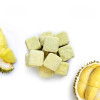
Durian Monthong (Thailand): The King of Fruits Exclusively
Here is our best-seller, and it's no coincidence. The durian is nicknamed "the king of fruits" in Southeast Asia, and the Monthong variety from Thailand is considered the most noble.
Its taste? Imagine a smooth custard with notes of vanilla and almond, with a hint of caramelized onion. I know, it might sound strange when said like that, but it's an absolutely unique explosion of flavors.
Nutritional profile:
- Exceptionally rich in potassium (more than a banana!)
- Source of magnesium and copper
- Good fiber content
- Moderate glycemic index despite its sweet taste
The freeze-dried durian from Biovie is a European exclusive. You won't find it anywhere else in this form, originating from the Chanthaburi province, renowned for producing the best durians in the world.
? ? Discover the durian, king of fruits
For smoothie enthusiasts, try our durian smoothie recipe - a surprising and delicious combination !
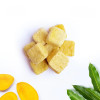
Nam Dok Mai Mango: The Premium Fiberless Variety
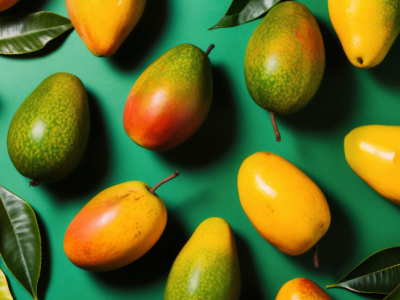
The Nam Dok Mai mango is an exceptional Thai variety, practically impossible to find fresh in Europe. Its distinctive feature? A fiberless flesh with an incredible sweetness.
If you have tasted mangoes sold in supermarkets (often picked green and artificially ripened), you are going to discover a completely different fruit. The difference is comparable to that between a garden tomato picked at maturity and a supermarket tomato.
Nutritional benefits:
- Very rich in vitamin C
- Excellent source of beta-carotene (provitamin A)
- Powerful antioxidants that contribute to skin and vision health
To learn more about this extraordinary fruit, I invite you to discover the health benefits of mango.
? ? Taste the premium Nam Dok Mai mango
Jackfruit: The Unique-Tasting Plant-Based Alternative
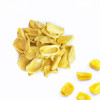
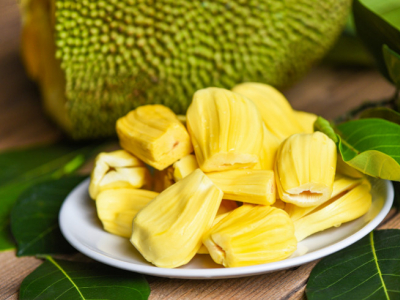
The jackfruit – or jack tree fruit – is the largest fruit in the world. It can weigh up to 35 kg! Its taste is reminiscent of a mix of banana, mango, and pineapple, with subtle floral notes.
In Asia, it has been used for centuries in both savory and sweet dishes. The freeze-dried version offers an absolutely addictive crunchy texture.
Nutritional benefits:
- Source of vitamin C
- Contains lignans, isoflavones, and saponins with antioxidant properties
- Contributes to the normal functioning of the immune system
If this fruit intrigues you, discover the 7 benefits of jackfruit in our dedicated article.
? ? Test the freeze-dried jackfruit
Pineapple: Preserved Bromelain
The pineapple is probably the most well-known tropical fruit, but the freeze-dried version reveals an unexpected taste dimension. The flavor is 10 times more concentrated than the fresh fruit !
The major advantage of freeze-drying for pineapple is that it preserves bromelain, the valuable digestive enzyme that is destroyed by heat. Canned pineapples, cooked at high temperatures, contain almost none of it.
Nutritional benefits:
- Excellent source of vitamin C
- Rich in bromelain (contributes to normal digestion)
- Source of manganese
? ? Discover the pineapple rich in bromelain
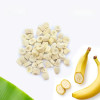
Gros Michel Banana: The Rediscovered Historic Variety
The Gros Michel banana is a bit of nostalgia in the mouth. This variety was THE reference banana until the 1950s, before being decimated by a fungus and replaced by the Cavendish that we know today.
Its taste? Much more intense, sweeter, with notes of vanilla that the Cavendish does not have. It is this banana that inspired the artificial banana flavor you find in candies – not the Cavendish !
Nutritional profile:
- Excellent source of potassium
- Rich in vitamin B6
- Good fiber content
- Quick energy source for athletes
? ? Rediscover the taste of the real banana
Lychee (Vietnam): the vitamin-rich pearl
This small fruit with translucent flesh comes from our Vietnamese suppliers certified with ISO 22000, HACCP, and IFS. The lychee is one of the fruits richest in vitamin C – much more than an orange of the same weight !
Its taste evokes rose and muscat grape, with an incomparable freshness. In its freeze-dried form, this delicate flavor is concentrated to offer a taste experience similar to a natural candy, but without any added sugar.
Nutritional benefits:
- Exceptionally rich in vitamin C
- Source of antioxidant polyphenols
- Contributes to the normal functioning of the immune system
- Good copper content
? ? Discover the ultra-vitamin-rich lychee
Longan (Vietnam): the dragon's eye with hints of honey
A close cousin of the lychee, the longan is nicknamed "dragon's eye" in Asia due to its appearance once peeled. Its taste is more musky, with notes of honey and an aromatic finesse that appeals to the most discerning palates.
Slightly less sweet than the lychee, the longan offers a different subtle taste. Frankly, it's a fruit that is rarely found in Europe and truly deserves attention.
Nutritional benefits:
- Rich in vitamin C
- Source of riboflavin (vitamin B2)
- Contains potassium
- Antioxidant properties
? ? Taste the longan with floral notes
Whole strawberries: the intensity of French flavor
Freeze-dried strawberries are truly a rediscovery of the fruit. The process concentrates the flavors so much that a single freeze-dried strawberry is equivalent in intensity to a handful of fresh strawberries.
What I particularly like about our whole strawberries is their versatility: as a direct snack for their crunchiness, blended into powder to naturally color your pastries, or rehydrated in your yogurts and smoothies.
Nutritional benefits:
- Very rich in vitamin C
- Source of manganese
- Contains antioxidants (anthocyanins)
- Low in calories
? ? Fall for whole freeze-dried strawberries
Coconut: the tropical crunch
Freeze-dried coconut offers a completely different texture and experience compared to traditional dried coconut. The crunch is lighter, more airy, and the fresh coconut taste is remarkably preserved.
It is a must-have for anyone who appreciates tropical flavors. In cooking, it integrates perfectly into granolas, energy balls, or simply as a topping on your smoothie bowls.
Nutritional benefits:
- Source of fiber
- Contains medium-chain triglycerides (MCT)
- Rich in manganese
- Source of copper and selenium
? ? Discover freeze-dried coconut
Purple dragon fruit (Pitaya): the spectacular antioxidant
The purple dragon fruit – or purple pitaya – is undoubtedly the most photogenic in our range. Its intense magenta color comes from betalains, pigments with powerful antioxidant properties.
Its taste is subtle, slightly sweet with notes of kiwi and pear. The freeze-dried version reveals a crunchy texture and a color that remains vibrant – perfect for impressing your guests !
Nutritional benefits:
- Exceptionally rich in betalains (antioxidants)
- Source of vitamin C
- Contains iron
- Good fiber content
With Aurélie, we often use pitaya powder to naturally color our smoothie bowls. The result is spectacular and 100% natural.
5 creative ways to use your freeze-dried fruits
Do not limit yourself to pure snacking! Here are my favorite uses.
1. As a direct snack: the crunchy pleasure
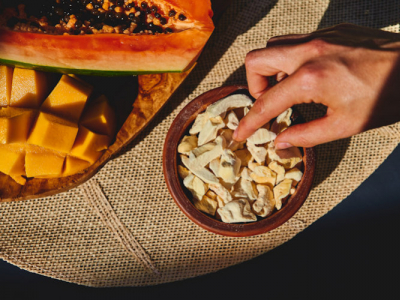
The simplest and purest way to enjoy them. Open the bag, grab a few pieces, crunch. This crunchy and airy texture, somewhat like a plant-based meringue, is absolutely addictive.
Ideal for:
- The children's snack
- The office snack
- The healthy appetizer
- Hiking or sports
2. In your smoothies and mueslis
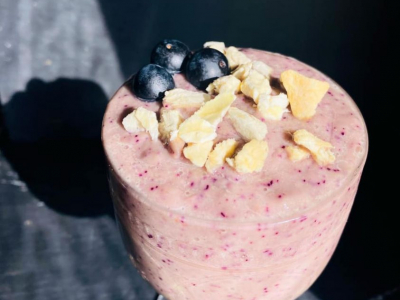
Add a few pieces of freeze-dried fruits in your smoothie before blending: they will rehydrate and bring an incredible concentrated flavor. Mango and pineapple work particularly well.
In your morning muesli or granola, they add crunch and a burst of flavor to every bite.
3. In pastry and desserts
Mix some freeze-dried fruits into powder to obtain a natural coloring and flavoring for your cakes, creams, or frostings. Strawberry and mango provide beautiful colors.
You can also use them whole as a topping on your yogurts, ice creams, or pies.
4. Rehydration and culinary uses
Dive your freeze-dried fruits in lukewarm water for a few minutes: they will regain a texture similar to fresh fruit. Perfect for using them in cooking when fresh fruits are not in season.
Rehydrated jackfruit can even be used in savory dishes – it is a very popular plant-based alternative in Asia.
5. In decoration and cocktails
To impress your guests, there's nothing like a few pieces of freeze-dried lychee or mango to decorate a cocktail or dessert. They float elegantly and rehydrate upon contact with the liquid.
Conservation and practical advice
Shelf life: up to 18 months
Not opened, our freeze-dried fruits They can be stored for 18 months at room temperature. The MDD (Minimum Durability Date) is indicated on each packet.
Once opened, ideally consume within 2 to 3 weeks, making sure to reseal the bag tightly after each use.
How to properly store your freeze-dried fruits
The enemy of freeze-dried fruits, it is the humidity. Their very low water content (4-5%) makes them hygroscopic: they absorb moisture from the air and can lose their crunchy texture.
My advice:
- Store them in a dry place, away from light.
- Carefully reseal the bag after each use (our bags are resealable).
- In case of high humidity, you can store them in an airtight container.
- No need for a refrigerator – room temperature is perfectly suitable.
If your fruits have slightly softened, you can put them in the dehydrator for a few minutes at a low temperature (less than 42°C) to restore their crunchiness.
FAQ: Your Questions About Freeze-Dried Fruits
Do freeze-dried fruits make you gain weight ?
No, the freeze-dried fruits do not cause more weight gain than their fresh fruit equivalents. They contain exactly the same calories and natural sugars—simply concentrated because the water has been removed.
The key is to keep in mind the equivalence: 30g of freeze-dried fruit is roughly equivalent to 150g of fresh fruit. Therefore, the portions are naturally smaller.
Moreover, the crunchy texture and intense taste of the freeze-dried fruits promote satiety: we generally eat less of them than we would eat fresh fruits.
Can freeze-dried fruits be given to children ?
Absolutely! It's even one of their best uses. Without added sugars, without additives, the freeze-dried fruits are a perfectly healthy alternative to industrial candies.
Children love their crunchy texture and natural sweet taste. Start with familiar fruits (banana, mango) before exploring more exotic flavors.
Only precaution: as with any dry food, ensure that young children chew well before swallowing.
What is the difference between freeze-dried and dehydrated ?
The difference is major:
- Freeze-drying It uses cold and vacuum to sublimate water (direct transition from solid to gaseous state). It preserves 95-97% of the nutrients and gives a crunchy texture.
- Dehydration uses heat to evaporate the water. It preserves only about 60% of the nutrients and gives a supple texture.
In terms of taste, texture, and nutritional value, these are really two different products.
Are freeze-dried fruits really organic ?
Our freeze-dried fruits are not certified organic, and we are completely transparent about this. Why? Because organic supply chains simply do not exist for some of these exotic fruits in Thailand and Vietnam.
On the other hand, our suppliers are certified ISO 22000, HACCP, and IFS, with analyses guaranteeing the absence of pesticide residues. We are actively working on developing organic supply chains for the future.
Our commitment: total traceability, transparency on origins, and quality controlled at every step.
How to rehydrate freeze-dried fruits ?
It's very simple: soak them in warm water for 5 to 10 minutes. They will absorb the water and regain a texture similar to fresh fruit.
You can also rehydrate them in fruit juice, plant-based milk, or directly in your smoothie. In cooking, add them to a liquid preparation (sauce, compote) and they will naturally rehydrate.
How many freeze-dried fruits to consume per day ?
There is no strict limit – they are fruits, after all! A reasonable portion is between 20 and 40g per day, which is equivalent to about 100-200g of fresh fruit.
In practice, a 200g bag can last 5 to 10 days for moderate daily snacking consumption.
Where to buy quality freeze-dried fruits ?
For some freeze-dried fruits exceptional, harvested at maturity and freeze-dried on site in their country of origin, I invite you to discover our entire range on the Biovie store.
What sets us apart:
- Harvesting at maturity in the provinces of origin (no fruits picked green)
- On-site lyophilization for maximum freshness
- Rare varieties : Monthong durian, Nam Dok Mai mango, Gros Michel banana
- 18 years of expertise in raw food and superfoods
- Eco-friendly packaging : recycled bags, compostable, "Plastic neutral"
Want to explore even more exotic flavors? Discover our exotic fruits beyond freeze-dried products.
In summary
The freeze-dried fruits represent a true revolution in the way we consume fruits. Convenient, nutritious, tasty, they adapt to all lifestyles: athletes, parents, travelers, culinary enthusiasts...
At Biovie, we have applied our expertise to this exceptional range. Each fruit is selected for its taste and nutritional qualities, picked at maturity in its place of origin, and freeze-dried on site to preserve all its richness.
Here you go, I hope this guide has shed some light on the world of freeze-dried fruits. If you have any questions, don't hesitate to contact us – Aurélie and I are always happy to share our passion for raw food.


How to choose your freeze-dried fruits according to your needs ?
With 10 varieties, it can quickly become confusing. Here is my selection guide according to your goals.
For energy and sports: durian, banana, pineapple
Are you looking for a natural energy boost? These three freeze-dried fruits are your allies:
With Aurélie, we always bring a bag of freeze-dried bananas on hikes. Ultra-light, zero waste (we eat it all!), and an immediate energy boost.
For immunity and vitamins: lychee, mango, pineapple
Need to stock up on vitamin C? Bet on this winning trio:
A daily intake of these fruits contributes to the normal functioning of the immune system, especially during periods of fatigue.
For children: a healthy alternative to candy
It is perhaps the use that makes me the most proud. Our freeze-dried fruits have become the "candy" of many children – and their parents !
Start with:
For the more adventurous:
For discovery: which fruit to start with ?
If you have never tasted freeze-dried fruits, I recommend starting with a fruit that you already know in its fresh version. Mango or pineapple are perfect for beginners.
Once you have mastered the technique (and you will!), venture towards durian or jackfruit for truly new flavors.