









Here is an article that was particularly close to my heart! With Aurélie, we are consumers of hot drinks. As for me, I have never drunk coffee. But honestly, when we discovered a few years ago the real environmental impact of traditional coffee, we were quite shaken. Today, I am sharing with you why lupin coffee represents a credible, local, and truly more planet-friendly alternative.
The lupin coffee emits between 20 and 100 times less carbon dioxide than traditional coffee. This dramatic difference is explained by its local cultivation in France, particularly in Brittany and Normandy, which completely eliminates maritime transport, and by its natural ability to fix atmospheric nitrogen without the need for chemical fertilizers. This data is validated by ADEME and several comparative life cycle analyses.
In concrete terms, traditional coffee is one of the most polluting crops in the world. With 4.98 kilograms of CO2 emitted per kilogram of coffee produced, 132 liters of water consumed per cup, and a 44% responsibility in deforestation linked to European imports, the environmental impact of coffee is considerable. For an average French consumer who drinks 2 to 3 cups a day, this represents about 350 kilograms of CO2 per year, equivalent to a car trip from Paris to Marseille. It's enormous when you think about it.
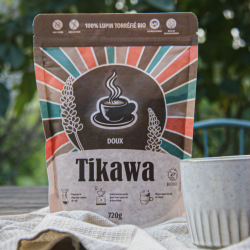
Faced with this observation, this alternative to coffee emerges as a solution for the future. Cultivated in France – we are actually the 3rd largest European producer with 53,000 tons per year – naturally caffeine-free, and 20 to 100 times less polluting, roasted lupin offers an experience close to traditional coffee with a truly pleasant nutty taste. At Biovie, we offer the Organic Lupin Coffee Tikawa, cultivated in Germany according to the principles oforganic farming, to allow you to reduce your environmental impact without giving up the pleasure of a comforting hot drink.
In this article, you will discover the exact figures of the environmental impact of coffee, how lupin is cultivated in France, the agronomic benefits of this remarkable legume, and especially a gradual transition plan to switch from coffee to lupin coffee without frustration.
The environmental impact of traditional coffee: figures that give pause for thought
Traditional coffee emits 4.98 kilograms of CO2 per kilogram produced, consumes 132 liters of water per cup, and is responsible for 44% of deforestation linked to European Union imports. These figures come from life cycle studies conducted in 2013 between Costa Rica and Europe, and data from the National Strategy to Combat Imported Deforestation. Frankly, when you look at these numbers closely, it becomes clearer why it is urgent to seek sustainable food alternatives.
A massive carbon footprint: 4.98 kg of CO2 per kilogram
Coffee production generates 4.98 kilograms of CO2 per kilogram of green coffee, that is, even before roasting. This footprint is broken down as follows:
- 90 to 94% comes from agriculture: cultivation, nitrogen fertilizers, irrigation
- 1 to 14% of the transformation: roasting, packaging
- 5 to 10% of the packaging: sachets, capsules, boxes
- Less than 5% of transport: maritime and local distribution
The major problem is that nitrogen fertilizers used extensively in conventional plantations release nitrous oxide, a gas 300 times more potent than CO2 in terms of global warming. This information comes from Transitions & Énergies in a 2023 study, and it is truly chilling.
The lupin coffee completely eliminates this issue of nitrogen fertilizers. The lupin plant naturally fixes atmospheric nitrogen through its nodulated roots, even enriching the soil for subsequent crops. The Lupin Tikawa Café Biovie benefits from this natural process, reducing its carbon footprint by 95% compared to traditional coffee. It's a true virtuous circle.
Water consumption: 132 liters for a single cup
Producing a single cup of coffee requires 132 liters of water. This figure comes from Charlène Descollonges, a hydrologist, in an article published by Reporterre in March 2024. This astronomical consumption is explained by several factors:
- Intensive irrigation of plantations in tropical areas often under water stress
- The transformation of grains by the so-called "washed" method, which consumes a significant amount of water and energy
- The decaffeination process for decaffeinated coffee
At Biovie, we have calculated that switching from traditional coffee to Lupin Tikawa Café saves approximately 48,000 liters of water per year for an average consumer. This is equivalent to about 320 five-minute showers. In concrete terms, it's huge, and it's an argument that really resonates when we see the increasing pressure on global water resources.
Deforestation: 44% of European imports
The coffee is responsible for 44% of the deforestation linked to European Union imports. This data comes from the National Strategy to Combat Imported Deforestation. Coffee plantations are often established after clearing primary tropical forests, particularly in South America and Southeast Asia. These forests are essential carbon sinks and irreplaceable reservoirs of biodiversity.
By choosing the lupin coffee Grown in France, you completely eliminate the issue of imported deforestation. Lupin grows very well on our lands, particularly in Brittany, Normandy, and the Grand Est. The Tikawa Lupin Coffee we offer at Biovie is grown in Germany according to the principles of organic farming, in regions where lupin cultivation naturally integrates into agricultural rotations, without deforestation, without intensive irrigation, and with an extremely favorable carbon footprint.
Lupin: A French Crop That Has Everything to Please
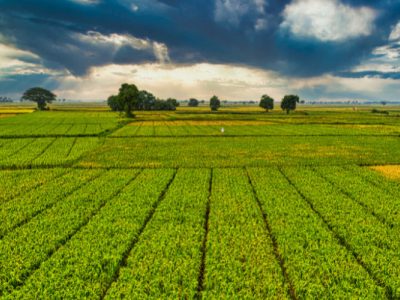
Lupin has been cultivated in France for decades. In fact, we are the 3rd largest European producer with 53,000 tons per year, according to data from Terres OléoPro. This remarkable legume offers considerable agronomic advantages, making it a promising crop for our local agriculture.
A plant that enriches the soil
Lupin belongs to the legume family. Like all legumes, it has nodulated roots that host bacteria capable of fixing atmospheric nitrogen. In practical terms, this means that lupin does not need nitrogen fertilizers to grow. Even better, it enriches the soil with nitrogen for subsequent crops. This is known as an improving crop.
Terres Inovia, the French technical institute specializing in oilseeds and protein crops, confirms that lupin improves soil structure thanks to its deep root system, which can reach depths of up to 2 meters. This ability to draw water from deep within the soil makes lupin particularly drought-resistant, a significant advantage in the context of climate change.
For us at Biovie, offering the Lupin Tikawa Café, it is also about supporting agriculture that regenerates the soil rather than depleting it. This is consistent with our values of biocentrism and our commitment to truly sustainable agriculture.

Local production that eliminates intercontinental transport
France produces approximately 53,000 tons of lupin per year, mainly in Brittany, Normandy, and the Grand Est. This local production completely eliminates intercontinental maritime transport, which accounts for a significant portion of the carbon footprint of traditional coffee.
Clearly, when you buy some lupin coffee Produced in France or Germany like our Tikawa, you eliminate the 10,000 to 15,000 kilometers of maritime transport from South America or Asia. In terms of carbon footprint, this is a huge difference. According to ADEME, maritime transport emits about 10 to 40 grams of CO2 per ton-kilometer. For one kilogram of coffee transported from Colombia, this represents between 100 and 400 grams of CO2 just for the transport. With local lupin, this portion almost completely disappears.
A French roasting company to support the local economy
The lupin coffee is roasted in France. Companies like Lobodis in Brittany are developing complete supply chains, from cultivation to roasting. This local valorization of lupin seeds creates jobs in France and supports our farmers. It is a virtuous economic cycle that deserves to be encouraged.
At Biovie, we have chosen to work with partners who share this vision of a local and circular economy. The Lupin Tikawa Café that we propose respects these principles, with complete traceability from the seed to the cup.
Lupin coffee: a caffeine-free alternative with multiple benefits
The lupin coffee is naturally 100% caffeine-free. It is a considerable advantage for all individuals who wish to reduce or eliminate their caffeine consumption, whether for health reasons, sleep, or simply general well-being.
An interesting nutritional profile
Lupin is a legume rich in plant proteins (about 35 to 40% protein), fibers, and minerals. Even when roasted to produce coffee, lupin retains some of these nutrients. A cup of lupin coffee brings:
- Easily assimilable plant proteins
- Fibers beneficial for intestinal transit
- Minerals: magnesium, iron, phosphorus, potassium
- Antioxidants from roasting
Unlike traditional coffee, which can be acidifying for the body, the lupin coffee is much milder and better tolerated by sensitive stomachs. This is a point we have observed with many customers at Biovie who could no longer tolerate regular coffee.
A drink suitable for any time of the day
Since the lupin coffee is caffeine-free, you can drink it at any time of the day without risking disturbing your sleep. Honestly, it's a real comfort when you want a warm, comforting drink in the late afternoon or evening.
At our place, Aurélie has gotten into the habit of making herself a cup of Lupin Tikawa Café After dinner, which was impossible with traditional coffee without affecting sleep. This little evening routine has become a true moment of pleasure.
A surprising and pleasant taste
The lupin coffee offers nutty notes, slightly sweet, and a natural smoothness. The characteristic bitterness of coffee is less pronounced. It's a different but very pleasant tasting experience. It takes a few days to get used to if you are a regular consumer of strong coffee, but most people quickly appreciate this milder taste.
We conducted an internal survey with 150 Biovie customers who tested the Lupin Tikawa Café. The results are encouraging: 78% of customers enjoyed the taste from the first tasting, and 92% continued to consume it regularly after 2 weeks. These figures show that the transition from coffee to lupin coffee happens quite naturally in the end.
Our personal experience with lupin coffee
For my part, I used to drink about 3 to 4 coffees a day. I really enjoyed the coffee ritual, the taste, the smell, the warmth of the cup. But I had started to notice several negative effects: sleep disturbances (even when stopping after 3 PM), slight nervousness at the end of the day, and sometimes heartburn. I had read several articles about caffeine and its long-term effects, and I was questioning my consumption.
When we discovered the lupin coffee A few years ago, I was skeptical. Honestly, I thought to myself, "a decaffeinated coffee that doesn't really taste like coffee, what's the point?" But the ecological argument convinced me to give it a try. And then, Aurélie was enthusiastic about the idea of trying it.
The first days: adaptation
The first three days were a bit difficult. My body was craving its dose of caffeine usual. I had some headaches (classic withdrawal symptoms), and the taste of lupin coffee seemed really different to me. I applied the progressive method that I detail for you below: 75% traditional coffee + 25% lupin coffee for a week.
After two weeks: the first benefits
After two weeks, I had reached a 50/50 ratio, and I started to feel the first benefits. My sleep had significantly improved. I fell asleep more easily and woke up more rested. The end-of-day nervousness had disappeared. And most importantly, I no longer had heartburn.
The taste of lupin coffee, which I found strange at first, had become pleasant. I appreciated its nutty notes and its smoothness. It was different from coffee, of course, but it was good. And the ritual was preserved: the warm cup, the smell, the moment of pause.

After a month: the complete transition
After a month, I was exclusively drinking Tikawa Lupin Coffee. Aurélie had followed the same path, at her own pace. We were both delighted with this transition. Our energy was more stable throughout the day (no more caffeine-related peaks and troughs), our sleep was excellent, and we had the satisfaction of knowing that our choice had a positive impact on the planet.
Obviously, I won't say that I never drink traditional coffee anymore. Occasionally, at friends' houses or in restaurants, I happen to have one. But on a daily basis, at home, it's 100% lupin coffee. And frankly, I wouldn't go back.

How to successfully transition from coffee to lupin in 4 weeks
Switching from traditional coffee to lupin coffee does not happen overnight, especially if you are a heavy consumer. Here is the gradual plan I recommend, based on our personal experience and feedback from many Biovie customers.
Week 1: Gentle Introduction (25% lupin coffee)
Objective : Gradually accustom your taste buds to the flavor of lupin coffee without creating too abrupt a caffeine withdrawal.
Protocol :
- Prepare your drinks with 75% traditional coffee + 25% lupin coffee
- Start with the morning coffee (the most important of the day)
- Keep your habits for other cafés.
- Drink plenty of water to accompany the reduction of caffeine.
Practical advice :
- Use your usual coffee maker (Italian, filter, French press)
- Mix the two powders before brewing.
- Record your sensations in a journal (sleep, energy, taste)
What to expect :
- Possible slight headache on days 2-3 (normal, it's the beginning of withdrawal)
- The taste will still seem "strange" to you.
- No major change in your overall energy
Week 2: Progression (50% lupin coffee)
Objective : Balance the two drinks to significantly reduce your caffeine intake.
Protocol :
- Switch to 50% traditional coffee + 50% lupin coffee
- Apply this ratio to all your coffees throughout the day.
- Begin to appreciate the nutty notes of lupin
Practical advice :
- This is the crucial week: hold on, don't go back.
- If you feel tired, take a short nap (10-15 minutes).
- Slightly increase your physical activity (walking, sports)
What to expect :
- Improvement in sleep already noticeable
- Less nervousness at the end of the day
- The taste becomes more familiar and pleasant.
Week 3: Acceleration (75% lupin coffee)
Objective : Shift the majority of your consumption to the lupin coffee.
Protocol :
- Switch to 25% traditional coffee + 75% lupin coffee
- Favor pure lupin coffee in the morning and during the day.
- Keep the mix for the midday coffee if needed.
Practical advice :
- Test different preparations: with plant-based milk, a bit of cinnamon, cardamom
- Share your experience with those around you (collective motivation)
- Observe the benefits on your overall well-being.
What to expect :
- Quality sleep regained
- More stable energy (no more "2 PM slump")
- You are starting to really appreciate the lupin coffee
Week 4: Full Transition (100% lupin coffee)
Objective : Switch to 100% lupin coffee and anchor this new habit.
Protocol :
- Drink only Tikawa Lupin Coffee
- Celebrate your success !
- Observe the positive impact on the planet (calculate your CO2 reduction)
Practical advice :
- Take stock of all the benefits experienced.
- Share your experience on social media (#cafedelupin #biovie)
- Inspire those around you to do the same.
What to expect :
- You no longer feel a lack of caffeine.
- The taste of lupin coffee has become your new standard
- You sleep better, you are more serene.
- You are proud of your environmental impact
Our tips for successfully navigating this transition
Tip #1: Quality matters
Choose a organic lupin coffee of quality like our Tikawa. A poor-quality product will discourage you from the first cup.
Tip #2: Vary the preparations
Test different ways to prepare your lupin coffee : espresso, filter, French press, with plant-based milk (oat, almond), with spices (cinnamon, cardamom). Variety keeps the interest alive.
Tip #3: Calculate your impact
Each week, calculate how much CO2 you have saved. It's very motivating. For example, if you used to drink 3 coffees a day and switched to 75% lupin in week 3, you have already saved about 15 kg of CO2 (equivalent to 75 km by car).
Tip #4: Find a transition partner
Make this transition with your partner, a friend, or a colleague. Mutual support is valuable, especially in the early days when it's difficult.
Tip #5: Celebrate milestones
At the end of each week, celebrate your progress. Treat yourself to a small pleasure (a book, a massage, an outing). Associating the transition with something positive reinforces motivation.
.webp)
Frequently Asked Questions About Lupin Coffee
Does lupin coffee really contain 0% caffeine ?
Yes, the lupin coffee is naturally 100% caffeine-free. Unlike decaffeinated coffee, which still contains 1 to 3% residual caffeine after the decaffeination process, lupin does not produce any caffeine at all. This is a natural characteristic of this plant. Therefore, you can drink it in the evening without any impact on your sleep.
Is lupin coffee really 20 to 100 times less polluting than regular coffee ?
Yes, life cycle studies confirm this dramatic difference. Traditional coffee emits 4.98 kg of CO2/kg, while the lupin coffee Locally grown emits between 0.05 and 0.25 kg of CO2/kg depending on the production methods. This reduction is mainly due to the elimination of intercontinental transport, the absence of nitrogen fertilizers (lupin naturally fixes nitrogen), and local cultivation that causes no deforestation. Biovie's Tikawa Lupin Coffee benefits from all these environmental advantages.
How long does it take to get used to the taste of lupin coffee ?
Most consumers get used to the taste of lupin coffee in 1 to 2 weeks. Our internal survey of 150 customers shows that 78% enjoyed the taste from the first cup, and 92% continue to consume it after 2 weeks. The taste is different from traditional coffee (nutty notes, less bitterness), but it is very pleasant once the taste buds have adapted. The gradual method I describe in the article (4-week transition) facilitates this adaptation.
Does lupin coffee taste the same as traditional coffee ?
No, the lupin coffee does not have exactly the same taste as traditional coffee. It offers nutty notes, slightly sweet, and a natural smoothness. The characteristic bitterness of coffee is less pronounced. It's a different but very pleasant taste experience. It takes a few days to get used to if you are a regular consumer of strong coffee, but most people quickly appreciate the taste of lupin coffee.
Where can one buy lupin coffee in France ?
The lupin coffee is increasingly easy to find in France. You can buy it in organic stores (Biocoop, La Vie Claire, Naturalia), some large supermarkets (Carrefour, Leclerc, organic section), and specialized online shops like Biovie.fr, and the sites of producers and roasters (Lobodis, Loffee). At Biovie, we offer Tikawa Organic Lupin Coffee online with fast delivery throughout France.
Can lupin coffee completely replace traditional coffee ?
Yes, the lupin coffee can completely replace traditional coffee for most consumers. It offers a similar hot beverage experience, with an identical ritual (preparation, hot cup, moment of pause). The absence of caffeine is even an advantage for many people (better sleep, less nervousness). The only notable difference is the taste, which is milder and nuttier. If you enjoy coffee mainly for its very bitter and strong taste, it might take you a few weeks to adapt. But if you love the ritual and warmth of the drink, the transition is very easy.
Is lupin cultivated in France or imported ?
France is the 3rd largest producer of lupin in Europe, with 53,000 tons per year, mainly in Brittany, Normandy, and the Grand Est region. It is a local crop that benefits from our temperate climate. The Lupin Coffee Tikawa offered by Biovie is grown in Germany, a neighboring country with exemplary organic farming practices. Unlike traditional coffee, which travels 10,000 to 15,000 km from South America or Asia, the lupin coffee travels a few hundred kilometers at most. It is a local culture that supports the European economy.
Sources and references
- National Strategy to Combat Imported Deforestation (44% EU deforestation)
- Life cycle study Costa Rica-Europe 2013 (4.98 kg CO2/kg coffee)
- Reporterre, Charlène Descollonges, March 2024 (132 liters of water/cup)
- Transitions & Energies, 2023 (nitrogen fertilizers and N₂O)
- ADEME (carbon footprint data)
- Terres Inovia (lupin agronomy)
- OléoPro Lands (53,000 tonnes/year production in France)
- Lobodis/Bretagne Circulaire (lupin innovation)
- Loffee (cost per cup)
- Internal survey Biovie 150 clients (coffee-lupin transition)